ION'S BLUETOOTH-ENABLED CASSETTE ADAPTER GIVES NEW LIFE TO OLD STEREOS
If you find yourself stuck with an antiquated music system - at your parents' house, perhaps, or in your car - then take a look at ION's new Cassette Adapter Bluetooth (those words are in the right order, by the way). It lets you stream Nasheeds wirelessly to any stereo that has a tape deck.
Any Bluetooth-enabled device that has Nasheeds or Qur'an or even lectures on it can be used as your source, so a smartphone or tablet would do just fine. You can even use it to make hands-free phone calls while driving, if you want to. The device automatically switches on and off when it's loaded and ejected from a stereo, and according to ION you'll get around six hours' worth of playing time from one battery charge (a USB charging cable comes with the cassette).
It's easy to set up and configure, so even your mom should be able to get to grips with it, and of course there are no reams of tape to get caught up in the deck itself. The product has only just appeared on ION's site, so we don't have pricing or availability details as yet, but it's a useful idea that saves you having to replace your old music center (at least for the time being).
If you've never been able to listen to your podcasts or digital audio on the road, now's your chance. You can get more details about the Cassette Adapter Bluetooth by heading over to the ION website.
Could it be that Apple, after conducting their own consumer studies, has determined that the size is optimal as-is... is there a mad rush on the part of Apple to draw customers away from Android (as there is with Android)? Apple seems quite comfortable in their little niche, yawning as they watch the Android world compete furiously with each other, trying all sorts of tricks.
True, Apple can afford to sit back and relax. The thing is Apple fans are like zombies (no offense) they need as much ammo as possible to be woken up! And when they wake up, they see a whole new world.
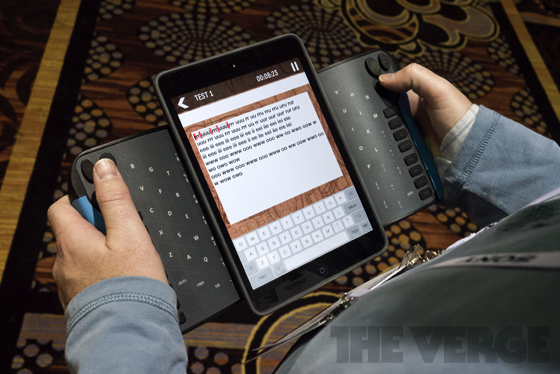
TrewGrip reverse engineers the smartphone�keyboard
TrewGrip's Kickstarter campaign failed to reach its $100,000 goal, but that doesn't mean its founders have given up on their dream of bringing "rear typing" to the masses.�TrewGrip today debuted its titular product, a keyboard for smartphones that very literally turns the idea of a QWERTY keyboard on its head. Whereas other Bluetooth keyboards aim for portability or more natural-feeling tactility, the TrewGrip asks you to type backwards - on the bottom of the device itself. As you type, corresponding lights illuminate on the device's top, letting you know you've pressed the correct key.
Tab, enter, space, and back are the only buttons on the front of the TrewGrip and can be pressed using your thumbs. The TrewGrip uses Bluetooth to connect to your smartphone or small tablet, which it holds in place using a sticky pad on its front, but the device can also connect to TVs and computers. An accelerometer inside the device acts as a mouse, and the company is working on gestures to help you "flick" to the next page or field in a document. "The learning curve for TrewGrip is virtually the same as a split fixed-angle ergonomic keyboard, which equates to about 8-10 hours," the company says.
"YOU NEED TO STOP THINKING ABOUT IT AND LET YOUR FINGERS MOVE THE WAY THEY'VE BEEN TRAINED."
Unlike the Grippity, a competing rear-typing keyboard, TrewGrip's keyboard isn't laid out horizontally in conventional QWERTY fashion. Instead, the TrewGrip splits the keyboard in half then flips it inwards. The top row of keys on the TrewGrip, for example, is NHY7-6TGB. The effect is startling and will make you feel as if you're a kid again, hunting and pecking for keys one by one. I felt even dumber when I witnessed TrewGrip's Robert Price typing away like a pro.�"You're using the same muscle memory, because the fingers are making the same movements," he says. On the Grippity, in contrast, keys are laid out differently and require you to re-master both muscle memory and recall for which keys are where, he says. Price claims to have mastered typing on the device in just five days.
"You need to stop thinking about it and let your fingers move the way they've been trained," says CEO Mark Parker, but it's easier said than done. Using the TrewGrip feels like typing on an accordion, which for many, might not be worth learning. "We want to focus on the healthcare industry," Parker added. "They hate the concept of having to hunt and peck on a tablet or sit in the corner [while they type]. They want to maintain eye contact with the patient." Parker expects to ship TrewGrip for about $250 in the second half of 2014.
A US firm claims to have designed the world's first antimicrobial touchscreen glass which can combat bacteria and fungi.
The firm Corning said its Antimicrobial Gorilla Glass is formulated with an antibacterial agent, ionic silver, which is incorporated into the glass surface for sustained activity.
The glass can be installed in electronic devices such as computers, cellular phones, calculators, telephones, and other electronic display panels, the company said.
According to Corning, as touch technologies proliferate, consumers are becoming aware of how bacteria can exist on mobile devices, particularly as we increasingly share touch-enabled surfaces at home, work, and elsewhere.
"Corning's Antimicrobial Gorilla Glass inhibits the growth of algae, mold, mildew, fungi, and bacteria because of its built-in antimicrobial property, which is intrinsic to the glass and effective for the lifetime of a device," said James R Steiner, senior vice president and general manager, Corning Speciality Materials.
The glass is being tested with numerous manufacturers for various applications, and high-volume production capability has been demonstrated.
"As more people move through shared work spaces, there is an increased need for antimicrobial surfaces," said Allan Smith, vice president of Product Marketing for Steelcase.
The company said antibacterial wipes, foams, sprays, and films exist today, but they are temporary, and many device manufacturers advise against them.
Other areas for the glass include frequently touched interior architectural surfaces in the health care, hospitality, and transportation industries, the company said.
The glass was unveiled at the International Consumer Electronics Show (CES) 2014.
Some news for "3" network users with an Apple product!
If you have an Apple product that is locked to the 3 network, Apple have opened up a portal that will allow you to unlock your item to all networks for free. Simply insert a non 3 SIM card and connect to iTunes. Your item will get unlocked.
This has been working for the last month or more and don't know when it'll close.
Summary: Intel and partners are going to be bringing us PCs that run both Android and Windows 8.1. Meanwhile, AMD and its partner BlueStacks will enable users to run Android and its apps on Windows.
This cannot be undone and I am sure it will be greatly appreciated.
We apologise but you have been denied access to report posts in this thread. This could be due to excessively reporting posts and not understanding our forum rules. For assistance or information, please use the forum help thread to request more information. Jazakallah