Muslim Landmarks Explored
@MuslimLandmarks
·
17h
This is Al-Rabadha, Saudi Arabia - a remote desert settlement 200km east of Madinah where a remarkable prophecy of the Prophet ﷺ was fulfilled relating to the Sahabi Abu Dharr al-Ghifari (رضي الله عنه).
During his lifetime, the Prophet ﷺ told Abu Dharr al-Ghifari (رضي الله عنه): "You will live alone, die alone, and be buried alone." Abu Dharr, among the earliest converts to Islam was later exiled to this isolated wilderness during Uthman's (رضي الله عنه) caliphate due to his uncompromising stance on wealth accumulation.
When death came, Abu Dharr (رضي الله عنه) lay dying alone. He told his wife to watch the road, recalling the Prophet's words that believers would witness his death. A caravan from Iraq soon appeared, led by Abdullah ibn Mas'ud (رضي الله عنه), who wept: "The Messenger of Allah ﷺ spoke the truth!"
They washed, shrouded, and buried him in this desolate place in an unmarked grave - the prophecy fulfilled exactly as foretold by the Prophet ﷺ.
The Holy Mosques
@theholymosques
The longest walkway in the world in Makkah Al Mukarramah.. The walkway connects the holy sites starting from Arafat, passing through Muzdalifa and reaching Mina, with a length of more than 25 kilometers.
Hajj Journey Map ♥️
The image shows the sequence and distances of the Hajj rituals: Masjid al-Haram → Mina → Arafat → Muzdalifah → Mina (Jamarat) → Masjid al-Haram.
On his way to the Farewell Pilgrimage, the Prophet ﷺ stopped and prayed at various locations between Mecca al-Mukarramah and Medina al-Munawwarah, where mosques were later built and named "the Prophetic Mosques," and their sites appear on the map of the journey's route.
@IslamicInfoOff
The location inside Masjid an-Nabawi (the Prophet’s Mosque) from which the first Adhan was called.
One of the most remarkable locations in Islamic history is the rooftop from which Bilal ibn Rabah (RA) called the Adhan in the early days of Islam.
According to Islamic historical accounts, the Adhan was called from the rooftop of a house belonging to a woman from the Banu al-Najjar tribe, as it was one of the highest points near Masjid an-Nabawi.
The location is located near Al Hijrah, Al Rahma and Abu Bakr Siddiq Gate in Masjid an Nabawi.
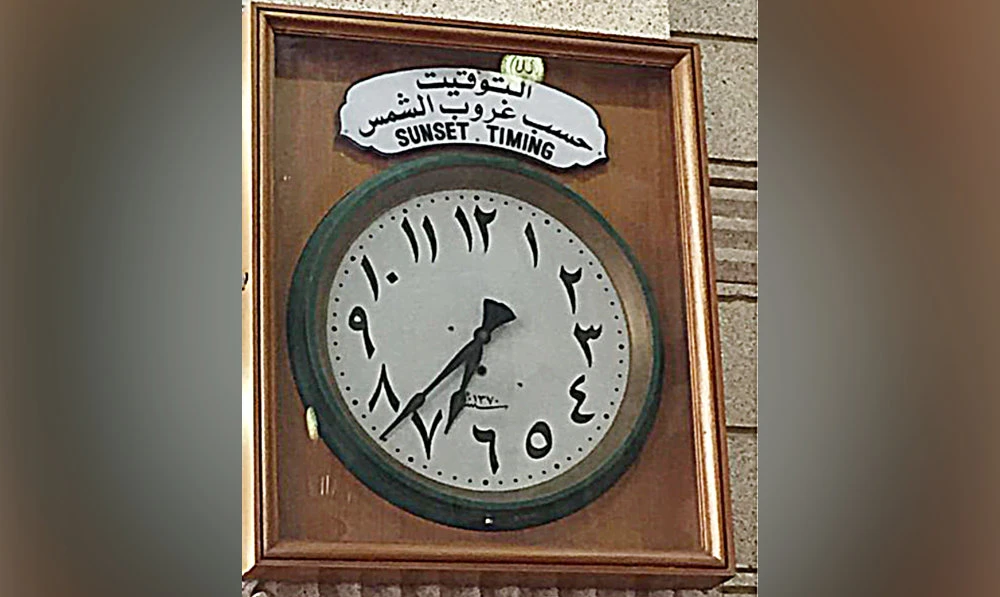
As you walk through Masjid Al Nabawi, a clock near the Bab Al Salam gate will catch your attention. The first time you stop in front of it, you’ll notice that its time is wrong!
First, we need to understand that in Arab culture, night comes before day. On this basis, time was reckoned by the sunset system, with the day beginning at sunset. At sunset, or when the Maghrib call to prayer is made, the clock strikes 12, which was the standard time in most Islamic countries, including Saudi Arabia. It was simply based on sunset, with the start of Maghrib coinciding with the start of sunset. As soon as people saw the sun set or heard the call to Maghrib prayer, they would immediately turn to their watches to adjust them, or “feed them.”
However, this time system was abandoned because of two problems. The first was the difference in time between regions: the time in Riyadh differed from the time in Jeddah, Dammam, and several other areas of the Kingdom. The differences were small, depending on sunset, so you might find one area on 12:00, a neighboring area on 12:02, and another nearby area on 12:04. This caused confusion, with each city having its own time.
The second reason was that this system posed a major obstacle to international correspondence and communication with the rest of the world, because it differed from most of the world’s time zones. In 1384 AH / 1964, King Faisal issued a decree ending the use of this time system and adopting mean solar time, which is the time we use today, known as Greenwich Mean Time + 3 hours.
As time went on, complaints about solar time diminished, and people began to get used to it. Today, it is the only timekeeping system in the Kingdom of Saudi Arabia, and all the clocks around us are set to it—except for one clock, the one mentioned at the beginning of this post!
This clock was installed in the Prophet’s Mosque in 1370 AH (1950) and was set to sunset time. It remains on this timekeeping system to this day and has been adjusted manually every day for more than 70 years by Abdul Ghaffar Abdul Ghani, who has been maintaining it for 40 years.
The Prophet’s Mosque preserves this clock as an old heritage timepiece.
This is a good thing because there are plenty of Muslims who still don't pray between the Imam of Haram i.e. Witr in Ramadhan is a prime example of Hanafees not praying or repeating or praying it as a continuous 3 Rakaat instead of following the Imam.
This cannot be undone and I am sure it will be greatly appreciated.
We apologise but you have been denied access to report posts in this thread. This could be due to excessively reporting posts and not understanding our forum rules. For assistance or information, please use the forum help thread to request more information. Jazakallah



 Loading tweet