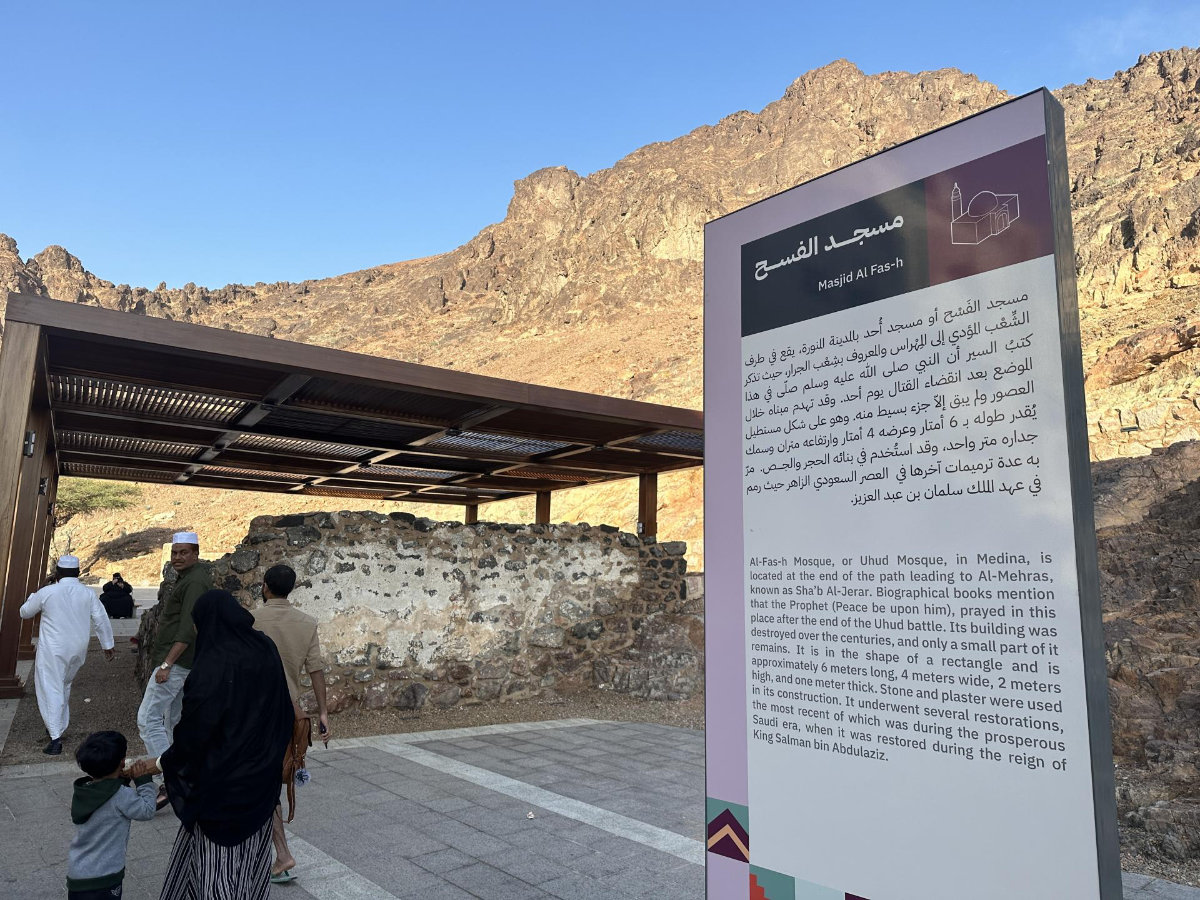
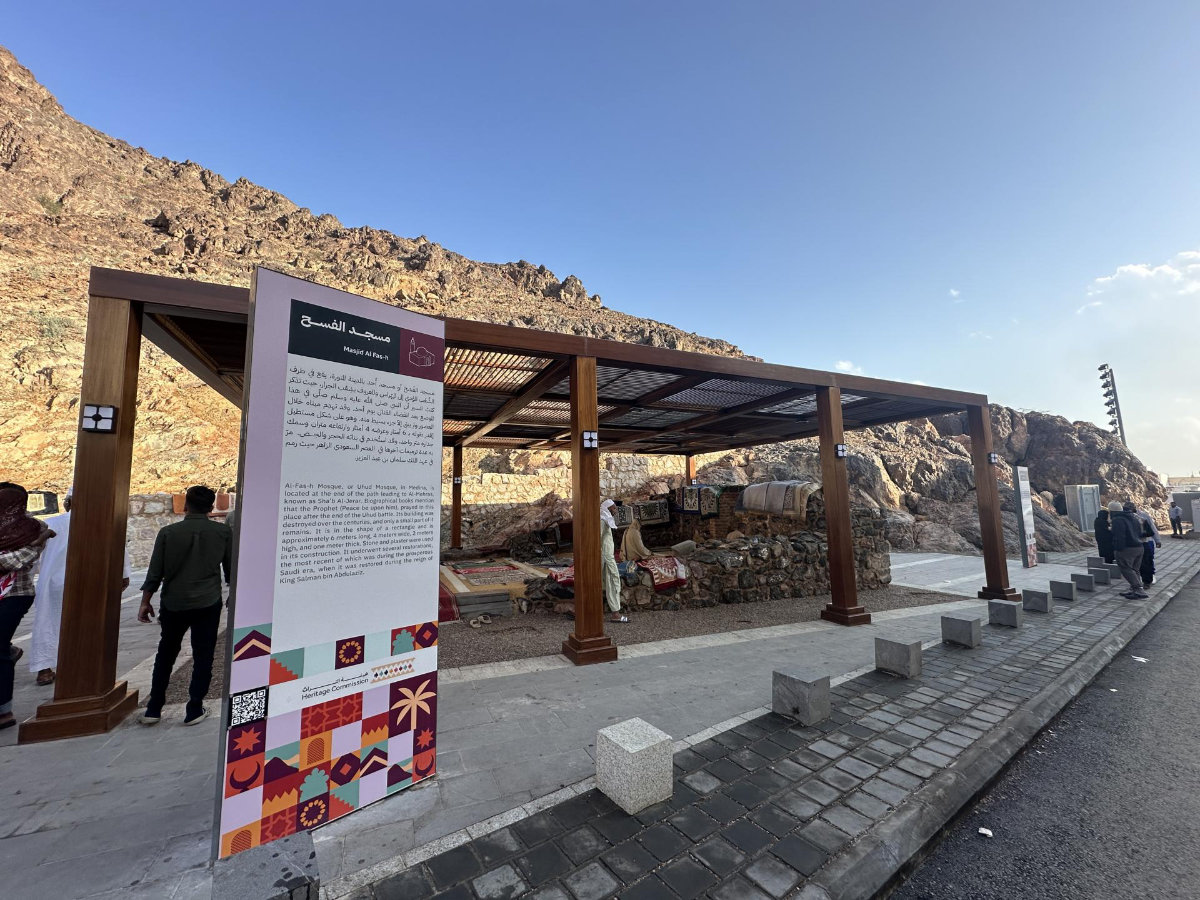
RIYADH: A historical gem nestled at the foot of Mount Uhud, north of Madinah, Al-Fas’h Mosque stands as a reminder of the Battle of Uhud, a pivotal moment in Islamic history.
This has a special place in the history of Islam because it is also where Prophet Muhammad is believed to have prayed, and attracts visitors from around the world, the Saudi Press Agency reported recently.
Historian Dr. Fouad Al-Maghamsi highlighted Al-Fas’h Mosque’s significance within the wider historical landscape of Uhud, which includes Jabal Al-Rumah and Wadi Qanat.
Al-Fas’h Mosque’s proximity to the Uhud battlefield, roughly 800 meters away, makes it an integral part of the sacred landscape of Madinah. (Photo courtesy: welcomesaudi.com)
Known as Uhud Mosque or Sha’b Al-Jerar Mosque, Al-Fas’h has been meticulously preserved and restored.
“The remnants of Al-Fas’h Mosque, enclosed by a roughly 1-meter-high stone wall on three sides, measure 6 meters in length and 4 meters in width,” said Al-Maghamsi.
He added that this landmark, constructed with resilient black stones, has endured through centuries and undergone numerous restorations, most recently under the reign of King Salman, as part of a broader initiative to revitalize historical sites.
The mosque’s simple yet distinctive architecture features a rectangular prayer space and a mihrab crafted from red bricks.
Al-Fas’h Mosque’s proximity to the Uhud battlefield, roughly 800 meters away, makes it an integral part of the sacred landscape of Madinah. (Photo courtesy: welcomesaudi.com)
Recent restoration efforts, overseen by the Saudi Heritage Commission, have introduced a wooden roof, a floor of artistically arranged yellow natural stones, paved surrounding areas, seating, and informative signage.
The mosque’s location, approximately 4.5 km north of Al-Masjid Al-Nabawi or the Prophet’s Mosque, places it in the heart of an area rich with Islamic heritage.
Its proximity to the Uhud battlefield, roughly 800 meters away, makes it an integral part of the sacred landscape of Madinah.
@LifeSaudiArabia
🕋 Area: 356,000 square meters
🕋 Can accommodate 2 million people
🕋 It is visited by 20 million people annually.
🕋 Open 24 hours
🕋 Never closes
🕋 It has 1800 cleaners.
🕋 40 electric cleaning vehicles
🕋 60 yard cleaning machines
🕋 2000 cleaning containers
🕋 40,000 carpets in the Holy Mosque
🕋 A warehouse that can hold 15,000 carpets
🕋 13,000 toilets are cleaned 4 times a day.
🕋 25,000 water bottles
🕋 100 random water samples are tested daily.
🕋 Excess water from Zamzam
🕋 Al-Haramain Quranic Recitation Center
🕋 More than 2,000 safe deposit boxes
🕋 Hundreds of cooling units for the Holy Mosque
🕋 The tiles reflect light and reflect heat.
🕋 The Maqsad application service guides you to any place in the Holy Mosque.
🕋 Audio systems
🕋 Error rate 0%
🕋 6000 speakers
🕋 4 audio systems
🕋 50 Voice Employees
🕋 The Holy Qur’an translated into 65 different languages.
🕋 Translation of the Friday sermon into 5 different languages
🕋 Services for people with special needs
🕋 10,000 regular carts distributed for free
🕋 400 electronic vehicles
🕋 Independent double and triple carriages
🕋 4,000,000 Iftar
🕋 5,000,000 pitted dates distributed inside the Haram
🕋 5,000,000 pitted dates distributed outside the .Haram
🕋 Cleaning is completed after breakfast in just two minutes.
13 May 2025
"The Greatest 10 Days: History of the Ka'ba" is an immersive lecture that explores the rich spiritual, historical, and cultural legacy of the Ka'ba—the sacred heart of Islam—within the context of the first ten days of Dhul-Hijjah, considered the holiest days in the Islamic calendar. This session traces the Ka'ba’s journey from its origins, built by Prophet Ibrahim (AS) (Abraham) and his son Ismail (AS), through pre-Islamic times, the life of Prophet Muhammad (peace be upon him), and into the modern era. Participants will gain insight into how the Ka'ba has served as a focal point for pilgrimage, and a symbol of unity for Muslims worldwide. The lecture will also reflect on the spiritual significance of the ten days leading up to Eid al-Adha, drawing connections between sacred history and contemporary devotion. Whether you're a student of Islamic history or a seeker of deeper spiritual understanding, this lecture offers a powerful perspective on why these days—and this sacred structure—remain central to Muslim identity and faith.
SubhanAllah, these pictures and videos are truly heart-moving. May Allah grant us all the opportunity to visit His House again and again. Seeing inside the Ka'bah always reminds me how much of our Islamic history is layered with deep symbolism and untouched beauty.
I recently came across some Quranic verses and tafsir related to the Ka'bah, and it made me reflect even more during teaching. For those interested in deepening their understanding of the Ka'bah’s role in the Quran and early Islamic history, I found this beginner-friendly guide useful — especially for those who are new to structured learning or teaching:
👉 How to Learn Quran Online Effectively – Guide for Beginners
It connects the spiritual meanings we often feel during Hajj or Umrah with consistent daily study — something I think we all need to stay connected long after leaving Makkah and Madinah.
JazakAllah khair for sharing these treasures — may they inspire many hearts.
• 40 liters of Zamzam water divided into two gallons of silver
• Mix Zamzam water with 540 ml of Taif rose water
• 24 ml of high quality Taif rose oil
•24 ml of the sanctuary Oud oil
•3 ml of musk to perfume the walls and floor of the Kaaba
A Bahraini man, Ali al-Awadhi, became famous after a camera captured him performing Tawaf (circumambulating the Kaaba), during the 1941 flood which caused the Kaaba to be surrounded by water.
The pictures from 77 years ago show al-Awadhi in the water, which measured up to more than a meter and a half high, in front of Maqam Ibrahim (Station of Abraham/a stone associated with Abraham), as well as his brother and friend sitting by the door of the Ka’ba in the back.
Al-Awadhi, who passed away in 2015, has previously said that he was about 12-years-old studying in Mecca, when the heavy rain persisted for an entire week without any interruptions.
He said that he went to the Meccan Sanctuary with his brother and two of his friends, as well as his teacher, when they found the place completely flooded. Al-Awadhi, who used to swim often, said he suggested performing Tawaf around Kaaba by swimming for their pilgrimage to count.
As quoted from the Islamic prophet Muhammad’s biography, the first person to perform Tawaf swimming was the sahabi (the prophet’s companion) `Abd Allah al-Zubayr.
Others who swam around the ka’ba include scholar Badr al-Din bin Jama'a, who dove every time he approached the stone to kiss it.
Performing Tawaaf by swimming is a rare form of worship. Mecca has seen many large floods, but according to historians, it is never high enough for someone to swim, except for two incident, one from the Islamic era, and one 77 years ago.
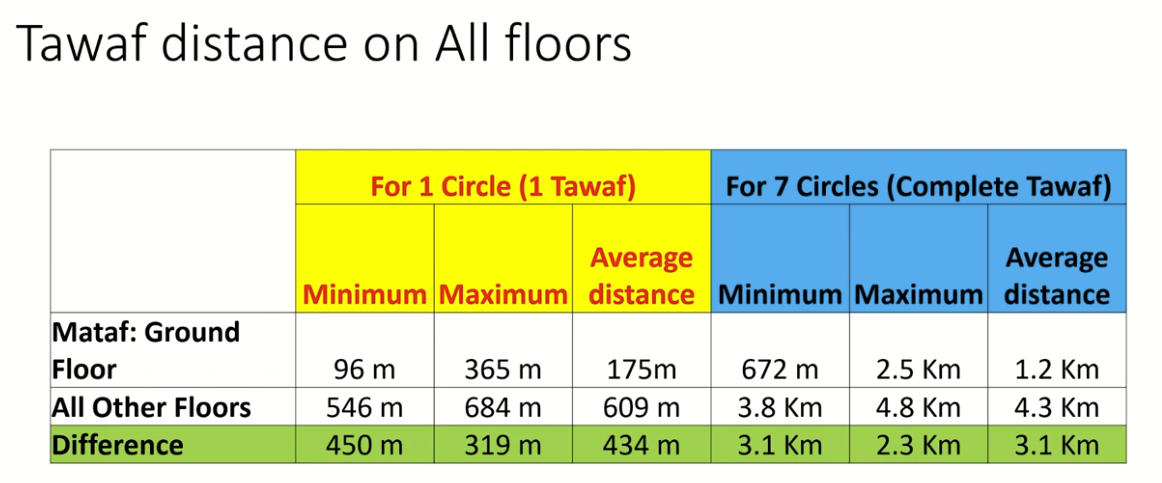
These calculations was done by a Pakistani vlogger using Google Maps. It's a snippet from one of his videos (will try and link video if I come across it again)
This cannot be undone and I am sure it will be greatly appreciated.
We apologise but you have been denied access to report posts in this thread. This could be due to excessively reporting posts and not understanding our forum rules. For assistance or information, please use the forum help thread to request more information. Jazakallah


 Loading tweet



 biography, the first person to perform Tawaf swimming was the sahabi (the prophet’s companion) `Abd Allah al-Zubayr.