Forum Menu - Click/Swipe to open
 

How much you could be eating at Iftar- 4000 Calories.

You have contributed 0.0% of this topic

Thread Tools
Appreciate
Topic Appreciation
Taalibah, abu mohammed, Yasin
Rank Image
dr76's avatar
Offline
Unspecified
2,178
Brother
5,852
dr76's avatar
#1 [Permalink] Posted on 17th June 2015 07:01
السلام عليكم

(bism1)


Interesting and beneficial article i came across on how much we eat at Iftar and how it affects our health..

Source

4,000 calories – How much you could be eating at iftar


Ramadan fasters could be taking in as many as two days’ worth of calories when they sit down to break their fast at iftar, health experts have said.

Doctors warned many will typically take in between 3,000 and 4,000 calories in an evening, after fasting for more than 12 hours.

The recommended average daily calorie intake is 2,000 for women and 2,500 for men.

Dr Rita Tobias, an endocrinologist at the Dubai Weight Care Clinic, said: “People who are not bothered about watching their diet can easily take in up to 3,000-4,000 calories after they break their fast.

“In my clinic, where the purpose of them coming is to control their diabetes and their weight, a third of patients choose not even to come before Ramadan.”

Tobias said many people get lured into over-indulgence by tempting offers, in what she described as increasing commercialisation of the Holy Month.

Dr Zuhair Yousif, a cardiologist at Mediclinic City Hospital, said: “If you are attending a tent for 30 days and eating excessive carbohydrates and saturated fats, you are probably going to have doubled your bad cholesterol by the end of Ramadan.”

And you could be “doubling your chances of heart disease”.


Among the types of food served up are rich cheese qatyef pastries – a single piece of which has about 350 calories. At least.

Families and friends gather around for iftar and suhour meals that are in many cases rich, fatty and high in carbohydrates. And many fall into the trap of over-eating.

Avoiding over-indulgence is made more difficult as Ramadan is increasingly becoming commercialised – with many restaurants and hotels cashing in on the festive season through tempting offers and Ramadan tents.

“I personally put on around 5kg during Ramadan,” said Hamsa Haddad, a 40-year-old Syrian sales executive. “It is the only time I eat sweets every day and I also eat at around midnight. “I eat much more and I also do not go to bed before 3am.”

Haddad said she also spends more on outings – as at least twice a week she goes to eat at a Ramadan tent.

“You hear a lot about them and it is always something new so you want to try it out,” Haddad said.

However, Abir Al Habash, 47, a Syrian housewife, said that she is saddened over what Ramadan has become. “Ramadan has been reduced to food, tents and abaya fashion,” she said.

“The concepts of modesty and compassion which Ramadan should represent are no longer there.”

contd..

report post quote code quick quote reply
+3 -0
back to top
Rank Image
dr76's avatar
Offline
Unspecified
2,178
Brother
5,852
dr76's avatar
#2 [Permalink] Posted on 17th June 2015 07:09
بسم الله الرحمن اللرحيم


Dr Adil Obeid, a nephrologist – the study of the kidneys and its diseases – at Sobeh’s Vascular and Medical Centre, said the commercialisation of Ramadan and its negative impact needs to be addressed.

“Ramadan spiritually is very clear – it is about being modest in everything,” he said. “[But] people sleep late, eat more, smoke more, take more carbohydrates – so we have a big challenge in trying to fight the commercialised part of Ramadan.”

However, Obeid added that the media is playing a negative role in changing the concept of Ramadan.

“The tents in five-star hotels do not tell us the whole story but this is the reflection we get from the media,” he said.

Dr Zuhair Yousif, a cardiologist at Mediclinic City Hospital, said fasting could help you lower blood pressure and bad cholesterol.

“But in fact what we see from the actual life experience is how Ramadan has turned into probably the opposite to the expected positive benefits,” said Yousif. “People tend to eat the wrong food a lot of the time during the iftar and suhour.”

The cardiologist said more education is needed on how people should approach dieting during Ramadan.

“It is important that we intensify the health education in various specialties to highlight the risks that maybe are associated with the negative lifestyle impact on Ramadan,” Yousif said.

End


May Allah سبحانه وتعالى Bless us All with a Ramadhan filled with Barakah.. that we renew our Niyyah this month to get Closer to Allah سبحانه وتعالى & His Rasool (saw) and that we lead a life of Taqwa.. forever.. in all the months of the year.. Ameen..

in need of ur duas..

wa Assalam..
report post quote code quick quote reply
+2 -0Ameen x 2
back to top
Rank Image
Maripat's avatar
Offline
Gham-o-Huzn
3,269
Brother
3,512
Maripat's avatar
#3 [Permalink] Posted on 20th June 2015 08:36
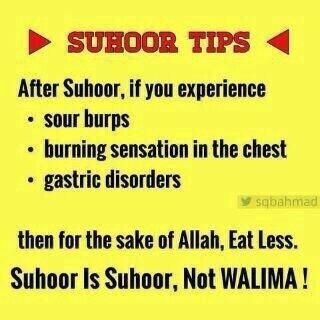
Where is that Sehri vs Waleema quote?
report post quote code quick quote reply
No post ratings
back to top
Rank Image
dr76's avatar
Offline
Unspecified
2,178
Brother
5,852
dr76's avatar
#4 [Permalink] Posted on 1st July 2015 08:33
Maripat wrote:
View original post


السلام عليكم

Here Sir..

report post quote code quick quote reply
+2 -0Like x 1Creative x 1
back to top
Rank Image
dr76's avatar
Offline
Unspecified
2,178
Brother
5,852
dr76's avatar
#5 [Permalink] Posted on 1st July 2015 08:34
Iftar Overeaters Rushed to Hospital!


More than 100 people were rushed to hospital in the first five days of Ramadan after gorging at iftars, a top UAE medic warns.

Dr Magdi Mohamed, of Abu Dhabi’s Burjeel Hospital, said stomach pain was the leading problem, with a third of patients at its emergency room suffering from food-related ailments.

“This is roughly what we expect, it happens every year,” he told Arabian Business magazine. “However, the number of cases tends to be higher at the beginning of the Holy Month, before people’s bodies have grown accustomed to fasting.”

Of the patients who turned up at hospital, about five or six each day were admitted as inpatients for more intensive treatment, said Dr Mohamed, a specialist in emergency medicine.

The most common conditions seen are gastritis, in which the stomach’s lining becomes inflamed, and the bacterial infection gastroenteritis. Nasty!

Take it easy, folks!

source
report post quote code quick quote reply
+2 -0
back to top