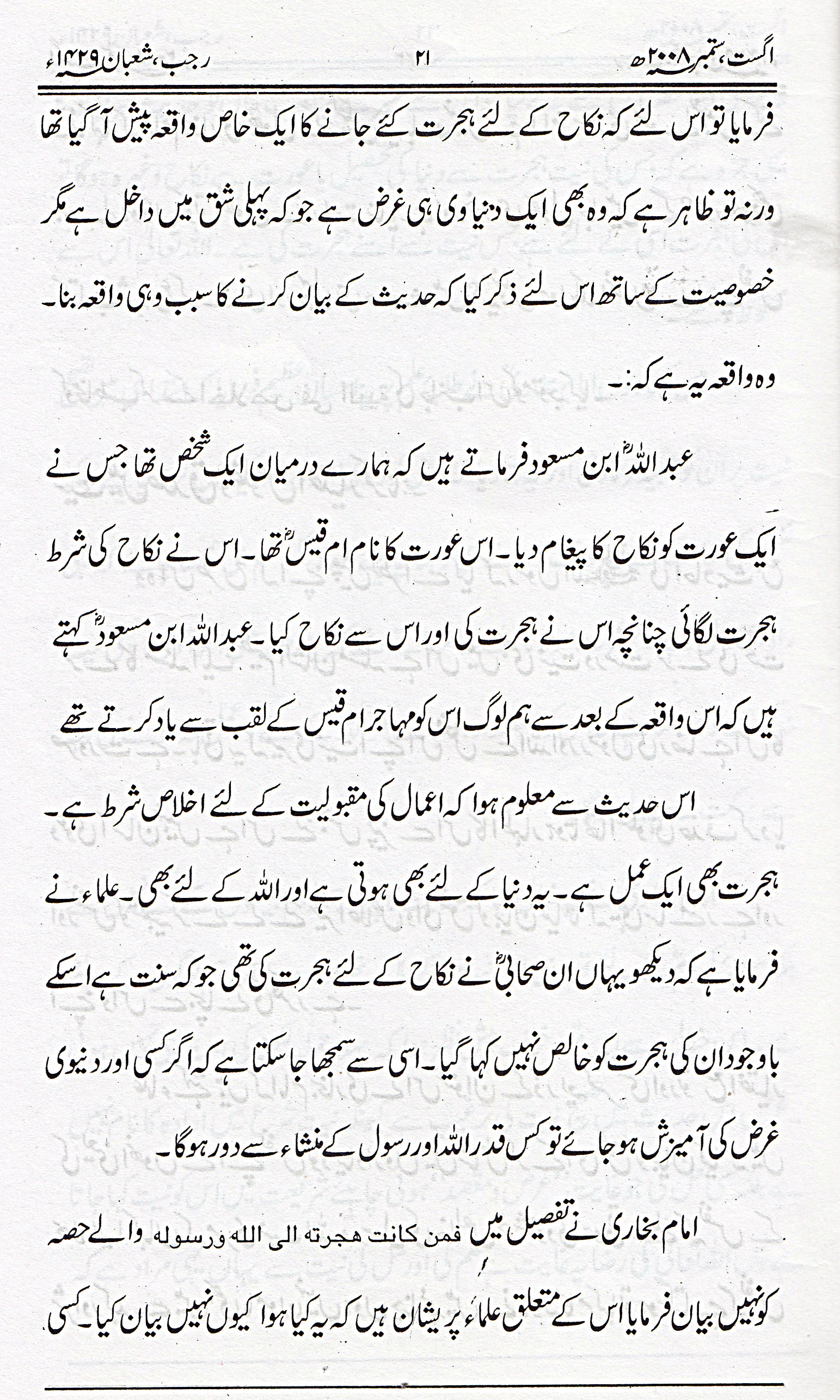
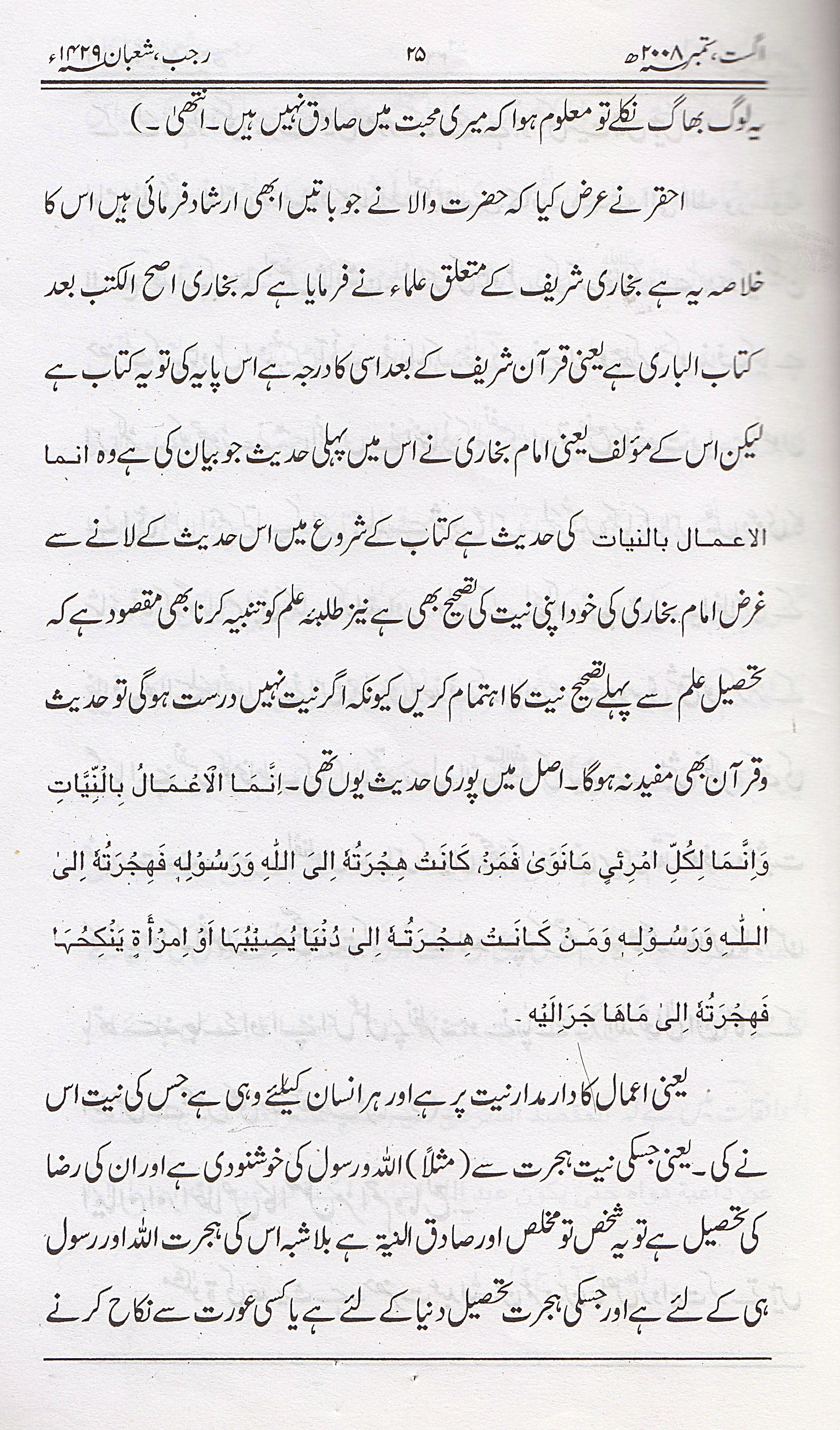
Meaning whose Niyyat and purpose was to seek the pleasure of Allah and Rasool, then his Hijrah (Migration) was Sahih ( True, correct, unblemished) and Maqbool (accepted).
And only this person is a Muhajir- ila ‘Allah in the true sense, who is sincere in his Migration. The reward of whom is a entrusted with Allah, even if he may die on the way. As Allah سبحانه وتعالى says
“Whoever leaves his home migrating for the sake of Allah and His Messenger, and death overtakes him, then, his reward is established with Allah.” (Surah Nisaa:100, Mufi Taqi Uthmani (db) translation)
After reading the words of Mishkat sharif.. we learn that the topic has been completely covered here.. that it was first mentioned "Inna mal A'maalu Binniyyah" meaning that The reward of deeds depends upon the intentions.. the kind of Niyyat done yields proportional Barakah.. the one who makes a particular intention shall gain similar fruit..
It was narrated further by "wa innama li-kulli imri` ma nawa," ‘and every man shall have but that which he intended’.
Thereafter explaining this abridgment that whose Niyyat for migration was of Khair (good), meaning that it was to seek the pleasure of Allah and His Rasool (s.a.w)..then his migration is appropriate and accepted. And the person shall be counted amongst the sincere (Mukhlis).
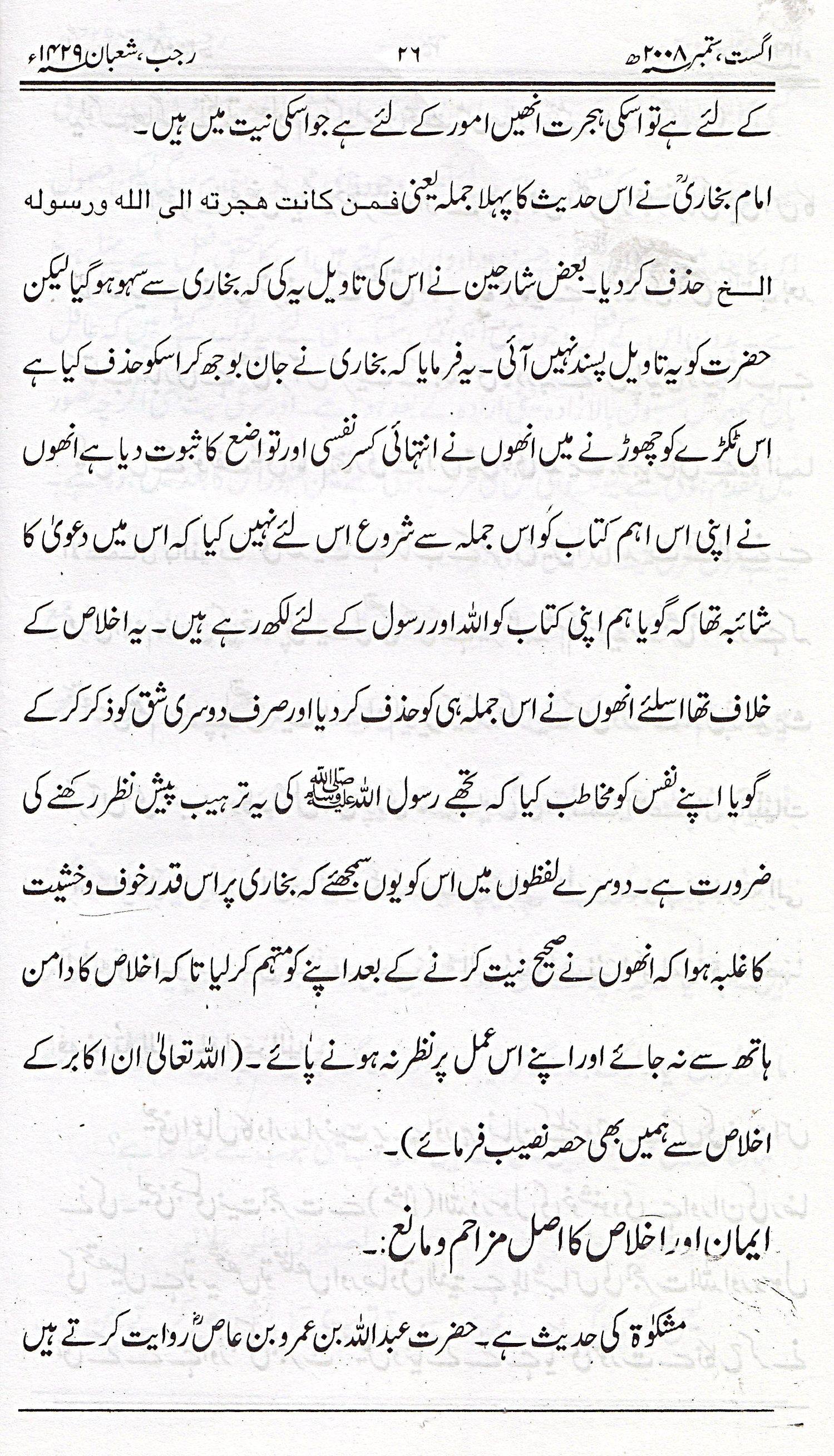
As opposed to him..Whose migration was to achieve some worldly benefit or to take some woman in marriage .. so his migration shall be considered for the very purpose having no attachment with Allah and His Rasool .
In this Hadith the reason for the words ‘to achieve some worldly benefit’ followed by ‘or to take some woman in marriage’ was due a special case that came to light where someone migrated for the sake of Nikah.. else its understood being a worldly purpose fitting in the first half itself.
But it was specifically mentioned since the reason for the Hadith became the incident itself.
It was the following incident:
Hazrat Abdullah bin Mas’ud رضي الله عنه narrates that there lived a person amongst us who had sent a marriage proposal to a certain woman. She was called Umm Qais رضى الله عنها. She had put the condition of Hijrah (Migration) for the Nikah.. thereafter he migrated and married her.
Hazrat Abdullah Bin Mas’ud رضي الله عنه narrates that after this incident, we would remember him with the title of Muhajir Umm Qais. We learnt from this Hadith that for deeds to be accepted.. Ikhlaas is a Prerequisite.
Migration too is a deed.. it is done as a worldly act and also for the sake of Allah.
Ulema have mentioned it is to be seen here that this Sahabi رضي الله عنه had migrated for Nikah which was sunnah.. even then.. his migration was not considered Khalis (with pure intent).
So it can be understood from here that the addition of any worldly purpose would steer the person away from the motive of Allah and His Rasool .
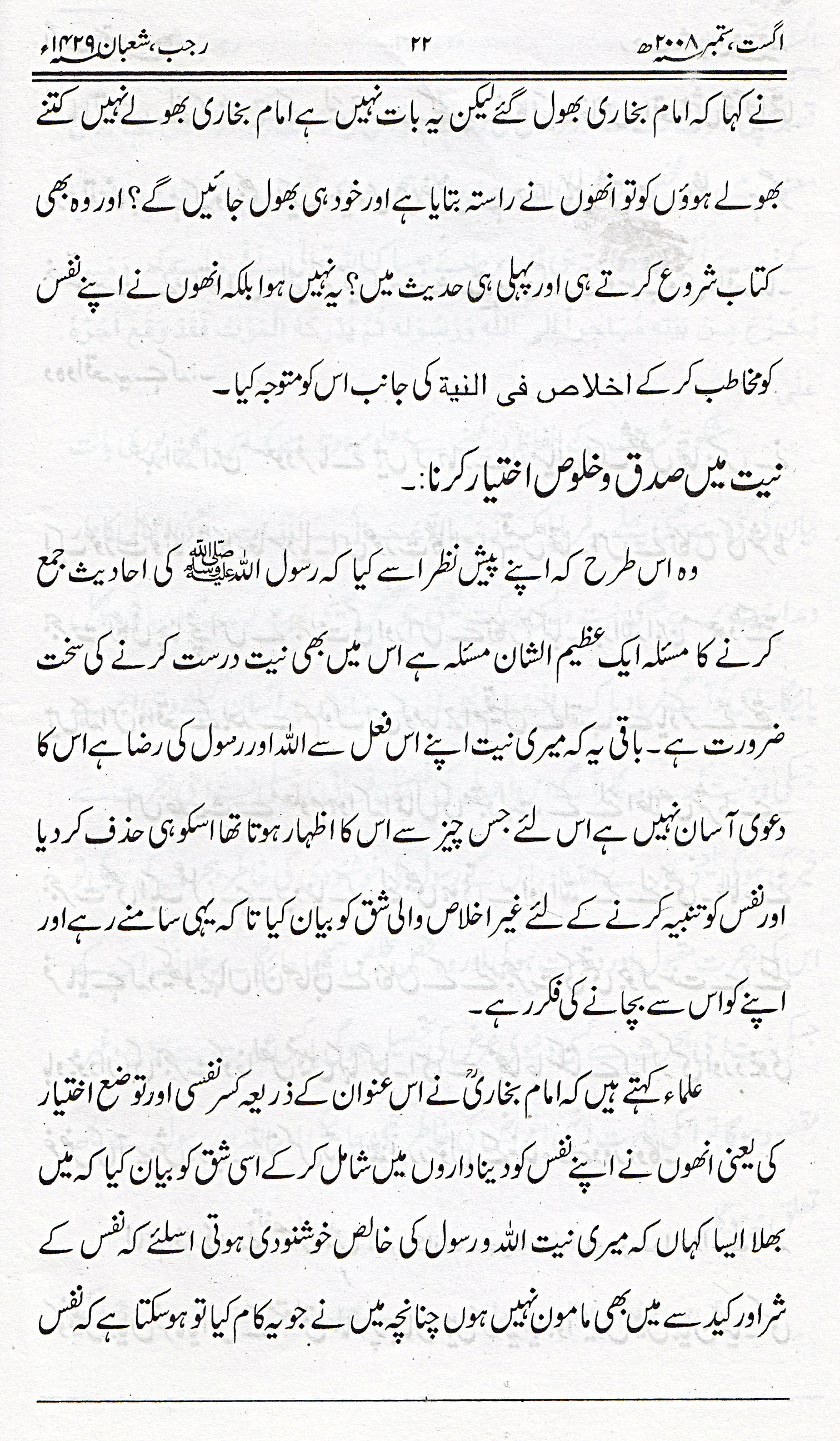
Imam Bukhari رحمة الله عليه has not narrated the part of “whose migration was for Allah and His messenger…” in detail. Ulema get anxious here as to why he has not narrated it, what was the matter..
Someone commented that Imam Bukhari forgot the part.. but it wasn’t so.. He did not forget.. How many astray did he not guide.. and he forgot himself..? And that too while beginning the book itself.. on the first hadith..? This wasn’t the issue.. but he focused upon his Nafs turning it towards Ikhlaas fi Niyyah.
Adopting Truthfulness and sincerity in Niyyah:
He brought it before himself that the matter of collecting Hadeeth of Rasululllah was a greatly hallowed task.. and it was also necessary that Niyyah (intention) should be strictly rectified here..
Such that my Niyyah through this action of mine, was to seek the pleasure of Allah & his Rasool was not an easy claim to make..
So the place where it manifested (that he laid any claim) he omitted it.. and to reprimand his Nafs narrated the part on insincerity of Niyyah.. such that only this (part) remains highlighted and to remain observant in guarding himself from it..
The scholars comment that Imam Bukhari رحمة الله عليه has displayed soberness of Nafs & Tawadhu through this episode. Such that he counted his Nafs amongst the worldly and only mentioned that part.
For how is it possible that my Niyyah was so pure as to seek the pleasure of Allah & His Rasool .. whereas even Iam not exempted from the clutches & mischief of the Nafs.. since while doing this work it was possible for Nafs to take its part..
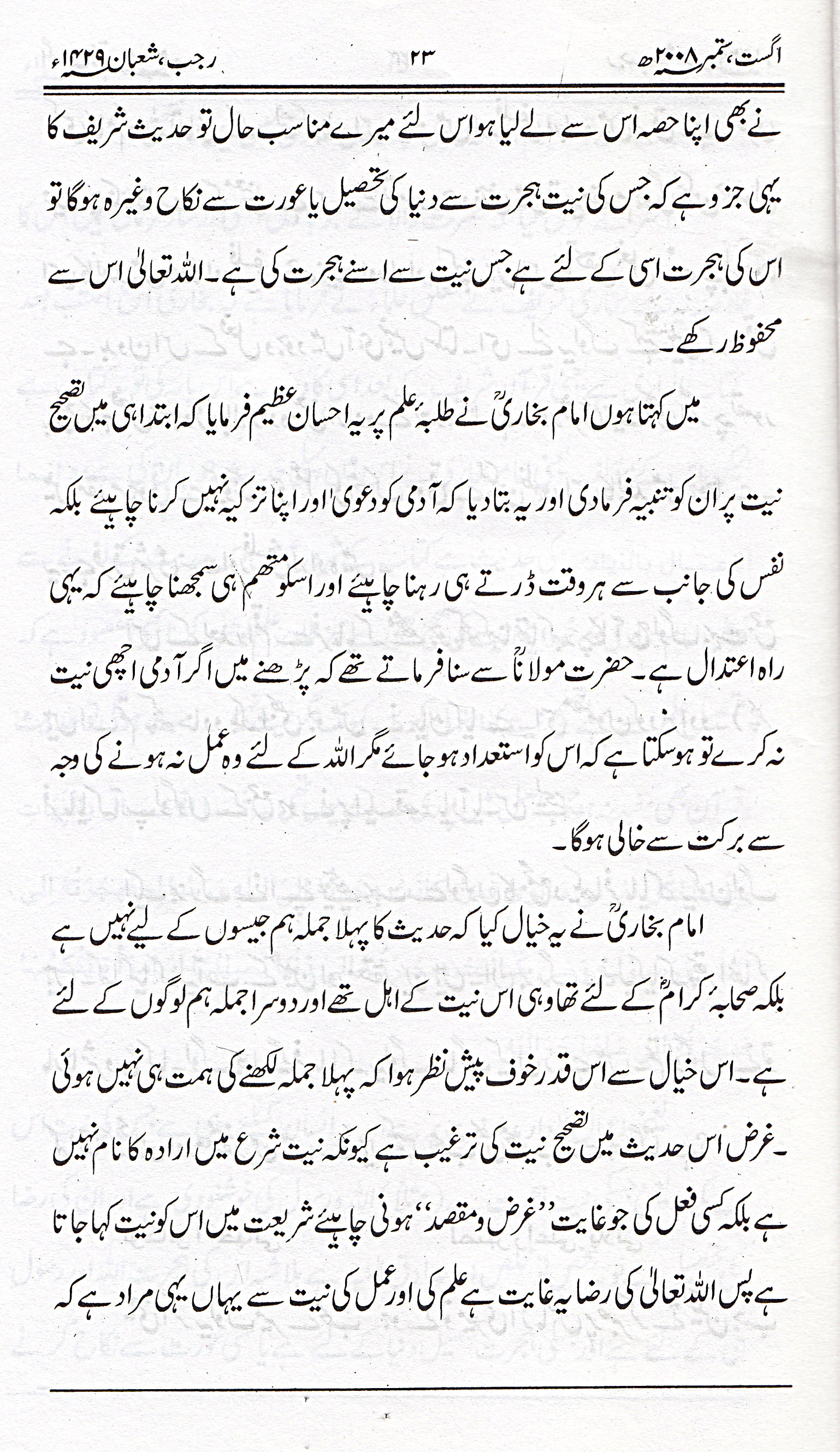
Thus, suitable for my condition was that part of Hadeeth ‘He whose (Intention for) migration was to achieve some worldly benefit or to take some woman in marriage, his migration was for that for which he (intended to be) migrated.’ May Allah سبحانه وتعالى keep us safe from it.
I say that Imam Bukhari رحمة الله عليه has bestowed a great favor upon students of knowledge that in the beginning itself he admonished them on rectification of Niyyah. And he conveyed that one should refrain from making claims and doing self-Tazkiyah. But to constantly remain vigililant as regards to Nafs and keep it under suspicion as it is the only balanced way.
I learnt from Hazrat Maulana (Hazrat Thanwi رحمة الله عليه) who would say that while studying.. if one does not make the right Niyyah, It is possible that he gains competence, but due to the act not being done for the sake of Allah سبحانه وتعالى , would be deprived from its Barakah (blessings).
Imam Bukhari رحمة الله عليه observed that that first stanza of the Hadeeth was not for the likes of us.. but was meant for sahabah رضي الله عنهم. They were indeed entitled to such Niyyah and the other part (of Hadeeth) was applicable to us.
He was so much frightful of this thought that he couldn’t muster courage to write the first stanza.
Thus there is exhortation for rectification of Niyyah in this Hadeeth. Since Niyyah in (Islamic) law is not the name for ‘will’.. but an act which should be uttermost towards the motive, which is called as Niyyah in Shari’ah.
Such that seeking the pleasure of Allah سبحانه وتعالى should be uttermost while making the Niyyah for Ilm or Amal.. which is only desired here.. that any Amal should be done solely for Allah سبحانه وتعالى.
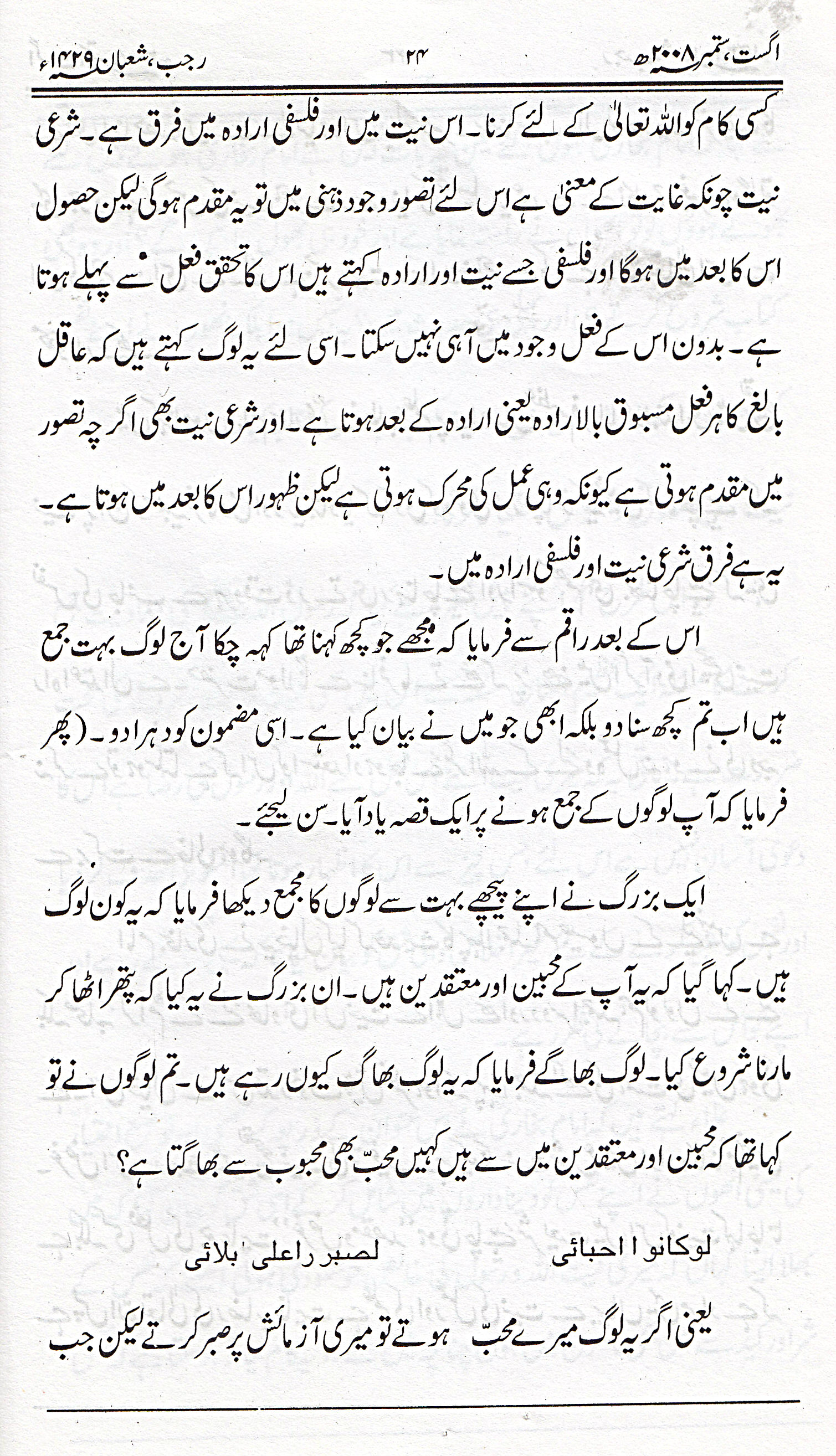
There is a difference between this Niyyah and the Philosophical ‘Will’. Since the Shar’i Niyyah means uttermost (or the extreme)..Thus in the realm of thoughts it has to bear precedence.. but the result of it comes later.
The philosophers who coin the term as Niyyah or Iradah (will) is ascertained prior to the act. Deprived of which the act can never come into existence. That’s the reason these people comment that every act of a mature and Intelligent person occurs after ‘will’..
Even if Shar’i Niyyah bears precedence in thoughts since it is the promoter for the act..but it manifests later. This is the difference between Shar’i Niyyah and the philosophical will.
Then he said to the writer of these lines that I have said what was needed.. people have gathered in large numbers today.. now you say something.. why not repeat the topic I just explained..
Then he said that I just remembered an incident seeing your gathering.. listen..
A Buzurg once noticed a large crowd behind him.. asked who they were.. said these are the people who are your votaries & deeply love you.. Now the buzurg picked up some stones and started pelting at them.. the people began running away..
So he asked why are they running.. you spoke to be amongst votaries and beloveds.. does the beloved run away from his loved one..?
Lau kanu Ahib’ba’I, La sabr Ala Bala’i
Meaning that if these people were my beloved.. then they would have been patient upon my trial. But when they took flight.. it was revealed they weren’t truthful in my love.
The lowly self commented that the summary of Hazrat’s (Maulana Shah Wasi’ullah sahab رحمة الله عليه) bayan today was that scholars have stated regarding Bukhari Shareef as Asah Al kutub ba’ad Kitab Al Bari, meaning it occupies the position only after the Noble Qur’an. Such a hallowed status it retains. The first Hadith he has mentioned is of Inna mal A’malu bin’niyyah.
At the outset of the book, while narrating this Hadith, Imam Bukhari رحمة الله عليه has aspired to rectify his own Niyyah as well as sought to admonish students of knowledge.
Thus to rectify Niyyah before initiating to seek knowledge.. incase if Niyyah wasnt appropriate.. then Qur’an & Hadith shall not benefit.
Actually the complete Hadith was the following:
“Deeds are [a result] only of the intentions [of the actor], and an individual is [rewarded] only according to that which he intends. Therefore, whosoever has migrated for the sake of Allah and His messenger, then his migration was for Allah and His messenger.
Whosoever migrated for the sake of worldly gain, or a woman [whom he desires] to marry, then his migration is for the sake of that which [moved him] to migrate."
Imam Bukhari رحمة الله عليه has omitted the first stanza of this Hadith.. ‘whosoever has migrated for the sake of Allah and His messenger’. Some commentators have interpreted it as an oversight by Imam Bukhari رحمة الله عليه. but Hazrat (Maulana Shah Wasiullah sahab رحمة الله عليه ) disapproved this exposition.
He commented that Imam Bukhari رحمة الله عليه had deliberately omitted that part. And While doing so he has displayed an example of intense Tawadhu and soberness.
At the outset of his Magnum opus, he chose not to begin with that stanza since there was an apprehension of staking a claim.. as if iam writing this book for the sake of Allah and his Rasool .
This was against Ikhlaas.. and the very reason for omitting the stanza itself, while expounding only the other part, as if addressing his own Nafs that it has to keep this apprehension of Rasulullah on the forefront.
In other words it may be understood that Imam Bukhari رحمة الله عليه overcame with such fright and trepidation that after rectifying his Niyyah he had constrained himself that the fabric of Ikhlaas may not slip away from his hands.. and that this act of his may go unnoticed. ( May Allah سبحانه وتعالى give us a part of Ikhlaas these Akabir possessed)
The real obstruction & hindrance in the path of Iman and Ikhlaas:
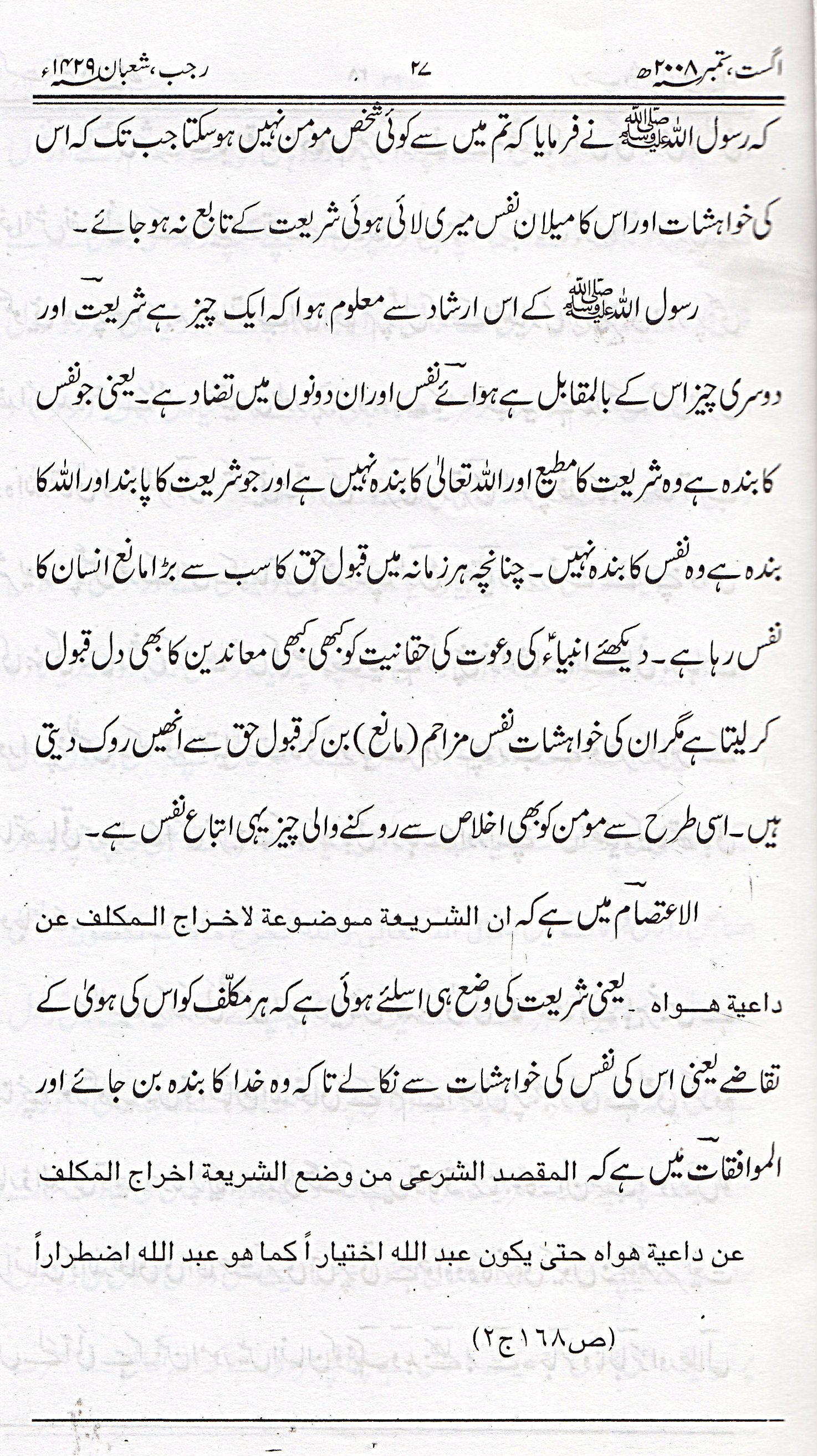
A Hadith of Mishkat states (meaning): Hazrat Abdullah bin Um’roo Bin Aas رضي الله عنه narrates that Rasulullah said ‘None amongst you can become a Mu’min (believer) untill his desires and the affinity of his Nafs are not subjected to the Shari’ah I have brought forth.
We learn by this saying of Rasulullah that Shari’ah is one entity and the second opposing factor is desire of Nafs.. and there exists contrariety in between.
Thus, the one enslaved by Nafs is not governed by Shari’ah and not a bondsman of Allah سبحانه وتعالى.. whereas the one conforming obeisance to Shariah and a bondsman of Allah سبحانه وتعالى is not a slave of Nafs.
Therefore it is observed in every period that the hindrance in acceptance of truth has been the Nafs of man.
See.. at times the veracity of the call of Prophets (Alaihis salam) gets acquiescence even upon the hearts of the rebels.. but their desires of Nafs becomes an obstacle towards acceptance of the truth, restraining them.
Similarly, the one restraining a believer from Ikhlaas is the obedience of Nafs.. it is written in Al A’tisaam that the reason for Shari’ah to be established is to remove every faithful from the cravings of his Nafs that he becomes a bondsman of Allah سبحانه وتعالى.
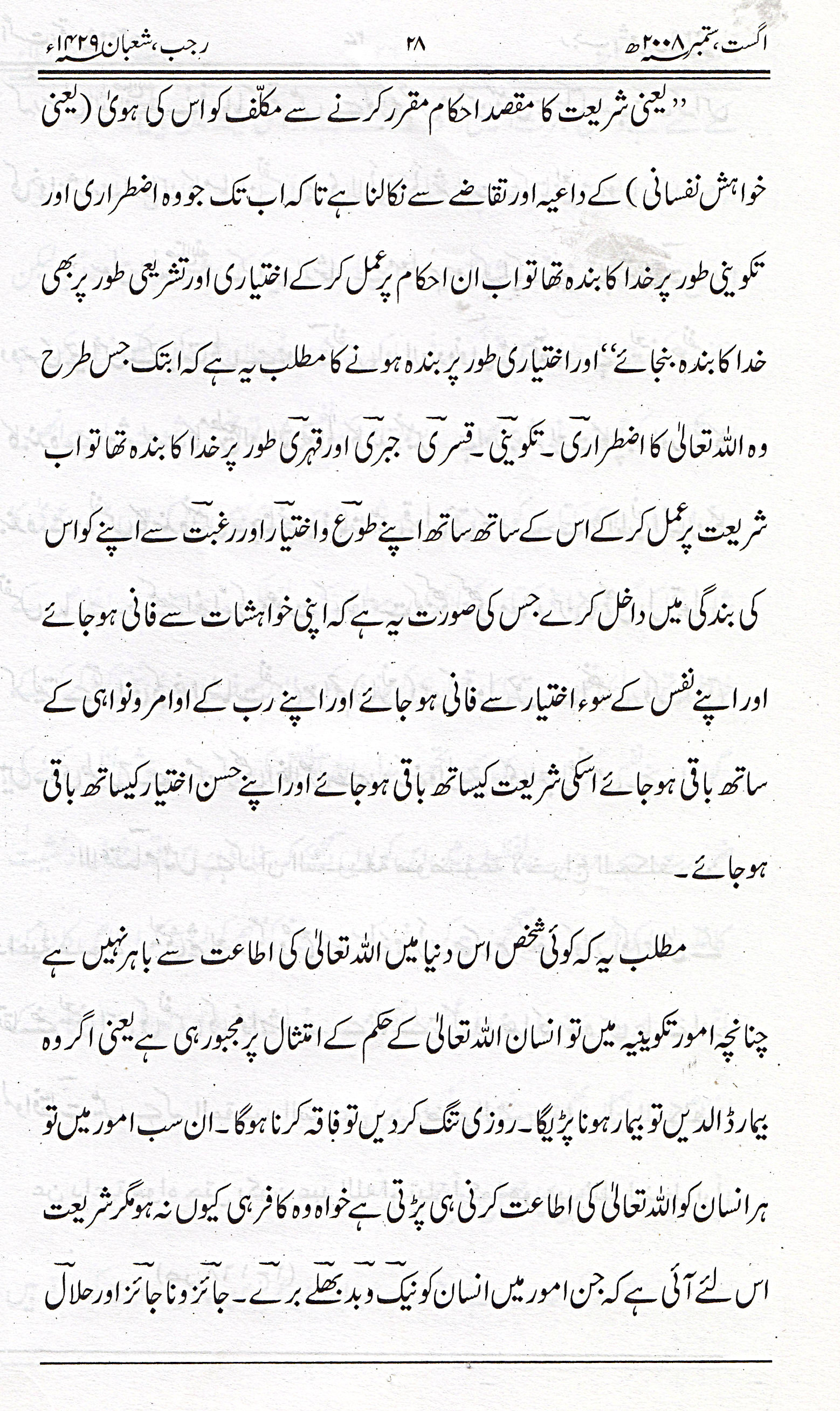
“The objective of shari’ah for instituting injunctions is to expel the faithful away from the inexorable dunning of his Nafs. So that up till now he was a bondsman of God under duress & natural order and now after complying with these injunctions he voluntarily ( & in conformity with Shari’ah), becomes a bondsman of Allah”
The meaning of voluntarily becoming a bondsman is that to this day he was under duress.. compulsion.. coercion..Intimidation.. And now after adhering to Shari’ah..submissively..voluntarily..Passionately..admits himself under his bondsmanship.
Which manifests itself as annihilating ones desires (attaining Fana), decimating away from the evil clutches of Nafs… and remaining alive with the ordinances of the Lord (attaining Baqaa) and prevailing along with liberty.
It means that none in this world is exempted from obedience to Allah سبحانه وتعالى.. whereas in the scheme of natural order.. Man is compelled to obey the command of Allah سبحانه وتعالى. Such that when he brings forth sickness..one has to be sick. When He constricts sustenance.. he has to undergo starvation..
In all such commands every human has to be subservient to Allah سبحانه وتعالى , even if he is a disbeliever (Kafir). But Shari’ah has reached us to show that when someone has total liberty to act upon good or bad..lawful or unlawful..permissible or prohibited..then he gives precedence to Shari’ah.
That he abandons the cravings of Nafs, while voluntarily submitting himself towards the bondsmanship of his Lord, abiding with the decree of Allah سبحانه وتعالى. Such that he attains acceptance and honor in this world, shadowed by (Allah سبحانه وتعالى’s) ) mercy in the hereafter.
And if he declines to follow the Shari’ah, then he shall be disgraced in this world and be deprived of the mercy of Allah سبحانه وتعالى in the hereafter.
As I explained just now.. the thing which obstructs a person from Imaan and a believer from Ikhlaas.. is his Nafs. Such that the ostentatious (filled with Riya) cannot be Mukhlis (sincere).
The motive of the ostentatious is to gain name & fame with his Riya, but Allah سبحانه وتعالى gives manifold to his Mukhlis bondsmen on account of their Ikhlaas..
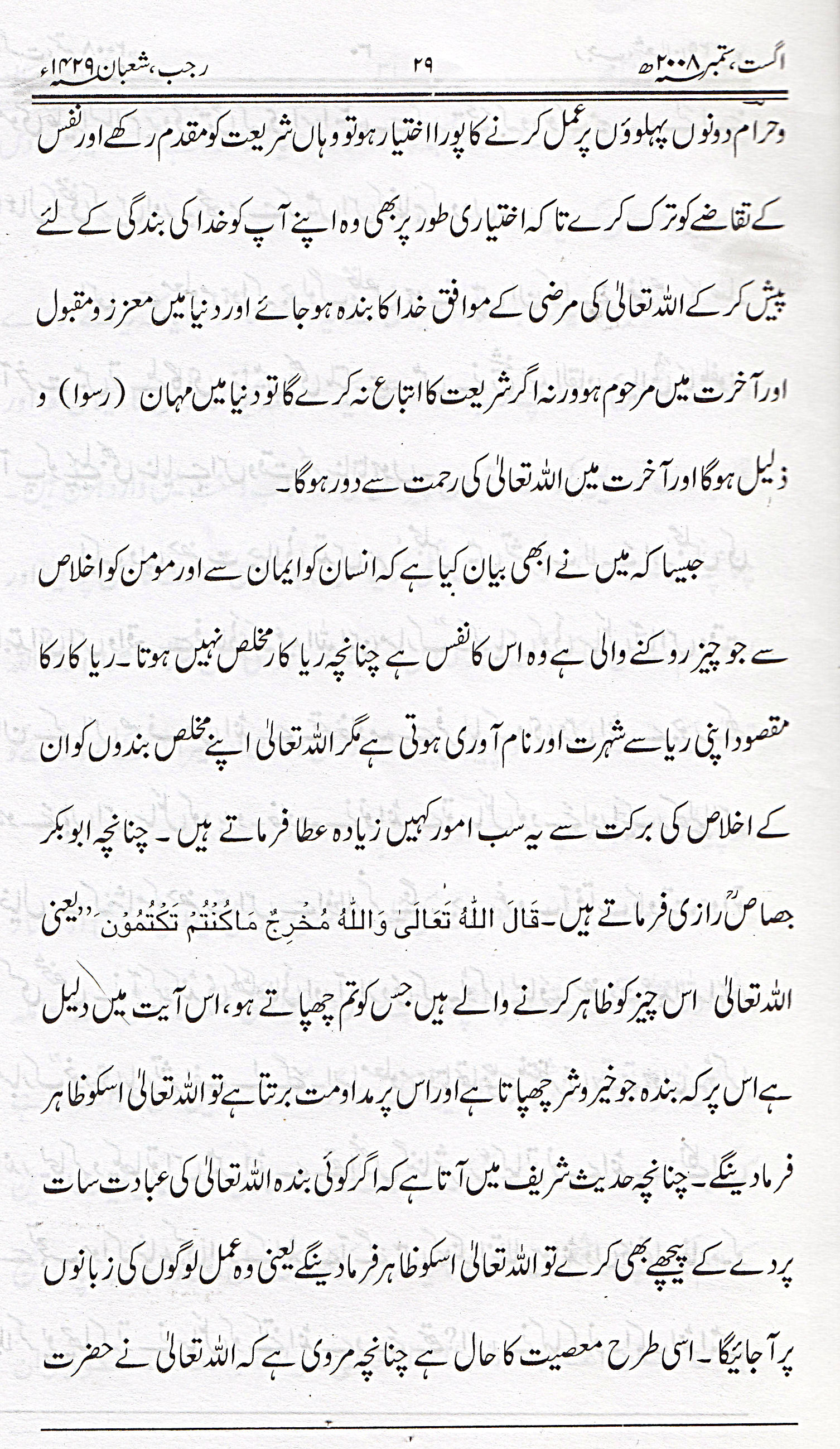
Abu bakr Jassas Razi رحمة الله عليه comments that Allah سبحانه وتعالى says “while Allah was to bring forth
what you were holding back” (Baqarah:72).
This ayat contains proof (daleel) that which the bondsman conceals, either good or bad, keeping in continuum, Allah سبحانه وتعالى shall bring it forth.
Such that it is mentioned in the noble Hadeeth that if someone worships Allah سبحانه وتعالى even behind the cover of seven curtains, Allah سبحانه وتعالى shall make it known.. that the act shall reach the lips of common folks.
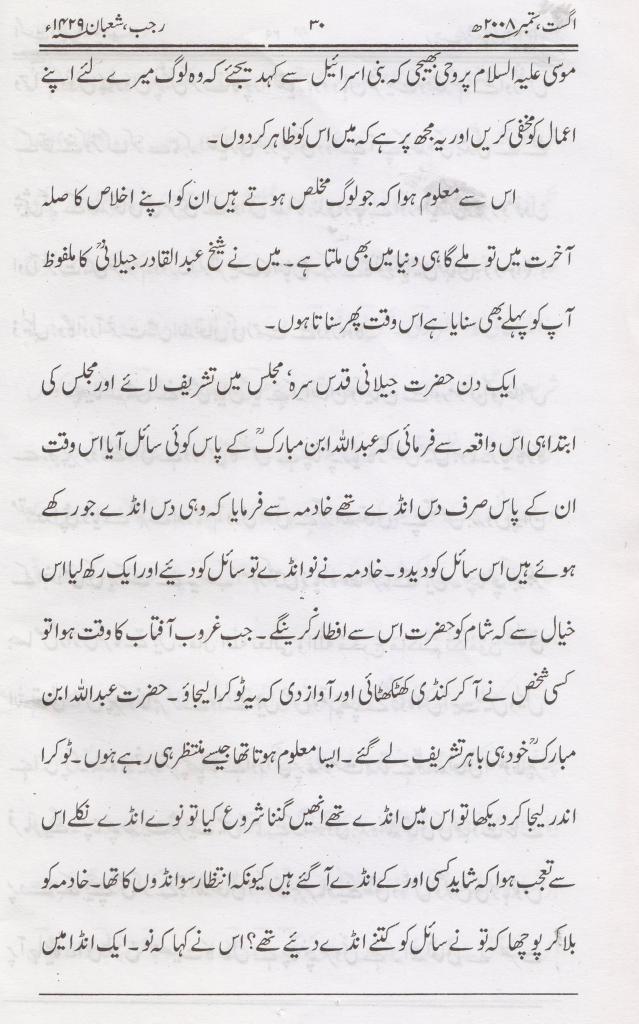
Similar is the condition of sins.. it is reported that that Allah سبحانه وتعالى had sent revelation to Hazrat Musa (Alaihis salam) to inform Bani Israel that they keep their actions concealed for him.. and it is at my discretion to bring it forth.
We understand now that those who are Mukhlis shall definitely be rewarded in the hereafter on account of their Ikhlaas but are also rewarded in this world itself.
I have earlier mentioned the Malfuz of Hazrat Shaikh Abdul Qadir Jeelani رحمة الله عليه before you.. and I shall repeat it now..
Once Hazrat Shaikh Jeelani رحمة الله عليه arrived at the Majlis and commenced it with the following incident .
A beggar approached Hazrat Abdullah Bin Mubarak رحمة الله عليه.. at that instance his only possession were ten eggs.. he told the maidservant to give away the eggs to the suppliant.
She gave nine eggs to the beggar and retained one, assuming that he might use it for Iftar at dusk.
At the time of sunset, someone gave a knock at his door.. calling out, saying to accept this basket. Hazrat Abdullah Bin Mubarak رحمة الله عليه himself went out. It seemed as if he was already expecting someone. Carrying the basket inside, he saw there were eggs within and began to count..they were ninety in all.
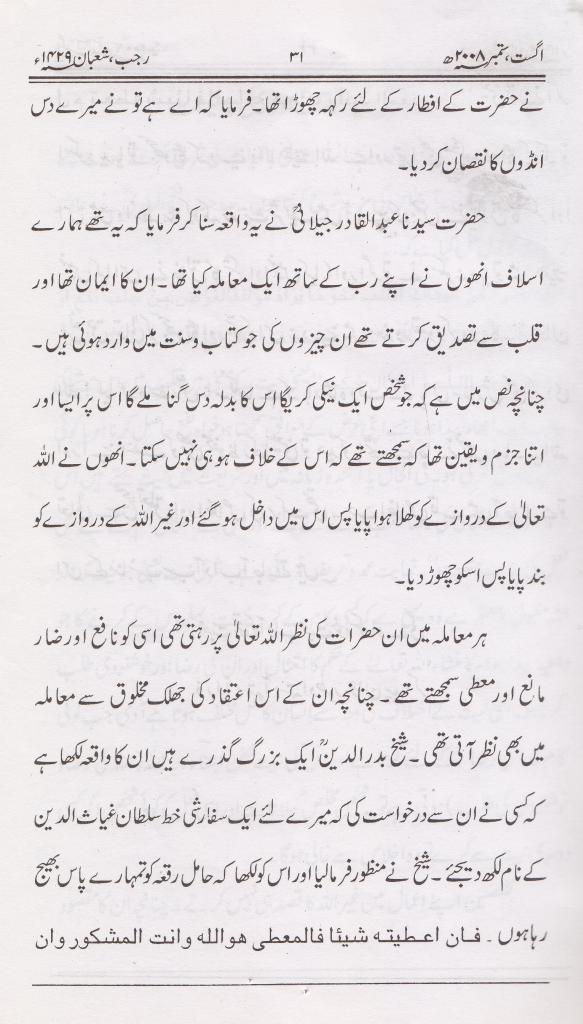
Bewildered, that perhaps it belonged to someone else, since he was anticipating a hundred eggs, He summoned the maidservant and inquired as how many eggs did you give to the beggar? She replied as nine. I had kept one egg that you may use at Iftar (breaking of fast). To which he said Alas..! You incurred upon me a loss of ten eggs..
Hazrat Shaikh Abdul Qadir Jeelani رحمة الله عليه after narrating this incident commented that these were our Aslaaf.. they had made an agreement with their lord. They had faith and attested with their hearts, things which were present in kitaab and sunnah.
Since it appears in Nas (scripture/ Qur’an) that the one who commits a single act of virtue shall be rewarded with a hundred fold, it was ingrained with such unflinching faith and altruistic fervor within them, that they regarded impossible anything in contradiction.
They found the gates of Allah سبحانه وتعالى to be open and just passed through.. and saw the doors of anything aside him ( besides Allah سبحانه وتعالى ) to be closed, thus, abandoned it.
For every matter they set their eyes upon Allah سبحانه وتعالى believing only Him to be the creator of good and harmful.. the Preventer of Harm and Benefactor. Such that the reflection of their faith was also seen in their dealings with the creation.
Shaikh Badruddin رحمة الله عليه was a saintly man (buzurg) who passed away long.. An incident of his has been reported that someone requested him to write a recommendation letter to Sultan Ghiyas-uddin.
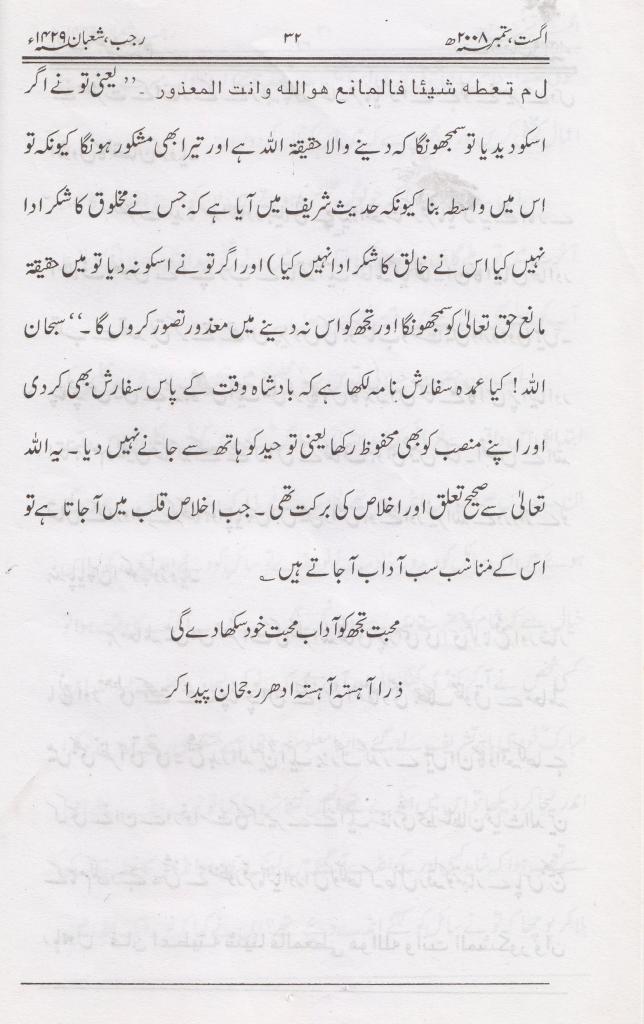
The shaikh accepted and wrote that Iam sending towards you the bearer of this epistle. “That if you grant him, I shall infer the benefactor in reality is but Allah. And I shall also be thankful to you since you are the medium.
As it is mentioned in Hadith that the one who isn’t thankful towards the creation hasn’t been grateful to the creator. And if you do not grant him, I shall assume Allah سبحانه وتعالى having deprived him and absolve you in this matter.”
Subhan Allah ! what an excellent recommendation letter did he write. That he sent words of praise to the king, while safeguarding his own integrity, holding firm on Tauheed.
This was due to the blessing of a strong connection with Allah سبحانه وتعالى & of Ikhlaas. that When Ikhlaas enters the heart then all appropriate etiquettes also follow suit.
Love itself shall teach you its decorum..
Slowly & steadily.. build your passions here..
(Hazrat Maulana Shah Wasiullah sahab رحمة الله عليه ) commented that while expounding on the Hadeeth Innamal A’malu Binniyah I had mentioned a few points. Today I shall further elaborate on the same.
The author of Fath ul Baari has reported a statement of Allamah Baidhawi رحمة الله عليه that:
“Niyyah is meant by the creation of that rising tide felt in the heart towards that which is sought after, in compliance of his needs. Be it to acquire some benefit or repel any harm, at present or in future. And Niyyah in Shari’ah is known as that intention which is made to seek the pleasure of Allah سبحانه وتعالى, to obey his commands, by focusing towards some act.”
What an excellent definition he has given. Shar’i Niyyah, meaning Niyyat which is accepted and credible in the presence of Allah سبحانه وتعالى .. is the one when made prior to initiating a task, rouses craving for the act , where his ambition is to obey the commandments of Allah seeking his pleasure and benevolence.
Due to the conflict of this very Niyyat the action of man contradicts. When someone performs a deed to please Allah, and, his Niyyat is solely to seek His pleasure, then this person is known as a Mukhlis (sincere). And the same deed when carried by any other Niyyat.. shall be devoid of Ikhlaas.
Mukhliseen never entertain the purport of Ghair Allah in their actions.
Their objective is not any worldly gain. However, Allah سبحانه وتعالى due to the barakah of Ikhlaas, does reward their obedience in this world as well.
We do visit saintly people (Buzurg/the pious) so that one could attain a part of Ikhlaas in our hearts. But this has all disappeared in today’s day and age.
Whereas, I do comment on these visitors that you are here only for two things. one that you remain foolish and second to keep being sick. I say this because I notice these visitors doing any work with knack or wisdom. Neither they posses intellect nor learn when someone teaches them.
Similarly, whoever I see.. they seem to be sick. I have been saying this quite oftenly that Allah سبحانه وتعالى says:
“ Those who do good, there is good (end) in this world, and indeed the abode of the Hereafter is much better.” (Surah Al Nahl:30)
Meaning those who are righteous shall also receive Hasanah (good) in this world. Scholars have also made Tafsir of Hasanah as Health and Aafiya. While it is recorded in Tafsir Ruh al Ma’ani that “Muhsineen are also recipient of a little amount of reward in this world as a measure of their good deeds.. and this is of Health and Aafiya. And they shall get the absolute recompense in the hereafter.”
I say to these people that look.. Health and Aafiya has been termed as a reward for Imaan & Amal salih (good deeds), so the manner in which Health and Aafiya rests on Amal Salih, similarly there is also a prerequisite.
That when you do not keep healthy at all, how will you then perform good deeds. So when there is no health.. there are no deeds.. and in the absence of Amal (deeds) there is no Traquility.
This cannot be undone and I am sure it will be greatly appreciated.
We apologise but you have been denied access to report posts in this thread. This could be due to excessively reporting posts and not understanding our forum rules. For assistance or information, please use the forum help thread to request more information. Jazakallah


 .
.