Forum Menu - Click/Swipe to open
 

Muslim Inventions

You have contributed 0.0% of this topic

Thread Tools
Topic Poll
Were you Shocked by the Great Muslim Inventions
» YES
75%
3 members | 0 guests
» NO
25%
1 members | 0 guests
» It Doesnt Bother Me, I dont care!
0%
0 members | 0 guests
Appreciate
Topic Appreciation
Seifeddine-M, sweetmuslimahk1, abu mohammed, Yasin, Taalibah, Naqshband66, abuzayd2k
1 guest appreciates this topic.
Rank Image
abu mohammed's avatar
London
27,443
Brother
9,578
abu mohammed's avatar
#46 [Permalink] Posted on 15th January 2011 12:40
Swordmaking

Damascus steel: One of the most famous steels produced in the medieval Near East was Damascus steel used for swordmaking, and mostly produced in Damascus, Syria, in the period from 900 to 1750. This was produced using the crucible steel method, based on the earlier Indian wootz steel. This process was further refined in the Middle East using locally produced steels. The process allowed carbides to precipitate out as micro particles arranged in sheets or bands within the body of a blade. The carbides are far harder than the surrounding low carbon steel, allowing the swordsmith to make an edge which would cut hard materials with the precipitated carbides, while the bands of softer steel allowed the sword as a whole to remain tough and flexible. A team of researchers based at the Technical University of Dresden that uses x-rays and electron microscopy to examine Damascus steel discovered the presence of cementite nanowires and carbon nanotubes. Peter Paufler, a member of the Dresden team, says that these nanostructures give Damascus steel its distinctive properties and are a result of the forging process.

Flyssa and Kaskara:
The swords developed in early Islamic Morocco and the Baguirmi Sultanate, respectively.

Grip:
In the late 12th century, the figure of a Turkish cavalryman was depicted holding a sabre which was carried using what would later be known in Europe as the 'Italian Grip'.

Kilij:
A sabre developed by the Turks in Central Asia, it came into widespread use by the 15th century. Polish sabres of the 17th century (known as pallash or palache) were derived from this weapon.

Nimcha:
An Arab short sabre with a knuckle guard developed in Morocco.

Pulwar, Qama, and Quaddara:
The pulwar is a form of talwar that was developed in Islamic India. The qama was a sword developed in Islamic Georgia, and is probably the origin of the Cossack kindjal. The quaddara was a Persian broadsword, like a long kindjal, used in the Caucasus.

Sabre and Saif:
The sabre and the Arab saif were developed in the early Islamic world.

Scimitar and Shamshir:
The earliest evidence of the scimitar, or curved sword, is from the 9th century, when it was used among soldiers in the Khurasan region of Persia. The Persian shamshir in its current form dates to the 15th century.

Shashka and Shotel:
Developed in the Caucasus and Abyssinia, respectively.

Takouba, Talwar, and Yatagan:
The takouba was developed by the Taureg people of the Sahara. The talwar is an Indian sword based on the Persian shamshir. The yatagan was developed in Turkey.
report post quote code quick quote reply
No post ratings
back to top
Rank Image
abu mohammed's avatar
London
27,443
Brother
9,578
abu mohammed's avatar
#47 [Permalink] Posted on 15th January 2011 12:47
Navigational technology

Instruments Cartographic Qibla indicators:
These were brass instruments with Makkah-centred world maps and cartographic grids engraved on them. They were invented in 17th-century Safavid Iran.

Cartographic Qibla indicator with sundial and compass:
This was a Qibla instrument with a sundial and compass attached to it, and was invented by Muhammad Husayn in 17th century Safavid Iran.

Transport

Kamal:
Arab navigators invented a rudimentary sextant known as a kamal, used for celestial navigation and for measuring the altitudes and latitudes of the stars, in the late 9th century. They employed in the Indian Ocean from the 10th century, and it was adopted by Indian navigators soon after, followed by Chinese navigators some time before the 16th century. The invention of the kamal allowed for the earliest known latitude sailing, and was thus the earliest step towards the use of quantitative methods in navigation.

Qarib:
The origins of the caravel ship, used for long distance travel by the Spanish and Portuguese since the 15th century, date back to the qarib.

Rudder with tackle, permanent sternpost-mounted:
The Arabs used a sternpost-mounted rudder which differed technically from both its European and Chinese counterparts. On their ships "the rudder is controlled by two lines, each attached to a crosspiece mounted on the rudder head perpendicular to the plane of the rudder blade." The earliest evidence comes from the Ahsan al-Taqasim fi Marifat al-Aqalim ('The Best Divisions for the Classification of Regions') written by al-Muqaddasi in 985. According to Lawrence V. Mott, the "idea of attaching the rudder to the sternpost in a relatively permanent fashion, therefore, must have been an Arab invention independent of the Chinese."

Xebec and Polacca:

The xebec and polacre sailing ships used around the Mediterranean from the 16th to the 19th centuries originated from the Barbary pirates, who successfully used them for naval warfare against European ships at the time. A combination of the fore and aft sails and aerodynamics, along with the improved square sail on the Polacca, allowed these ships to sail much closer to the wind than European and American ships. An expert on the Barbary pirates said that their ships had guns at the bow and stern. "They would approach, pounding away, and it took too long for our square riggers to bring the broadside guns around. The Arabs had oars and a sail arrangement that meant they were able to turn more quickly and could flee closer to the wind than we could chase them."

Aviation

Attempt at gliding:
According to the 17th century historian Ahmed Mohammed al-Maqqari, Abbas Ibn Firnas of Islamic Spain made in 875 the first − unsuccessful − attempt at a heavier-than-air glider flight in aviation history. It may have inspired the attempt by Eilmer of Malmesbury between 1000 and 1010 in England, recorded by the medieval historian William of Malmesbury in about 1125, although there is no evidence that the earlier recorded event in Anglo-Saxon England took place with foreign stimulus
report post quote code quick quote reply
No post ratings
back to top
Rank Image
abu mohammed's avatar
London
27,443
Brother
9,578
abu mohammed's avatar
#48 [Permalink] Posted on 19th January 2011 20:27
STILL TO COME INSHAALLAH

Analogue computers
Laboratory apparatus
Mural instruments
Optical instruments
Timekeeping devices
Astronomical clocks
Clocks with gears and escapements
Dials
Mechanical clocks
Water clocks


Also Musical Instruments, But in this case I do not see it worthy of going into details as Music is the voice of Shaitan.
report post quote code quick quote reply
No post ratings
back to top
Rank Image
abu mohammed's avatar
London
27,443
Brother
9,578
abu mohammed's avatar
#49 [Permalink] Posted on 21st January 2011 18:49
Analogue Computers


Equatorium:
Invented by Abū Ishāq Ibrāhīm al-Zarqālī (Arzachel) in Islamic Spain circa 1015, it was a mechanical analog computer device for finding the longitudes and positions of the moon, sun, and planet's, without calculation using a geometrical model to represent the celestial body's mean and anomalistic position.

Saphaea:
An astrolabe, invented by Abū Ishāq Ibrāhīm al-Zarqālī (Arzachel) in 11th century Islamic Spain.

Zuraqi:
A heliocentric astrolabe where the Earth is in motion rather than the sky, by al-Sijzi in the 11th century.

Fixed-wired knowledge processing machine:
Abū Rayhān al-Bīrūnī's hodometer was an early example of a fixed-wired knowledge processing machine in the early 11th century.

Mechanical lunisolar calendar computer:
Featured a gear train and gear-wheels, and was invented by Abū Rayhān al-Bīrūnī.

Mechanical geared astrolabe:
Invented by Ibn Samh (c. 1020).

Linear astrolabe ("staff of al-Tusi"):
Invented by Sharaf al-Dīn al-Tūsī in the 12th century.

Programmable analog computer:
The castle clock, an astronomical clock invented by Al-Jazari in 1206, is considered to be the earliest programmable analog computer. It displayed the zodiac, the solar and lunar orbits, a crescent moon-shaped pointer travelling across a gateway causing automatic doors to open every hour, and five robotic musicians who play music when moved by levers operated by a camshaft attached to a water wheel. The length of day and night could be re-programmed every day in order to account for the changing lengths of day and night throughout the year.

Mechanical geared astrolabe with calendar computer:
Invented by Abi Bakr of Isfahan in 1235.

Plate of Conjunctions:
A computing instrument used to determine the time of day at which planetary conjunctions will occur, and for performing linear interpolation, invented by al-Kashi in the 15th century.

Planetary computer:
The Plate of Zones, a mechanical planetary computer which could graphically solve a number of planetary problems, was invented by al-Kashi in the 15th century. It could predict the true positions in longitude of the sun and moon, and the planets in terms of elliptical orbits; the latitudes of the Sun, Moon, and planets; and the ecliptic of the Sun. The instrument also incorporated an alidade and ruler.
report post quote code quick quote reply
No post ratings
back to top
Rank Image
abu mohammed's avatar
London
27,443
Brother
9,578
abu mohammed's avatar
#50 [Permalink] Posted on 21st January 2011 18:53
Laboratory apparatus

Aerometer
:
Abū Rayhān al-Bīrūnī in the 11th century.

Conical measure:
Abū Rayhān al-Bīrūnī in the 11th century.

Laboratory flask and pycnometer:
Abū Rayhān al-Bīrūnī.

Refrigerated coil and refrigerated tubing:
In the 11th century, Avicenna invented the refrigerated coil, which condenses aromatic vapours. This was a breakthrough in distillation technology and he made use of it in his steam distillation process, which requires refrigerated tubing, to produce essential oils.
report post quote code quick quote reply
No post ratings
back to top
Rank Image
abu mohammed's avatar
London
27,443
Brother
9,578
abu mohammed's avatar
#51 [Permalink] Posted on 19th March 2011 11:57

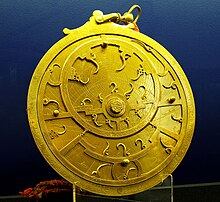
The astrolabe was invented by Abū Ishāq Ibrāhīm al-Zarqālī (Arzachel) in Islamic Spain circa 1015. The one shown here is from Persia in the 18th century.
 

File:Spherical astrolabe.jpg

The spherical astrolabe was invented by Muslim astronomers. This is the earliest surviving example from the 14th century.

report post quote code quick quote reply
No post ratings
back to top
Rank Image
abu mohammed's avatar
London
27,443
Brother
9,578
abu mohammed's avatar
#52 [Permalink] Posted on 19th March 2011 12:04

Mural instrument

Mural instrument: Invented by Al-Khwarizmi in 9th century Baghdad, Iraq.

Horary quadrant: For specific latitudes, by al-Khwarizmi in 9th century Baghdad.

Sine quadrant: - also known as the "Sinecal Quadrant", the Arabic term for it is "Rubul Mujayyab" – used for solving trigonometric problems and for astronomical calculations, by al-Khwarizmi in 9th century Baghdad.

Almucantar quadrant: Invented in the medieval Islamic world. It employed the use of trigonometry. The term "almucantar" is itself derived from Arabic.

Quadrans Vetus: Meaning "Old Quadrant", this was a universal horary quadrant which could be used for any latitude and at any time of the year to determine the time, as well as the times of Salah, invented by al-Khwarizmi in 9th century Baghdad. This was the second most widely used astronomical instrument during the Middle Ages after the astrolabe. One of its main purposes in the Islamic world was to determine the times of Salah prayers.

Quadrans Novus: An astrolabic quadrant invented in Egypt in the 11th century or 12th century, and later known in Europe as the "Quadrans Novus" (New Quadrant).

Sextant: The first sextant was constructed in Ray, Iran, by Abu-Mahmud al-Khujandi in 994. It was a very large sextant that achieved a high level of accuracy for astronomical measurements, which he described his in his treatise, On the obliquity of the ecliptic and the latitudes of the cities. In the 15th century, Ulugh Beg constructed the mural "Fakhri Sextant", which had a radius of approximately 36 meters. Constructed in Samarkand, Uzbekistan, the arc was finely constructed with a staircase on either side to provide access for the assistants who performed the measurements.

File:Ulugh Beg observatory.JPG

report post quote code quick quote reply
No post ratings
back to top
Rank Image
abu mohammed's avatar
London
27,443
Brother
9,578
abu mohammed's avatar
#53 [Permalink] Posted on 19th March 2011 12:08
Optical instruments
Observation tube: The "observation tube" (without lens) was invented by al-Battani (Albatenius) (853-929) and first described by al-Biruni (973-1048). These observation tubes were later adopted in Europe, where they influenced the development of the telescope.

Intromission theory of vision: Ibn al-Haytham (Alhazen), with his Book of Optics (1021), refuted the emission theory of vision, and correctly explained and proved the modern intromission theory of vision, through extensive experimentation and visual perception.

Camera obscura: Ibn al-Haytham worked out that the smaller the hole, the better the picture, and set up the first camera obscura, a precursor to the modern camera.

Pinhole camera: Ibn al-Haytham first described pinhole camera after noticing the way light came through a hole in window shutters.

Magnifying glass: The earliest evidence of "a magnifying device, a convex lens forming a magnified image", dates back the Book of Optics published by Ibn al-Haytham in 1021. The Latin translation of his work was instrumental to the later inventions of eyeglasses, the telescope, and the microscope.
report post quote code quick quote reply
No post ratings
back to top
Rank Image
abu mohammed's avatar
London
27,443
Brother
9,578
abu mohammed's avatar
#54 [Permalink] Posted on 19th March 2011 12:14
Other instruments

Compendium instrument: A multi-purpose astronomical instrument, first constructed by the Muslim astronomer Ibn al-Shatir in the 13th century. His compendium featured an alidade and polar sundial among other things. Al-Wafa'i developed another compendium in the 15th century which he called the "equatorial circle", which also featured a horizontal sundial. These compendia later became popular in Renaissance Europe

Framed sextant:
At the Istanbul observatory of Taqi al-Din between 1577 and 1580, Taqi al-Din invented the mushabbaha bi'l manattiq, a framed sextant with cords for the determination of the equinoxes similar to what Tycho Brahe later used.

Seamless globe and celestial globe: Considered one of the most remarkable feats in metallurgy, they were invented in Kashmir by Ali Kashmiri ibn Luqman in 998 AH (1589-90 CE), and twenty other such globes were later produced in Lahore and Kashmir during the Mughal Empire. Before they were rediscovered in the 1980s, it was believed by modern metallurgists to be technically impossible to produce metal globes without any seams, even with modern technology. These Mughal metallurgists pioneered the method of lost-wax casting while producing these seamless globes.

Shadow square: An instrument used to determine the linear height of an object, in conjunction with the alidade for angular observations, invented by Muhammad ibn Mūsā al-Khwārizmī in 9th-century Baghdad.
report post quote code quick quote reply
No post ratings
back to top
Rank Image
abu mohammed's avatar
London
27,443
Brother
9,578
abu mohammed's avatar
#55 [Permalink] Posted on 27th March 2011 11:58
Timekeeping devices

Astronomical clocksMuslim astronomers and engineers constructed a variety of highly accurate astronomical clocks for use in their observatories.

Astronomical alarm clock:
See Mechanical clocks below.

Geared mechanical lunisolar calendar computer:
See Analog computers above.

Geared mechanical astrolabe:
Featured a calendar computer and gear-wheels, and was invented by Abi Bakr of Isfahan in 1235.

Monumental water-powered astronomical clocks:
Al-Jazari invented monumental water powered astronomical clocks which displayed moving models of the sun, moon, and stars. His largest astronomical clock displayed the zodiac and the solar and lunar orbits. Another innovative feature of the clock was a pointer which travelled across the top of a gateway and caused automatic doors to open every hour.

Observational clock measured in seconds:
See Mechanical clocks below.

Programmable castle clock:
See Analog computers above.

Quadrans Vetus:
See Mural instruments above.

Clocks with gears and escapementsWeight-driven mercury clock:
A mercury clock, employing a mercury escapement mechanism and a clock face similar to an astrolabe dial, was described in a Spanish language work for Alfonso X in 1277, compiled from earlier Arabic sources that likely date back to the 11th century. The Jewish author of the relevant section, Rabbi Isaac, constructed the mercury clock using principles described by a philosopher named "Iran", identified with Heron of Alexandria (fl. 1st century AD), on how heavy objects may be lifted. Knowledge of the mercury clock was later transmitted to other parts of Europe through translations.

Weight-driven water-powered scribe clock:
In 1206, Al-Jazari invented some of the earliest weight-driven water clocks, including the water-powered scribe clock. This water-powered portable clock was a meter high and half a meter wide. The scribe with his pen was synonymous to the hour hand of a modern clock. This is an example of an ingenious water system by Al-Jazari. Al-Jazari's famous water-powered scribe clock was reconstructed successfully at the Science Museum (London) in 1976.

Dials Navicula de Venetiis:
A universal horary dial used for accurate timekeeping by the sun and stars, and could be observed from any latitude, invented in 9th century Baghdad. This was later considered the most sophisticated timekeeping instrument of the Renaissance.

"jewel box" device:
In the early 14th century, Ibn al-Shatir invented a timekeeping device incorporating both a universal sundial and a magnetic compass to find the times of Salah prayers.

Mechanical clocks Observational clock, measured in seconds:
Taqi al-Din invented the "observational clock", which he described as "a mechanical clock with three dials which show the hours, the minutes, and the seconds." This was the first clock to measure time in seconds, and was used for astronomical purposes, specifically for measuring the right ascension of the stars. This is considered one of the most important innovations in 16th century practical astronomy, as previous clocks were not accurate enough to be used for astronomical purposes.

Water Clocks
Geared water clock:
See Clocks with gears and escapements above.

Elephant clock:
The elephant clock described by al-Jazari in 1206 is notable for several innovations. The float regulator employed in the clock later had an important influence during the Industrial Revolution of the 18th century, when it was employed in the boiler of a steam engine and in domestic water systems.

Programmable castle clock:
See Analog computers above.

Weight-driven water clock:
See Clocks with gears and escapements above.

Weight-driven water-powered scribe clock: See Clocks with gears and escapements above.

Monumental water-powered alarm clock:
In 1235, an early monumental water-powered alarm clock that "announced the appointed hours of prayer and the time both by day and by night" was completed in the entrance hall of the Mustansiriya Madrasah in Baghdad.

New water clocks have recently been discovered in Ibn Khalaf al-Muradi's Book of Secrets (1000), as shown in the Museum of Islamic Art, Doha, Qatar.
report post quote code quick quote reply
No post ratings
back to top
Rank Image
abu mohammed's avatar
London
27,443
Brother
9,578
abu mohammed's avatar
#56 [Permalink] Posted on 2nd April 2011 11:27

Other inventions from the Islamic world include:

Airmail system utilizing homing pigeons by the Fatimid Caliph Aziz, and advances in music theory and irrigation techniques

Algebra: While the roots of algebra can be traced back to earlier civilizations, where mathematicians solved linear and quadratic equations using arithmetic and geometric methods, it was Muhammad ibn Mūsā al-Khwārizmī's al-Kitāb al-muḫtaṣar fī ḥisāb al-jabr wa-l-muqābala (The Compendious Book on Calculation by Completion and Balancing) which established algebra as an independent mathematical discipline in its own right.  Al-Khwarizmi was the first to clearly establish algebra as a discipline that is independent of geometry and arithmetic. The name he coined for the discipline, al-jabr, referred to the underlying method of "reduction" and "balancing" he introduced, meaning the transposition of subtracted terms to the other side of an equation, that is, the cancellation of like terms on opposite sides of the equation.

Biographical dictionary: In the medieval Islamic civilization, biographies began being produced on a large scale with the advent of paper. This led to the introduction of a new literary genre: the biographical dictionary. The first biographical dictionaries were written in the Muslim world from the 9th century onwards. They contain more social data for a large segment of the population than that found in any other pre-industrial society. The earliest biographical dictionaries initially focused on the lives of the prophets of Islam and the their companions, with one of the earliest examples being The Book of The Major Classes by Ibn Sa'd al-Baghdadi, and then began documenting the lives of many other historical figures (from rulers to scholars) who lived in the medieval Islamic world.

Check reading: The medieval Islamic world also developed a unique method of reproducing reliable copies of a book in large quantities, known as check reading, in contrast to the traditional method of a single scribe producing only a single copy of a single manuscript, as was the case in other societies at the time. In the Islamic check reading method, only "authors could authorize copies, and this was done in public sessions in which the copyist read the copy aloud in the presence of the author, who then certified it as accurate."  With this check-reading system, "an author might produce a dozen or more copies from a single reading," and with two or more readings, "more than one hundred copies of a single book could easily be produced."

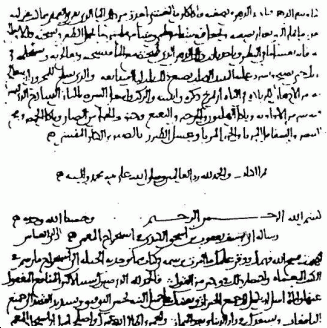
Cryptanalysis and frequency analysis: In cryptology, the first known recorded explanation of cryptanalysis was given by 9th-century Arabian polymath, Al-Kindi (also known as "Alkindus" in Europe), in A Manuscript on Deciphering Cryptographic Messages. This treatise includes the first description of the method of frequency analysis. It has been suggested that close textual study of the Qur'an first brought to light that Arabic has a characteristic letter frequency. Its use spread, and similar systems were widely used in European states by the time of the Renaissance.

Diary: In the medieval Near East, Arabic diaries were written from before the 10th century. The earliest surviving diary which most resembles the modern diary was that of Ibn Banna in the 11th century. His diary is the earliest known to be arranged in order of date (ta'rikh in Arabic), very much like modern diaries.

Experimental psychology: Ibn al-Haytham (Alhazen) is considered to be the founder of experimental psychology, for his experimental approach to the psychology of visual perception and optical illusions.

Geomancy: The most widely accepted origin for this practice is in the medieval Arabic world.

Persian carpet

Scientific method, experimental science, and experimental physics: The scientific method was pioneered by the Muslim scientist and physicist, Ibn al-Haytham (Alhazen), who emphasized the role of experimentation and mathematics in obtaining the results in his Book of Optics (1021). Due to his formulation of a modern quantitative, empirical and experimental approach to physics and science, he is also considered the pioneer of experimental science and experimental physics, and some have described him as the "first scientist" for these reasons.

report post quote code quick quote reply
No post ratings
back to top
Rank Image
abu mohammed's avatar
London
27,443
Brother
9,578
abu mohammed's avatar
#57 [Permalink] Posted on 2nd April 2011 11:31

Equipment

Fireproof paper, glow-in-the-dark ink, rust-free iron, and waterproof textile: According to Ismail al-Faruqi and Lois Lamya al-Faruqi, "In response to Jafar al-Sadik's wishes, [Jabir ibn Hayyan] invented a kind of paper that resisted fire, and an ink that could be read at night. He invented an additive which, when applied to an iron surface, inhibited rust and when applied to a textile, would make it water repellent."

Fustian: The original medieval fustian was a stout but respectable cloth with a cotton weft and a linen warp, derived from El-Fustat, the name of a suburb of Cairo where this cloth was originally manufactured.

Jinete: A short-stirrup riding style that was adopted by Spanish riders from the Moors during Islamic rule in Spain. American cowboys in turn adopted the jinete riding style from the Spanish tradition.

Graph paper and orthogonal and regular grids: The first known use of graph paper dates back to the medieval Islamic world, where weavers often carefully drew and encoded their patterns onto graph paper prior to weaving. Islamic quadrants used for various astronomical and timekeeping purposes from the 10th century also introduced markings with orthogonal and regular grids that are still identical to modern graph paper.

report post quote code quick quote reply
No post ratings
back to top
Rank Image
abu mohammed's avatar
London
27,443
Brother
9,578
abu mohammed's avatar
#58 [Permalink] Posted on 2nd April 2011 11:36

Geomantic instrument Egypt or Syria 1241-1242 CE Muhammad ibn Khutlukh al Mawsuli In The British Museum

report post quote code quick quote reply
No post ratings
back to top
Rank Image
abu mohammed's avatar
London
27,443
Brother
9,578
abu mohammed's avatar
#59 [Permalink] Posted on 2nd April 2011 11:42

The first page of al-Kindi's manuscript "On Deciphering Cryptographic Messages", containing the oldest known description of cryptanalysis by frequency analysis.
 

report post quote code quick quote reply
No post ratings
back to top
Rank Image
abu mohammed's avatar
London
27,443
Brother
9,578
abu mohammed's avatar
#60 [Permalink] Posted on 2nd April 2011 11:46

Page from a 1531 Latin translation by Peter Argellata of Abu al-Qasim al-Zahrawi's Al-Tasrif on surgical and medical instruments.


report post quote code quick quote reply
No post ratings
back to top