

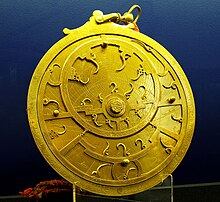
The astrolabe was invented by Abū Ishāq Ibrāhīm al-Zarqālī (Arzachel) in Islamic Spain circa 1015. The one shown here is from Persia in the 18th century.

The spherical astrolabe was invented by Muslim astronomers. This is the earliest surviving example from the 14th century.
Mural instrument
Mural instrument: Invented by Al-Khwarizmi in 9th century Baghdad, Iraq.
Horary quadrant: For specific latitudes, by al-Khwarizmi in 9th century Baghdad.
Sine quadrant: - also known as the "Sinecal Quadrant", the Arabic term for it is "Rubul Mujayyab" – used for solving trigonometric problems and for astronomical calculations, by al-Khwarizmi in 9th century Baghdad.
Almucantar quadrant: Invented in the medieval Islamic world. It employed the use of trigonometry. The term "almucantar" is itself derived from Arabic.
Quadrans Vetus: Meaning "Old Quadrant", this was a universal horary quadrant which could be used for any latitude and at any time of the year to determine the time, as well as the times of Salah, invented by al-Khwarizmi in 9th century Baghdad. This was the second most widely used astronomical instrument during the Middle Ages after the astrolabe. One of its main purposes in the Islamic world was to determine the times of Salah prayers.
Quadrans Novus: An astrolabic quadrant invented in Egypt in the 11th century or 12th century, and later known in Europe as the "Quadrans Novus" (New Quadrant).
Sextant: The first sextant was constructed in Ray, Iran, by Abu-Mahmud al-Khujandi in 994. It was a very large sextant that achieved a high level of accuracy for astronomical measurements, which he described his in his treatise, On the obliquity of the ecliptic and the latitudes of the cities. In the 15th century, Ulugh Beg constructed the mural "Fakhri Sextant", which had a radius of approximately 36 meters. Constructed in Samarkand, Uzbekistan, the arc was finely constructed with a staircase on either side to provide access for the assistants who performed the measurements.

Other inventions from the Islamic world include:
Airmail system utilizing homing pigeons by the Fatimid Caliph Aziz, and advances in music theory and irrigation techniques
Algebra: While the roots of algebra can be traced back to earlier civilizations, where mathematicians solved linear and quadratic equations using arithmetic and geometric methods, it was Muhammad ibn Mūsā al-Khwārizmī's al-Kitāb al-muḫtaṣar fī ḥisāb al-jabr wa-l-muqābala (The Compendious Book on Calculation by Completion and Balancing) which established algebra as an independent mathematical discipline in its own right. Al-Khwarizmi was the first to clearly establish algebra as a discipline that is independent of geometry and arithmetic. The name he coined for the discipline, al-jabr, referred to the underlying method of "reduction" and "balancing" he introduced, meaning the transposition of subtracted terms to the other side of an equation, that is, the cancellation of like terms on opposite sides of the equation.
Biographical dictionary: In the medieval Islamic civilization, biographies began being produced on a large scale with the advent of paper. This led to the introduction of a new literary genre: the biographical dictionary. The first biographical dictionaries were written in the Muslim world from the 9th century onwards. They contain more social data for a large segment of the population than that found in any other pre-industrial society. The earliest biographical dictionaries initially focused on the lives of the prophets of Islam and the their companions, with one of the earliest examples being The Book of The Major Classes by Ibn Sa'd al-Baghdadi, and then began documenting the lives of many other historical figures (from rulers to scholars) who lived in the medieval Islamic world.
Check reading: The medieval Islamic world also developed a unique method of reproducing reliable copies of a book in large quantities, known as check reading, in contrast to the traditional method of a single scribe producing only a single copy of a single manuscript, as was the case in other societies at the time. In the Islamic check reading method, only "authors could authorize copies, and this was done in public sessions in which the copyist read the copy aloud in the presence of the author, who then certified it as accurate." With this check-reading system, "an author might produce a dozen or more copies from a single reading," and with two or more readings, "more than one hundred copies of a single book could easily be produced."
Cryptanalysis and frequency analysis: In cryptology, the first known recorded explanation of cryptanalysis was given by 9th-century Arabian polymath, Al-Kindi (also known as "Alkindus" in Europe), in A Manuscript on Deciphering Cryptographic Messages. This treatise includes the first description of the method of frequency analysis. It has been suggested that close textual study of the Qur'an first brought to light that Arabic has a characteristic letter frequency. Its use spread, and similar systems were widely used in European states by the time of the Renaissance.
Diary: In the medieval Near East, Arabic diaries were written from before the 10th century. The earliest surviving diary which most resembles the modern diary was that of Ibn Banna in the 11th century. His diary is the earliest known to be arranged in order of date (ta'rikh in Arabic), very much like modern diaries.
Experimental psychology: Ibn al-Haytham (Alhazen) is considered to be the founder of experimental psychology, for his experimental approach to the psychology of visual perception and optical illusions.
Geomancy: The most widely accepted origin for this practice is in the medieval Arabic world.
Persian carpet
Scientific method, experimental science, and experimental physics: The scientific method was pioneered by the Muslim scientist and physicist, Ibn al-Haytham (Alhazen), who emphasized the role of experimentation and mathematics in obtaining the results in his Book of Optics (1021). Due to his formulation of a modern quantitative, empirical and experimental approach to physics and science, he is also considered the pioneer of experimental science and experimental physics, and some have described him as the "first scientist" for these reasons.
Equipment
Fireproof paper, glow-in-the-dark ink, rust-free iron, and waterproof textile: According to Ismail al-Faruqi and Lois Lamya al-Faruqi, "In response to Jafar al-Sadik's wishes, [Jabir ibn Hayyan] invented a kind of paper that resisted fire, and an ink that could be read at night. He invented an additive which, when applied to an iron surface, inhibited rust and when applied to a textile, would make it water repellent."
Fustian: The original medieval fustian was a stout but respectable cloth with a cotton weft and a linen warp, derived from El-Fustat, the name of a suburb of Cairo where this cloth was originally manufactured.
Jinete: A short-stirrup riding style that was adopted by Spanish riders from the Moors during Islamic rule in Spain. American cowboys in turn adopted the jinete riding style from the Spanish tradition.
Graph paper and orthogonal and regular grids: The first known use of graph paper dates back to the medieval Islamic world, where weavers often carefully drew and encoded their patterns onto graph paper prior to weaving. Islamic quadrants used for various astronomical and timekeeping purposes from the 10th century also introduced markings with orthogonal and regular grids that are still identical to modern graph paper.
Geomantic instrument Egypt or Syria 1241-1242 CE Muhammad ibn Khutlukh al Mawsuli In The British Museum

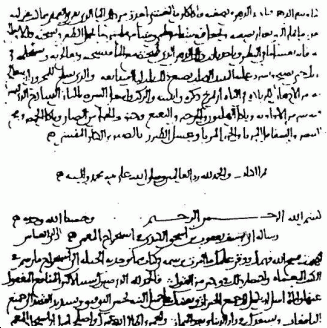
The first page of al-Kindi's manuscript "On Deciphering Cryptographic Messages", containing the oldest known description of cryptanalysis by frequency analysis.
Page from a 1531 Latin translation by Peter Argellata of Abu al-Qasim al-Zahrawi's Al-Tasrif on surgical and medical instruments.

This cannot be undone and I am sure it will be greatly appreciated.
Please wait...

