Forum Menu - Click/Swipe to open
 

carpets in masjid

You have contributed 0.0% of this topic

Thread Tools
Appreciate
Topic Appreciation
morganjeames
Rank Image
Offline
Unspecified
37
Brother
1
#1 [Permalink] Posted on 19th February 2016 08:28
assalaam

does anyone have info regarding carpets in the Masjid?

some say that it is bidah to furnish the Masjid with carpets.

Kindly assist.
report post quote code quick quote reply
No post ratings
back to top
Rank Image
Offline
Unspecified
37
Brother
1
#2 [Permalink] Posted on 19th February 2016 08:30
i heard that Hazrat Umar ra was the first to put carpets in the Masjid.

Any1 with a reference?
report post quote code quick quote reply
No post ratings
back to top
Rank Image
abu mohammed's avatar
London
27,479
Brother
9,579
abu mohammed's avatar
#3 [Permalink] Posted on 19th February 2016 09:07
It is not a Biddah to pray on carpets, rugs or mats and here is the evidence for it. Hope that helps.

Quote:
What is the ruling on praying on rugs? What is the ruling on putting a rug in the mosque for the imam to pray on? Is this bid’ah? May Allaah reward you with good.

Praise be to Allaah.
Praying on rugs is permissible in principle. Al-Bukhaari (379) and Muslim (513) narrated that Maymoonah (may Allaah be pleased with her) said: The Messenger of Allaah (peace and blessings of Allaah be upon him) used to pray on a khumrah.

A khumrah is a small mat made of palm leaves that is big enough for the face, on which a worshipper may prostrate to protect himself from the heat or coldness of the ground.

Al-Khattaabi favoured the view that the khumrah may be bigger than that, and he quoted as evidence the report narrated by Abu Dawood (5247) from Ibn ‘Abbaas, who said: A mouse came and started dragging the wick of the lamp and threw it in front of the Messenger of Allaah (peace and blessings of Allaah be upon him), on the khumrah on which he was sitting, and it burned an area the size of a dirham… This hadeeth was classed as saheeh by al-Albaani in Saheeh Abi Dawood, 4369.

It says in ‘Awn al-Ma’bood: This clearly shows that the word khumrah may apply to a large mat. This was also stated in al-Nihaayah.

See Fath al-Baari, 333.

Al-Shawkaani said:

This hadeeth indicates that there is nothing wrong with praying on a mat, regardless of whether it is made of rags, palm leaves or anything else, whether it is small or big, like a mat or carpet, because it is proven that the Prophet (peace and blessings of Allaah be upon him) prayed on mats, carpets and animal pelts.

Islamqa
report post quote code quick quote reply
+1 -0
back to top
Rank Image
Offline
Unspecified
37
Brother
1
#4 [Permalink] Posted on 19th February 2016 10:18
ive read what you wrote.


praying on a carpet is permissible.

can you find out who was the first to put carpets in the Masjid?
report post quote code quick quote reply
No post ratings
back to top
Rank Image
abu mohammed's avatar
London
27,479
Brother
9,579
abu mohammed's avatar
#5 [Permalink] Posted on 19th February 2016 10:46
Not exactly what you are looking for, but a step in the right direction

Quote:
Historical and cultural background

Muslims regard the carpet with special esteem and admiration. For the traditional Bedouin tribes of Arabia, Persia and Anatolia, the carpet was at the centre of their life being used as a tent sheltering them from the sand storms, a floor covering providing great comfort for the household, wall curtains protecting privacy, and useful items such as blankets, bags, and saddles. It was indeed a resourceful inspiration to make use of the abundant wool produced by their herds.

With Islam, another significant value was added to the carpet, being a furniture of Paradise mentioned numerous times in the Qur‘an. For example in Chapter 88 (Surah), the carpet is counted as one of the riches the believer will be rewarded in the afterlife.

There is considerable material dealing with the history, nature and character of the Muslim carpet. Such material is published under three main themes: the Oriental carpet, the Muslim carpet, or under regional classification such as the Turkish carpet, or the Persian carpet and the like. Historic sources have established that the carpet tradition is a very old custom practised by early civilisations. Recent discoveries (dating from 1949) of a carpet in the tomb of a Scythian prince in Pazyryk in the Altai Mountains (southern Siberia) date back to the 6th century BCE. This carpet, now in the Hermitage Museum in Saint Petersburg, is the oldest extant knotted carpet . From a study of its knotting technique, as well as its decoration, it appeared clearly that the so-called "Pazyryk carpet" had a Persian origin. The next evidence available in the early development of the carpet consists of small 6th-century CE fragments from Turfan (east Turkestan), on the old silk road, which were discovered between 1904 and 1913. It appears clear from these two evidences that the carpet was first made in the region of what was to become later a substantial part of the Muslim world.

The earliest surviving Muslim carpet, however, are fragments found in Al-Fustat (old Cairo). The oldest of these belonged to the 9th century (821 CE), while the remaining were dated to 13th, 14th and 15th centuries. Based on the form of their knots and decorative designs, these fragments were classified into two types. The first group included fragments having a knot similar to a later Spanish knot (knotted onto a single warp) and decorated with geometrical design similar to Spanish (Andalusian) carpets of the 15th century from Alcaraz. Therefore, these were considered to be the first prototype of the later Spanish design. The other category of fragments incorporated stylised animal presentations and were considered to be of Anatolian typology from the 14th and 15th centuries, when animal decorative designs were the fashion. The similarity to the Spanish and Anatolian carpets has made some historians think they were only Fatimid imports. However, the fame gained by the so-called "Cairene carpets" during the 17th century can only refer to the refinement reached by the Fustat carpet tradition.

muslimheritage.com/article/muslim-carpet or PDF of Muslim Heritage/Carpet
report post quote code quick quote reply
No post ratings
back to top
Rank Image
abu mohammed's avatar
London
27,479
Brother
9,579
abu mohammed's avatar
#6 [Permalink] Posted on 19th February 2016 11:02
adamjee wrote:
View original post

I doubt this is correct because of Imam Malik's statement:

Quote:
Shaykh al-Islam (may Allaah have mercy on him) said:

Praying on rugs, in the sense that the worshipper insists on that, this was not the way of the salaf, the Muhaajireen and Ansaar and those who followed them in truth at the time of the Messenger of Allaah. Rather they used to pray on the ground in his mosque, and none of them had a rug that was used just for prayer. It was narrated that when Abd al-Rahmaan ibn Mahdi came to Madeenah he spread out a rug, and Maalik ordered that it be taken away. It was said to him, "He is Abd al-Rahmaan ibn Mahdi." Maalik said, "Do you not know that spreading a rug in our mosque is bidah (an innovation)"

Majmoo al-Fataawa, 22/163


Had Hazrat Umar introduced it throughout the mosque, then it would have been present in Masjid-e-Nabawi where Imam Malik was. They preferred the sujood on the ground, removing any pride and prostrating in humility on a dusty ground. This still does not make it a Biddah for today as times change.
report post quote code quick quote reply
No post ratings
back to top
Rank Image
abu mohammed's avatar
London
27,479
Brother
9,579
abu mohammed's avatar
#7 [Permalink] Posted on 19th February 2016 12:44
abu mohammed wrote:
View original post

Having said that, a carpet was present in the mosque, possibly to measure the time of Salah. It is not clear yet if Prayer was performed on this mat, maybe the Ulama can help.

Yahya related to me from Malik from his uncle Abu Suhayl ibn Malik that his father said, "I used to see a carpet belonging to Aqil ibn Abi Talib spread out on the day of jumua up to the west wall of the mosque. When the shadow of the wall covered the whole carpet, Umar ibn al-Khattab would come out and pray the jumua prayer."
Malik, Abu Suhayl's father, added, "We would then return after the jumua prayer and take our midday sleep."

حَدَّثَنِي يَحْيَى، عَنْ مَالِكٍ، عَنْ عَمِّهِ أَبِي سُهَيْلِ بْنِ مَالِكٍ، عَنْ أَبِيهِ، أَنَّهُ قَالَ كُنْتُ أَرَى طِنْفِسَةً لِعَقِيلِ بْنِ أَبِي طَالِبٍ يَوْمَ الْجُمُعَةِ تُطْرَحُ إِلَى جِدَارِ الْمَسْجِدِ الْغَرْبِيِّ فَإِذَا غَشِيَ الطِّنْفِسَةَ كُلَّهَا ظِلُّ الْجِدَارِ خَرَجَ عُمَرُ بْنُ الْخَطَّابِ وَصَلَّى الْجُمُعَةَ - قَالَ مَالِكٌ وَالِدُ أَبِي سُهَيْلٍ - ثُمَّ نَرْجِعُ بَعْدَ صَلاَةِ الْجُمُعَةِ فَنَقِيلُ قَائِلَةَ الضَّحَاءِ ‏.‏
Muwatta of Imam Malik - Arabic/English book reference : Book 1, Hadith 13
report post quote code quick quote reply
No post ratings
back to top
Rank Image
abu mohammed's avatar
London
27,479
Brother
9,579
abu mohammed's avatar
#8 [Permalink] Posted on 19th February 2016 13:45

I cannot find the reference for this narration, but there is also a mention of a carpet here.


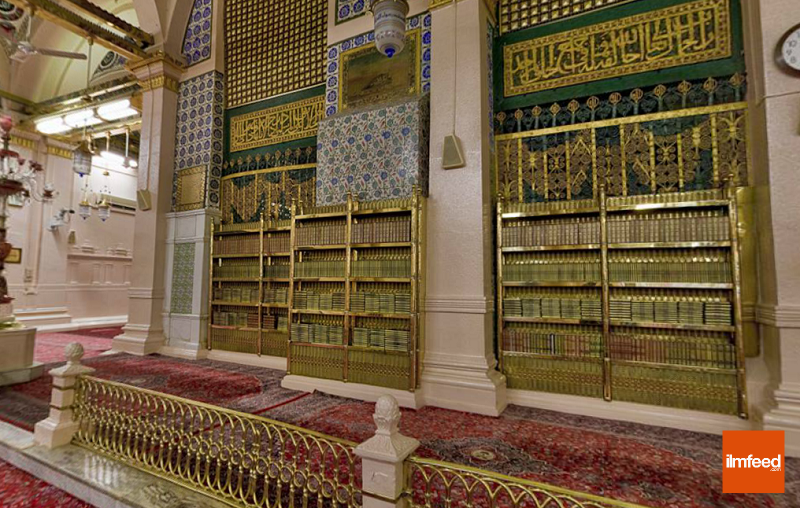
Ustuwaanah Tahajjud

mihrab tahajjud location

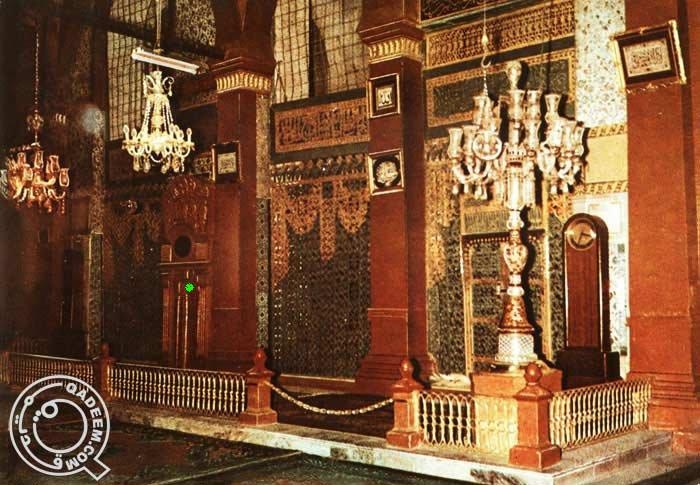
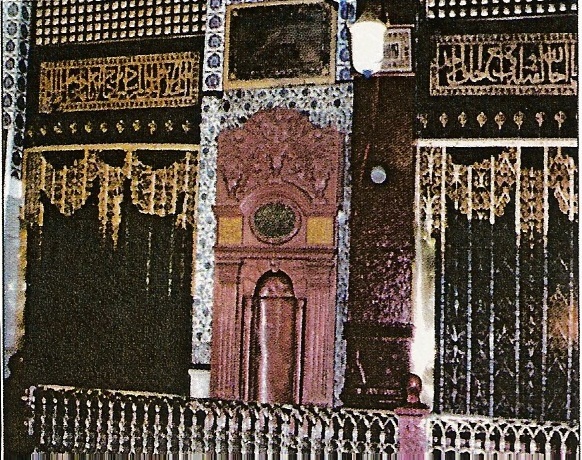
It is reported that this was the spot where late at night a carpet was spread for the Prophet  to perform tahajjud prayer after the people had left. There used to be a niche at this place to indicate the Prophet’s ﷺ place of performing Tahajjud but it has now been hidden with a bookcase as you can see above.

These historical photos show what is hidden behind the bookcase:

mihrab tahajjud old

mihrab tahajjud old 2

report post quote code quick quote reply
+1 -0Like x 1
back to top