Please share any good detailed works of senior Ulama on this subject.
I am primarily looking for situations when some spending would be israaf and when it will not be considered as israaf, and also to know when one is being extreme in not. spending.
@Maulana Yaani jazakumullahu Khair.l this issue was being discussed in the Madrassa and one student said that it depends from person to person.. ( she could have been wrong ) but then when a teacher was asked about this issue she said if a person can easily afford 4 cars.. he can keep them because he can easily afford it.. whereas a person who cannot afford much then he should keep only one car.. ( it is very difficult to type with this colour of text I.e. white)
If a person can afford it and buys a luxury car proportionate to his/her assets then it's not considered Israaf. If the same person buys a really really cheap car thereafter and there's no need for it (usually the "just in case" scenarios) where it just sits there for years then that's Israaf even though it's affordable. At the same time, even if affordable, even the first car can be Israaf if there's extravagance.
If another person buys that same luxury car because they need a car and they go in debt because of it then it's not just Israaf, it's stupidity and Haraam in some cases if they have responsibilities of family etc. For this person, Israaf would be buying two cheap cars within budget when only one is needed.
Abdullah ibn Amr reported: The Messenger of Allah, peace and blessings be upon him, passed by Sa’d while he was performing ablution. The Prophet said, “What is this extravagance (saraf/wasting)?” Sa’d said, “Is there extravagance with water in ablution?” The Prophet said, “Yes, even if you were on the banks of a flowing river.”
So accordingly, if by a flowing river then it's "affordable" (in terms of amount of water available) but the advice is still not to waste above necessity classed as "Saraf" - extravagance
Other common Israaf which is common amongst Indian womenfolk (may also apply to others)
- Buying something just because it's on offer
- Stocking up because something is really cheap not considering the expiry, needs and whether it will all be used.
- Buying a new pair of occasional wear clothing for "every" occasion.
- Buying expensive (even if affordable) under pressure for "show" when there's no need
- Buying the latest model phone every time it's released when the previous one is sufficient (if anyone is guilty of this, please don't admit it on the forum)
Israaf is not just in spending... for example Israaf would also be driving at high revs consuming more petrol than required, not extracting all the food from the cooking pots before putting them in the sink, ordering more than what can be eaten at restaurants as we know what happens to that food after etc. etc.
Then there's misconceptions on Israaf:
Buying something of quality over something cheaper even though they both do the same job. If longevity is considered then it's not Israaf, if the make, model and name of item is looked at then it is Israaf.
"And waste not by extravagance. Verily, He (Allaah) loves not Al-Musrifeen (those who waste by extravagance)." (Soorah al-An'aam, 6:141)
Mufti Muhammad Shafi رحمه الله comments,
"That is, do not spend beyond limits because Allah سبحانه و تعالى does not like wasteful spenders. A question arises here. In case a person spends everything he has in the way of Allah سبحانه و تعالى, his wealth, even his life, this cannot be called 'Israf (extravagance). In fact, it would be difficult to say that, even by having done all that, one can be sure that he or she has done what was really the due of Allah! Then, what does this prohibition of 'Israf or extravagance at this place really mean? The answer is that extravagance in one department of life usually causes shortfall, shortcoming or deficiency in other departments. One who spends extravagantly to fulfill his desires generally ends up failing in his duty to fulfil the due rights of others. Prohibited here is this kind of shortcoming. It means that should a person give away whatever he has in the way of Allah سبحانه و تعالى and return with empty hands, how is he going to fulfill the rights of his children, family and relatives, even those of his own self? Therefore, the rule of guidance given is that one should observe moderation even when spending in the way of Allah سبحانه و تعالى so that all due rights can be taken care of." (Ma'afirul Qur'an)
Mufti Menk mentioned in a lecture that there are two issues here: quality and quantity. If one had the means and he were to buy a high quality expensive product, then as long as he is fulfilling his obligations of paying zakah, sadaqah, etc, this would be permissible. But if a person were to buy far more of something than he needed, even if the products were much lesser in value, this would be wasteful and not permissible.
"O Children of Adam! Take your adornment while praying and going round the Ka'bah, and eat and drink but waste not by extravagance, certainly He (Allah) likes not Al-Musrifeen (those who waste by extravagance)." (Sooratul A'raaf, 7:31)
Mufti Muhammad Shafi رحمه الله comments, "The last sentence of the verse, 'But waste not by extravagance,' proves that eating and drinking is, no doubt, permissible - in fact, it is an order - but, along with it, being extravagant while doing so is prohibited. Israaf means to cross the limit. Then, the crossing of limits takes many forms. One of them is to cross the limits of Halaal and land into the are of Haraam, that is, one starts eating and drinking things which are prohibited. That this is Haraam is all to obvious.
Another aspect is that one starts taking what Allaah has made Halaal and abstains from it as being Haraam without any valid legal excuse as admitted by the Sharee'ah of Islaam. It should be understood that the way it is a crime and sin to use what is Haraam, similarly, taking the Halaal as Haraam is also a rebellion against Divine Law and a very grave sin. (Ibn Katheer; Mazhari; Roohul Ma'aani)
On the same analogy, eating and drinking beyond the limits of hunger and need is aso what Israaf or extravanagnce is. It is for this reason that Muslim Jurists (Fuqahaa') have written that eating more than needed to remove hunger is not permissible. (Ahkaam al-Qur'aan) (Ma'aariful Qur'aan) End quote.
Scholars have divided consuming food into five categories:
The first category is that which is obligatory. This is the amount of food that it takes for one to survive and maintain himself.
The second category is that food for which one will also receive a reward for eating. This is the food that is specifically consumed with the intention that it will give one the strength needed to perform acts of worship and so forth.
The third category is the permissible food which is beyond the first two categories.
The fourth category is that of disapproval, where the person eats more than what he needs to satisfy and fill himself.
The fifth category is the forbidden level where one eats so much or such foods that he actually is physically harming his body and his ability to worship Allaah سبحانه و تعالى. (Commentary on the 40 Hadith of Imaam an-Nawawi رحمه الله)
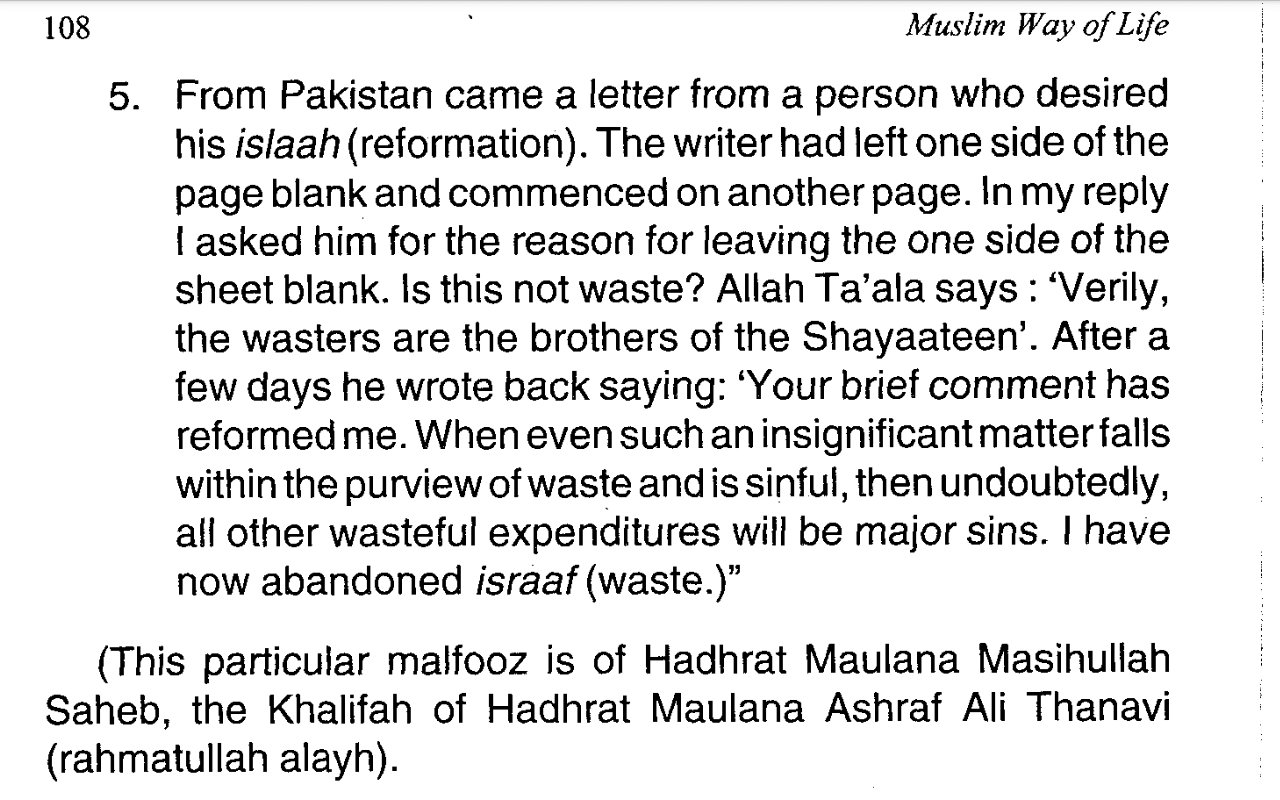
"Verily, spendthrifts are brothers of the Shayaateen (devils), and the Shaytaan (Devil - Satan) is ever ungrateful to his Lord." (Sooratul Israa;, 17:27)
Mufti Muhammad Shafi رحمه الله comments, The Qur'aan expresses the sense of spending wastefully through two words:
(1) Tabdheer [تبذير], 'squandering recklessly.'
(2) Israaf [اسراف], 'extravagance.'
Some commentators say that both words are synonymous. Any spending in sin or disobedience or a wrong occasion or place is called tabdheer and israaf. There are others who refine it by saying that tabdheer is spending in sin or on some totally unsuitable occasion or place, while israaf is spending beyond the level of need on an occasion where it is permissible to spend. Therefore, tabdheer is emphatically worse than israaf. Al-Mubadhdhireen (squanderers/spendthrifts) were called brothers of the Shaytaan and his cohorts.
Of the early tafseer authorities, Mujaahid رحمه الله has said: "'If someone spends everything he has for the sake of what is haqq, it is not tabdheer. And should he spend even one mudd for what is false, then it is tabdheer.' Sayyiduna Abdullaah Ibn Mas'ood رضي الله عنه said: 'Spending out of place in what one has not been obligated with is tabdheer.' (Mazhari)
Imaam Maalik رحمه الله said: 'Tabdheer is that one acquires wealth and property, lawfully and cleanly, as he has been obligated to do but spends it off in ways counter to it - and this is also given the name of israaf, which is haraam.'
Imaam al-Qurtubi رحمه الله said: 'As for things unlawful and impermissible, spending even one dirham for these is tabdheer. And spending limitlessly to fulfill permissible and allowed desires - which exposes one to the danger of becoming a needy beggar in the future - is also included under tabdheer. Yes, if someone keeps his real capital holding in tact and goes on to spend its profit liberally to fulfill his permissible desires, then, that is not incuded under tabdheer. (Ma'aariful Qur'aan)
"And those, who, when they spend, are neither extravagant nor niggardly, but hold a medium (way) between those (extremes)." (Sooratul Furqaan, 25:67)
Mufti Muhammad Shafi رحمه الله comments, Allaah's blessed servants are neither spendthrifts nor misers but they spend moderately. The word israaf and iqtaar are used in the verse for the two opposite traits.
Iqtaar means to spend with miserliness. In Islaamic jurisprudence it means to be tight fisted where a believer is directed to spend. In case one does not spend at all at a place where he has been directed to spend, then that is the worst situation. This explanation is given by Sayyiduna Ibn 'Abbaas رضي الله عنه, Qataadah رحمه الله, etc. (Mazhari)
Therefore, the message of the verse is that Allaah's blessed servants are neither spendthrifts nor misers but in the matter of spending they take the middle path. (Ma'aariful Qur'aan)
Senior teacher at Darul Uloom Karachi (Pakistan) Hadhrat Mufti Abdur Rauf Sukharvi [HA] - who is also a khalifa of Mufti Muhammad Shafi' Usmani [RH] - while covering Hakeemul Ummah Mawlana Ashraf Ali Thanvi's [RH] tremendous work "Hayatul Muslimeen" has lately been giving an on-going series of lectures on Israaf (wastefulness) and it's harms & different types. I would like to humbley recommend everyone who understands Urdu to listen to them. Mufti sahab is alhamdulillah giving a very balanced view. First I intended to write down notes of the lectures and post them here, but unfortunately I don't think I got the time for that (maybe someone else can volunteer). Here is the link...
A good luxury standard suit would cost 2000 rupees so it would be extravagant as the neighbours are going to sleep hungry in that country. A ten thousand rupee suit would be designer name standard which is copying the ways of the wasteful.
Other points to consider:
1.To own more than one car would me haram anyway, as by law you have to insure it and necessity demands that you pay the least amount of insurance and that only if it is necessary to own a car in the first place.
2.To spend out of order whilst others don't have food to eat in your neighbourhood.
3.Having a bmw as a luxury car should be enough, to own a lamborgini is going far over the top
Some time ago, I listened to a bayan of Hazrat Mufti Taqi Usmani sb db, in which he told about a sin, in which most of the religious people are involved, even more than those who are not very religious. Unfortunately that sin isn't considered a sin and after doing that sin people don't even realize that they have committed a sin and therefore they do not do tawba on that. And that sin is: (may be you can guess)
This cannot be undone and I am sure it will be greatly appreciated.
We apologise but you have been denied access to report posts in this thread. This could be due to excessively reporting posts and not understanding our forum rules. For assistance or information, please use the forum help thread to request more information. Jazakallah


 Posted via the Muftisays Android App