


As campaigning draws to a close on Tuesday, Maulana Anisur Rahman is sitting, cross-legged, inside his office in the Muslim pocket of Phulwari Sharif.
He is the general secretary of Imarat Shariah, an influential socio-religious institution working in the fields of education and welfare. And he has a busy 36 hours ahead.
Phulwari Sharif is located in the Pataliputra Lok Sabha seat, witnessing a fierce three-cornered contest between RJD's Misha Bharti, daughter of Lalu Prasad; BJP's Ram Kripal Yadav, who recently defected from RJD, and sitting MP Ranjan Prasad Yadav of the JD(U).
Polls are scheduled for Thursday.
Conventional political wisdom suggests that Muslims decide on their vote collectively and 'tactically', on the last day, and back the candidate best positioned to defeat the BJP.
But is it true? And how does it work?
"It is true that the single-most important agenda for Muslims today is to defeat Narendra Modi," says Rahman.
"But we do look at candidates, too."
There is a mixed demography in each constituency, he says. Pataliputra itself has over four lakh Yadavs, one-and-a-half lakh Koeris and Kurmis, a substantial Bhumihar population, as well as Dalits and Mahadalits.
Read: Maulanas endorse candidates, leave voters confused
"Of course, Muslims cannot decide the outcome an election on their own. In this seat, we are about a lakh and a half. I will start getting reports from villages by this evening and tomorrow about how different caste groups are voting. Are Yadavs pre-dominantly with Lalu or splitting three-ways? Where are Dalits voting?" Rahman says.
Only after ascertaining which candidate is placed where can they decide which way the Muslims should tilt to defeat the BJP, he says.
"So far, Lalu has successfully projected that he has a solid core base, and is the biggest challenge for the BJP."
Asked why Nitish had not been able to win the Muslim vote despite challenging Modi, he said, "He didn't have the time. Plus, Lalu has a better organisation. Many Muslims will go back to Nitish in the assembly elections, but this is for the Centre, where he is not seen as a player."
Rahman admits, though, that their influence should not be overestimated, and Muslims often choose not to go by the collective choice.
Read: Will Muslim votes make a difference in LS polls?
But if advice is sought, it is given. "With technology, mobile phones, etc, it is easy to spread the word for one candidate."
Rahman adds that phase-wise elections influence choices.
"In a day or two after polling, people will know who is winning, Assume Yadavs have split in this seat, we will know that in future contests, the community may go with Yadav candidates of BJP and JD (U). That will affect our decision in those seats."
As the conversation wraps, Shafrul Haq Khan of Rajabazar comes to give Rahman a thin pamphlet in Hindi and Urdu, on all that Nitish Kumar has done for Muslims.
"I will vote for Nitish irrespective of what others say," says Khan.
Driven by fears about a particular leader and party coming to power, Muslims will strategise and organise. But every single voter ultimately exercises his or her own choice.


He has been against congress for a while.
This is a breakaway faction of Deobandees called "Jamaat-e-Ulamah (Hind)" and not the historic "Jamiat-e-Ulamah (Hind)".
By Mumtaz Alam Falahi, TwoCircles.net,
Jamaat-e-Ulama-e-Hind. I fear you may be thinking that I am going to talk about Jamiat Ulama-i-Hind (JUH), the oldest Muslim organization in India. Sorry, read it again. It is a newborn, hardly two-month old organization appeared in the backdrop of the leadership dispute in JUH. Maybe to exploit the situation, or in its own imagination to capture the space to be vacated by JUH.
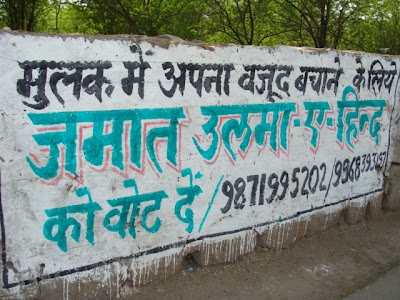
What makes this new organization suspect is its name that gives a sounding much similar to that of Jamiat Ulama-i-Hind. Do you want to confuse people with this name? “No,” says Sohaibuzzafar Khan Qasmi, the New Delhi-based man who is running the show. Why this name? “A tradition of Prophet Muhammad reads ‘yadullahe elal jamaah’ (Allah backs unity, organization). Besides, all members of the founding committee chose this name because such names are popular and well-accepted by masses,” says Sohaib trying to justify the name of his organization whose one-page website in Urdu holds Muslim leadership responsible for overall deterioration and sordid state of Muslims in India.
Sohaib harshly criticizes JUH and its leadership. “JUH is the only Muslim organization in the country which has its units in every district. JUH claims to be the sole representative of the Muslim community. They have a vast network. But what have they done for the community in the last 60 years? They have misused the network. They have used it for the destruction of the community,” alleges Sohaib whose purpose of launching an organization is yet to go down well with the community.
A news report today in the Urdu daily Hindustan Express, published from New Delhi, about Sohaib’s organization establishing its unit in Saharanpur (UP), reads, “Jamaat-e-Ulama-e-Hind which came into being to get benefit out of the dispute in Jamiat Ulama-i-Hind has established its unit in Saharanpur.” When I asked Sohaib what does he say about this qualification of his organization, he said, “We have no intention to exploit the JUH dispute.”
Are you recruiting those who have left JUH or are annoyed with the JUH leadership over this dispute? “We have not recruited a single person of JUH past because we think those people have lost their potential.” He says he is nominating young Ulema for leadership role. We have formed ad hoc committees and district committees in several states including Assam, Manipur, West Bengal, Bihar, UP, Uttaranchal and Maharashtra. None of the district leaders of this organization is from JUH, Sohaib claims.
What do you want to do which other organizations have not done? “The problems of the Muslim community have been exposed by the Sachar Committee. The Muslim organizations have not done to uplift the community which has a plethora of issues from illiteracy to health. We want to work on those fronts.”
Tall claims. Let’s visit the office of the organization which sounds determined to replace JUH. And let’s talk to people in the neighborhood of the man who negates any role played by JUH for the Muslim community in the last 60 years.
Located in a dingy lane of Walled City’s Daryaganj locality, the office hardly leaves one with any impression. It is open but no one to welcome you. A few dozen fat envelopes probably containing invitation for a meeting are scattered on the table. The landline phone on the table seems to be switched off because before going there I had ringed half a dozen times but got only message of it being switched off. Some bundles of big posters are also lying there.
A hakeem sb is sitting in his dispensary next to Sohaib’s office. Do you know about Jamaat-e-Ulama-e-Hind? “No,” he says. What do you know about Sohaibuzzafar Khan Qasmi? “I don’t know,” he continues without looking towards me, maybe he was unhappy with these questions. You will be surprised to know that this man later turned out to be father of the emerging “messiah” of the Muslim community. I came to know about it when I was talking to a tea vendor near Sohaib’s office in the lane.
I asked the same first question with the tea vendor. He showed ignorance. And he was looking honest but you cannot say this about his father. Do you see Ulema coming to the office? “I haven’t seen any group of such people. Yes, if a maulvi comes to my stall for tea, he (Sohaib) comes across, gets involved in talks and takes him to his office.”
A cloth shop owner in the lane is also ignorant about the “revolution” boiling in the kettle of Sohaib.
Guess, what is the entire drama for?


This cannot be undone and I am sure it will be greatly appreciated.
Please wait...

