Forum Menu - Click/Swipe to open
 

Tableeghi Jamaat: In the scale of Qur'aan & Sunnah

You have contributed 25.0% of this topic

Thread Tools
Appreciate
Topic Appreciation
abu mohammed, Naqshband66
Rank Image
Muadh_Khan's avatar
Offline
UK
11,902
Brother
342
Muadh_Khan's avatar
#1 [Permalink] Posted on 24th March 2013 17:32
report post quote code quick quote reply
+1 -0Disagree x 1
back to top
Rank Image
atifsayyed's avatar
Offline
dammam
4
Brother
0
atifsayyed's avatar
#2 [Permalink] Posted on 24th March 2013 18:36
Jazakallah Brother for sharing..
report post quote code quick quote reply
No post ratings
back to top
#3 [Permalink] Posted on 24th March 2013 21:38
atifsayyed wrote:
Jazakallah Brother for sharing..


Haven't shared it yet, please let me know any mistakes in it

Jzk
report post quote code quick quote reply
No post ratings
back to top
Rank Image
Desi tadka's avatar
Offline
Heavens Thunder is o
829
Brother
66
Desi tadka's avatar
#4 [Permalink] Posted on 25th March 2013 08:37

"Muadh_Khan" wrote:

Asslamo Allaikum,

Please don't forward this to anyone yet!

Kindly read it because we wrote it and then the formatting got corrupted (fonts, colors etc) so read it and inform me of any errors which can be corrected.

http://central-mosque.com/index.php/Civil/tableeghi-jamaat-in-the-scale-of-qur-aan-sunnah.html


Its already got 282 hits and we haven't even released it yet!

Jazakullah Khairun

JazakAllah Khair.

This is one of the proofs among billions that Allah rabbul izzat can take the work of Deen from anyone just about anyone - something I've learned and seen with my own eyes in tabligh.

May Allah grant you ikhlaas, isteqamatt and aafiyatt. Ameen.


report post quote code quick quote reply
No post ratings
back to top
Rank Image
Muadh_Khan's avatar
Offline
UK
11,902
Brother
342
Muadh_Khan's avatar
#5 [Permalink] Posted on 25th March 2013 09:47
report post quote code quick quote reply
No post ratings
back to top
Rank Image
Muadh_Khan's avatar
Offline
UK
11,902
Brother
342
Muadh_Khan's avatar
#6 [Permalink] Posted on 25th March 2013 10:22

Asslamo Allaikum,

Second Correction (request for addition):

ObjectIon: Tableeghees are grave worshippers because they bury their elders inside the Masjid!

Response: Bangla Wali Masjid (Present Tableeghi Markaz) was on the edge of town and in the middle of nowhere when Maulana Ilyas Kandhalwi (RA) was buried and when Maulana Yusuf Kandhalwi (RA)was buried it was still a tiny place and in the middle of nowhere. Due to population expansion and natural expansion of Delhi and expansion of the Markaz this is not in the courtyard, it isn't inside the Masjid at all

The situation is very similar to the explaination given by Shaykh Ibn Baz (RA) about the Prophet's grave:

There is a specious argument put forward by those who worship graves, namely the fact that the grave of the Prophet (peace and blessings of Allaah be upon him) is in his mosque. The answer to that is that the Sahaabah (may Allaah be pleased with them) did not bury him in his mosque, rather they buried him in the house of ‘Aa’ishah (may Allaah be pleased with her). When al-Waleed ibn ‘Abd al-Malik expanded the Mosque of the Prophet (peace and blessings of Allaah be upon him) at the end of the first century, he incorporated the room into the mosque, but he did wrong thereby, and some of the scholars denounced him for that, but he believed that there was nothing wrong with it for the sake of expanding the mosque. 

It is not permissible for a Muslim to take that as evidence that mosques may be built over graves, or that people may be buried inside mosques, because that goes against the saheeh ahaadeeth, and because it is a means that may lead to shirk by associating the occupants of the graves in worship with Allaah.  End quote. 

Majmoo’ Fataawa al-Shaykh Ibn Baaz, 5/388, 389.

More research needed from someone who has been to Nizamud-deen Markaz as I have heard:

  1. Graves are outside the Masjid
  2. Inside a separate area cordoned off
  3. People are not allowed inside
report post quote code quick quote reply
No post ratings
back to top
Rank Image
Muadh_Khan's avatar
Offline
UK
11,902
Brother
342
Muadh_Khan's avatar
#7 [Permalink] Posted on 25th March 2013 10:30

Asslamo Allaikum,

Third Correction (request for addition):

Expand the issue of 40 days and 3 days read the following urdu research produce the original Arabic and translate as necessary

report post quote code quick quote reply
No post ratings
back to top
Rank Image
Muadh_Khan's avatar
Offline
UK
11,902
Brother
342
Muadh_Khan's avatar
#8 [Permalink] Posted on 25th March 2013 10:30

Asslamo Allaikum,

Third Correction (request for addition):

Expand the issue of 40 days and 3 days read the following urdu research produce the original Arabic and translate as necessary

report post quote code quick quote reply
No post ratings
back to top
Rank Image
Muadh_Khan's avatar
Offline
UK
11,902
Brother
342
Muadh_Khan's avatar
#9 [Permalink] Posted on 25th March 2013 10:58

Asslamo Allaikum,

Fourth Correction (request for addition): Tableeghi Jamaat: Why do they prioritise and concentrate on Muslims?

Add:

  1. [4:136]
  2. [49:14]
  3. It is arrested on the authority of Anas b. Malik that the Prophet (may peace and blessings be upon him) observed: one amongst you believes (truly) till one likes for his brother or for his neighbour that which he loves for himself. [Muslim]

Make the argument Sunnah based instead of logic based...
 

report post quote code quick quote reply
No post ratings
back to top
#10 [Permalink] Posted on 25th March 2013 13:50
Muadh_Khan wrote:
Asslamo Allaikum, Fourth Correction (request for addition): Tableeghi Jamaat: Why do they prioritise and concentrate on Muslims? Add: [4:136] [49:14] It is arrested on the authority of Anas b. Malik that the Prophet (may peace and blessings be upon him) observed: one amongst you believes (truly) till one likes for his brother or for his neighbour that which he loves for himself. [Muslim] Make the argument Sunnah based instead of logic based...  


Hadith of bukhari, dua after athaan, allahuma rabba hathi dawatit taamaa.

Athaan is perfect dawah and it is for muslims, and not just for any ordinary muslims but for those who pray FIVE times a day!
report post quote code quick quote reply
No post ratings
back to top
#11 [Permalink] Posted on 25th March 2013 13:52

"Muadh_Khan" wrote:
Asslamo Allaikum, Second Correction (request for addition): ObjectIon: Tableeghees are grave worshippers because they bury their elders inside the Masjid! Response: Bangla Wali Masjid (Present Tableeghi Markaz) was on the edge of town and in the middle of nowhere when Maulana Ilyas Kandhalwi (RA) was buried and when Maulana Yusuf Kandhalwi (RA)was buried it was still a tiny place and in the middle of nowhere. Due to population expansion and natural expansion of Delhi and expansion of the Markaz this is not in the courtyard, it isn't inside the Masjid at all The situation is very similar to the explaination given by Shaykh Ibn Baz (RA) about the Prophet's grave: There is a specious argument put forward by those who worship graves, namely the fact that the grave of the Prophet (peace and blessings of Allaah be upon him) is in his mosque. The answer to that is that the Sahaabah (may Allaah be pleased with them) did not bury him in his mosque, rather they buried him in the house of ‘Aa’ishah (may Allaah be pleased with her). When al-Waleed ibn ‘Abd al-Malik expanded the Mosque of the Prophet (peace and blessings of Allaah be upon him) at the end of the first century, he incorporated the room into the mosque, but he did wrong thereby, and some of the scholars denounced him for that, but he believed that there was nothing wrong with it for the sake of expanding the mosque.  It is not permissible for a Muslim to take that as evidence that mosques may be built over graves, or that people may be buried inside mosques, because that goes against the saheeh ahaadeeth, and because it is a means that may lead to shirk by associating the occupants of the graves in worship with Allaah.  End quote.  Majmoo’ Fataawa al-Shaykh Ibn Baaz, 5/388, 389. More research needed from someone who has been to Nizamud-deen Markaz as I have heard: Graves are outside the Masjid Inside a separate area cordoned off People are not allowed inside

Well, iv been there, the grave is not even in the direction which you face while praying, it is behind the masjid and 99% of people would not even know that it is actually there.

report post quote code quick quote reply
No post ratings
back to top
#12 [Permalink] Posted on 25th March 2013 13:57
Muadh_Khan wrote:
Asslamo Allaikum, Fourth Correction (request for addition): Tableeghi Jamaat: Why do they prioritise and concentrate on Muslims? Add: [4:136] [49:14] It is arrested on the authority of Anas b. Malik that the Prophet (may peace and blessings be upon him) observed: one amongst you believes (truly) till one likes for his brother or for his neighbour that which he loves for himself. [Muslim] Make the argument Sunnah based instead of logic based...  


Plus the ayah of surah wathaariyaat I.e. wathakkir finna thikra tanfa ul mu'mineen.
report post quote code quick quote reply
No post ratings
back to top
Rank Image
xs11ax's avatar
Unspecified
3,243
Brother
2,561
xs11ax's avatar
#13 [Permalink] Posted on 25th March 2013 14:11
Muadh_Khan wrote:
More research needed from someone who has been to Nizamud-deen Markaz as I have heard: Graves are outside the Masjid Inside a separate area cordoned off People are not allowed inside


salaam

as far as i can remember the graves are next to the main prayer hall in a separate section. the section is walled off but the graves can be seen through gaps (maybe decorative gaps) in the wall. from what i have seen people tend not to regard the graves at all and there is definitely no grave worship or over veneration taking place.

someone also pointed out that had the graves not been within the confines of the markaz then all manner of bidah and shirk would have taken place around the esteemed hazraat (r), just like it has around the grave of Hazrat Nizammuddin (r). so it actually turned out to be a good thing.
report post quote code quick quote reply
No post ratings
back to top
Rank Image
Muadh_Khan's avatar
Offline
UK
11,902
Brother
342
Muadh_Khan's avatar
#14 [Permalink] Posted on 25th March 2013 15:34

"xs11ax" wrote:
"Muadh_Khan" wrote:
More research needed from someone who has been to Nizamud-deen Markaz as I have heard: Graves are outside the Masjid Inside a separate area cordoned off People are not allowed inside
salaam as far as i can remember the graves are next to the main prayer hall in a separate section. the section is walled off but the graves can be seen through gaps (maybe decorative gaps) in the wall. from what i have seen people tend not to regard the graves at all and there is definitely no grave worship or over veneration taking place. someone also pointed out that had the graves not been within the confines of the markaz then all manner of bidah and shirk would have taken place around the esteemed hazraat رضي الله عنه, just like it has around the grave of Hazrat Nizammuddin رضي الله عنه. so it actually turned out to be a good thing.

Excellent point, didn't think of that

Jazakullah Khairun

report post quote code quick quote reply
No post ratings
back to top
Rank Image
Muadh_Khan's avatar
Offline
UK
11,902
Brother
342
Muadh_Khan's avatar
#15 [Permalink] Posted on 26th October 2013 16:34

An objection about a poem mentioned in fadhail e durood

Question:

An objection about a poem mentioned in fazaile durood has been raised by a brother. The poem says :

Raha jamaal pe tera hijab e Bashriyat
Najana kaun hai kuch bhi kisine Juz e Sattar’

“Your beauty had been under the veil of mortality/humanity,
No one was able to identify who was the ‘Juz-e-Sattar’ (Branch/Part of Sattar)”


In the above poem, the author said that the Prophet (Peace be upon him) was under the veil of humanity.

That is the Prophet (Peace be upon him) was in reality Allah who came to earth as a human being.

In the second line, he says that the Prophet (Peace be upon him) was part/branch of Allah (Sattar).

If this is not shirk, what else is shirk? If other religions say that Allah came to earth as human, what we say about that belief….

Above were his comment. as i dont know urdu, if you shed some light it will help a lot.

Answer:

In the Name of Allah, the Most Gracious, the Most Merciful.
As-salāmu ‘alaykum wa-rahmatullāhi wa-barakātuh.

The quoted section is taken from the last qaseedah of Hadhrat Maulana Qasim Nanotwi rahimahullah reproduced in Fadha’il Durood of Hazrat Sheikh Zakariyyah rahimahullah. Here is the scan of the particular part.
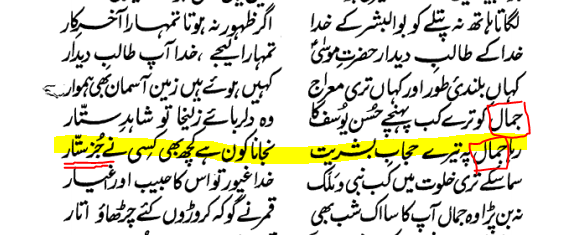
beauty of rasulullah - qaseeda qasimi from fazail durood 2

I have taken the liberty to highlight the specific portions.

Now, let us see the contention and then answer it.

Issue 1: The claimant has contended that the statement “Raha jamaal pe tera hijab e Bashriyat” is talking a the dhaat of Rasulullah salallahu alayhi wasallam. If that were not the case, he would not have commented on it by saying “In the above poem, the author said that the Prophet (Peace be upon him) was under the veil of humanity.” Of course, that is not what the author said. The author said that “the beauty of the Prophet (Peace be upon him) was under the veil of humanity.” Such a statement is nothing controversial. Allama Ibrahim ibn Muhammad Bajuri rahimahullah (1277h) in his famous Sharah on Al Shamail Al Muhammadiyyah has mentioned,

“It has be explicitly mentioned that from the perfection of one’s Imaan is to have I’tiqad that the beautiful apparent qualities never gathered in a body of a human to the level that gathered in the body of Rasulullah salallahu alayhi wasallam, and along with that too, his (i.e Rasulullah salallahu alayhi wasallam’s) full beauty never became apparent, otherwise no eye had the ability to see it.” (pg. 37)

The couplet that preceded the one quoted also indicates that the author is exemplifying the quality of beauty. Otherwise there was no need to compare the beauty of Sayiduna Yusuf alayhisalam with that of Rasulullah salallahu alayhi wasallam. Hence there is nothing qabeeh in the first part of this couplet “Raha jamaal pe tera hijab e Bashriyat

Issue 2. The claimant has also contended with the second sentence of the couplet, “Najana kaun hai kuch bhi kisine Juz e Sattar’“, and then contended that it means “No one was able to identify who was the ‘Juz-e-Sattar’ (Branch/Part of Sattar)”.

My response is that this translation is grossly biased to say the least. In order to correctly translate, allow me to give three words and their respective meanings.

word 1: Juz’ / جزء : This is an arabic word. The translator has confused the original word جز of urdu with جزء of arabic. Juz’ means a part, or a portion. Below is the page from the arabic to english dictionary called Hans Wëhr, Pg. 146

juz- arabic hanswher pg146

word 2: Juzw / جزو: Juzw is the urdu equivalent of the arabic جزء. The claimant could not strike this difference between the arabic word and the urdu term. Below is the pertinent scan from Ferozul Lughat Pg 458.
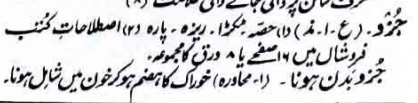
juzw ferozul lughat pg 458

word 3: Juz / جز : Juz is an urdu word  which is an abbreviation of the second word Juzw above. However, it is not only an abbreviation of juzw, rather is also a Persian word Juz. This is why it has multiple meanings. While being an abbreviation of juzw, one of its meaning is indeed “part or portion”, but at the same time it also carries a primary meaning from its Persian origin meaning “besides/Except”. This meaning can be corroborated in both urdu and persian dictionaries. The Pg. 458 of Ferozul Lughat mentions:

 juz ferozul lughat pg 458

Hence, both meaning are ascribed to it. The primary Persian meaning can be checked in Persian dictionary. You may use one of the dictionaries available here : Click Here

Or see here for search result on the Juz : Click Here

Response: Considering the meanings of the word, the appropriate meaning of the second line should be:

“No one came to know , who he really was except Allah “

Or more contextually it would be:

“No one knew the extent of his beauty, except Allah”

With this meaning, the statement is a continuation of expounding the beauty of Rasulullah salallahu alayhi wasallam. Makhluq was not able to encompass the real beauty of Rasulullah salallahu alayhi wasallam, then who shall really harness the reality of his beauty besides the creator who created Rasulullah salallahu alayhi wasallam.

One begs the question, why would one choose a meaning and reconstruct a sentence which would render the author mushrik? Why not adopt a meaning which is contextual to the language, poetry and befitting the aim of the poetry itself. The entire poetry is expounding the grandeur of Rasulullah salallahu alayhi wasallam.

Just imagine! Allah Ta’ala says in the Qur’an:

وَنَفَخْتُ فِيهِ مِنْ رُوحِي
[الحجر: 29]

وَنَفَخْتُ فِيهِ مِنْ رُوحِي
[ص: 72]

…and breathed into him my soul…

Do we really attribute the Ruh blown into Adam alayh salam to be part of Allah’s soul, while the wording of the quran apparently suggest that? If that is the case, then why go out of the way to establish a meaning of Juz as a part of Allah, instead of opting for the academically sound meaning of besides/except, rendering the statement void of any problems.

And Allah Ta’āla Knows Best

Mufti Faisal bin Abdul Hameed al-Mahmudi
www.fatwa.ca

report post quote code quick quote reply
+2 -0
back to top