Make Qur'an supportive in all scientific research, says Princess Hessa
By ARAB NEWS Published: Mar 7, 2012 01:10 Updated: Mar 7, 2012 01:10
RIYADH: Princess Hessa bint Salman, daughter of Defense Minister Prince Salman, hoped her father's vision for the Holy Qur'an is realized.
"His vision was that Qur'an should not be confined only to discussion, but to be an approach for a comprehensive study of jurisprudence science and religion," Princess Hessa said.
At the closing session of the 14th ceremony of Prince Salman Contest for Memorization, Recitation and Interpretation of the Qur'an for Girls, the princess told Arab News that Prince Salman Contest allows women participation in all spheres, as the future participation in the Saudi Shoura Council comes as a breakthrough.
"The support of the Custodian of the Two Holy Mosques for women to enter the Consultative Council is a surprise that transcends women driving cars," Princess Hessa said.
The princess also hoped to see women defending and pleading in courts. She called on the winners to not only memorize the Qur'an, but also to make it supportive in their research in all scientific fields. The princess said sponsoring this event is a pleasure for her. She expressed her happiness for the winners and appealed to Allah to light up their ways in this world and the hereafter.
She said, "Qur'an is not for memorizing only, but for applying its rules in our daily life."
Deputy Minister of Education for Girls Affairs Norah Al-Fayez, said, "This is the harvest of the efforts of Prince Salman's care for the Qur'an and its people." She said: "The Qur'an Memorizing Contest is the outcome of the interest of Prince Salman."
She praised Princess Hessa as a descendant of a religious family that cares very much for the Qur'an and its students.
Fifteen girls won prizes valued about SR554,046. The winners of the contest expressed their happiness at the patronage of Princess Hessa. They said "caring for the Qur'an increased in the last few years."
Asma'a Al Sa'doun, a winner, said, "The class that used to contain 25 students now contains 36. This means the increasing interest in the Qur'an and learning its sciences, and that reflects the mentality and intellectual thinking of today's girls."
Dr. Hana'a Al-Motawa, assistant professor of jurisprudence at Princess Nora bint Abdul Rahman University, said, "There are many mothers who let their children take part in this kind of contests that raise the faith in their hearts."
She added, "This contest is an opportunity for girls looking and competing for good deeds."
One of the winners, Sumayah Al-Harby, said, "Memorizing the Qur'an is not only improves personality but also teaches you how to manage and organize your time...Participating in this contest is a great honor whether I won or not."
Raghad Al-Sa'doun, a second grade student, said, "I memorized 22 parts of the Qur'an, and I hope to be one of the winners. .. to be in a Qur'an school made me organize my time much better than before."
Prince Salman Award for Qur'an Memorization aims to project the care of the Kingdom for the Qur'an and the people memorizing it. The prize is divided into 5 categories: First, memorizing the whole Qur'an with recitation and interpretation; second, memorizing the whole Qur'an with recitation only; third, memorizing 20 parts of the Qur'an with recitation; fourth, memorizing 10 parts of the Qur'an with recitation; and finally, memorizing 5 parts of the Qur'an with recitation. The value of the contest's prizes is more than SR1 million.
Peddlers use a van to store their wares in a Madinah neighborhood. (AN photo by Yusuf Muhammad removed)
By MADINAH: YOUSUF MUHAMMAD ARAB NEWS STAFF
Published: Mar 8, 2012 00:36
Residents of Al-Masanie districts in Madinah have complained that their residential quarter was swamped with wrecked cars. Peddlers used these cars as warehouses for their goods.
"The wrecked cars have fearfully spread in our district. Usually peddlers stack their goods in these cars just before sunset. Not only do these cause congestion but they also create an uncivilized scene," said Ahmed Al-Hussein, a resident.
Muhammad Al-Jabri, another resident, said the peddlers rent most of these old cars at SR300 a month. "The peddlers share the rent price and save a lot of money in the process," he said.
Resident Hussein Faheem said the peddlers shift their activities close to the wholesale shops in the district to buy their goods and store them in the old cars for the next day.
Mustapha Hameed said he asked the municipality several times to tow these away, but there was no response. "The old cars have become a real threat to the health and personal safety of the residents," he said.
Most of the old cars are vans, used to transport goods. They were parked in front of people's homes, even though the municipality has marked them as obsolete cars, which should be dumped.
To mislead the municipality and protect the cars against towing, the peddlers write the names of various fake companies on the cars. They also shade the window, so people cannot see what is inside.
When I was in Makkah the first time in 1995, I was doing Maghrib Salah on the roof in the first row and had my eyes on the Ka'bah, when all of a sudden there was a breeze that passed us and all of a sudden the Kiswah (cloth of the Ka'bah) started to wave around thumping backwards and forwards against the Ka'bah, and then from the middle of nowhere a small sand storm passed through the Haram.
It was so scary, yet so pleasing to have the thought in the mind that my life is over and I'm in front of the Ka'bah in Salah, what more could I ask for. Then suddenly it stopped and went away. Disappointed to be alive and at the same time overjoyed. SubhanAllah.
Can you imagine all the verses of the Quran that would be running through your head at that moment, specially if your an Arab and understand the Quran.
Published: Mar 9, 2012 01:08 Updated: Mar 9, 2012 01:08
As many as 439 Saudis and 682 expatriates tested HIV positive in 2010, Alsharq Arabic daily reported yesterday, quoting latest Health Ministry figures. This brings the total number of people affected by AIDS in the Kingdom to 16,334 as of the end of 2010.
The paper also quoted Dr. Ahmed Muhammad Kanaan, head of the department for combating contagious diseases in the Eastern Province, as saying that annual expenditure for the treatment of a single AIDS patient could reach $50,000 because medication is costly.
The report also revealed 93 percent of HIV cases in the Kingdom spread through sexual relations. Taking drugs using syringes was another major reason for the spread of this deadly disease in the country.
Of the total number of AIDS cases reported in the Kingdom, 4,458 were among Saudis and 11,876 among expatriate workers. About 10 percent of AIDS cases have been found among Saudis in the Eastern Province, the paper pointed out.
Kanaan said the treatment of AIDS is expensive as patients have to purchase costly medicine throughout their lives. "Medical treatment cannot achieve a complete cure. It can only reduce the symptoms," he said. Research work is in progress to find a complete cure for the disease.
Kanaan said there was little possibility of the HIV virus being transferred through blood transfusions as the blood is only taken from donors after stringent tests are conducted. AIDS will not spread by dining together or shaking hands with a patient. Advanced devices have been developed to detect AIDS cases quickly and correctly.
Dr. Khaled Mirghalani, spokesman of the Health Ministry, said his ministry has been providing necessary medical care and moral and material support to AIDS patients and their families. "We have established 20 centers across the Kingdom to provide medical advice and counseling to patients. In addition there are five mobile centers and free diagnosis centers in Riyadh, Madinah, Dammam and Jazan," he added.
Sociologist Salma Al-Ali said lack of awareness was the main reason for the spread of AIDS in the Kingdom. "Many people do not know how this disease transfers from one person to another. Many people get a big shock when they are diagnosed with HIV. They usually carry out blood tests several times to make sure the report is correct. Some people try to commit suicide while others try to spread the disease to take revenge," she pointed out.
Al-Ali said AIDS patients required mental and social support. "I know a woman who tried to commit suicide when she became pregnant carrying her first baby while infected. She got the virus through her husband."
One 17-year-old girl admitted that she got the disease as a result of illicit sexual relations with a friend. "My parents have died and I am living with my brother's family. They have kept me in a single room without allowing me out, except for going to hospital. They will not allow me to eat with them. I have thought several times about committing suicide."
Another woman said she contracted the disease from her husband. "My husband died seven months after he tested HIV positive. I am still living. In my case the disease was not that serious and it seems in a dormant stage. Although I had tried for jobs, employers denied me jobs when they found out that I am an AIDS patient. I told my children that I was infected through my husband and not because of any illicit sexual relationship."
The paper also quoted a young Saudi man as saying that he got the disease through his relations with women. "I never thought I would get this disease and I had not taken any precautions," he said.
Ahmed Abdullah, deputy consul at the Saudi Embassy in New Delhi, said expatriate workers are allowed to enter the Kingdom after conducting necessary medical tests including for AIDS. These tests are conducted at authorized health centers approved by the Saudi Health Ministry. "The embassy will not deal with health centers that do not comply with the ministry's conditions," he told the paper.
Peace TV finalizes plan to launch 24-hour Arabic channel
Dr. Zakir Naik
By RIYADH: GHAZANFAR ALI KHAN, ARAB NEWS STAFF
Published: Mar 9, 2012 00:54 Updated: Mar 9, 2012 00:54
RIYADH: Internationally renowned scholar Dr. Zakir Naik, who is founder and president of the India-based Islamic Research Foundation (IRF), said in Riyadh yesterday that the IRF-owned Peace TV has finalized plans to launch a 24-hour Arabic-language Islamic channel.
"The Arabic channel, to air in mid-2013, will be dedicated especially for Arabic-speaking viewers around the world," said Naik.
Peace TV is a major Islamic satellite television network with a record global viewership exceeding more than 100 million.
Naik, who has delivered more than 1,500 public lectures across the world, including some 220 in Saudi Arabia alone, on comparative religion, said Peace TV Arabic channel would not be just another Islamic channel.
"There are more than 60 Arabic channels today but the Peace TV channel will be unique in content and technology," said the IRF chief.
Naik, who will inaugurate a branch and bookstore of Darussalam International Publications Company in Riyadh today, was felicitated at a dinner reception hosted in the capital on Wednesday night by Rashid Ali Sheikh, an Indian businessman and social worker.
Another reception in honor of this Islamic scholar, to be attended by a large number of diplomats, businessmen and Saudi as well as non-Saudi officials and guests, will be hosted by Abdul Malik Mujahid, Darussalam managing director, in the capital tomorrow.
Naik said he was happy to attend the opening ceremony of Darussalam branch in Riyadh. "Darussalam is probably the biggest publisher of Islamic books in the world," he added.
Entry to Darussalam's inaugural program at the Riyadh Avenue Mall (Lulu Hypermarket) is open to all. A raffle draw will be organized on the sidelines of the opening ceremony, said Mustafa Habib Siddiqui, Darussalam media manager.
Asked about the uniqueness of the proposed Peace TV's Arabic channel, the IRF chief added: "It will be far superior to existing channels."
The new channel will have access to the world's 300 million native Arabic speakers, he added. He said the new channel would be a respected global media outlet presenting Islam and removing misconceptions about Muslims and the Islamic world.
Asked about the popularity of the Peace TV programs, he said viewership is growing and his presence on the channels was about 17 to 18 percent in terms of airspace. He pointed out that Peace TV has had a large number of speakers and presenters, including many from Saudi Arabia and the Middle East. Sheikh Asim Al-Hakeem and Sheikh Ahmed bin Saifuddin, who have been associated with the channel for the last several years, are some of them.
Naik said he had no plans to deliver public lectures during this trip to the Kingdom. The Islamic scholar in his interview also spoke about the lawsuit he had filed against the UK government after it imposed an exclusion order on his visa/entry into the UK a couple of years ago. He also explained how his statements were often construed without any substance to be in favor of social persecution and for political action abroad.
Naik made it clear that he does not support any act of terrorism, but his Islamic speeches, especially when he criticizes Western powers for their interventions in the affairs of the Muslim countries, are often taken out of context to blame him as a supporter of "terrorism and extremism."
On the ban imposed by the UK since June 2010, he said the term "exclusion" means authorities will not grant him a visa to travel to the country. "But my books and reading materials are freely available in the UK," he added.
Naik, who earlier challenged his exclusion in a UK court, has approached the France-based European Court of Human Rights, which will now decide whether he will be allowed into the UK or not. Naik said he has never been prevented from entering any country in the past.
Naik's popularity can be gauged from the fact that "The Indian Express", one of India's top daily newspapers, listed him recently as the country's 89th most powerful person, ahead of Nobel Laureate economist Amartya Sen and eminent lawyer and former attorney general Soli Sorabjee.
The Islamic scholar said the IRF had planned to open two world-class international Islamic schools in Riyadh and Jeddah. These schools will be run based on the model of his Mumbai-based school, he noted.
Far more Christian than Muslim migrants worldwide: Study
By TOM HENEGHAN | REUTERS
Published: Mar 9, 2012 04:00 Updated: Mar 9, 2012 04:06
PARIS: Christians far outnumber Muslims as migrants around the world, including in the European Union where debates about immigration usually focus on new Muslim arrivals, according to a new study issued on Thursday.
Of the world's 214 million people who have moved from their home country to live in another, about 106 million (49 percent) are Christians while around 60 million (27 percent) are Muslims, the study by the Pew Forum on Religion and Public Life said.
Only 3.6 million Jews around the world have moved across international borders, the study said, but that is 25 percent of the world's Jewish population, by far the highest proportion on the move of any faith group.
"Many experts think that, on the whole, economic opportunities - better jobs and higher wages - have been the single biggest driver of international migration," it said.
"At the same time, religion remains a factor in some people's decisions to leave their countries of birth and their choices of where to go."
The study defined migrants as people living in another country in 2010 for over a year, including estimates of illegal immigrants and long-term refugees including Palestinians and their descendants.
"Perhaps contrary to popular perception, ... Christian immigrants outnumber Muslim immigrants in the European Union as a whole," the report said, indirectly referring to far-right parties that have long campaigned against Muslim newcomers.
Of the 47 million migrants in the EU, 26 million (56 percent) are Christians, double the 13 million Muslim migrants, who make up only 27 percent of the total, it said.
The gap narrows when intra-EU migration - for example, Christian Greeks to Germany or French-born Muslims to Britain - is excluded, but Christians migrating from outside the EU still outnumber non-EU Muslim migrants by about 13 million to 12 million.
Christians head for USA, Muslims to KSA
The United States is the leading destination for Christian migrants, who account for 32 million (74 percent) of its 43 million-strong foreign-born population. Two-thirds of them are from Latin America.
"The United States has received about as many immigrants from Mexico alone (more than 12 million, including both legal immigrants and unauthorized ones) as any other nation has received from all sources combined," the study said.
The US is also the world's top destination for Buddhists, many from Vietnam. "About five percent of US immigrants are Muslims, a much lower share than in Europe," it added.
Saudi Arabia is the top destination for Muslim migrants, mostly workers from other Arab countries, the Indian subcontinent, Indonesia and the Philippines.
While nearly half of all Muslim migrants come from the Asia-Pacific region, the largest single group - over five million - is made up of migrants and their descendants from the Palestinian territories, the study said.
Israel takes in the most Jewish migrants, many of them from Russia and Ukraine, followed far behind by the US, Canada and Australia.
The United Nations estimates that about three percent of the world's population are migrants.
"If the world's 214 million international migrants were counted as one nation, they would constitute the fifth most populous country on the globe, just behind Indonesia and ahead of Brazil," the study said.
An apostate Saudi journalist who is believed to be facing execution for insulting Prophet Mohammed PBUH (Peace Be Upon Him) has repented at court and this means reduced sentence.
According to the Arabic language daily Sharq, Hamza Kashgari declared his repentance before the judge at the court in Riyadh.
"Kashgari declared his repentance and expressed regret for offending the Prophet (PBUH)....this means he will face a light sentence," the paper said, citing Kashgari relatives.
The 23-year-old man, who works for Albilad Arabic language daily, fled to Malaysia last month after King Abdullah ordered his arrest on charges of apostasy in an article he wrote on Twitter. A few days later, he was deported to the Kingdom and arrested on arrival.
Speculation mounted after his arrest that Kashgari could be executed following statements by a senior Saudi Muslim cleric that the writer would be sentenced to death for apostasy.
Sheikh Saleh bin Fowzan Al Fowzan, a member of the 7-man supreme committee of scholars in Saudi Arabia, said it has been established in Islam that any one who insults God or the Prophet should be killed.
"Repenting will not work...any man who insults God or our Prophet (PBUH) should be killed," he said. "But we should first verify that this man (Kashgari) did insult Prophet Mohammed in his article on Twitter...if verified, then he must be killed......many scholars and people are now demanding his execution."
Published: Mar 10, 2012 01:04 Updated: Mar 10, 2012 01:24
The Riyadh summarycourt has not endorsed the repentanceof HamzaKashghari and hiscommitment to Al-Shihadatain (La Illah Ila AllahMuhammad Rasoul Allah), Alsharq newspaper reported yesterday, quoting the president of the court Saleh Al-Asheikh.
"The case has not reached the court. It is not within our specialty. Maybe it has gone to another court. The sure thing is that we have not endorsed or documented the repentance," he said.
Kashghari is currently being detained in Al-Hair prison in Riyadh for his slanderous tweets against Islam and the Prophet Muhammad (peace be upon him). Local media reports on Thursday claimed that the 23-year-old Kashghari,who isa writerand columnist, had formally repented before the summary court in Riyadh on Tuesday during a session that was also attended by his father, mother, brothers and lawyer.
Kashghari fled thecountry after making the insulting comments against Islam and the Prophet on Twitter but was detained in Malaysia and deported to the Kingdom on instructions of Custodian of the Two Holy Mosques King Abdullah.Hewasflown to Riyadh airport on board a special plane.Hehasbeenin prison since then.
Abdul Rahman Allahim,Kashghari'slawyerrefused to deny or confirm the reports but a legal source said the case was not the concern of a summary court but a general court, which did not issue any comment on the case.
The source said the case would be subjectto the normal procedures of criminalcasesthatusually start with the arrest of the criminal, questioning at the Prosecution and Investigation Commission (PIC) and finally sending the person to court.
Former Deputy Chairman of the National Committee of Lawyers Sultan bin Zahim,who isa legal consultant, said the case would set a precedent in the Kingdom's judicial history and said it was being tackled by the PIC.
He said the judge in the case would ask the defendant to repent and would accept his repentance and give him a formal document to the effect when he was sure that the defendant was sincere and his intentions were good. "This, however, does not relievethe accused from the discretionary punishment which the judge will decideaftercarefully studying thecase," he said.
The legal consultantsaid the court ruling would be used if the defendant retracted his repentance. "In this case the accused will face capital punishment according to the Shariah rules," he explained.
for the first phase of a metro network in the holy city of Makkah
By MAKKAH: ARAB NEWS
Published: Mar 10, 2012 01:04 Updated: Mar 10, 2012 01:05
An amount of SR20 billion has been allotted for the execution of the first phase of a metro network in the holy city of Makkah, Mayor Osama Al-Bar announced yesterday.
"Work is currently going on in the blueprint of the project. Six months after that we will start signing contracts for the execution of the project," he told business daily Al-Eqtisadiah.
He said the network will cover all parts of Makkah and will facilitate transport to the city center and the Grand Mosque.
Al-Bar expected Makkah to attract investments of more than SR200 billion in the coming two years and said government and private development projects worth about SR100 billion were currently being implemented. "Makkah is a safe haven for investment," he added.
He said among others, the ongoing development projects in Makkah include the project of Custodian of the Two Holy Mosque King Abdullah for the development of the holy city, which was being directly financed by the Finance Ministry away from the budgets of the government departments concerned.
Al-Bar described King Abdullah's project as "pioneer and unprecedented" and said it was aimed at developing the basic infrastructure of the holy city in a limited period of time.
He explained that the project consists of axial and ring roads and transport stations. "A budget of SR23 billion has been allotted for the implementation of the first phase of the projects," he added.
The mayor said about 3,000 real estate units have been expropriated for King Abdullah's expansion of the Grand Mosque for which compensations of more than SR40 billion were paid.
He said the expropriated real estate was estimated at SR550,000 per sq. meter, which is equivalent to $18,000 per sq. foot. "This is among the highest rates in the world," he said.
King Abdulaziz Public Library present The Hajj New website : kapl-hajj.org
Hajj: Journey to the Heart of Islam
The Custodian of the Two Holy Mosques, His Majesty King Abdullah Bin Abdulaziz Al Saud has given directives to commence a major expansion of Al-Haram Mosque.
With this in mind, The King Abdulaziz Public Library, Riyadh, Saudi Arabia has launched an initiative to inform and update the global community of this ground breaking expansion project. As part of this initiative The King Abdul Aziz Public Library has partnered with the British Museum, London UK, to launch the "Hajj Exhibition - Journey to the heart of Islam"
The new kapl-hajj.org website www.kapl-hajj.org is a wider part of this initiative to provide information, news and updates as well as feedback from the global community on their personal experiences.
This website endeavours to provide a rich resource of text and media not only of the current work taking place but also of both historic and future plans of the Hajj expansion program, to provide pilgrims with a peaceful and safe spiritual journey to the heart of their Islam, the Hajj.
Very interesting website with beautiful pictures!
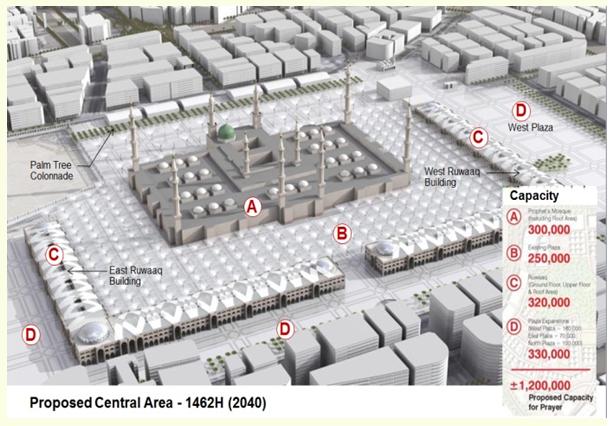
Expansion of the Prophet's Mosque
The Prophet Muhammad PBUH Throughout its history, the Prophet's Mosque built his mosque in the first year of Hijrah ( 622). The area at that time was 1030 square meters. In the seventh year of Hijrah the Prophet expanded the mosque to an area of 2475 square meters. The Prophetic Mosque has witnessed consecutive expansions during the caliphs and Islamic states afterwards.
The Prophetic Mosque has never seen an expansion greater than what the kings of Saudi Arabia. In 1948, during the reign of King Abdulaziz, the mosque was enlarged to cover a total area of 16,327 square meters. At the same time, repairs and renovations were carried out in the existing structure.
During the following decades, the mosque continued to be enlarged, until it reached its present surface area of 400,500 square meters with a capacity of 707,000 worshippers.
Care was taken during all these modern phases of expansion to preserve and renovate the existing older sections of the Prophet's Mosque, in order that they may form a harmonious whole with the new areas. The Prophet's Mihrab was restored, for example, and the pillars of the Rawdah and all the rest of the pillars of the earlier periods of construction were consolidated, and the mosque was outfitted with all modern needs and equipment.
The protective awnings
The Custodian of the Two Holy Mosques King Abdullah Bin Abdulaziz ordered the completion of the expansion project.
This included the addition of 68 awnings to the 182 awnings which provide shade in the externals areas of the Prophet's Mosque in order to protect the worshippers and visitors from the sun and rain.
The awnings were equipped with a system of rain water discharge, lighting and automatic opening and closing.
They are also designed in two different heights, so that the higher ones would cover the lower ones to form an integrated whole. When they are closed, the awnings are all 21 meters high. One of the unique features of these awnings is that they can be opened and closed automatically according to need. When they are all open, they cover an area of 144,000 square meters.
The awnings have endowed the open areas surrounding the Prophet's Mosque with a special beauty which is wholly in keeping with the atmosphere of peace, spirituality and sanctity which pervades the mosque and they enable more than 200,000 worshippers to carry out their devotions at any time of the day.
This cannot be undone and I am sure it will be greatly appreciated.
We apologise but you have been denied access to report posts in this thread. This could be due to excessively reporting posts and not understanding our forum rules. For assistance or information, please use the forum help thread to request more information. Jazakallah