
Jumuah at Masjid al Haram
8 February 2013


8 February 2013

You have contributed 0.4% of this topic


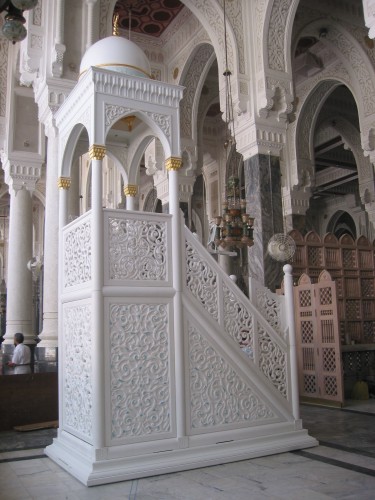
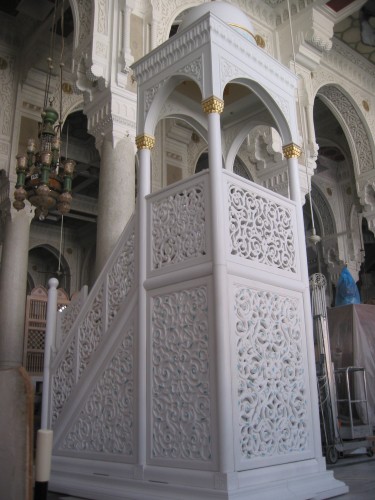
Minbar of Masjid al Haram
منبر المسجد الحرام
A minbar (Arabic: منبر, also spelt mimbar or mimber) is a pulpit in the mosque where the imam (leader of prayer) stands to deliver sermons (khutbah خطبة ) where the speaker sits and lectures the congregation. The word is a derivative of the Arabic root m-b-r 'to raise, elevate'; the Arabic plural is manābir (Arabic: منابر).
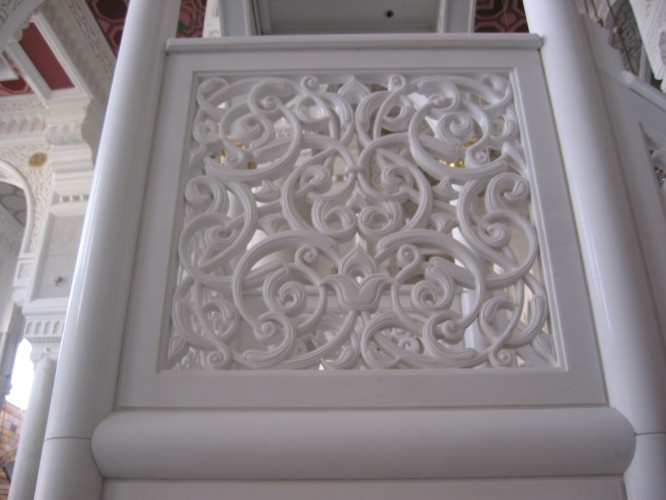
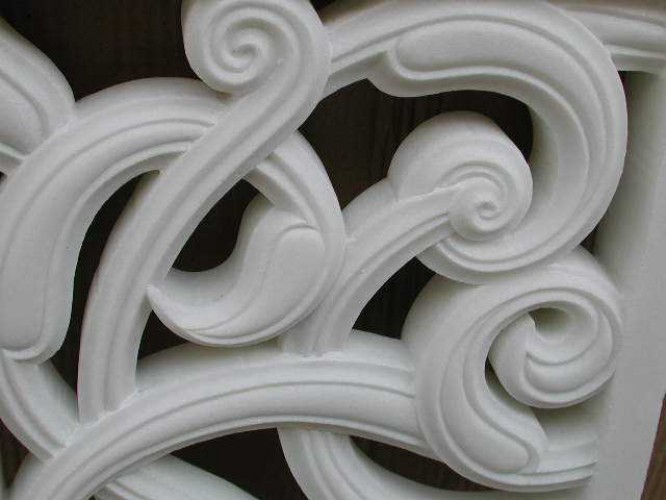
The ornamental design for the Masjid al Haram minbar was produced by Jay Bonner in the same pan-Islamic style that he originally developed for the Sliding Domes at the Prophet’s Mosque in Medina. This white marble for this minbar is from Macedonia, and was hand carved by the finest Muslim stone workers in Ajmer, India. The floral panels are of two types: high relief, and pierced. The high relief panels include inlaid Persian turquoise stones set in gold plated bezels. The floral elements in the pierced panels are designed so that they have optimum contact with one another; thus providing greater structural integrity to each pierced panel. The Masjid al Haram minbar is mechanized so that it can be easily removed from the Haram courtyard during the Hajj; thereby avoiding potential accidents among the throng of circumambulating pilgrims.
Completed in 2002.
 -
- 
 -
- 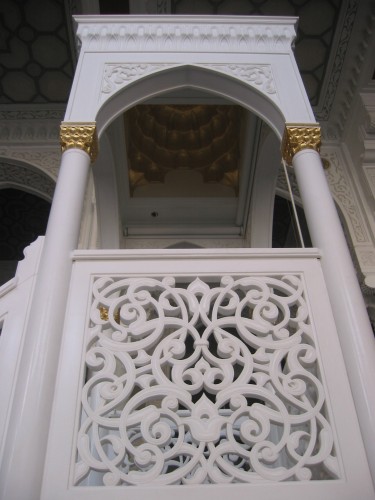
For this revered mosque, Saray Design was given the honour of making a minbar in pure white marble set with turquoise leaves and Qu'ranic calligraphy, which could combine 21st century German technology with 17th century Mughal craftsmanship, to create a movable and air conditioned structure--the first of its kind.

Left: Movable white marble minbar being test driven next to the Ka’bah Shareef.
Right: Indian carvers and inlay artisans putting the final polish to the minbar.

Inlay artisans working on the turquoise calligraphy for the minbar dome.

Above: Ring of calligraphy inside the Masjid Al-Haram Al-Shareef.

Detail of the Qu'ranic calligraphy from the minbar dome inlaid with Persian turquoise.



تسارعت وتيرة العمل في مشروع خادم الحرمين الشريفين الملك عبدالله بن عبدالعزيز لتوسعة الحرم المكي الشريف، وتتضمن توسعة صحن المطاف، توسعة الحرم من ناحيتي المسفلة وأجياد، وزيادة أدواره إلى 6، وتشغيل مبنى التكييف المركزي لمشروع وقف الملك عبدالعزيز، وإنشاء 63 برجاً فندقياً في أطراف ساحات الحرم وتوسعات أخرى، واتضحت أولى معالم هذه التوسعة التاريخية للحرم بالجهود الكبيرة للشركة المنفذة للمشروع.
وكشفت لـ «عكاظ» مصادر مطلعة أن العمل ينفذ خلال ثلاث محاور رئيسية الأولى التوسعة ذاتها للحرم المكي، ليتسع بعد التوسعة لمليوني مصل، الثانية الساحات الخارجية وتحوي دورات المياه والممرات والأنفاق والمرافق الأخرى المساندة والتي تعمل على انسيابية الحركة في الدخول والخروج للمصلين والمعتمرين والحجاج، والثالثة منطقة الخدمات والتكييف ومحطات الكهرباء ومحطات المياه وغيرها وتصل مساحة التوسعة إلى 750.000م2 ويشمل المشروع على توسعة ساحات الحرم من جهة الشامية، تبدأ من باب المروة وتنتهى عند حارة الباب وجبل هندي بالشامية وعند طلعة الحفائر من جهة باب الملك فهد وهذه التوسعة عبارة عن ساحات فقط ومقترح إنشاء 63 برجا فندقيا عند آخر هذه الساحات.
كما يتضمن المشروع توسعة صحن المطاف بهدم التوسعة العثمانية وتوسيع الحرم من الجهات الثلاث وقوفاً عند المسعى، حيث أن المسعى ليس من الحرم وتوسيع الحرم من جهة أجياد، كما تتم تعلية أدوار الحرم لتصبح 4 أدوار مثل المسعى الجديد حاليا ثم تعلية دورين مستقبلاً ليصبح إجمالي التعلية 6 أدوار، وتشمل توسعة الحرم من ناحية المسفلة بهدم فندق الإطلالة وفندق التوحيد إنتركونتيننتال.
ومن المقرر بعد تشغيل مبنى التكييف المركزي لمشروع وقف الملك عبدالعزيز تغذية تكييف الحرم من هذا المشروع وهدم المبنى القديم للتكييف وتوسعة الحرم من ناحية أجياد.
وكان خادم الحرمين الشريفين الملك عبدالله بن عبدالعزيز آل سعود قد وافق على تنفيذ مشروع لتوسعة الساحات الشمالية للمسجد الحرام تشمل إضافة ساحات شمالية للحرم بعمق (380) مترا تقريبا وأنفاق للمشاة ومحطة للخدمات بمساحة 300 ألف متر مسطح يدخل الحرم المكي الشريف مرحلة تاريخية جديدة في بنائها.
http://www.okaz.com.sa/new/Issues/20...0209571268.htm
Google translation: Accelerated work on a project server Two Holy Mosques King Abdullah bin Abdulaziz, to expand the Haram al-Sharif, and include expansion of the mataf, and expanding the Haram in terms of Misfalah and Ajyad, and increasing roles to 6 innings, and run a building central air conditioning project King Abdul Aziz Endowment, and the creation of 63 towers Fendkie on the outskirts of the courtyards of the Haram, as well as other expansions.
It turned out the first features of this historic expansion of the Haram of the great efforts of the company executing the project.
Sources told the newspaper "Okaz" Saudi Arabia should work carried out through three main themes, the first is the expansion itself of the Haram, to accommodate after expansion to two million worshipers, and the second external areas, which contain restrooms, hallways and tunnels and other facilities support and working on the traffic flow in the entry and exit of worshipers and pilgrims.
The third region services, air conditioning, power plants, water plants, etc., and reach an area expansion to 750.000 square meters, The project includes the expansion of courtyards of the Haram hand Shamiya, starting from the door Marwah and ends at the hot door and Mount Indian Bahamih When sorties excavations hand door of King Fahd. This expansion is only yards and proposed the establishment of 63 towers Fendkie at the last of these squares.
The project also includes expansion of the Mataf demolition expansion Ottoman and expanding Haram of three actors standing when endeavor, as the endeavor is not the campus and expanding campus of the Ajyad, are also ramp roles campus to become 4 floors like new endeavor now, then ramp Doreen future, bringing the total ramp 6 innings, and include the expansion of the campus in terms of Misfalah demolished hotel panoramic Tawhid Intercontinental Hotel.
It is scheduled to run central air conditioning for building the King Abdul Aziz Endowment Project, feeding air campus of this project, the demolition of the old building to adapt and expand the campus Ajyad hand.
The Custodian of the Two Holy Mosques has approved the implementation of a project to expand the squares North of the Grand Mosque, include the addition of yards north of the campus depth 380 meters and almost pedestrian tunnels and station service area of 300 thousand sqm enters Haram new historical stage in the construction.


10 February 2013 - 29 Rabi Al-Awaal 1434 H
MAKKAH — The project for the expansion of the holy mosque in Makkah includes the expansion of the Mataf area and increasing the number of floors to six. The project also includes the installation of the central air-conditioning of the King Abdulaziz Endowment Project, and the construction of 63 hotel towers.
Dr. Muhammad Al-Khozaim, deputy head of the Presidency for the Two Holy Mosques, told Okaz/Saudi Gazette that there is a study underway to connect all courtyards of the mosque with Mataf area via escalators to facilitate smooth flow of pilgrims.
The expansion project consists of three main areas. The first is the expansion of Al-Haram itself to accommodate 2 million worshippers.
The second is the development of exterior areas consisting of rest rooms, tunnels, and other services to ensure the smooth movement of worshippers.
The third is the support services area of air-conditioning, electricity station, water stations, and other services.
The Ottoman expansion of Mataf will be removed, and the Mataf will be expanded on three sides.
Al-Haram will initially consist of four floors, similar to Mataf, and will have two more floors added in the future.
http://www.saudigazette.com.sa/index...20130210152596


Sunday 10 February 2013
The Ministry of Municipal and Rural Affairs and the Commission for the Development of Makkah are studying a project related to the digging of a four-kilometer tunnel for pedestrians, stretching from the northern part of Jamarat Bridge in Mina to the northern courtyards of the Grand Mosque.
The study that is being finalized showed the project would cost SR 800 million.
If launched, it will take about 24 months to complete, the study stated, and will pass through the Alaziziya district and the northern parts of the area. It will end at the mosque’s northern expansion site, which is now under construction.
Makkah and the holy sites of Mina, Muzdalifah and Arafat are witnessing huge projects worth more than SR 100 billion. These projects include expanding the 'mataf' (circumambulation) and northern courtyards, building residential towers that can accommodate hundreds of thousands of pilgrims as well as bridges, tunnels and infrastructures that would provide better services to pilgrims.
http://www.arabnews.com/ministry-pla...-tunnel-makkah


Tuesday 12 February 2013
Prince Sultan bin Salman, president of the Saudi Commission for Tourism and Antiquities, yesterday announced SCTA’s plan to develop historical Islamic sites in the Kingdom, including those in Makkah and Madinah.
Addressing the First Conference of “Archaeology and Tourism in Al-Ula: Challenges and Aspirations,” he said the project would be carried out in consultation with Islamic scholars and archaeologists.
“A number of prominent Islamic scholars have expressed their desire to visit archaeological sites in the Kingdom and last week two members of the Council of Senior Islamic Scholars visited Madain Saleh in Al-Ula,” he said, adding that SCTA would encourage such visits.
Prince Sultan commended Custodian of the Two Holy Mosques King Abdullah and Crown Prince Salman for their support to SCTA’s efforts to preserve the Kingdom’s heritage sites.
“It has a cultural dimension as these heritage sites reflect the great contributions made by the people of Arabian Peninsula to human civilization over the years and the Kingdom’s heritage is part and parcel of world heritage,” the SCTA chief said.
The three-day conference at Taibah University’s Al-Ula campus is organized by the university in association with SCTA. Madinah Governor Prince Faisal bin Salman attended the opening session.
The conference aims at highlighting the cultural role of the people of Al-Ula, review appropriate means of preserving its cultural heritage and discuss practical experience and examples of sustainable development in archaeology and tourism, an SCTA official said.
Prince Sultan described Al-Ula as one of the important Islamic sites in the Kingdom. “We have signed an agreement with the Ministry of Islamic Affairs and Endowments to renovate historical mosques. We have already renovated an old mosque in Al-Ula.”
He said SCTA would work with the Presidency of the Two Holy Mosques to preserve historical Islamic sites and museums under the presidency. He emphasized the cultural, archaeological and economic dimensions of the Kingdom’s tourism development strategy.
Prince Sultan disclosed plans to develop 120 archaeological sites, establish five regional and six local museums, develop existing museums and preserve the Islamic historical sites in Makkah and Madinah as well as those sites related to Prophet Muhammad (peace be upon him) and Caliphs. “We’ll also transform historical palaces and government buildings into cultural centers.”
He said 24 scientific missions, including Saudi and foreign archaeologists, are working in different parts of the Kingdom to explore antiquities.
“We’ll work to enhance citizens’ relations with their heritage and include the topic in the curriculum, conduct national and international heritage exhibitions, encourage private museums and promote heritage villages,” he said while expressing satisfaction over the positive results of Saudi heritage exhibitions in Europe and the United States that attracted more than 1.5 million visitors including archaeologists.
Prince Sultan said SCTA was able to retrieve more than 14,000 pieces of antiques from abroad and 3,000 from inside the Kingdom with the support of government and private agencies. “Many citizens have handed over their artifacts to SCTA in order to take care of them properly,” he pointed out.
The SCTA chief commended Prince Abdul Aziz bin Majed, former governor of Madinah, for his support to the commission’s efforts to preserve historical sites in the region. He congratulated the new Governor Prince Faisal for winning the confidence of the Saudi leadership. “I wish him every success to serve the region as well as its citizens and visitors.”
Dr. Adnan Al-Mazroue, president of Taibah, emphasized the importance of protecting the Kingdom’s cultural heritage and archaeological sites. “Some of the archaeological sites in the Madinah region date back to the Stone Age,” the president said.
Salim Al-Bulwi, supervisor of Taibah University campus in Al-Ula, said 40 research papers would be presented by experts at eight sessions of the conference. The papers will focus on Al-Ula Antiquities and History, Cultural Heritage Resources Management, Urban Heritage and Tourism Development.
http://www.arabnews.com/scta-develop-islamic-sites

This cannot be undone and I am sure it will be greatly appreciated.
Please wait...
