Muhammad Sadiq Bey (1832-1902)
Muhammad Sadiq Bey was an Egyptian army engineer and surveyor and the first person to take photographs of the holy cities of Mecca and Medina and the Hajj. Travelling several times to the Hijaz in an official capacity as treasurer of the pilgrims’ caravan, he first went in 1861 taking with him a device known as a wet-plate collodion camera, a technique invented in the 1850s which used glass plate negatives. These were more robust than paper negatives and produced clear photographic images which could be reproduced in large numbers on albumen-coated paper.
In 1880 Sadiq Bey returned to the Hijaz and took photographs of buildings and interiors in Mecca and Medina, as well as of important Meccan officials. He was also able to take panoramic pictures of the holy mosque at Mecca from multiple angles. Sadiq Bey’s pioneering achievement was noted with great interest in Arabic and European magazines and he won a gold medal at the Venice geographical exhibition in 1881.
He published Mash‘al al-Mahmal (The Torch of the Mahmal) in 1881, which contains his collection of photographs, a history of the mahmal and the kiswa cloth which covered the Ka‘ba, and his observations of Mecca and Medina. Further publications include Dalil al-Hajj (The Guide to the Hajj) in 1896, a distillation of his journeys.
Later publications on the holy cities often used Sadiq Bey’s photographs, including Muhammad Batanuni’s The Journey to Hijaz and Subhi Saleh’s Pèlerinage à la Mecque et à Medine. (See Badr el-Hage Photographies anciennes de la Mecque et de Médine, 1880-1947 (Paris 2005)
https://www.britishmuseum.org/explor..._the_hajj.aspx
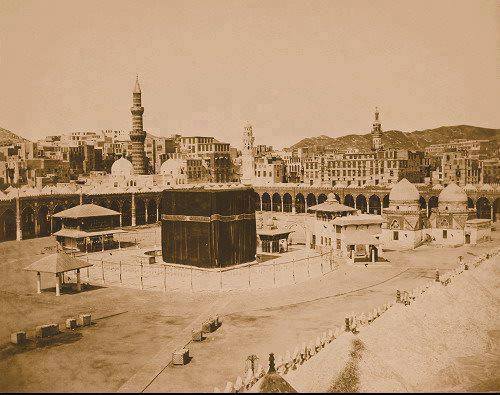
Makkah 1880


This view is from the east of the holy mosque with the city of Mecca in the background. Muhammad Sadiq Bey (1832-1902), the Egyptian army engineer,
surveyor and a pioneer of photography, probably took this photograph from one of the minarets of the holy mosque. In the courtyard of the mosque, from left
to right, can be seen the Maqam Maliki, the Ka‘ba, Maqam Hanafi (behind the Ka‘ba), the structure erected over the Zamzam well, and the Maqam Shafi‘i.
https://www.britishmuseum.org/explor...d_present.aspx