Hajj Day 4 - 11th Dhu-AlHijjah __________________________________
Rains excite Hajis as Jamrat ritual progresses 
Monday 6 October 2014
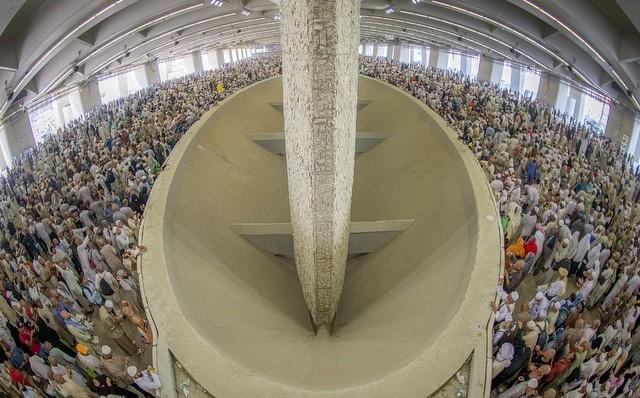
Pilgrims symbolically stoned the devil on Day 4 of the Haj on Sunday. Chanting “God is Greatest,” pilgrims threw seven small pebbles at each of three gray stone walls in the last ritual of Haj. The ritual, will be repeated on Monday as the Haj winds down.
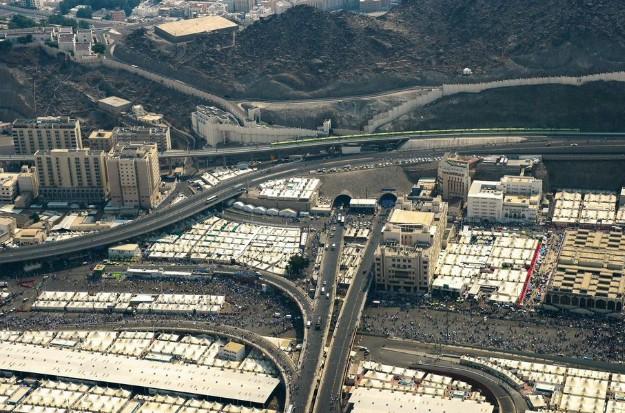
Throughout the day, the weather remained cool with overcast skies. To add to the happiness of the pilgrims, a steady stream of cool winds was blowing across the valley sending excitement among the more than two million pilgrims who are camping in Mina.
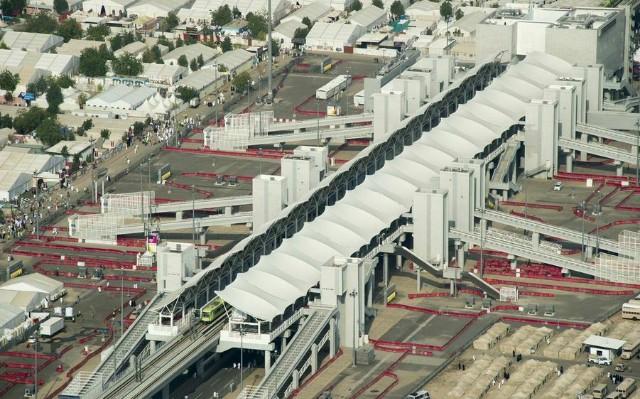
As soon as we got off at the Jamrat train station, we were welcomed by a cool draft of air," said Ahmad Sayeed, a Sudanese pilgrim. "And when we started walking toward the Jamrat complex to carry out the stoning ritual, it looked as if a divine shade had been created to protect the pilgrims," he said. For the pilgrims, it was the shade of Allah and a sign of His mercy.
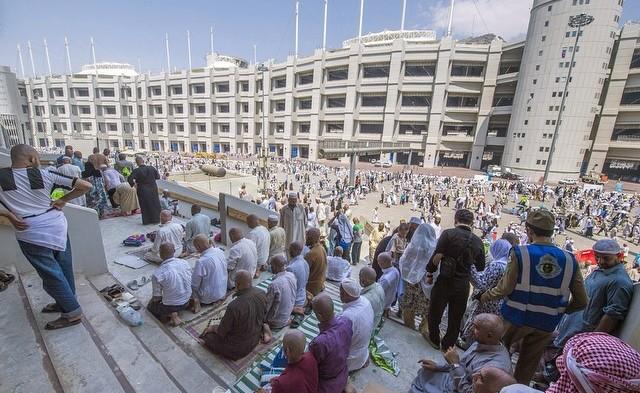
The stoning ritual was done with absolute ease. There were no bottlenecks. Even elderly pilgrims could stone the devil with ease and comfort. Huge fans at the Jamrat complex blew humidified air to keep the area cool. At around 4 p.m., the skies opened up and Mina experienced light showers. Pilgrims expressed their joy by coming out of their tents, and exclaiming, SubhaAllah, in unison.
"This is Allah's sign that our Haj has been accepted," said Abdul Bari, from Dhaka, Bangladesh. "This means our sins are being washed away."
With just one day to go for the completion of this year’s Haj, many pilgrims were seen engaged in supplication and prayers.
Kamal Ahmad from London said the whole exercise required mental preparation.
Overcoming the stresses of Haj is a metaphor for what must be done in life, he said. “The aim is to always seek the peace of Allah,” he said. “It teaches us that all of life is a spiritual quest.”
The pilgrims will stream out of Mina today after performing what for many will be a once-in-lifetime journey of faith.
http://www.arabnews.com/featured/news/640361
Stoning ritual goes smoothly
Monday, 06 October 2014
MINA/MAKKAH — On the second day of the stoning ritual on Sunday, over two million pilgrims pelted pebbles at each of the three Jamarat (pillars symbolizing Satan) in Mina. The afternoon ritual was smooth and peaceful.
Chanting “Allah-o-Akbar” (God is the Greatest), pilgrims hurled seven pebbles each first at Jamarat Al-Sughra, then at Jamarat Al-Wusta, and finally at Jamarat Al-Aqba. After performing stoning at each of the first two pillars, they turned towrad Qiblah, raised their hands and beseeched Almighty Allah’s mercy and forgiveness.
Stoning at Jamarat is the main ritual pilgrims have to perform during the last three days of Haj, known also as Ayyam Al-Tashreeq. It is to emulate the stoning of Satan at three spots by Prophet Ibrahim (peace be upon him) where the devil is said to have appeared trying to dissuade him from obeying Allah’s order to sacrifice his son, Ismail (pbuh). In essence, it is a renunciation of evil in all its forms and a solemn promise never to fall prey to the machinations and intrigues of Satan, the cursed.
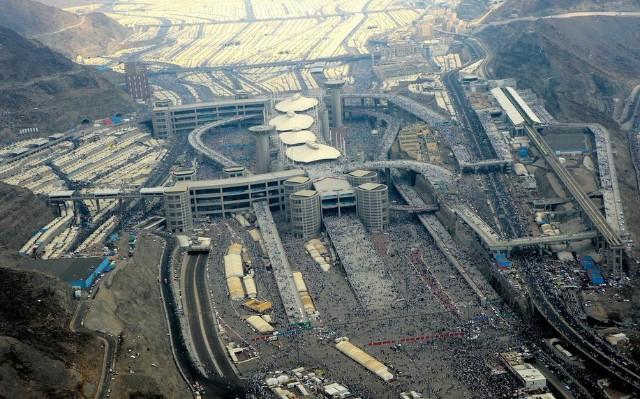
Huge presence of security forces and Civil Defense personnel was seen at various points at the mammoth state-of-the-art Jamarat complex, which has the capacity to hold 300,000 pilgrims per hour, as well as on the passages leading to Jamarat.
Under the direct supervision of Minister of Interior and Chairman of the Supreme Haj Committee Prince Muhammad Bin Naif, and Emir of Makkah and Chairman of the Central Haj Committee Prince Mishal Bin Abdullah, the forces had performed a huge task of crowd management smoothly.
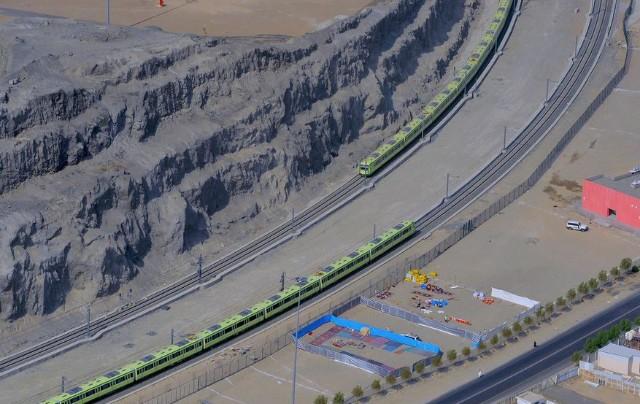
A large number of security men were engaged in preventing pilgrims from squatting on the pathways leading to Jamarat and thus facilitating smooth flow of pilgrims between Jamarat and their places of accommodation. More than 1.3 million pilgrims have so far benefited from the Mashair train, which is transporting 360,000 pilgrims a day. The Ministry of Commerce and Industry officials were seen ensuring supply of food and other essential goods at various outlets and stores at reasonable prices in Mina.
On Sunday, pilgrims performed four main rituals of Haj – stoning at Jamarat Al-Aqba, sacrifice of animals, shaving head or cutting their hair, and performing Tawaf Al-Ifadah and Sai. With this, pilgrims had an exit from their state of ihram and they started wearing normal dress. Most of the pilgrims will leave Mina after performing the stoning ritual for the third day on Monday while the remaining pilgrims will stay back in the Tent City to complete the stoning ritual on Tuesday, the third day of Tashreeq, following the example of Prophet Muhammad (peace be upon him).
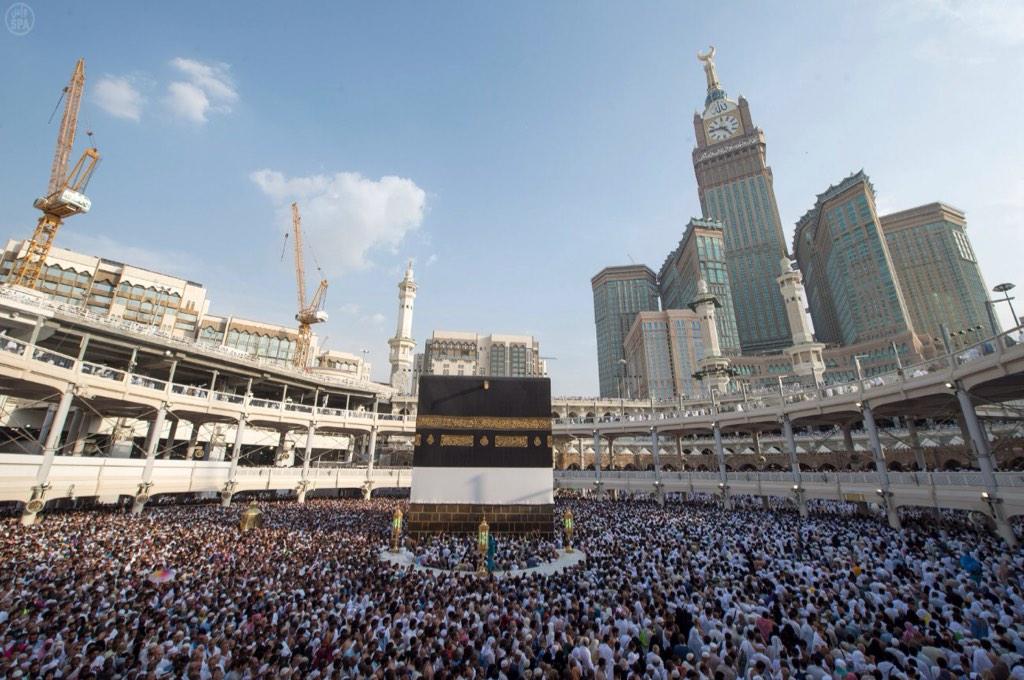
Although the Haj, one of the five pillars of Islam, comes to a close officially on Tuesday, pilgrims are allowed to leave a day earlier. Those pilgrims who leave Makkah Monday will perform their Tawaf Al-Wida (farewell circumambulation around the Holy Kaaba), which is the last ritual of Haj. Some pilgrims will leave Saudi Arabia Monday itself at the end of this year’s totally incident-free Haj.
A total of 2,085,238 pilgrims, including 1,389,053 foreigners, performed this year’s Haj which was by and large hassle-free and very much comfortable.
Addressing a press conference in Mina on Saturday, Maj. Gen. Mansour Al-Turki, spokesman of the Ministry of Interior, attributed the resounding success of Haj to the excellent outcome of the government’s Haj operation plan and cooperation of pilgrims as well as full support of various Haj missions.
http://www.saudigazette.com.sa/index...20141006220383
Rain in Mina
Monday, 06 October 2014
Pilgrims, in front of the Indian Haj Mission, take cover under umbrellas following rain in the Tent City of Mina on Sunday. The rain provided relief for pilgrims, setting out to perform their stoning ritual under the hot sun, by bringing the temperatures down.
Most of the districts of Makkah City received moderate to heavy rain. Makkah Emir Prince Mishal Bin Abdullah closely followed the situation and instructed all concerned agencies to ensure the safety and security of pilgrims. The authorities reported no casualties.
http://www.saudigazette.com.sa/index...20141006220391 Radars and satellites observe weather at holy sites 
Monday 6 October 2014
The Presidency of Meteorology and Environment (PME) is closely monitoring weather conditions through the Arafat and Mina radars for the safety of the pilgrims in the holy sites, better known as Mashair.
Dr. Mohammed Al-Jasser, general president of the PME said: “The operation room for environment and meteorology is working to serve the sectors working during the Haj and providing them with data about the weather, temperature and climate.”
The room operates round-the-clock and is equipped with the required human resources and automated machines to ensure the safety and comfort of Haj pilgrims.
Al-Jasser explained that there are five automatic monitoring stations distributed in Mina, Muzdalifah, Arafat and some of the highways leading to the Mashaer specifically the Makkah-Jeddah Expressway, Makkah road and Madinah road. All of these stations work to provide the main center with meteorological and environmental information.
He pointed out that all the observation centers are associated with the main center located in Jeddah providing the latest updates in weather conditions and issuing weather bulletins.
“There is no indication of bad weather threatening the pilgrimage season. The sky will remain clear except for some cloud on the last three days. It may also be accompanied by light drizzle at high altitudes in Taif and parts of the holy sites,” assistant chief of the meteorology and national center for environmental observation Saad Muhallafi said in a statement.
He added that temperatures in the holy sites during the Haj were expected to reach highs of 38 degrees Celsius and lows of 21 degrees Celsius. The source added that more automated observation points in Jeddah, Madinah, and along the entire stretch of the Red Sea coast from north to south were being planned. The source added that the PME has launched a new portal to supply the latest weather reports at Arafat, Mina, Muzdalifah, Makkah, Madinah and Jeddah during the pilgrimage.
Al-Jasser said that the presidency inaugurated its own electronic portal of Meteorology and Environment reports during the Haj. He added that the portal will be equipped with various updated meteorological data, in addition to other environmental and meteorological information.
The portal sends information of weather and environment directly to the command and control center in Mina, in addition to relevant authorities.
The data includes weather forecasts at Muzdalifah, Mina, Makkah, Madinah and Jeddah as well as proactive weather Information for the upcoming ten days.
The presidency has operated the automatic monitoring stations in Makkah, Madinah and Jeddah, and also the Red Sea coastal area. These stations receive satellite pictures and weather information from radars around the Kingdom operated by experts and specialists from the presidency. These experts use advanced tools to communicate the information to beneficiaries.
In the environmental sector, the PME operates mobile laboratories in the holy sites, to measure air quality and environmental pollutants in the Mashair, and the leading tunnels. It also works on drafting environmental studies and surveys, to protect the Haj environment and use this information in future analysis.
The supervisor of the Haj works stressed that satellites pick up images of the Mashear weather every 15 minutes. The data and the weather radars in Mina and Arafat that scan the skies of Makkah and the Mashaer areas, will be then analyzed.
http://www.arabnews.com/saudi-arabia/news/640306
Pilgrims safe from infectious diseases
Monday 6 October 2014
Health authorities detected 134 MERS cases during this Haj season but they all tested negative during lab investigations.
“By the grace of God, all suspected MERS cases were negative,” said Dr. Anis Sindi, deputy chief of the command and control center in a statement on Sunday.
He said the health condition of pilgrims is satisfactory, adding that no confirmed MERS or Ebola cases have been found among them.
He said the Kingdom’s health facilities in Makkah and other holy sites had provided 903 dialysis services in addition to 11 open-heart surgeries and 277 catheterization and cardiovascular interventions.
“We have dealt with suspected MERS cases considering them as confirmed cases in order to prevent the spread of this disease in the Kingdom,” Sindi said, adding that the ministry has set up a mobile laboratory inside the holy sites to test samples from suspected cases.
Saudi nurses taking part in the Haj service said they were not afraid of being exposed to MERS and Ebola cases during the Haj season. “I am serving pilgrims during the Haj season for the third year in a row,” said Hussein Buhamoud from the Health Department in Al-Ahsa.”
Jowhara Hamad, a female nurse, said she joined the Haj service this year for the first time seeking the blessings of God. “I have taken all precautions against infectious diseases and the rest I leave to God,” she added.
http://www.arabnews.com/news/640356
More electric wheelchairs for the disabled at Jamrat
Sunday 5 October 2014
The Ministry of Municipal and Rural Affairs has provided 234 electric wheelchairs for use at the Jamrat (stoning area) and its vicinity to facilitate the Haj rituals through safe and easy mobility.
Wajdi bin Hassan Toulah, director of maintenance and operations in the holy sites, said these electric wheelchairs will serve more than 70,000 disabled pilgrims in addition to their companions which takes the number to 200,000.
The number of chairs were increased following the allocation of three more paths in addition to the existing five leading to the bottom of Mount Arafat. Toulah said that two more paths had been added to the pedestrian area in Aziziyah while an additional 50 carriers had been provided to further facilitate the disabled pilgrims.
“The electric wheelchairs will soon become operational on the three new paths including the first path which ascends from the Jamrat yards from the southern side to the second floor of the facility with 665 carriages. Path number two which ascends on the northern side of the Jamrat facility to the second floor has been allocated 28 carriages while path number three in Mina has a capacity of 105 carriages in addition to paths seven and eight with 29 carriages.
All these paths converge on the King Abdulaziz road and can transport 900 pilgrims.
Wajdi said the operational plan in Jamarat for serving the disabled, the elderly and the sick called for the allocation of a large number of drivers, supervisors and maintenance teams.
There are around 232 drivers who work on 12-hour shifts in addition to 134 field supervisors and maintenance technicians who work around the clock to assist users and deal with technical issues.
http://www.arabnews.com/saudi-arabia/news/639961