Forum Menu - Click/Swipe to open
 

Makkah News and Updates

Jump to page:

You have contributed 0.4% of this topic

Thread Tools
Appreciate
Topic Appreciation
omer, Taqwah, Taalibah, rizmalek, super-glue, Seifeddine-M, bint Mohammed, member2, sweetmuslimahk1, abu mohammed, Yasin, Heather2727, Naqshband66, ummi taalib, mo_isaq, Acacia, Desi tadka, umar123, habeeba, Jinn, Arslan., ibn Ismail, najimuddin, ALIF, al-adnan, abuzayd2k, Moonlight, Mohammed8, ssaad, tanveerzakee, sharjan8643, opc121177
224 guests appreciate this topic.
Rank Image
Roukaya19's avatar
Montreal
4,092
Sister
4,288
Roukaya19's avatar
#4666 [Permalink] Posted on 4th October 2014 15:19
 
Arafat day - 9th Dhu-AlHijjah
__________________________________


Pilgrims in submission at high point of Haj


Muslim faithful gather at the Plain of Arafat near Makkah, Saudi Arabia, on Friday
Saturday 4 October 2014

More than two million pilgrims performed the most important rite of Haj on Friday as they stood in prayer from dawn to dusk on the plains of Arafat, 15 km east of Makkah.

A white sea of the faithful surged to Mount Arafat as dawn broke on the second leg of the five-day pilgrimage. Waves of men in seamless white robes and veiled women in long dresses raised their voices to a crescendo, chanting Labbaik Allahumma Labbaik (Here I am O God, answering your call).
On behalf of Custodian of the Two Holy Mosques King Abdullah, Crown Prince Salman, deputy premier and minister of defense, arrived in Mina to supervise services for the pilgrims at the holy sites on Friday.

King Abdullah received a telephone call from Qatari Emir Tamim bin Hamad Al-Thani congratulating him on Eid Al-Adha. King Abdullah also received similar calls from King Hamad bin Isa Al-Khalifa of Bahrain and Emir of Kuwait Sheikh Sabah Al-Ahmed Al-Jaber.

Makkah Gov. Prince Mishaal bin Abdullah, chairman of the Supreme Haj Committee, was in the front row of Masjid Al-Namira when Grand Mufti Sheikh Abdul Aziz Al-Asheikh delivered the Haj sermon. The massive mosque was overflowing with pilgrims.

The grand mufti said Islam was the religion of humanity, with a perfect constitution aimed at bringing people together.

Al-Asheikh lashed out at people using Islam to further their violent and extremist agendas. He said these people cannot be considered Muslims.
“We have been tried with people who shed the blood of innocent people and tarnish the image of Islam. They are in fact the Khawarij whom the Prophet (peace be upon him) referred to,” the sheikh said.

The sheikh said that Muslims must stand together and work to help each other, particularly in protecting moral values. He said Islam's enemies are preparing to attack Muslims on all fronts, including their security, faith, strength and intellect.

He urged the GCC to bury their differences. “The Gulf Cooperation Council has gone forward in a remarkable way but need to cooperate to ensure the dignity and stability of the ummah.” He said that Muslims have the responsibility to do everything they can to avoid division and ensure the security of the community at large. “The media has a crucial role to play in disseminating Islamic teachings that could provide solutions facing Muslims today.”

Meanwhile, Haj Minister Bandar Hajjar said that the Haj has gone smoothly so far. “To manage such a large number of people coming from more than 140 countries and speaking 100 different languages is quite an achievement,” he said.

Thousands of police were stationed along the routes to Arafat with helicopters hovering overhead. Many faithful carried umbrellas to protect themselves from the sun. The government has installed thousands of water sprinklers to cool pilgrims, although the weather was moderate.
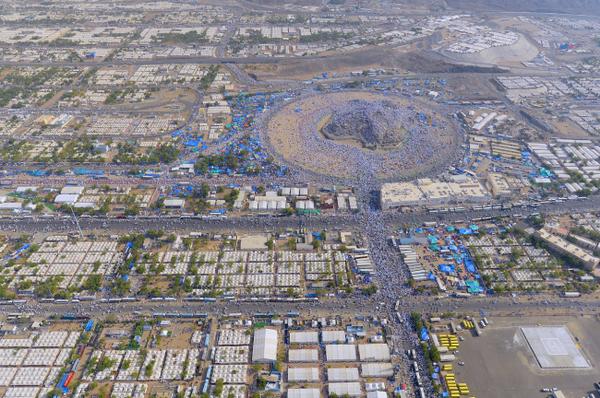
 

Many pilgrims interviewed praised the government for their organization. Others said they were simply happy to be in the Kingdom to perform the pilgrimage.

Saleh Al-Owaili, a young Saudi from Najran, said he was performing the pilgrimage for the second time. “I feel blessed to be part of this grand gathering of Muslims,” he said. “I am taking comfort in the fact that Allah answers our prayers on these days from this place.”

He said one should never forget the main principles of Islam. “Islam is based on tolerance and forgiveness,” he told Arab News. He was part of a large contingent of Saudi pilgrims from all over the Kingdom.

Adam Ali from Chad said he was performing Haj for the second time and his wife, Naeemat, the first time. “We are extremely happy to have fulfilled the most important pillar of Islam,” said Ali.

Ahmad Abdul Hadi, from Khartoum, Sudan, said he was surprised by the huge numbers of people and the hot weather. “I am happy, yes. There are too many people here,” he said.

Pakistani pilgrim Mohammad Abbasi said performing Haj was a great experience. “It is an opportunity that people dream of all the time,” he said.
Abbasi, a father of seven, said he prayed for his parents, his country, his relatives and the Muslim Ummah. “May Allah awaken the Muslim masses and shower his choicest blessings on our community,” he said.

Standing at Mount Arafat in prayer before sunset on Dhul Hijjah 9 is the high point of the Haj. The pilgrims who fail to make it on time must repeat the journey.

The pilgrims left Arafat after sunset, moving to Muzdalifah where they will spend the night following in the footsteps of Prophet Muhammad (peace be upon him). They will collect pebbles to stone the Jamarat in Mina at dawn on Saturday, the symbolic stoning of the devil.

http://www.arabnews.com/featured/news/639636


Defeat forces sowing chaos — Grand Mufti


Pilgrims assemble at Nimrah Mosque on the plains of Arafat, Friday.
Saturday, 04 October 2014

ARAFAT/MAKKAH — The vast plains of Arafat on Friday soaked with tears of millions of repenting pilgrims and the air reverberated with their prayers at the spiritual climax of Haj. Chanting “Labbaik Allahumma Labbaik” (O God, here I am answering your call), around two million believers from all corners of the globe converged on the plains of Arafat with many of them openly crying and beseeching Almighty Allah to forgive their sins.

Retracting the noble tradition of Prophet Muhammad (peace be upon him), who said “Haj is Arafat”, pilgrims performed noon (Dhuhr) and evening (Asr) prayers, shortened and combined, at the time of Dhuhr with one adhan and two iqamas, and then immersed in prayers seeking forgiveness and mercy of Almighty Allah as well as seeking welfare of the Ummah and world peace.

In his Arafat sermon, Grand Mufti Sheikh Abdul Aziz Al Asheikh said the enemies of Muslim nations are trying to spread “chaos and confusion.”

“Oh Muslim people, your countries have been entrusted to you, so safeguard your security and stability, your gains, your resources and public projects,” Al Asheikh said in a televised address from Nimrah Mosque.

“And know that you are targeted by your enemies who want to tear your ranks, turn your hearts against each other and spread chaos and confusion and beware of their conspiracies,” he said from the spot where Prophet Muhammad (pbuh) made his final sermon 14 centuries ago.

He called on the Ummah to work jointly to protect the religion of Islam and its morality. “Your religion is targeted. Your security, ideology, strength, and intellect are all targeted. The enemies of Islam are making preparations against you, and so be wary of them.” Asheikh also highlighted the great role that media can play in serving the Ummah and solving its problems in line with the teachings of Islam. He urged the media to stay away from polemics but to focus on reforms.

Asheikh urged Muslim leaders to strike the enemies of Islam within the Kingdom and outside with an iron fist.

Islam calls for preserving the fundamentals of human life including religion, human soul, wealth and honor and the grand mufti warned against abuse of drugs and liquor.

“Despite these clear instructions, our Islamic Ummah has been put to test because of some people who resort to bloodletting, killing innocent people, and thus presenting a bad image that is nothing to do either with Islam or humanity. These people are dangerous than “Khawarijs” about whom the Prophet (pbuh) had warned.”

Asheikh warned that these criminals carry out rapes, bloodshed and looting, and these vile crimes can be considered terrorism and their perpetrators have nothing to do with Islam. “They are tyrants,” he said while warning of their deviant ideology.

“These heinous crimes are sheer terrorism and aggressive brutality and sedition. It is worse that they cover their evil under the guise of jihad (holy war), which is also not their true belief since they kill innocent people and destroy properties. Makkah Emir Prince Mishal Bin Abdullah and other dignitaries were present at the Nimrah Mosque whose 110,000 sq. meters capacity and squares overflowed with pilgrims.

Asheikh’s comments, similar to his Haj sermon last year, come in the context of widespread revulsion among the world’s Muslims toward the self-proclaimed Islamic State group. The standing at Arafat, one of the four pillars of Haj, began afternoon prayers. Pilgrims engaged in prayers and supplication until after sunset.

Realizing that on this day the gates of heaven are open, prayers are answered and past sins are forgiven, they wept seeking forgiveness and pleasure of Allah. The Prophet (pbuh) said about the Arafat Day: “There is no day on which Allah frees more people from the Hell than the Day of Arafat. He comes close and expresses His pride to the angels, saying, “What do these people want?”
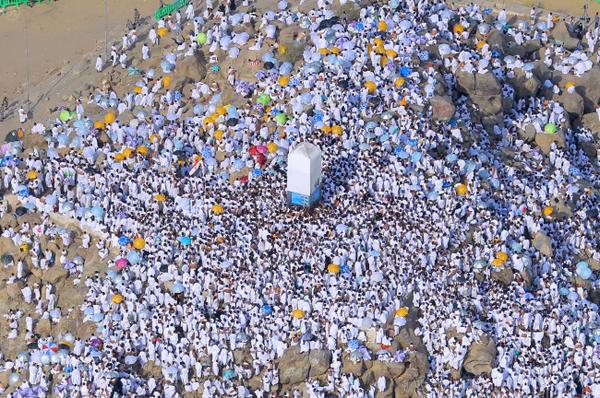
 

Responding to this, Nigerian pilgrim Taofik Odunewu said: “I am now a newborn baby and I don’t have any sin.” Standing at the foot of Mount of Mercy, tears were streaming down his face when he told this to AFP. Odunewu raised his hands to the heavens in the seamless two-piece white “ihram” outfit that he wore. “I pray for prosperity, long life and… I pray for my country,” Odunewu said with a broad smile. “I’m very blessed to be part of this occasion. I don’t think I will go back to the sinful way,” he pledged.

Mehreem Sulaiman, a pilgrim from the US state of Wisconsin, told Saudi Gazette that it is an amazing experience to be at the Holy Sites as a guest of Almighty Allah. “I was so much excited while circumambulating the Holy Kaaba and standing at Arafat with an exalted level of spirituality. I prayed Allah to shower His infinite mercy on me and all other Muslims as well as to forgive us and help the Islamic Ummah to overcome crises and hardships.” “I feel that Haj connects Muslims from all parts of the world with strong bonds of brotherhood, equality and compassion, and that was what I have experienced in the holy cities of Makkah and Madinah as well as at the Holy Sites of Mina and Arafat,” she said. Mehreem arrived to perform Haj along with her husband Arshad Ahmed from New York.

Many pilgrims were seen crowded onto the slippery, rocky hill known as Mount of Mercy. The pilgrims’ attire turned the hill white in color, and they carried umbrellas as shields against the hot desert sun. All male pilgrims dress in white ihram to symbolize a state of purity, which also emphasizes their unity regardless of social status or nationality. Some pilgrims sat alone on rocks, praying silently, as others gathered in groups, their voices in a loud appeal to God.


Egyptian pilgrim Mohammed Ahmed, 53, sat with his wife under a yellow garbage bag they set up as a make-shift tent. He said they were praying for “the victory of Muslims, those who are weak, oppressed, and jailed... all over the world.”

Muslims across the world observed fasting on Friday in a sign of solidarity with the pilgrims. It is a great Sunnah for those who do not perform Haj to observe fasting on Arafat day.

After completing the ritual of standing at Arafat, the pilgrims moved to Muzdalifah in a calm and dignified manner, reciting talbiyah a great deal. They offered Maghreb prayer with three rakaats (units) and two rakaats of Isha after reaching Muzdalifah to spend the night there in supplication and picking up pebbles to be thrown at the pillars symbolizing satan in Mina.

The pilgrims have to perform four main rituals on Saturday, which is known as the Day of Sacrifice, when all Muslims other than pilgrims celebrate Eid Al-Adha festival. After reaching Mina from Muzdalifah, they have to stoning the Jamarat Al-Aqba, sacrifice animals, shave their heads and then leave for Makkah to perform Tawaf Al-Ifada and Sai’, two other pillars of Haj. In the remaining two or three days of Haj, the only ritual to perform at the Holy Sites is stoning at each of the three Jamarats in Mina.

http://www.saudigazette.com.sa/index...20141004220238
report post quote code quick quote reply
+1 -0
back to top
Rank Image
Roukaya19's avatar
Montreal
4,092
Sister
4,288
Roukaya19's avatar
#4667 [Permalink] Posted on 4th October 2014 15:22


Arafat day - 9th Dhu-AlHijjah

3 October 2014


report post quote code quick quote reply
+1 -0Like x 1
back to top
Rank Image
Roukaya19's avatar
Montreal
4,092
Sister
4,288
Roukaya19's avatar
#4668 [Permalink] Posted on 5th October 2014 18:06
 
Pilgrims in ‘sublime act
of complete surrender’


Saturday 4 October 2014

The Mount of Mercy or Jabal Al-Rahma is the place where Prophet Muhammad (peace be upon him), delivered his all-encompassing farewell sermon 1,425 years ago, which still serves as the guiding light for Muslims and humankind.

Jabal Al-Rahma is a granite hill. At its 70-meter peak is a platform, in the center of which is a white pillar that can be seen from afar. The hill has a cluster of boulders with deep crevices in it, with some perched quite precariously. Many have been artificially reinforced and supported by iron rods.

On the Day of Arafat on Friday, it was as if the hill itself was draped in white as thousands in their ihrams climbed up to be as close as possible to the pillar. This dramatic scene, of this moving sea of humanity, was among the highlights of Arab News' coverage.

The mount was ringed by very polite security forces officers who had earmarked entry and exit points to control the flow of pilgrims.

Pilgrims were reciting verses from the Holy Qur'an with tears rolling down their cheeks, or had their arms stretched out in prayers and supplications. Others, apparently tired from their long journey, slept with their prayer beads in their hands.

At the foot of the Jabal Al-Rahma, the government has erected big billboards stating that the Prophet (pbuh) did not climb it and pilgrims therefore do not need to do so. Some pilgrims had scribbled the names of their loved ones on the rocks and the white pillar. The instructions clearly state that this should not be done. The instructions are in many languages, including English.

The scenes at Jabal Al-Rahma were indescribable and moving, especially of fragile old women struggling to climb the mount. An elderly Moroccan pilgrim, Fatima Jalloul, her face deeply furrowed, told Arab News: "I want to take memories of this place and share them with my grandchildren. I am storing all these images in my mind."

For Jalloul, performing the Haj is a dream come true. "In Morocco, the pilgrims are selected by drawing lots. I was among the lucky ones to be here. You cannot imagine my happiness," she said with a wide angelic smile.

When it comes to describing the scene at Arafat, no one has done better than Lady Evelyn Cobbold, the Englishwoman who became a Muslim and took the name of Zainab. Every year, Haj reporters recall her words to describe the standing at Arafat, or wuqoof in Arabic.

"It would require a master pen to describe the scene, poignant in its intensity, of that great concourse of humanity of which I was one small unit, completely lost to their surroundings in a fervor of religious enthusiasm,” she wrote in her Haj journal decades ago. “Many of the pilgrims had tears streaming down their cheeks; others raised their faces to the sky that had witnessed this drama so often in the past centuries. The shining eyes, the passionate appeals, the pitiful hands outstretched in prayer moved me in a way that nothing had ever done before, and I felt caught up in a strong wave of spiritual exaltation. I was one with the rest of the pilgrims in a sublime act of complete surrender to the Supreme Will which is Islam.”

http://www.arabnews.com/saudi-arabia/news/639621


Aged Indian sells farm
for his and wife’s pilgrimage

 
Saturday, 04 October 2014 -

MINA — He has no money, in fact he is a pauper. But he is rich in his heart and satisfied.

It was only some months ago that this aged Indian man owned a small farm that was a source of livelihood for him and his wife. He decided to sell his only source of income to be able to collect the money needed for Haj pilgrimage.

“I did not have any other option than selling my small farm,” Mohammed Saeed, in his 70s, told Al-Watan newspaper. He said he and his wife, about the same age, had to make sacrifices to be able to come to Saudi Arabia to fulfill the fifth pillar of Islam.

“Our sacrifice was purely for God. We are happy to have made it to the Kingdom to perform the Haj,” he said.

Saeed and his wife are staying at the camp of the Indian Haj mission in Mina.

“This is the first time me and my wife are performing Haj,” he said.

He said many times in the past he had thought of coming to the Haj but his financial position did not allow him. “I could not collect the money needed for the Haj journey. I am not working. The only source of income for me and my wife was our small farm,” he said.

Saeed said he had prayed several times near the Holy Ka’ba. “Every time I prayed, I felt exultant. I also liked the voice of the imam of the Grand Mosque reciting the Qur’an in the prayers,” he said.

He said he could not believe that he was actually praying facing the Ka’ba inside the Grand Mosque.

“I felt as if I was newly born when I first came to the Kingdom.”

Saeed said for many years he was eager to perform the Haj but financial constraints came in his way. Finally he thought of selling his farm.

“I have strong faith in God, and I don’t regret selling the farm to come to Allah’s House,” he said.

He said he was sure that Almighty Allah would compensate him with another farm or give him another source of income when he goes back home.

http://www.saudigazette.com.sa/index...20141004220239


Despite losing everything,
Syrian pilgrim’s heart pleads for homeland

 
Saturday, 04 October 2014

MINA — He lost his wife, five children, home and country. These tragedies, one after another, gave him no respite in his old age. But despite losing so much, he willed himself to come to the pilgrimage where his heart pleads for his homeland despite his spirit and body being broken.

"I am in Mina with a devastated body and spirit. The war in Syria has claimed my entire family — wife and five children. My right hand’s fingers have been paralyzed by a bullet wound," Mohammed Hussein, a Syrian pilgrim said.

He told Al-Hayat newspaper that all members of his family died when their house in Aleppo was razed to rubble by an air raid by the Syrian government forces. "No one survived the raid. We dragged all the bodies from the rubble and buried them. Since then I have not been quite myself," he said.

Hussein said the dreams he had been cherishing for more than 50 years to see his children married and happily settled have been shattered by the rain of bombs.

"In addition to the loss of my wife, children and house my greatest loss is Syria itself, which has been hijacked by President Bashar Al-Assad and his gang," he said.

Hussein described the war as a "damnation," but asked all Syrians to be patient because no matter how long the night is, day would finally break.

He said the images of his wife and children are haunting him. "They are deeply engraved in my heart. I am may look composed from outside but deep inside I am bleeding," he said.

http://www.saudigazette.com.sa/index...20141004220242


Muslims from Cuba performing Haj for first time

 
Saturday, 04 October 2014

MINA — Five pilgrims from Cuba are performing Haj this year as guests of Custodian of the Two Holy Mosques King Abdullah. This was for the first time, Muslims from Cuba arriving in the Kingdom to perform Haj, according to Abdullah Al-Modlej, executive director for the program of the King’s guests at the Ministry of Islamic Affairs.

Al-Modlej said the five-member team includes leader of the Muslim community in Cuba. He noted that the ministry deputed one preacher to lead taraweeh prayers for Muslims of Cuba during the last Ramadan. There are no mosques in Cuba and therefore the Muslims hired a wedding hall to offer prayers. “On the first day, the number of worshippers who came to attend prayers was around 130 and the second day their number shot up to 500, and this number increased further by the end of the fasting month,” he said. Several new Muslims from Korea and Europe have also arrived to perform Haj as the King’s guests, Al-Modlej added.

http://www.saudigazette.com.sa/index...20141004220244


Seeking the pleasure of Allah,
volunteers help the weak and elderly perform Haj


Saturday 4 October 2014

With a broad smile on his face, Indian volunteer Basheer Chekku receives and helps pilgrims arriving at the train station in Mina on way to Arafat. Dressed in a phosphorus vest decorated with the Indian flag, Chekku, along with many other native and foreign volunteers, stand for hours at the station’s platforms offering their services free of charge to women and men, young and old from all over the globe who have come to the Kingdom to perform Haj.

While millions of pilgrims are seeking God’s forgiveness and blessings while performing Haj, Chekku and his fellow volunteers are seeking the same in their own way.

“I only seek to please Allah. This kind of work brings me peace of mind and satisfies my soul,” he told Arab News, as he helped an elderly female pilgrim board the train heading for Arafat.

Chekku is one of dozens of people who have been serving pilgrims during Haj for the past decade.

Chekku, who came to the Kingdom 21 years ago, works as a clerk at an Indian school. For the past 10 years, he has been volunteering as part of the Kerala Muslim Cultural Center (KMCC) group, which helps pilgrims of all ages and nationalities perform Haj rituals as smoothly as possible.

Some 10 groups, each comprising more than 1,000 members from the Indian community, stepped forward offering their services free of charge to elderly pilgrims not only from their community but also anyone in need of them. “I am so grateful to the Almighty that he blessed me with the opportunity of working in this holy land. I have performed Haj before and I believe that I can still serve Allah and Islam, not only by performing Haj, but also by assisting others who need assistance,” the father of two explained to Arab News.

Whoever is financially capable of performing Haj can apply, explains one Indian pilgrim who was on board the train. He added that every year more than 300,000 citizens apply for Haj. This year, only 136,000 of them could make it.

Most of the Indian pilgrims are elderly, because Muslims in India go on pilgrimage only after getting their end of service benefits on retirement at 60.

http://www.arabnews.com/saudi-arabia/news/639616


Saudis have accounted
for most domestic Haj campaign places
Saturday, 04 October 2014

JEDDAH — About 60 percent of the seats available at the domestic Haj campaigns has been taken up by Saudi citizens, according to a reservation official at a local Haj company.

Abd Al-Sahli said that Egyptian expatriates occupy second place with 10 percent of seats. The Haj Ministry had provided 15,000 seats in the low-cost Haj campaigns and all these seats were reserved early, he said.

Al-Sahli said the average price this year for the low-cost campaigns was SR2,500 per person while the rate of VIP packages cost SR15,000 to SR20,000 and sometimes more.

Abdulaziz Al-Jahdali, another reservation official, said low-cost packages have this year attracted more pilgrims than in any other year. “This was due to the strict measures taken by concerned authorities to prevent people going for Haj without a permit and against pilgrims squatting in Makkah and the Holy Sites.”

He said most Saudis who had come to them for reservations were mainly concerned with the services that would be provided for them during the pilgrimage, while expatriates mostly looked at costs.

Al-Jahdali said the majority of Saudis opted to join the VIP campaigns regardless of their high prices because they wanted better services.

Saud Allihaibi, an employee of a domestic Haj campaign, said Indonesians, Pakistanis and Indians were the leading expatriate groups that had signed up for the local packages. Hassan Abu Al-Majd, an Egyptian engineer, said he was told by many of his friends that the low-cost Haj campaigns do not usually provide good services.

Khaled Asiri, a Saudi employee of a government hospital in Jeddah, said he had looked for a campaign with tents in Mina close to the Jamarat area. Asiri said he was most interested in the means of transport the campaign would provide after his friends told him that not many of these packages have convenient transport means.

Abdul Rahman Abdo, an employee of a Haj campaign in Jeddah, said many citizens and expatriates had canceled their reservations with low-cost Haj campaigns after they found out their services were low standard.

http://www.saudigazette.com.sa/index...20141004220211
report post quote code quick quote reply
+1 -0
back to top
Rank Image
Roukaya19's avatar
Montreal
4,092
Sister
4,288
Roukaya19's avatar
#4669 [Permalink] Posted on 5th October 2014 18:07
 
SR2 billion project
to turn Arafat into a smart city

Saturday, 04 October 2014

JEDDAH – Seven government authorities are awaiting royal approval for a SR2 billion project to transform Arafat into a smart city.

Sources told Okaz/Saudi Gazette that the “Modern Arafat Tent Project” will focus on rebuilding the entire infrastructure of Arafat including huge drain canals, protective barricades, establishment of electricity stations, a separate train and the setting up of large dams on the outskirts of the valleys.

Habib Zain Alabideen, undersecretary for central projects at the Ministry of Municipal and Rural Affairs, said the project will be approved because it is a vital project, which once completed, will change Arafat and drastically improve its infrastructure.

Muhammad Al-Qarni, adviser to the Minister of Haj, said it was high time such a project is implemented.

“The project has become a strategic need. It will include building fire-proof tents all over Arafat, which are important in light of the recent fire that engulfed 120 tents. Also, we all remember the floods that took place in previous seasons and caused damage to tents and posed danger to pilgrims,” Al-Qarni said.

The sources said the new tents will be taller and fire-resistant just like the ones at the Pilgrims’ City, King Abdulziz International Airport, which covers 8 million sq. meters that can accommodate 5 million pilgrims. The new tents will consist of two floors in order to increase their total capacity by up to 71 percent to accommodate 8 million pilgrims.

The government has already implemented projects worth billions of riyals to develop and maintain the Holy Sites.

Prince Mansour Bin Miteb, minister of municipal and rural affairs, said this week that over a billion riyals have been spent for the purpose for this Haj season.

http://www.saudigazette.com.sa/index...20141004220240
report post quote code quick quote reply
+1 -0
back to top
Rank Image
Roukaya19's avatar
Montreal
4,092
Sister
4,288
Roukaya19's avatar
#4670 [Permalink] Posted on 5th October 2014 18:09
 
Statistics of the Haj season 1435/2014


10 Dhu-AlHijjah 1435 - 4 October 2014

Total Number of Pilgrims of Hajj Season:

*2,085,238*

Total Number of International Pilgrims:

1,389,053
______________________________________
More than 1.3 million foreign pilgrims
are expected to perform Haj this year


Statistics from General Department of Statistics and Information


Pilgrims' total number

Muzdalifah, Dhu-AlHijjah 10, 1435, October 04, 2014, SPA

The total number of pilgrims for this year 1435H amounted to 2,085,238 pilgrims, including 1,389,053 pilgrims from abroad, and the rest from the Kingdom, mostly of residents.
This came in a statement issued yesterday by General Department of Statistics and Information.

http://www.spa.gov.sa/english/print.php?id=1281196
report post quote code quick quote reply
+1 -0
back to top
Rank Image
Roukaya19's avatar
Montreal
4,092
Sister
4,288
Roukaya19's avatar
#4671 [Permalink] Posted on 5th October 2014 18:10
 
Pilgrims movements in Arafat, Muzdalifah, Makkah, Mina
_________________________________


Pilgrims Start to Move from Arafat to Muzdalifah

Arafat, Dhu-AlHijjah 9, 1435, Oct 3, 2014, SPA

Having successfully performed Hajj as they attended sunset at Arafat Mount and the prescribed surroundings, pilgrims started to descend from Arafat to the next station: Muzdalifah where they are scheduled to perform joint Maghrib (sunset) and Isha (evening) prayers, collect pebbles to throw at a replica of the devil in Mina tomorrow, and stay the night, before heading to Makkah early morning, SPA journalists covering Hajj reported.

Along the wide roads leading to Muzdalifah, traffic, security and national guard officers as well as scout squads were seen helping pilgrims and facilitate their movement.

SPA reporters noted the smooth and speed, but accurate, traffic going down the valley, using Al-Mashaer train and buses while some pilgrims opted to go the nearly 15-kilometer distance on foot.

The role of helicopters monitoring the crowd is to direct ground authorities wherever need is needed. However, without such aerial intervention, supplies of food, water, electricity and other health and medical services were done.
Pilgrims were also seen jubilantly speaking to their beloved back at home through a perfect communication network. Viewers of TV and listeners of broadcasting stations were also provided with live coverage directly from the Saudi TV and Radio. SPA supplies the two with official reporting.

While in Arafat, pilgrims enjoyed a one-day worshipping, the very moment they were dreaming of while at home, performed Zuhr (noon) and Asr (afternoon) prayers in or around Namirah mosque, listened to Arafat sermon, delivered by the Kingdom of Saudi Arabia's Grand Mufti, Sheikh Abdulaziz bin Abdullah Al Al-Shiekh, who is also Chairman of the Senior Ulema Commission, the Religious Research Department and Ifta, and attended the sunset appointment of appealing to Allah to accept their Hajj and forgive their sins.


Pilgrims Settle in Muzdalifah

Muzdalifah, Dhu-AlHijjah 9, 1435, Oct 3, 2014, SPA

Pilgrims settled in Muzdalifah today night after standing in Arafat.

Upon their arrival, the pilgrims performed joint Maghrib and Isha prayers, collect pebbles to throw at a replica of the devil in Mina tomorrow, and stay the night, before heading to Makkah early morning.

Ascending pilgrims from Arafat to Muzdalifah represents a third phase of the pilgrims' movements in the holy sites for performing Hajj rituals.

SPA reporters noted the smooth and speed, but accurate, traffic going down the valley, using Al-Mashaer train and buses while some pilgrims opted to go on foot.

The guests of Custodian of the Two Holy Mosques King Abdullah bin Abdulaziz Al Saud settled in Muzdalifah after standing in Arafat.

In a statement to Saudi Press Agency (SPA), Abdullah bin Medlij Al-Medlij, Executive Director of the program, said that the guests performed joint Maghrib and Isha prayers, collect pebbles to stoning of the devil (Jamarat) in Mina tomorrow, and stay the night, before heading to Makkah early morning.

He stressed that all services are provided around the clock to the guests of the Custodian of the Two Holy Mosques.

Success of the Civil Defense's plans
during ascending pilgrims in Arafat and Muzdalifah


Major General Suleiman bin Abdullah Al-Amro, Director General of Civil Defense, announced today success of the Civil Defense's plans regarding facing emergencies during ascending pilgrims in Arafat and Muzdalifah.

In a statement to Saudi Press Agency (SPA), he stressed that there is no dangerous cases among pilgrims, highlighting that the Civil Defense used modern technology in the fields of communications and information.


Pilgrims to perform Jamarat ritual tomorrow

Mina, Dhu-AlHijjah 9, 1435, Oct 3, 2014, SPA -- Pilgrims will start tomorrow, the first day of the blessed Eid Al-Adha, to perform Jamarat (Pebbles Throwing) ritual.

The cameras of Saudi Press Agency (SPA) will monitor the efforts of security men and members of the Boy Scouts advising and guiding pilgrims to use the storeys of Jamarat Bridge in throwing pebbles.


Pilgrims move to Mina Holy Site

Mina, Dhu-AlHijjah 10, 1435, October 04, 2014, SPA

Pilgrims moved to Mina Holy Site on Saturday sunrise, Dhu-AlHijjah 10, to perform the rite of throwing pebbles, after standing in Arafat yesterday and spending last night in Muzdalifah.

All plans set by sectors concerned with Hajj this year have been successful due to the follow up by Prince Mohammed bin Naif bin Abdulaziz, Minister of Interior and Chairman of Hajj Supreme Committee, and Prince Mishaal bin Abdullah bin Abdulaziz, Governor of Makkah Region and Chairman of Central Hajj Committee.

The mission of Saudi Press Agency (SPA) monitored the interest and keenness of Arab, Islamic and international media to convey this year's Hajj event which recorded the success of the stages of the movement of pilgrims between the holy sites smoothly and easily due to the best services and facilities provided by the Government of the Custodian of the Two Holy Mosques King Abdullah bin Abdulaziz Al Saud to enable pilgrims to perform their Hajj rituals easily and comfortably.

report post quote code quick quote reply
+1 -0
back to top
Rank Image
Roukaya19's avatar
Montreal
4,092
Sister
4,288
Roukaya19's avatar
#4672 [Permalink] Posted on 5th October 2014 18:17
 
Eid day - 10th Dhu-AlHijjah
_________________________________


Pilgrims stone ‘devil’ at Haj; Eid Al-Adha begins


Saturday 4 October 2014

MINA: Pilgrims stoned the devil on Saturday in the last major ritual of this year’s Haj in Makkah, and Muslims around the world began celebrating Eid Al-Adha, the feast of sacrifice.

The stoning ritual took place in Mina, about five kilometers east of the Grand Mosque in the holy city of Makkah.

Pilgrims had moved to Mina overnight Friday on foot, motorbikes, and buses from Mount Arafat after the Haj reached its zenith with a day of prayer, as well as tears by pilgrims moved by the sanctity of the spot where Prophet Muhammad (peace be upon him) is believed to have given his final sermon 14 centuries ago.

In the stoning ritual, pilgrims throw pebbles, which they collected at Muzdalifah on the way to Mina, at walls to emulate Prophet Abraham (pbuh), who is said to have stoned the devil at three locations when the devil tried to dissuade him from God’s order to sacrifice his son Ishmael.

In conjunction with the stoning, pilgrims offer sacrifices by slaughtering a sheep, whose meat goes to the needy.

Nowadays, pilgrims do not carry out this rite themselves, but agencies do it for them by distributing the meat to Muslims in many countries.

A total of about 1.5 billion Muslims around the world were celebrating Eid Al-Adha with sacrifices of sheep, goats and other animals.

This year’s Haj attracted just over two million believers including almost 1.4 million from abroad, according to statistics published by the official Saudi Press Agency.

The balance of almost 700,000 came from within the kingdom, both Saudis and expatriates.

These numbers are roughly the same as last year.

The Haj has drawn a cross-section of humanity, everyone from presidents — Sudanese leader Omar Al-Bashir was among them — to commoners including a wounded Syrian rebel war veteran, as well as rich and poor pilgrims alike.
The Haj, which officially ends on Tuesday, is the world’s largest Muslim gathering.

It is one of the five pillars of Islam that every capable Muslim must perform at least once, the high-point of his or her spiritual life.

http://www.arabnews.com/featured/news/639656


Pilgrims perform rituals in ease
 

Sunday, 05 October 2014

MINA/MAKKAH — Over two million pilgrims Saturday observed the Day of Sacrifice with four main rituals of Haj in ease and comfort. They smoothly performed their ritual of symbolic stoning of the Satan in the Mina valley, 7 km north east of Makkah, after returning to the Tent City from Muzdalifah where they spent the night praying and collecting pebbles for the stoning ritual. The occasion coincided with the first day of Eid Al-Adha, the feast of sacrifice, which is celebrated by Muslims around the world.

In his Eid sermon, Sheikh Saud Al-Shuraim, imam and khateeb of the Grand Mosque, urged the faithful to fear Allah and adhere to the teachings of the Holy Qur’an and Prophetic Sunnah. He highlighted the paramount essence of equality as epitomized in the Haj.

Lambasting the adverse effects of the modern civilization, the imam said that this has weakened the ability of the human soul to contend with mercy, peace of mind, wisdom, justice and altruism. “This civilization, featured by selfishness and spiritual vacuum, leads to use of weapons of mass destruction, and it presents a stupid image of peace and portrays mercy as weakness and justice as complacency,” he added.

Sheikh Abdurrahman Al-Hudaifi, imam and khateeb of the Prophet’s Mosque, also talked about the spiritual benefits of Haj and the sacrifice done by Prophet Ibrahim.

At the break of dawn, pilgrims started walking into the Tent City and headed toward the multistoried Jamarat complex. An endless stream of pilgrims stopped reciting talbiyah and started chanting “Allah-o-Akbar” (God is the Greatest) as they hurled pebbles at Jamarat Al-Aqba. The ritual symbolizes Prophet Ibrahim’s stoning of the devil that appeared three times to him and to his son, Ismail, and tried to dissuade them from obeying God’s command. The ritual, in actual, is renunciation of evil in all its forms and a promise never to fall prey to the intrigues of Satan, the cursed.

Assisted by hundreds of security officials, the ritual was conducted in an orderly fashion. Assistance was provided to the elderly. Maj. Gen. Abdul Aziz Al-Suwaili, commander of the Haj Security Forces, said all resources were mobilized to ensure security and comfort of pilgrims. The two new tunnels from the second level of Jamarat to Aziziyah and the third level of Jamarat to Al-Shaabeen contributed significantly in smoothening the flow of pilgrims, he said.


Several pilgrims heaved a sigh of relief after seeing the less crowded Jamarat complex with huge presence of security personnel and volunteers. Amani Harouna, a journalist from Niger, told Saudi Gazette that the stoning ritual was done smoothly. “Unlike past years, I saw pilgrims moving in small groups in an orderly manner. There has been a big drop in the number of domestic pilgrims this time, and this means that the awareness campaign worked well,” he said.

Indian Consul General B.S. Mubarak said that everything is going on smoothly at Jamarat and within the Tent City. “We have so far not at all encountered any major issues. Unlike past years, there were very few missing cases, and only 20 such cases have been reported so far,” he said. Mubarak thanked the elaborate arrangements made by the Saudi authorities for crowd management with heavy deployment of security forces, officials and volunteers.

After the first stoning, pilgrims offered sacrifices by slaughtering sheep or cattle. Most of the pilgrims delegated the task of sacrifice to the Islamic Development Bank’s Sacrificial Meat Program by purchasing Adahi coupons. Later, male pilgrims shaved their head or trimmed their hair, and women cut off small strands of their hair.

Pilgrims then headed back to the Grand Mosque in Makkah to perform Tawaful Ifadhad” and Sai, two pillars of Haj. After circumambulating the Holy Kaaba seven times, they performed the ritual of Sai by walking between the hills of Safa and Marwah seven times.

In the second day of the stoning ritual on Sunday, pilgrims will stone at each of the three Jamarat (pillars symbolizing Satan) in Mina. They will stone seven pebbles each first at Jamarat Al-Sughra, then at Jamarat Al-Wusta, and finally at Jamarat Al-Aqba. Most of the pilgrims will leave Mina after performing stoning at the three pillars on Monday, while the remaining will complete the stoning ritual on Monday, the last day of Haj. Stoning at Jamarat is the main ritual pilgrims have to perform in the last three days of Haj.

According to the latest figures of General Department of Statistics and Information, a total of 2,085,238 pilgrims performed Haj this year. These included 1,389,053 pilgrims from abroad, and the rest from the Kingdom, mostly residents.

http://www.saudigazette.com.sa/index...20141005220320

report post quote code quick quote reply
+1 -0
back to top
Rank Image
Roukaya19's avatar
Montreal
4,092
Sister
4,288
Roukaya19's avatar
#4673 [Permalink] Posted on 5th October 2014 18:21
 
For 1st time, Saudi women
work in slaughterhouses

 
Sunday, 05 October 2014

MINA — For the first time ever, 15 Saudi women are supervising the slaughtering of sheep, cattle and camels at Al- Moaissim Model Slaughterhouse, near Mina during this Haj season.

Bandar Al-Suhairi, chairman of the company operating the slaughterhouse, said the women are supervising the slaughtering of animals, assisting other women who want to use the slaughterhouse and distributing meat among the poor and needy.

He said the women employees were assigned the task of supervision and control and they prevent other women from entering the place where animals are being slaughtered.

“These are seasonal workers. The women are being employed for the first time at a slaughterhouse during the Haj,” he said.

Al-Suhairi said about 45,000 heads of sheep were slaughtered during the first day of Eid.

“Under the Islamic Shariah rule, the slaughtering of sheep begins at sunrise and continues until sunset,” he said.

During the next three days about 10,000 heads of sheep will be slaughtered daily. Al-Suhairi said about 1,000 persons are working in the slaughterhouse consisting of butchers, cleaners and other workers.

“There are about 65 Saudis who are doing the supervision and control work. They are organizing entry into the slaughterhouse,” he said.

There are 26 veterinarians at the slaughterhouse who examine the animals before and after slaughtering to make sure that they are in good health and that their meat is suitable for human consumption.

He said slaughtered meat is stored in a large fridge until it is time to be distributed among the poor and needy by the welfare societies. There are five slaughterhouses in Moassim with a daily capacity of slaughtering 500,000 heads of animals.

http://www.saudigazette.com.sa/index...20141005220325


Soldier honored for ‘humanitarian’ deed
 
Sunday, 05 October 2014

HOLY SITES — Prince Mishal Bin Abdullah, Emir of Makkah, has honored a solider of the Special Emergency Forces for his humanitarian act. The soldier, Khalil Abdullah Shawk, was photographed spraying water on pilgrims using a bottle to help them beat heat and exhaustion in Arafat. About two million people, braving scorching sun gathered on Mount Arafat on Friday, the high point of the five-day annual Haj pilgrimage.

Prince Mishal, who is also the Chairman of the Haj Central Committee, received and honored the solider in Arafat. He said the soldier’s humanitarian act was typical of local security officers who have dedicated their hearts and souls to serve pilgrims providing them as much ease and comfort as comfortable as possible.

Shawk thanked Prince Mishal and said such an honor would drive him and his fellow soldiers to exert greater efforts in the service of the guests of Allah.

The photo of the soldier is a hit on social media websites with countless people praising his humanitarian act.

http://www.saudigazette.com.sa/index...20141005220322


Visually-impaired scout guides his colleagues
 
Sunday, 05 October 2014

HOLY SITES — For the second year in a row, a blind scout is serving the pilgrims in his own unique way by participating in the Saudi Arabian Scouts Association (SASA), Saudi Press Agency reported Saturday.

Jaman Al-Zahrani, who is a teacher at Al-Noor Institute in Riyadh, works as a liaison and communications officer. He stays in contact over wireless communications with 54 scout leaders, memorizes the codes of 30 tasks, receives and sends over 100 messages a day.

“I love my work and the noble services I provide to others. I feel great satisfaction when I help the pilgrims who are the guests of Allah,” said Al-Zahrani.

Dr. Salih Al-Harbi, leader of civil service camps, said Al-Zahrani has impressed everyone, including his colleagues, with magnificent skills and strong memory. The SASA dedicates a lot of attention to the physically challenged and tries to give them more chances to participate and be active members in society, Dr. Al-Harbi said.

Al-Zahrani has set an example of the persevering, patient, and honest scout who has proved that sky is the limit for what one can and will do. The fact that he has come all the way down from Riyadh to help and join the camps speaks volumes of his determination and belief in the importance of scout work.

http://www.saudigazette.com.sa/index...20141005220326


Hajis expected to produce 6 million kg of rubbish

The Makkah Municipality increased efforts to clean all places surrounding holy sites in Makkah.

Saturday 4 October 2014

The Makkah Municipality is likely to face a huge challenge in cleaning up the garbage and waste to be left behind by pilgrims.

While walking down the streets of Makkah one can realize that the challenge for the municipality is likely to be greater than its capabilities.

“This place is holy and sacred. People should show absolute respect to the sanctity of the place by keeping it clean,” commented a pilgrim, adding that new pilgrims, arriving for their first Haj, may form a wrong impression when they visit the holy sites.

In recent statements to the media, Makkah Mayor Osama Al-Bar said more than 6 million kilograms of garbage are expected to be left behind by the pilgrims and the municipality would have to exert extraordinary efforts to tackle this environmental challenge of keeping the holy sites clean and tidy.

“Since the Haj season started and since the pilgrims started arriving in the Kingdom, the municipality has sent more than 10 millions text messages aimed at raising awareness among pilgrims, the mayor said.

These messages also urged pilgrims to adhere to public health regulations and not to litter their surroundings, he said.

“We have allocated more than 23,000 municipality personnel and 450 scouts tasked with cleanup operations,” he said.

The mayor revealed new plans to be followed by the municipality to address the garbage problem.

“We will soon be installing a dedicated pipe to transport all garbage from the holy sites to adjacent locations. This measure will facilitate efforts aimed at keeping the holy sites clean at a faster pace,” he said.

But the burden of processing the garbage should not be the responsibility of the authorities alone, said one pilgrim. He said that pilgrims should be educated on the importance of environmental protection before they arrive in the Kingdom.

http://www.arabnews.com/saudi-arabia/news/639646


Golf cart catches fire; pilgrims unhurt


A golf cart with pilgrims catches fire near the second level of the Jamarat Complex.
Sunday, 05 October 2014

MINA – A golf cart carrying nine pilgrims caught fire at the premises of the Jamarat Complex on Saturday evening but no one was hurt.

Civil Defense spokesman Col. Abdullah Al-Harthy said Civil Defense teams rushed to the scene and extinguished the fire. He said that the fire occurred at the pedestrian area in the southern direction on the second level of the Jamarat complex, the Saudi Press Agency reported.

The cart was carrying sick, elderly and disabled pilgrims. An investigation is under way to find out the cause of the fire, he added.

http://www.saudigazette.com.sa/index...20141005220324
report post quote code quick quote reply
+1 -0
back to top
Rank Image
Roukaya19's avatar
Montreal
4,092
Sister
4,288
Roukaya19's avatar
#4674 [Permalink] Posted on 5th October 2014 18:23


Record number of Syrians
performing Haj this year


Sunday 5 October 2014

The number of Arab pilgrims this Haj season stands at 265,217 pilgrims, according to figures released by National Tawafa Establishment for the Pilgrims of the Arab Countries.

Egypt topped the list of the number of Arab pilgrims with 68,749, followed by Algeria at 28,543, Morocco at 26,790, and Iraq at 26,259.

From Sudan came 25,719 pilgrims, while the number of Yemeni pilgrims, despite the crisis in the country, stood at 19,360 pilgrims. The number of Jordanian pilgrims was put at more than 10,000 pilgrims.

For the first time in three years, Syrian pilgrims came in record numbers this year, 9,185, with the Syrian National Coalition taking on the task of organizing the sending of pilgrims from the capitals of the countries surrounding Syria, namely Beirut, Amman, Cairo and Ankara.

The number of Syrian pilgrims who performed the holy rituals two years ago was the least among the Arab pilgrims, 1,000, while last year 4,000 pilgrims came to perform Haj. Their number increased two times this year, refuting rumours that said they were prevented from coming to perform the holy rituals.

From Tunisia came 8,895 pilgrims, Somalia 7,142 and a lesser number came from Libya with 6,123 pilgrims as the quota of pilgrims coming from Arab countries was also reduced by 20 percent because of the ongoing mataf expansion.

The number of Palestinian pilgrims coming from Ramallah and Gaza sector stood at 5,990, against 1,577 pilgrims of the Arab Palestinians of 48 territories. 99 Palestinian pilgrims came holding Syrian identification documents, 98 with Lebanese one and only one Palestinian with a Jordanian document.

The statistics of the National Tawafa Establishment for the Pilgrims of the Arab Countries recorded 5,204 Lebanese pilgrims, of which 1,200 were Palestinian pilgrims living in Lebanon.

From both Kuwait and Oman 16,000 pilgrims came. From Kuwait, 17 pilgrims of the Bedoons came to perform Haj this year.

From Mauritania came 2,515 pilgrims, Djibouti 874, Comoros 844, and from Eritrea, 432 pilgrims.

The surprise was the entry of international pilgrims from Asia, Europe and South America through Arab countries, including 4 Colombians, 17 Chinese, 93 Indonesians, 39 Pakistanis, 37 Malaysians, 15 Turks, 11 Brazilians, 8 Venezuelans, 7 Uzbeks, 7 Russians, 5 Australians, 2 Panamanians and one pilgrim each from Paraguay, Myanmar, Denmark, Germany, Uganda, Macau, Italy and Bosnia.

King Abdulaziz International Airport received the largest number of pilgrims with 121,139 pilgrims, followed by Jeddah Islamic Port with 13,375, while Prince Mohammad bin Abdulaziz International Airport in Madinah received 89,002 pilgrims. 5,677 Arab pilgrims came by road.

http://www.arabnews.com/saudi-arabia/news/639931


Ministry assists 345 sick pilgrims perform Haj
 

Sunday 5 October 2014

A total of 345 sick pilgrims of different nationalities were given assistance in performing Haj rituals on Friday. The sick included Saudi, Egyptian, Lebanese, Indian, Bangladeshi, German and other nationals.

Among the sick pilgrims, there were 218 from Makkah, 32 from Madinah and 95 from hospitals in Arafat and Mina.

They were taken to Arafat by a fleet of buses and ambulances organized by the Ministry of Health to fulfil the most important ritual of Haj: The standing on Mount Arafat (waqaf).

Standing on Arafat on this day is the most essential part of the pilgrimage, without which the Haj is considered void.

“The pilgrims were taken in a fleet composed of especially-equipped ambulances and accompanied by experienced health care professionals, fully prepared for any emergencies,” MoH spokesman Dr. Khalid Mirghalani told Arab News.

He added that assisting sick pilgrims in their Haj has become a sort of tradition and is being implemented by the Ministry of Health. “In the past years, the MoH has assisted between 300 to 500 sick pilgrims,” he said.

The practice stems from a moral responsibility to enable sick pilgrims to complete their Haj pilgrimage for which they have spent a lot of resources. Mirghalani stressed that the tradition of assisting sick pilgrims also comes in line with the teachings of Islam and is a part of social responsibility as well.

http://www.arabnews.com/saudi-arabia/news/639966


Female guides volunteer
to take care of children during Haj

Sunday, 05 October 2014

MINA — A group of Saudi female guides has volunteered to work in the Holy Sites and take care of children who get lost in Mina until their parents can be located, Makkah daily reported.

The volunteers also provide children with new clothes and toys and guide them on how to take care of themselves and, in future, keep a sense of direction and not get lost. The volunteers also ask healthcare professionals to check the health of children who look unwell or tired.

Once a child is placed at the center of lost children, the volunteers write down any information they can glean from the child, take his/her photograph and put a wristband on the child that has his/her full information. They then search the child’s belonging for any clues that might help them locate the parents.

The police is then notified and all of the child’s information is uploaded in a system so authorities can also see it. The child is given a shower, fresh pair of clothes and fed.

Before handing over lost children to their families, the female volunteers contact authorities and ask them to double check the identity of the family to ensure the child is returning to his/her rightful guardian.


This clip by Al Arabiya captures the act of humanity of Saudi female guides who volunteered to work in the Holy Sites and take care of children who get lost during Haj. One of the aides recounts the reuniting of the lost boy Idriss, who was lost in Arafat while his mother was praying at the Nimrah Mosque. His family claimed him on Saturday at the Jamarat Center, one of the two such centers with the other in Mina. The centers has reunited 41 lost children with the families with nine children still being looked after.

http://www.saudigazette.com.sa/index...20141005220328

report post quote code quick quote reply
+1 -0
back to top
#4675 [Permalink] Posted on 6th October 2014 12:13
jazakAllah for the pictures, they bring delight to the heart. despite the destruction of the harmain by the saudis it is still unrivled in its spirituality. I intend to go umrah as soon as the hajj season is over, does anyone have a rough a idea when umrah visa's will be open? i heard first week of december but nothing from a reliable source
report post quote code quick quote reply
No post ratings
back to top
Rank Image
abu mohammed's avatar
London
27,447
Brother
9,578
abu mohammed's avatar
#4676 [Permalink] Posted on 6th October 2014 13:28
Guest-197445 wrote:
View original post

Umrah season normally start after the 15th of Muharram
report post quote code quick quote reply
No post ratings
back to top
Rank Image
Roukaya19's avatar
Montreal
4,092
Sister
4,288
Roukaya19's avatar
#4677 [Permalink] Posted on 6th October 2014 16:49

Anonymous wrote:
View original post
You're welcome ... wa jazik

This last Umrah season began the 1st Safar /4 Dec

so the next Umrah season will begin again on 1st Safar ... but on 23 November 2014

inshallah

report post quote code quick quote reply
+1 -0
back to top
Rank Image
Roukaya19's avatar
Montreal
4,092
Sister
4,288
Roukaya19's avatar
#4678 [Permalink] Posted on 6th October 2014 16:53


Hajj Season 1435/2014

October 2014


report post quote code quick quote reply
+1 -0Like x 1
back to top
Rank Image
Roukaya19's avatar
Montreal
4,092
Sister
4,288
Roukaya19's avatar
#4679 [Permalink] Posted on 6th October 2014 16:55


Hajj Season 2014

October 2014


عدسة (واس) ترصد من الجو حركة ضيوف الرحمن اول ايام التشريق (واس) 11-12-1435

report post quote code quick quote reply
No post ratings
back to top
Rank Image
Roukaya19's avatar
Montreal
4,092
Sister
4,288
Roukaya19's avatar
#4680 [Permalink] Posted on 6th October 2014 16:57
 
Masjid al Haram
King Abdullah expansion


report post quote code quick quote reply
+1 -0Like x 1
back to top

Jump to page: