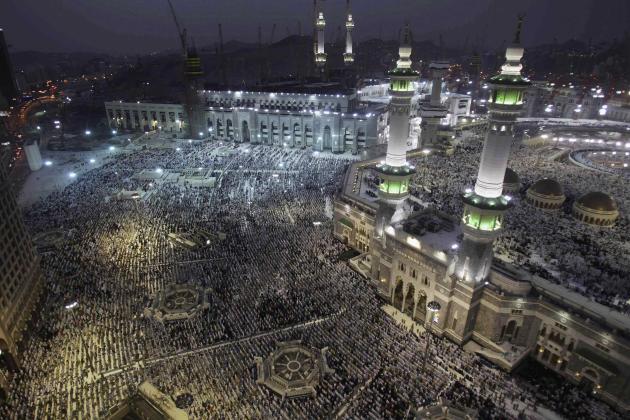
A massive change for Mina in 30 years 
HUGE TRANSFORMATION: In the last two years, the city underwent a massive change with the government
investing billions of riyals into many infrastructural projects to ease the daunting and physically demanding rituals of the annual pilgrimage.
14 October 2013
The tent city of Mina remains deserted throughout the year. It comes to life only during the five days of each Haj season.
Situated 12 kilometers outside Makkah, it was in this city that Prophet Ibrahim (peace be upon him) spent the night before he was set to carry out an order by God to slaughter his son. As Prophet Ibrahim prepared to slaughter Ismaeel, God instructed him to sacrifice a sheep instead. Muslims around the world slaughter sheep, cows and camels to feed the poor marking Prophet Ibrahim’s supreme sacrifice.
Mina is a small city located inside a valley. As far as the eye can see, tents cover every open space. They are neatly arranged, row after row. It is because of these ubiquitous tents that the city is referred to as the tent city.
In the last two years, the city underwent a massive change with the government investing billions of riyals into many infrastructural projects to ease the daunting and physically demanding rituals of the annual pilgrimage.
Those who came here 30 years ago or even 10 years ago can barely recognize Mina as it stands today.
Ahmed Muhammad Al-Haj, a Sudanese pilgrim, vividly remembers how the city looked in 1980.
“The one dominant structure in those days was Masjid Al-Qaif, in the center of Mina,” he said. “All pilgrims would come straight to the mosque from Makkah.”
It was here that Al-Haj made many friends from across the world. “There were Pakistanis, Indians, Malaysians, Americans, all of them,” he said. “The tents were there but they were in such massive numbers and they were not arranged with such meticulous precision. There was a lot of open space.”
The Jamarat Bridge, where pilgrims carry out the symbolic ritual of stoning Satan, was more like a small pedestrian footbridge. “There was a ground floor and a first floor; it was very small, but quite sufficient for the number of Hajis who came in those days,” said Al-Haj. “As the number of pilgrims swelled into millions in later years, the bridge became a death trap.”
Maulana Maqbool Rahmani, from India, is performing Haj after a gap of nearly 17 years. He was here in 1997. “We call that the year of the blaze,” he said, referring to the massive fire that swept through the tent city killing nearly 350 pilgrims. “I was among those who survived.”
Rahmani is full of appreciation for the Saudi authorities. “The very next year, the Saudi government started putting up high-tech fire-resistant tents throughout the city,” he said.
Each tent is made of fiberglass coated with Teflon and a heat-sensitive water sprinkler, which is linked to an alarm system, and electric lighting. That changed the face of Mina. The tents were organized in a scientific way.
After the fire, the government was faced with other daunting challenge; That of conducting an orderly ritual of stoning the Satan.
“That was the biggest challenge because tragedies at the Jamarat Bridge became a norm,” said Abrar Siddiqui, a Jeddah-based Haj operator. “It was a logistical nightmare for the authorities.”
It was then decided to convert the pedestrian-looking bridge into a massive complex to avoid congestion. Billions were spent on constructing the multi-floor complex with multiple exits, water sprinklers and air-conditioning.
“Now, performing the ritual is a breeze,” said Siddiqui. “The project, executed by Saudi Bin Ladin Group, has a helipad to evacuate pilgrims in distress during rush-hours.”
Also, in what is described as a smart move, the throwing of stones was made much easier by changing the shape of the pillars that symbolize Satan. “They were round pillars in the past and pilgrims would strain and sometimes injure themselves taking a shot at them with their pea-sized pebbles,” said Siddiqui. “They would miss their mark and would repeat the ritual again and again leading to catastrophes.”
The shape of the pillars was changed from round to elliptical. “As you approach them, they are now more like a V-shaped wall. And it is very easy to stone them,” said Siddiqui.
Once the tents and the bridge was taken care of, the government shifted its attention to organizing the chaotic transportation issue.
“Since all the pilgrims had to move from Makkah to Mina to Arafat and back to Muzdalifa and Mina, it would result in a logjam,” said Yasser Al-Qahtani, a television journalist. “Pilgrims would spend hours upon hours in their buses just to reach Muzdalifa and Mina from Arafat, a distance of mere 5 km.”
Despite constructing dozens of roads, there would still be traffic jams on the important day of Haj.
“That is when the government decided to introduce the Haj train,” said Al-Qahtani. “That resulted in taking the strain off the roads. Now, the Haj metro ferries thousands of pilgrims to Arafat from Mina and back.”
The Haj train added a dimension to the city. For first-time pilgrims it is nothing short of wonderment to see trains whizzing by on the elevated tracks in the tent city.
Rifat Anjum, a longtime Jeddah expat, said she performed Haj in 2000. “We were part of the Haj caravan organized by a Jeddah Haj operator. “We did not stay in a camp in those days; we were actually housed in a building located close to the Jamarat Bridge. On Jamarat day, we would actually look out from our building to see if the crowd was dense on the bridge,” she said.
All those buildings are now gone. The old city of Mina is now replaced by a modern city with massive health facilities, state-of-the-art slaughterhouses, over-bridges, pedestrian walkways and elevated train stations.
http://www.arabnews.com/news/467727  Mina field hospital ready for pilgrims
 The hospital includes 40 fully equipped beds and emergency beds. It is also equipped
with medical devices and clinical supplies, and operates around the clock.
14 October 2013
The Mina field hospital of the Health Affairs department at the National Guard has been built with fiberglass material, which is resistant to fire and heat.
The hospital includes 40 fully equipped beds and emergency beds. It is also equipped with medical devices and clinical supplies, and operates around the clock. The total area of the hospital is 256 square meters, divided into a section for men and one for women. It also includes specialized clinics, supporting services, dental clinics and gynecology, in addition to an integrated operation room, reception and administration offices, laboratories, an X-ray room and a pharmacy.
The location provides lodging for the staff on an area of 208 square meters.
The Health Affairs department provided umbrellas against the burning sun for the comfort and convenience of patients with air conditioners and emergency backup generators.
CEO of the department Bandar bin Abdulmohsen Al-Qanawi said that the field of medical services represents a common factor between the health department at the National Guard and the other health agencies in the Kingdom.
“The coordination process includes our department, the agencies of the Ministry of Health, the Ministry of Defense, the General Authority of Civil Aviation and the Ministry of Interior to provide the best services possible for the guests of Al-Rahman. These include medical evacuation operations. The National Guard has ten equipped teams on stand-by in case of emergencies,” said Al-Qanawi.
He pointed out the department is in constant coordination with the Civil Defense department to transport all patients whose health condition requires rapid intervention to King Abdulaziz Medical City in Jeddah.
“We coordinate also with the heads of Haj missions to provide all necessary medications, medical consultations and the other clinical supplies,” he said.
For this purpose, and a better cooperation between health affairs department and the Ministry of Health, a digital telephone line has been set up to link the information center at the Ministry of Health and the field hospital at Mina, in coordination with the Department of Information Systems and Informatics at King Abdulaziz Medical City in Jeddah.
The statistical system of the Ministry of Health, where all data on pathological cases and the services provided to the pilgrims are entered, will release special reports on the health status of the pilgrims.
He pointed out that equipped health camps would provide medical services in both Arafat and Muzdalifah as well.
“Two medical wagons were prepared to serve as an emergency centers at Arafat, one for men and the other for women. These can accommodate 20 beds,” he noted, adding that a team of doctors, pharmacists, technicians and administrators with the best Saudi qualifications will work around the clock to serve the pilgrims.
http://www.arabnews.com/news/467725 Colored wrist bands to assist pilgrims
using Mashair trains 
Wrist bands with color codes for various Mashair trains
14 october 2013
MAKKAH — The central department for the development of Mashair projects in the Ministry of Municipalities has published a guide for pilgrims using Mashair trains.
The guides include maps of the locations of camps for each train station at Mina, Muzdalifah, and Arafat, details of ticket colors used by pilgrims, train schedules, times of maintenance and the color of the wrist bands that will allow pilgrims to pass through the electronic gates in each station.
The Ministry has designated beige-colored wrist bands for stations No. 1 in Mina, Muzdalifah, and Arafat, dark brown for pilgrims using stations No. 2 and brown for stations No. 3 in the Mashair.
Black-colored wristbands are designated for all stations used by pilgrims during the Haj days from the tenth to the thirteenth of Dhul Hijja.
The Ministry stressed that wrist bands are only valid when worn on the wrist and become null and void if cut. The wrist bands are only valid for the days indicated on them and at the stations indicated by the color of the wrist bands.
Train stations No. 1 and 2 will serve 140,000 pilgrims each at the three holy places of Mina, Muzdalifah, and Arafat. Train stations No. 3 will serve 120,000 pilgrims and the total number of tickets will be 370,000.
Tickets are issued based on approved documents from the Ministry of Haj, which include the number of pilgrims and their camp locations, in addition to special permits of Tawafa establishments and Haj companies.
Tickets are issued and signed for by an official of the establishment who is committed to distributing the tickets to pilgrims.
http://www.saudigazette.com.sa/index...20131014183626