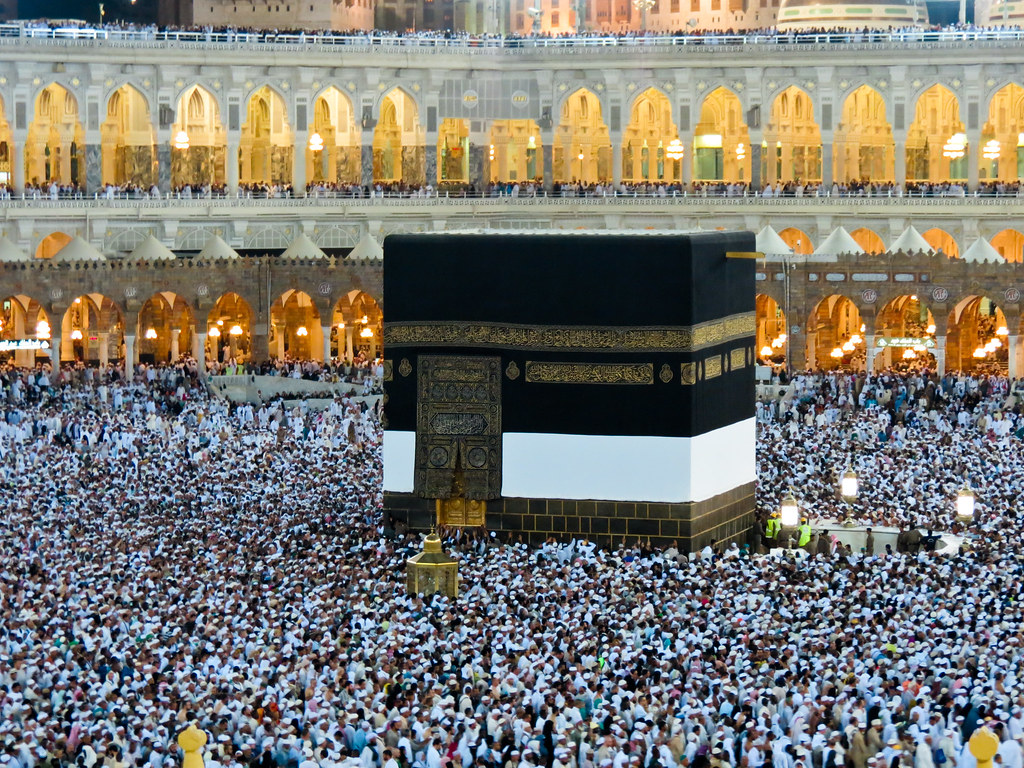
Saudi authorities stepped up preparations for the five-day annual Haj pilgrimage — which begins tomorrow — by mobilizing human and material resources.
More than three million pilgrims, including two million from abroad, are expected to take part in the spiritual event.
Groups of pilgrims have started the move from Madinah and other parts of the Kingdom to Makkah and Mina, chanting Labbaik Allahumma Labbaik (O God, here I am answering your call).
Custodian of the Two Holy Mosques King Abdullah, who is supervising Haj operation from Jeddah, instructed all related government departments to provide the necessary services to the guests of God.
Khaled Mirghalani, Health Ministry spokesman, said: “The ministry has readied 25 hospitals with a capacity of 5,200 beds in addition to the 141 health clinics situated in the holy sites, to serve pilgrims.” More than 175 ambulances are on stand by,” he added. The Saudi Red Crescent Authority plays an important role during Haj, providing first-aid and transportation services to hospitals. It will deploy 1,060 volunteers in Makkah, Mina and other holy sites.
The Civil Defense yesterday conducted a mock operation to control gas leakage near the Jamrat Bridge in Mina, where a large number of pilgrims assemble during the peak days of Haj for the stoning-the-Satan ritual.
Lt. Col. Abdullah Al-Ghamdi, commander of the Civil Defense’s special intervention force, said: “The operation was aimed at keeping our forces at a high level of readiness to deal with possible leakage of poisonous gases.”
Foreign pilgrims have expressed their joy over getting the opportunity to perform Haj, the fifth pillar of Islam. “It’s my first time in Makkah for pilgrimage. I can’t wait to pray in Arafat,” said 32-year-old Koara Abdulrahman, a businessman from Burkina Faso. Inside the Grand Mosque, scores of pilgrims circumambulated the Holy Kaaba with many pushing their way through the crowds to kiss Hajar Al-Aswad (the Black Stone) on a corner of the cube-shaped structure.
“Right now, I’ve got all the good feelings you can think of,” said an ecstatic Iranian pilgrim.
More than 1,400 Muslim leaders from around the world are performing Haj this year as guests of King Abdullah. They come from China, Russia, Cambodia, South Korea, Japan, Vietnam, Togo, Botswana, Burundi and Liberia.
Heavy rains hit Makkah and Mina on Sunday, and the Civil Defense said 13 people were slightly injured when a fire erupted in a building housing Indian and Myanmarese pilgrims.
Despite being marred by deadly incidents in the past such as floods, stampedes and fires, Haj has become nearly incident-free in recent years, thanks to multibillion-dollar projects implemented by the government annually.
This year, new development projects totaling SR 1.5 billion include an initiative to help pilgrims reach the Jamrat Bridge quickly from Makkah, Aziziya and Shaabain. The Ministry of Water and Electricity said it has started supplying 600,000 cubic meters of water daily to the holy sites. There are 36 water tanks in Makkah and 27 at the holy sites with a total capacity of 2.5 million cubic meters.
In other news, participants of a seminar organized by the Haj Ministry called for the use of social media networks to enhance Haj awareness for pilgrims. Najah Al-Qublan of Princess Norah University said: “We have to make use of social media effectively for creating Haj awareness and spreading the message of Islam.” Facebook users in the Arab world increased from 29.8 million in 2011 to 45.2 million by June 2012, she said.
http://www.arabnews.com/it%E2%80%99s...ms-go-haj-1433
Ibrahim’s legacy
Tuesday 23 October 2012
During Haj, Muslims remember and commemorate the trials and triumphs of the Prophet Ibrahim (peace be upon him). The Qur’an describes Ibrahim (pbuh) as follows: “Surely Ibrahim was an example, obedient to Allah, by nature upright, and he was not of the polytheists. He was grateful for Our bounties. We chose him and guided him unto a right path. We gave him good in this world, and in the next he will most surely be among the righteous.” (Qur'an 16:120-121)
One of Ibrahim (pbuh) supreme trials was to obey the command of Allah to sacrifice his only son, Ismail. Upon hearing this command, he prepared to submit himself to Allah’s will. When he was all prepared to carry out His Will, Allah revealed to him that his “sacrifice” had already been fulfilled. Ibrahim (pbuh) had thus proven that his love for his Lord superseded everything else and that he would lay down his own life or the lives of the people dear to him for the sake of God.
During the celebrations of Eid Al-Adha, Muslims commemorate and remember Ibrahim’s (pbuh) trials by slaughtering an animal such as a sheep, camel, or goat. Those outside the Islamic faith have often misunderstood this ritual.
Abdurahman Al-Rajhi said the Udhiyah (Islamic slaughtering) is a very meaningful and important occasion that reminds us of the sacrifices of Prophet Ibrahim (pbuh).
“We usually provide sacrifice on behalf of our parents and family and distribute part of it to the poor,” he said. “For me, I also have Udhiyah in the Philippines, three in Manila and two in Marawi city and this time another two in Bumbaran.”
The meats are distributed through a charitable organization there that I deal with, supervised and run by known Muslims in the country. They take half of them and distribute half of them to the poor people in the country.
Allah has given us power over animals and allowed us to eat meat, but only if we pronounce His name at the solemn act of taking life. Muslims slaughter animals in the same way throughout the year. By saying the name of Allah at the time of slaughter, we are reminded that life is sacred.
The meat from the sacrifice of Eid Al-Adha is mostly given away to others. Immediate members of the family and relatives eat one-third, another third is given away to friends, and one-third is donated to the poor. The act symbolizes our willingness to give up things that are of benefit to us or close to our hearts, in order to follow Allah's commands. It also symbolizes our willingness to forego part of our own bounties in order to strengthen ties of friendship and help those in need. We recognize that all blessings come from Allah, and we should open our hearts and share with others.
It is equally important to understand that the sacrifice itself, as practiced by Muslims, has nothing to do with atoning for our sins or using the blood to wash ourselves from sin. This is a misunderstanding by those of previous generations: “It is not their meat nor their blood that reaches Allah; it is your piety that reaches Him.” (Qur'an 22:37)
The symbolism is in the attitude — a willingness to render sacrifices in our lives in order to stay on the straight path. Each of us makes small sacrifices and give up things that are important to us. A true Muslim, who submits himself or herself completely to the Lord, is willing to follow Allah’s commands completely and obediently. It is this strength of heart, purity in faith, and willing obedience that our Lord desires from us.
On the day of Eid Al-Adha, Muslims around the world attend morning prayers at their local mosques. Prayers are followed by visits with family and friends, and the exchange of greetings and gifts. At some point, members of the family will visit a local farm or otherwise will make arrangements for the slaughter of an animal. The meat is distributed during the days of the holiday or shortly thereafter.
http://www.arabnews.com/ibrahim%E2%80%99s-legacy