Ministry to change ‘Shia question’ in Haj application
LAHORE: The Ministry of Religious Affairs undertook before the Lahore High Court on Friday to rephrase a question in the Haj application form, “Are you Shia?”, to “Do you require Shia facilities?” as it offended the community.
A deputy attorney general submitted an undertaking to the court on behalf of the secretary of the religious affairs ministry during the hearing of a petition filed by Syed Ali Hadi and others, questioning the alleged discrimination against the Shia community during Haj.
They complained that the authorities did not provide facilities to Shia pilgrims as per their sect.
Barrister Syeda Maqsooma Zahra Bokhari, representing the petitioners, said the Shia community had been subjected to discrimination, adding that a Shia applicant had to answer the “offending question”. She requested the court to order the ministry to amend the question in the Haj application form.
Justice Ayesha A. Malik disposed of the petition in the light of the ministry’s undertaking.
Sound bytes: ‘Shia identity column in Haj form is 20 years old’
MIRZA KHURRAM SHAHZAD — PUBLISHED MAY 07, 2015
SOCIAL Media is abuzz with criticism of a column in the Haj application form that seeks the identity of Shia Muslims. Many people insist that asking an applicant to reveal his or her sect in the Haj application form is religious or sectarian discrimination. While the Saudi government has reportedly denied that it had asked for this identity verification, the government of Pakistan says this column has existed in the form for the past 20 years.
Here are excerpts of an interview with Minister for Religious Affairs Sardar Mohammad Yousuf on the issue:
Take a look: Keep Hajj out of politics: Notes on the ‘Are you Shia?’ form debacle
Q: Why has the ministry of religious affairs introduced a separate column for the Shias in the Haj application form?
A: It hasn’t been introduced now. It has been there for 20 years, but it has apparently just been noticed by most people.
Q: Why are Shias required to reveal their sect in the Haj application form?
A: This is needed to meet some requirements of the Shia sect for Haj.
Q: What are these requirements?
A: Shias want some separate arrangements for them. They demand, for instance, roofless buses to travel after wearing ahrams. They also demand separate maktabs and residential buildings. They want to return home soon after Haj because of the approaching month of Muharram. They want to perform more umrahs than other pilgrims and also for their relatives. They want to travel at night only and they go to Jofa, a place 180 kilometres from Makkah, to wear ahrams unlike other pilgrims, who wear ahrams before flying to Jeddah from Pakistan. Shia women may perform Haj without a mehram while women from other sects can perform Haj only accompanied by a mehram. And they also organise majalis in their maktabs. So it’s important to ask the pilgrims if they are Shia to make all these arrangements possible for them.
Q: Does the Pakistan government also provide them separate clerics for their prayers and majalis?
A: No, they arrange it themselves.
Q: Are Shia leaders on board with the ministry on this issue?
A: Yes. All these arrangements are made on their own request. They are asking even for a separate quota of pilgrims for the Shia community, which we can’t provide because we can’t allocate a separate quota for the followers of every sect.
Q: Are Shias satisfied with the arrangements the ministry of religious affairs makes for them?
A: Yes, they are satisfied.
Q: Don’t you think this question about the Shia sect has fuelled religious disharmony among different sects in Pakistan?
A: No, because this is being asked to serve them better. There is no question of religious disharmony.
Q: What steps have you taken to dispel the impression that the government has created disharmony among various sects by asking such questions?
A: We are issuing statements to clarify the situation. We have also sent a detailed statement to parliament to clarify the issue. We will also release facts to the press to negate the wrong impression. There is certainly no controversy about it.
ISLAMABAD: On the directives of Prime Minister Nawaz Sharif, PIA has announced a reduction in air fare for Haj 2016 by approximately Rs4,000, a spokesman of the airline said.
The flights will be operated on a no-profit, no-loss basis, he said, adding that this year’s return fare for flights from Peshawar, Islamabad, Lahore and Sialkot would be Rs 95,000, while pilgrims from Karachi, Quetta and Sukkur would pay Rs86,000, inclusive of taxes.
Meanwhile, the government informed the Senate Standing Committee on Religious Affairs on Friday that the cost of Haj would be reduced by Rs120 per person this year.
The committee, headed by Senator Hafiz Hamdullah, was briefed on the draft Haj Policy for 2016, which will be forwarded to the federal cabinet for approval next week.
“A total of 143,368 Pakistanis will perform Haj this year at a cost of Rs264,851 per person compared to the Rs264,971 charged last year,” Religious Affairs Secretary Suhail Aamir told the committee.
He said that 60pc of the pilgrims would perform Haj under the government’s scheme. “The ministry will start receiving applications from April 4 and the final balloting will be held on April 17,” the secretary said.
The committee’s members criticised the schedule and asked how could the ministry start collecting applications from Monday when the policy was yet to be approved. The senators also expressed concern over the delay in finalising the policy. “April has started and the ministry is yet to send a draft to the prime minister for approval,” Senator Hafiz Hamdullah said.
Minister for Religious Affairs Sardar Muhammad Yousaf said that last year also the policy was finalised in April. He said that applications would be received from April 4 and 10 days were enough to complete the process.
According to the draft policy, Haj flights will operate from Rawalpindi, Islamabad, Lahore, Karachi, Multan, Peshawar, Rahim Yar Khan and Sukkur. And the ministry’s secretary said that PIA, Shaheen Air, Air Blue and Saudi Airlines would take part in the Haj operation.
The committee was also informed that an Emergency Management System would be in place to cope with any untoward situation, such as the Mina stampede last year. A seven-member committee headed by the Haj DG will supervise the working of the unit. Besides, a team of 450 supporting staff, including personnel of the police, army and other departments will be deputed with the pilgrims.
Joint secretary of the Ministry of Religious Affairs Ilyas Khan informed the committee that five private companies had been blacklisted on the basis of complaints filed by pilgrims against them last year.
Temporary Mataf is now closed! ____________________________________
Start the first phase to remove ''Temporary Mataf''
Full Mataf will be available for Ramadan
بدء المراحل الأولى من مشروع «إزالة المطاف المؤقت يأتي المشروع للاستفادة من كامل صحن المطاف خلال شهر رمضان
Sunday 2016/04/03
بدأت اليوم رئاسة شؤون الحرمين في المراحل الأولى من مشروع إزالة المطاف المؤقت المحيط بالكعبة المشرفة وذلك للاستفادة من كامل صحن المطاف خلال شهر رمضان. ونشرت رئاسة شؤون الحرمين على حسابها الرسمي في تويتر صورًا تبيّن بدء المراحل الأولى من المشروع.
وجاء قرار الرئيس العام لشؤون المسجد الحرام والمسجد النبوي الشريف الشيخ عبدالرحمن السديس أمس السبت للجهات الفنية في مباشرة مهام إزالة الطواف المعلق المؤقت المحيط بالكعبة المشرفة في أسرع وقت قبل شهر رمضان، وجاء هذا القرار لما تقتضيه المصلحة العامة، وللاستفادة من كامل صحن المطاف في الدور الأرضي، وكذلك الأدوار خلال شهر رمضان المقبل.
Google translation: Began today Affairs of the Two Holy presidency in the early stages of the project, remove the ultimate ocean Kaaba in order to benefit from the full Mataf during Ramadan. The Presidency of the Affairs of the Two Holy published on the official Twitter account at the start of photographs showing the early stages of the project.
The General President of the Sacred Mosque mosque decision of Prophet Mohammad Sheikh Abdul Rahman Al-Sudais Saturday artistic destinations in the direct removal functions circling the temporary suspension Ocean Kaaba as soon as the month before Ramadan, the decision came as required by the public interest, and to take advantage of a full bowl of the day on the ground floor , as well as roles in the coming month of Ramadan.
MAKKAH – The inside portion of the newly constructed Haram building that overlooks mataf (circumambulation area around the Holy Kaba) has been decorated with Islamic floral designs.
The prayer areas inside the Grand Mosque are also adorned by various engineering and geometrical designs adding beauty to the place’s spiritual environment.
“We have selected these special designs for the Grand Mosque as they are part of the Islamic heritage,” an informed source at the Haram Mosque told Makkah Arabic daily.
He said the new designs are made of best quality marbles brought specifically for the Grand Mosque. He described Islamic floral as the best form of architectural design.
“These decoration works are done by a team of experts recruited from different parts of the world,” said the source who requested anonymity. “This work has been done carefully to avoid any influence of un-Islamic faith and designs,” he said.
The Islamic floral designs are used for the external decoration, he said, adding that it is prepared on the basis of the designs of various types of leaves and flowers.
“A single floral design will have intertwined elements of various leaves, which are then repeated in an organized and harmonious manner,” he explained.
Floral designs look beyond nature as they are securitized through geometric decoration where the principle of abstraction prevails, the official said.
“These designs are widely used to decorate mosques, tombs, walls and other treasured materials made of copper, ceramic and glass,” he added. It is also used to decorate book pages and bindings.
He said the interior walls of the new Haram building is ornamented by geometric decoration with marvelous designs, which is based on the use of geometric lines.
It’s formulated in marvelous art forms with different polygons, star shapes and overlapping circles.
« Temporary Mataf bridge » dismantling work begins
“The temporary bridge will be dismantled by Shabaan 20, 1437 A.H. (about 10 days before Ramadan month begins),”
PURPOSE SERVED: With the expansion work at the Grand Mosque nearing completion, the temporary Mataf bridge is being dismantled.
Monday 4 April 2016
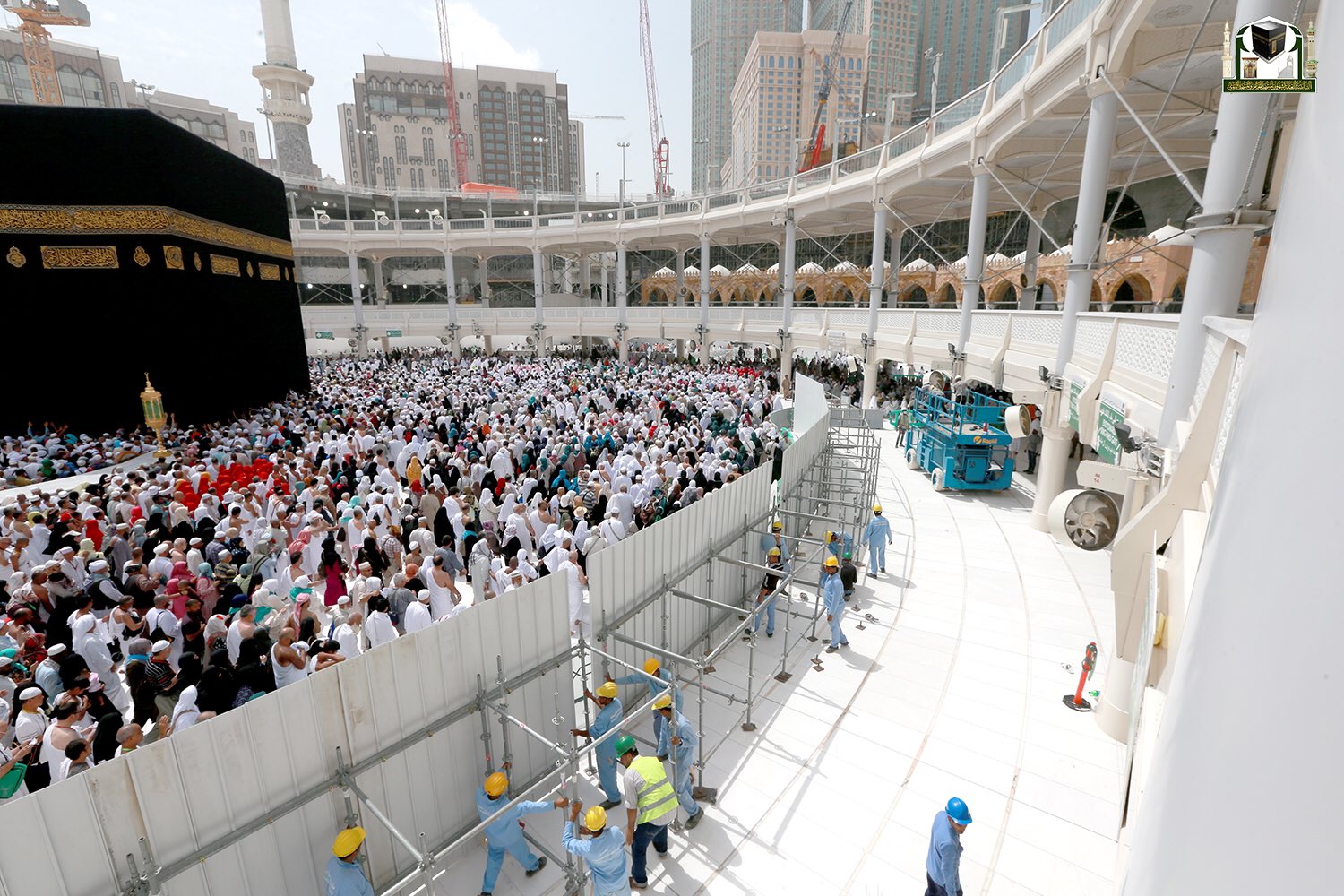
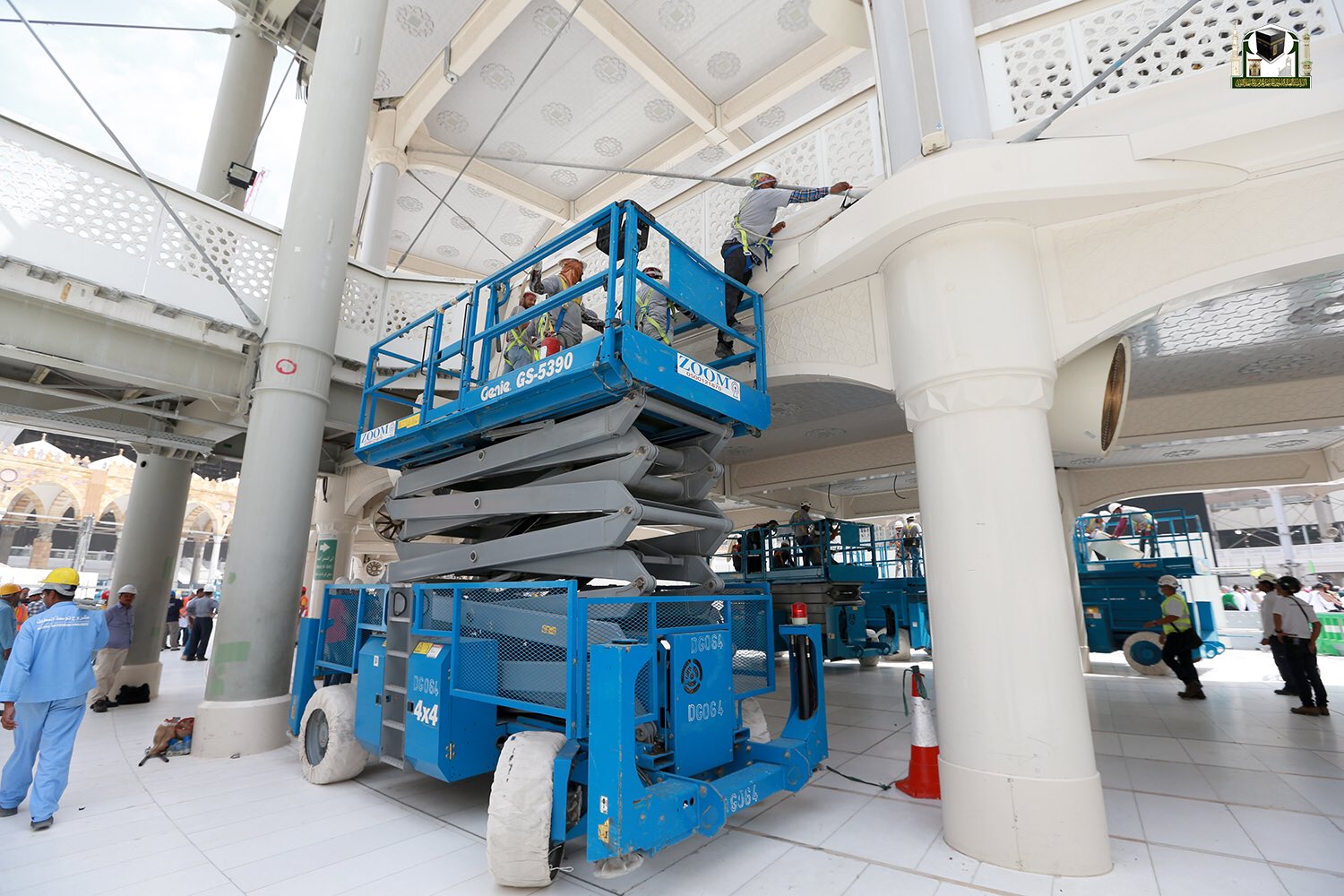
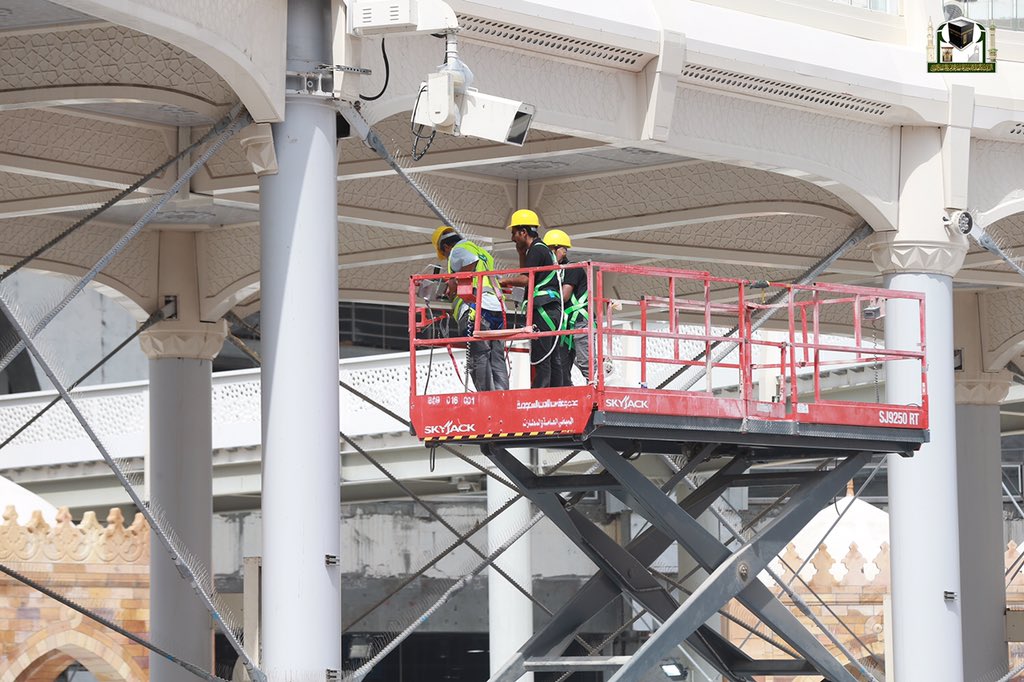
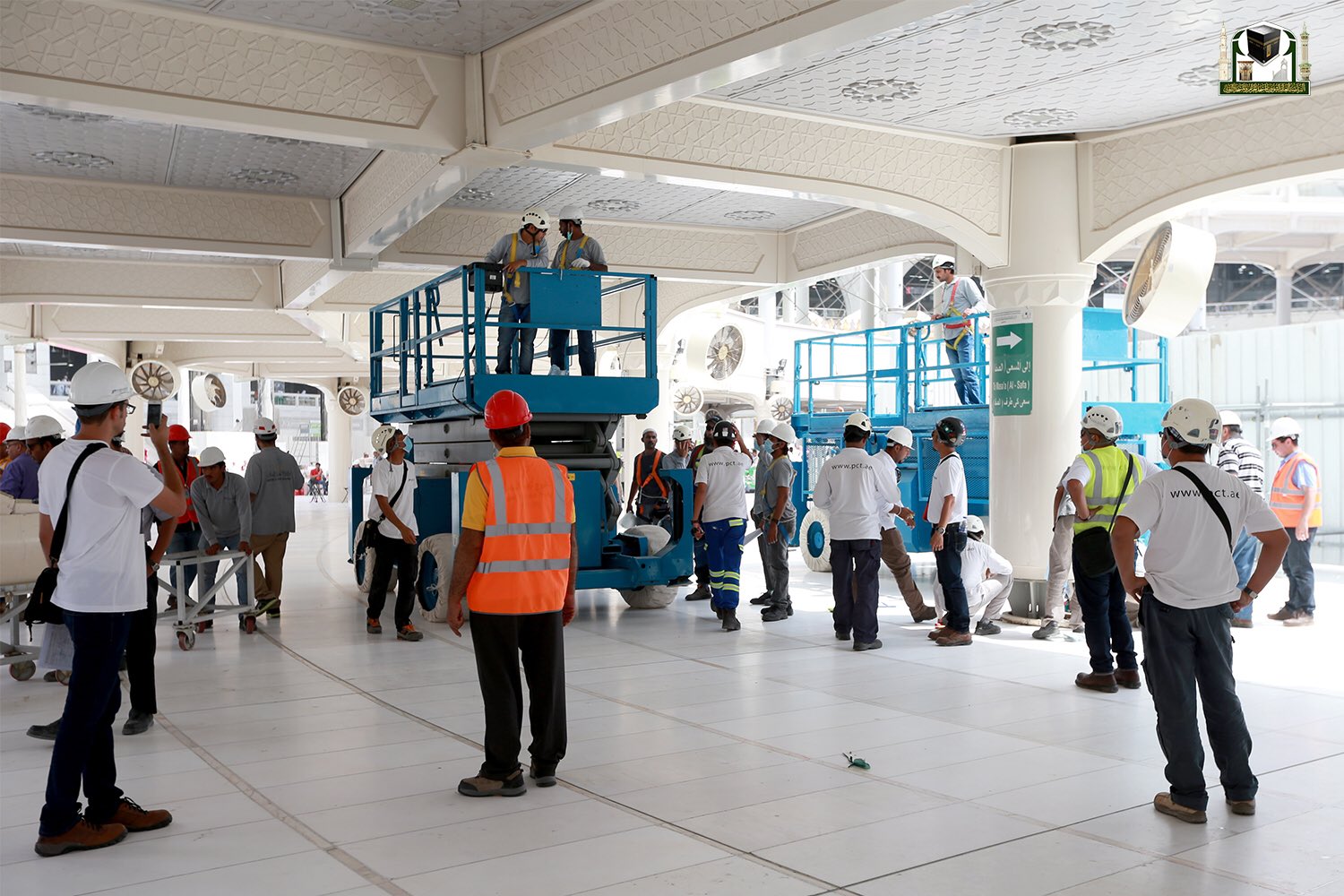
MAKKAH: Work on dismantling the temporary Mataf bridge began while ensuring all safety measures at the Grand Mosque here on Sunday.
The work will be carried out around the clock to meet the deadline of Ramadan, an official was quoted as saying by local media on Sunday.
“The temporary bridge will be dismantled by Shabaan 20, 1437 A.H. (about 10 days before Ramadan month begins),” said Faisal Wafa, head of the Mataf Technical Committee in Umm Al Qura University.
“The mosque’s security, civil defense, Umm Al-Qura Technical Committee and the project contractor are coordinating with each other to ensure total safety.”
Sheikh Abdul Rahman Al-Sudais, head of the Presidency of the Two Holy Mosques, said in a statement that the temporary bridge is not needed now because the Mataf expansion project has been completed.
Al-Sudais urged the elderly people and the handicapped who rely on wheelchairs to use the alternative track of the Mataf bridge and follow guidelines and instructions with regard to entry and exit.
MAKKAH — Work on demolition of the suspended mataf (makeshift bridge facilitating circumambulation of Holy Kaba) began on Sunday. The whole process will be completed by May 27.
The temporary bridge was erected in August 2013 to reduce congestion in the Grand Mosque due to the implementation of the third phase of its expansion.
The demolition has begun on the western side of King Fahd Expansion Project as the area is ready to receive pilgrims and visitors.
Faisal Wafa, a staff member of Umm Al-Qura University, who is the chairman of the technical committee of the mataf, said the purpose behind the construction of the temporary bridge has been served. “It is time it should be demolished,” he said.
He said the contractor of the expansion project is carrying out the demolition process in collaboration with the security forces of the Grand Mosque, the Civil Defense and the technical committee to ensure the highest degree of safety for the pilgrims.
Wafa said trucks to remove the debris will enter the mataf area through Al-Shabakiyah area.
He said the first floor of the mataf has been dedicated for pilgrims using hand-pushed wheelchairs while the mezzanine floor will be used by pilgrims on electric chairs.
Wafa said the entire third phase of the expansion project from Al-Shamiyah area, all mataf floors and the ceiling will be ready for use during Ramadan.
He said the new mataf area will allow about 107,000 pilgrims circumambulate the Kaaba in an hour...
ENSURING SAFETY: Workers erect safety barriers in the Mataf as work to dismantle the temporary bridge starts.
Tuesday 5 April 2016
MAKKAH: After four years of use, the temporary Mataf is being dismantled. Once the structure is removed, up to 30,000 worshippers will be able to perform tawaf (circumambulation of the Kaaba) per hour, which is an increase of over 20,000 per hour compared to previous times.
The dismantling is carried out according to a work plan that involves pulling apart the structure one section at a time, and done around the clock. The authorities plan to finish the job before Ramadan, which starts on June 6, depending on the sighting of the moon.
The dismantling was initiated on the orders of Custodian of the Two Holy Mosques, the crown prince, the deputy crown prince and the governor of Makkah because the expansion project of the Haram Mosque is now complete.
The head of the Presidency of the Two Holy Mosques, Abdul Rahman Al-Sudais, said the recent developments should be credited to King Salman. He said that it was on his directions that the work took place, including a number of workshops and meetings held with parties that have the direct bearing on the work. These included the technical committee in the Presidency of the Two Holy Mosques, the technical committee in the Education Ministry, the Finance Ministry, the executing contractor (Bin Laden Group) and the project advisers of Dar Al-Handasah.
This is in addition to the various security authorities, including the Grand Mosque Emergency Force, Special Haj and Umrah Force and the Civil Defense Security Force, who laid out an operations plan for the stages of dismantlement of the temporary Mataf bridge.
Al-Sudais added that there are now alternative routes to the Mataf for the elderly and physically challenged, as well as exit and entry points to ensure the safety of worshippers.
Additionally, there are currently four cranes inside the Mataf area, including a crane on the Haram surface to dismantle parts to the eastern side of the Salam Gate, to enable the dismantling process to be done in successive parts.
Temporary Mataf bridge « to be removed to warehouses »
Apr 5, 2016
MAKKAH-The dismantling of the temporary mataf (circumambulation of the Holy kaaba) which was constructed about three years ago began on Sunday by cutting off electricity, disconnecting the fans and closing its two floors before pilgrims and visitors could arrive.
The makeshift bridge was installed to provide more space for circumambulation seven times around the Kaaba to substitute the areas, which have been occupied by the expansion project of the Grand Mosque.
The expansion project has continued for three years with each phase taking about a year to complete. The Presidency of the Two Holy Mosques has prepared assembly points inside the Grand Mosque to collect the demolished parts of the temporary bridge so as to be removed to warehouses, which are away from the mosque.
Haj security man among ring of Iran spies faces treason charge
Apr 7, 2016
RIYADH — The defendant No. 30 in the ring of the 32 people suspected of spying for Iran, a Saudi security man who is working in the Haj security forces, has been accused of grand treason. The attorney general has asked for capital punishment for him.
The suspect, who stood before the Criminal Court on Tuesday, was charged with concealing the Iranian intelligence elements and his own brother the suspect No 7 and not informing the concerned authorities about them though he was well aware of their harmful intentions.
He was accused of meeting with Iranian intelligence elements and informing them about the nature of his work as a military man responsible for the safety and security during the Haj season. He was also accused of not informing about the defendant No. 18 with whom he was closely connected.
The defendant gave the judge two hand-written papers containing his reply to the charges against him but asked the judge not to consider them until they are legally written when he was able to meet his lawyer.
The defendant No. 29, who also appeared before the court on Tuesday, was accused of cooperating with Iranian intelligence elements to enable them achieve their evil designs of undermining national security and dismantling social fabrics in the Kingdom.
He was also accused of supplying these elements with security, social and economic data about the Kingdom, being behind the riots in Qatif and writing an inflammatory report against the Kingdom calling for demonstrations to spread chaos in the country.
The three lawyers, who were appointed by the defendants, have been absent from the court since it started sessions early February. The court has so far held 15 sessions.
30 percent work on dismantling of temporary mataf completed
« The whole project expected to be completed by May 25 »
Work to dismantle temporary mataf in the Grand Mosque continues in full swing.
Apr 7, 2016
MAKKAH — The dismantling of the temporary mataf, which was built about three years ago to facilitate circumambulation around the Holy Kaba, has been completed by about 30 percent in its first of eight stages, according to the chairman of the technical committee of the project Faisal Wafa.
The official expected the whole project to be completed by May 25 and said about 80 Saudi engineers are working 24/7 to complete the dismantling of the makeshift bridge on time.
Wafa said with the beginning of the holy month of Ramadan, pilgrims will be able to use the ground floor as well as the first floor, the mezzanine and the ceiling to perform circumambulation of the Kaba.
“This will ensure the pilgrims with enough mataf area that can accommodate more than 107,000 people in an hour instead of the present 20,000,” the official asserted.
Wafa said entrance to the ground, first and mezzanine floors of the mataf will be from the direction of King Fahd Expansion Project.
He explained that the ground and the mezzanine floors are connected to the Saie (hastening between the hillocks of Safa and Marwa) area and said pilgrims on wheelchairs will arrive at the mataf bridge from Al-Umrah Gate.
The chairman said an operations room has been established to immediately resolve any problem facing the workers in the project.
“Our top priority is the safety and security of the pilgrims. We are doing the dismantling of the bridge very carefully and removing the debris to warehouses which are far away from the Grand Mosque,” he said.
Academic calls for action to keep Hira Cave safe, clean
Apr 10, 2016
MAKKAH – A Saudi academic, who recently climbed on the Jabal Al-Nour near Makkah to see the Hira Cave along with her three Jordanian friends, has highlighted a number of concerns with regard to safety and cleanliness of the historic place.
According to her, a growing number of beggars, absence of safety systems, illegal vendors, absence of lights and lack of cleanliness are a cause for major concern.
Dr. Hajar Awad, the academic, has urged the authorities to give special care to this important historical landmark in Makkah by taking measures to ensure its cleanliness, safety of visitors, improve its pathway and control the growing number of beggars.
She urged the municipality and mayoralty to remove the illegal and disorganized vendors in and around the mountain, provide lighting and prevent people from visiting the cave in the night to avoid possible accidents.
“Climbing on the mountain to see Hira Cave was one of my childhood dreams,” the academic told Al-Madinah Arabic daily. “It’s not easy to climb the mountain but the place’s spiritual importance gave me the power and enthusiasm to realize that dream.”
She said her father had narrated the story of Hira Cave when she was a little girl. Prophet Muhammad, peace be upon him, used to climb on the mountain and spend days in the cave for the purpose of seclusion and meditation until he got the revelation from Allah.
“Since my childhood, I have been thinking about this historical place where the greatest of all prophets, Prophet Muhammad, used to spend many days and nights thinking about the Almighty. As a result I had tremendous desire to see that cave.”
She added: “When I became a mother I used to narrate the same story to my children and promised them that one day I would take them to that place on top of Jabal Al-Nour on a spiritual journey.”
Awad said she was extremely happy when she started the journey to the cave. “When I looked from the bottom to the top of the mountain I acquired great enthusiasm that helped me climb the mountain without any feeling of tiredness,” she said.
She said the Jordanian friends had asked her to accompany them while visiting the historical cave. “When we reached the middle of the mountain, one of the three said she is tired and could not continue and we asked her to sit in a place until we return.”
She said she was continuously praying to the Almighty to give her the power and courage to complete the journey without any difficulty. As they were climbing the mountain, Awad thought whether the authorities had given better care to the cave that attracts a large number of Haj and Umrah pilgrims every year.
“After reaching the top of the mountain I looked around and could see and the Grand Mosque in Makkah. What a beautiful and gracious place. I was wondering how the Prophet used to climb on this mountain during those days without any steps,” Awad said.
“When I sat inside the Hira Cave I felt an unprecedented spiritual feeling, which cannot be explained in words,” she said. “I had forgotten all the difficulties I had to face while climbing that lofty mountain, taking more than an hour and a half.”
When the sun was about to set, it was time for us to return through the difficult terrain of the mountain. “It was a wonderful experience and I will tell that story to my grandchildren one day.”
Yapı Merkezi-Saudi Bin Ladin Group Consortium signed an agreement with Saudi Railway Organization for the turnkey construction of the Mecca and Madinah railway stations of the Haramain High Speed Rail Project in Saudi Arabia. This project connects Mecca-Jeddah-King Abdullah Economic City-Madinah and it's 450 km long.
Due to consortium agreement with Saudi Bin Ladin Group, Yapı Merkezi undertook the construction of the Madinah Station. The project has been completed in 2015.
Permanent technical panel to ensure safety of Harams’ projects ________________________________________________________________
« Temporary Mataf dismantling = about 7% accomplished and 1st phase 60% »
« Dismantling in 8 phases each taking about 8 days to complete »
Apr 11, 2016
MAKKAH — Crown Prince Muhammad Bin Naif, deputy premier, interior minister and chairman of the Supreme Haj Committee, has ordered the establishment of a permanent technical committee to supervise the execution of the development and expansion projects of the Grand Mosque in Makkah and the Prophet’s Mosque in Madinah with a view to ensuring the highest degree of safety.
The prince said the safety and comfort of the pilgrims and visitors have the top priority for the Saudi authorities.
Meanwhile, member of the technical committee for the expansion of the mataf area, Wail Saleh Halabi said there was continuous coordination with the departments concerned with mass management to benefit from the completed expansion phases.
Temporary Mataf
He said the temporary mataf was constructed within the continuous search for a radical solution to find an alternative for the tawaf (circumambulation) on wheel chairs.
He said the temporary mataf was being dismantled because of its adverse visionary effects and its obstruction of the construction of the domes of the old portico. Halabi said the demolition of the makeshift mataf would be done through eight phases each taking about eight days to complete.
When the expansion of the mataf area is competed, it would easily accommodate more than 107,000 pilgrims an hour instead of the current 20,000.
“About seven percent of the demolition of the temporary bridge has been completed while the first phase was accomplished by about 60 percent,” he said.
He said they started the dismantling at the western side of the temporary bridge because the eastern side contains the control room for lighting and sound through loud speakers.
He said the electric power has been transferred to the original mataf building and therefore there was no negative impact on the process of work.
This cannot be undone and I am sure it will be greatly appreciated.
We apologise but you have been denied access to report posts in this thread. This could be due to excessively reporting posts and not understanding our forum rules. For assistance or information, please use the forum help thread to request more information. Jazakallah