JEDDAH: Grand Mufti and Chairman of the Council of Senior Scholarships Sheikh Abdulaziz Abdullah Al-Asheikh called on astronomers questioning the accuracy of prayer timings in the Umm Al-Qura calendar to refrain from confusing people, and confirmed that the calendar is accurate and the complaints against it are wrong.
In response to claims by astronomers that Umm Al-Qura calendar is a few minutes ahead of the actual Fajr time, he said: “The calendar is accurate and tests were conducted throughout different regions, while the Ministry of Finance confirmed that the calendar was accurate and the claims incorrect.”
Sheikh Abdulaziz bin Abdullah bin Baz, the former grand mufti of Saudi Arabia, sent two scientific committees to the desert to watch the sunrise, and found that the Um Al-Qura calendar is accurate, he said. “The claims otherwise merely seek to confuse people.”
Meanwhile, Abdullah Al-Khodari, an astronomer, said the calendar is “three minutes ahead of the actual Fajr time as well as sunset. As such, the call to prayer is three minutes early,” he said, noting that it is his duty before Allah to make this information available.
In a recent tweet, Al-Khodari said those who claim that the Umm Al-Qura calendar is 20 minutes earlier than the actual time are wrong, as it is only three minutes.
Masha'Ala Many have embraced Islam due to yesterday nights 'Makkah live snap chat vid', even the papers are talking about it. Many are inspired by how beautiful this religion and Makkah is, especially compared to how the media portrays it.
Any one please tell me what is best dua to do at Multazim, Always there is a huge crowd present at this place & when I reach there I am getting confused !
No special form of worship is prescribed for Laylatul Qadr. The night should be spent by offering as much nafl prayers as one can offer, in recitation of the Holy Qur'an, in dhikr and tasbeeh, in supplications and in making sadaqah (charity).
This is a night meant for developing a special connection with one's Creator, for offering acts of worship in solitude and seclusion, for having constant and exclusive contact with his Lord Who is the Lord of the universe, for minimizing the diversity of thoughts and actions and for devoting oneself to Allah Almighty with his heart and soul.
This purpose can seldom be achieved in congregations and assemblies. That is why the Holy Prophet never tended to celebrate this night by lectures, meetings, illumination or even by offering prayers in jama'ah. Instead, he used to perform acts of worship individually, and in solitude.
Sayyidah 'Aishah رضي الله عنه once asked the Holy Prophet as to what du'a (supplication) she should recite in the Laylatul Qadr. The Holy Prophet taught her the following du'a:
"O Allah, You are surely most forgiving and You like forgiving, so, forgive me." (Tirmidhi)
The best way to benefit from the blessings of this night is to keep awake for the whole night and spend it in worship and prayers. But people who cannot do so for any reason should spare at least a considerable part of the night for acts of worship. At least 8 rak'at should be prayed after midnight as tahajjud, some part from the Holy Qur'an should be recited and the supplications of the Holy Prophet should be offered. Any dhikr or tasbeeh should be constantly recited. Even when one is not in the state of wudu, the dhikr and tasbeeh may be recited. Similarly, the dhikr may also be performed during other states, when walking or in bed.
Ahaadeeth
Abu Hurairah (radiallahu anh) reported: The Prophet (salallahu alayhi wa sallam) said, "Whosoever performs Qiyam during Lailat-ul-Qadr (Night of Decree), with Faith and being hopeful of Allah's reward, will have his former sins forgiven.'' [Al-Bukhari and Muslim]
`Aishah (radiallahu anha) reported: The Messenger of Allah (salallahu alayhi wa sallam) used to seclude himself (in the mosque) during the last ten nights of Ramadan. He would say, "Search for Lailat-ul-Qadr (Night of Decree) in the last ten nights of Ramadan.'' [Al-Bukhari and Muslim]
`Aishah (radiallahu anh) reported: The Messenger of Allah (salallahu alayhi wa sallam) used to observe I`tikaf in the last ten days of Ramadan and say, "Seek Lailat-ul-Qadr (Night of Decree) in the odd nights out of the last ten nights of Ramadan.'' [Al-Bukhari]
We learn from this Hadith that Lailat-ul-Qadr occurs in any of the five odd nights - 21st, 23rd, 25th, 27th and 29th - of the last ten nights of Ramadan. Its exact date has not been revealed for the reason that people keep themselves awake for prayer for a larger number of nights. Had its date been fixed, people would have kept awake for prayer only on that night.
`Aishah (radiallahu anha) reported: When the last ten nights (of Ramadan) would begin, the Messenger of Allah (salallahu alayhi wa sallam) would keep awake at night (for prayer and devotion), awaken his family and prepare himself to be more diligent in worship. [Al-Bukhari and Muslim]
'Aishah (radiallahu anha) reported: The Messenger of Allah (salallahu alayhi wa sallam) used to strive more in worship during Ramadan than he strove in any other time of the year; and he would devote himself more (in the worship of Allah) in the last ten nights of Ramadan than he strove in earlier part of the month. [Muslim]
One should keep oneself awake for prayer, worship and glorification of Allah in the last ten nights of Ramadan so that one can attain the blessings of Lailat ul-Qadr. One should also persuade his family members to keep themselves awake for prayer and worship in the last ten odd nights of Ramadan so that they can also make efforts to please Allah. I`tikaf (seclusion in the mosque for prayers) in the last ten days of Ramadan is also a meritorious act for its being a practice of the Prophet (salallahu alayhi wa sallam).
`Aishah (radiallahu anha) reported: I asked: "O Messenger of Allah! If I realize Lilat-ul-Qadr (Night of Decree), what should I supplicate in it?'' He (salallahu alayhi wa sallam) replied, "You should supplicate: Allahumma innaka `afuwwun, tuhibbul-`afwa, fa`fu `anni (O Allah, You are Most Forgiving, and You love forgiveness; so forgive me).'' [At-Tirmidhi]
There is no specific du’aa’ that the Muslim should say in that place. He can cling to the Multazam when he enters the Ka’bah (if it is easy for him to enter) or he may do that before performing the Farewell tawaaf (tawaaf al-wadaa’), or he may do it at any time he wants. He should not cause difficulty for other people by offering a lengthy du’aa’. Similarly it is not permissible to crowd other people or annoy them in order to cling there. If he sees a space then he should say du’aa’. Otherwise it is sufficient for him to say du’aa’ whilst circumambulating and when prostrating in prayer.
What was narrated from the Sahaabah (may Allaah be pleased with them) concerning the Multazam is more sound than that which has been narrated from the Prophet (peace and blessings of Allaah be upon him).
It was narrated that ‘Abd al-Rahmaan ibn Safwaan said: When the Messenger of Allaah (peace and blessings of Allaah be upon him) conquered Makkah, I said: I will put on my garments, as my house was on the road, and I will wait and see what the Messenger of Allaah (peace and blessings of Allaah be upon him) does. So I went and I saw that the Prophet (peace and blessings of Allaah be upon him) had come out of the Ka’bah, he and his companions, and they were touching the House from the Door to the Black Stone. They had placed their cheeks against the House and the Messenger of Allaah (peace and blessings of Allaah be upon him) was in the midst of them. Narrated by Abu Dawood, 1898; Ahmad, 15124.
Its isnaad includes Yazeed ibn Abi Ziyaad, who was classed as da’eef (weak) by Ibn Mu’een, Abu Haatim, Abu Zar’ah and others.
It was narrated from ‘Amr ibn Shu’ayb that his father said: I circumambulated the Ka’bah with ‘Abd-Allaah, and when we came to the back of the Ka’bah I said: Will you not seek refuge with Allaah? He said: We seek refuge with Allaah from the Fire. Then he proceeded to touch the Stone, and he stood between the Corner and the door, and placed his chest, face, forearms and hands like this, and spread them out. Then he said: This is what I saw the Messenger of Allaah (peace and blessings of Allaah be upon him) do. Narrated by Abu Dawood, 1899; Ibn Maajah, 2962.
Its isnaad includes al-Muthanna ibn al-Sabaah, who was classed as da’eef (weak) by Imam Ahmad, Ibn Mu’een, al-Tirmidhi, al-Nasaa’i and others.
But these two ahaadeeth corroborate one another.
Shaykh al-Albaani classed it as saheeh in al-Silsilah al-Saheehah, 2138.
And he narrated that Ibn ‘Abbaas (may Allaah be pleased with him) said: “The Multazam is between the Corner and the door.”
Shaykh al-Islam Ibn Taymiyah said:
If (the pilgrim) wants to go the Multazam – which is the area between the Black Stone and the door – and place his chest, face, forearms and hands against it and make du’aa’ and ask Allaah for what he needs, he may do so. He may do that before the farewell tawaaf, for it does not matter if this iltizaam (clinging) is done at the time of the farewell tawaaf or at another time. The Sahaabah used to do that when they entered Makkah. If he wishes he may say the du’aa’ that was narrated from Ibn ‘Abbaas: “O Allaah, I am Your slave, son of Your male slave, son of Your female slave. You have caused me to ride that which You have subjugated to me of Your creation and You caused me to travel through Your land until You caused me to reach Your house by Your grace, and You have helped me to perform my rituals (of pilgrimage). If You were pleased with me then I hope that you will be more pleased, otherwise be pleased with me now before I depart from Your House, for now I am about to depart if You permit, without turning to anyone but You and seeking to visit any house other than Yours. O Allaah, give me good health in my body and protect my religious commitment; let me find my family well and safe upon my return and help me to obey You so long as You keep me alive, and join me, and give me the good of this world and the Hereafter, for You are able to do all things.”
If he stands by the door and prays there without clinging to the House, that is also good.
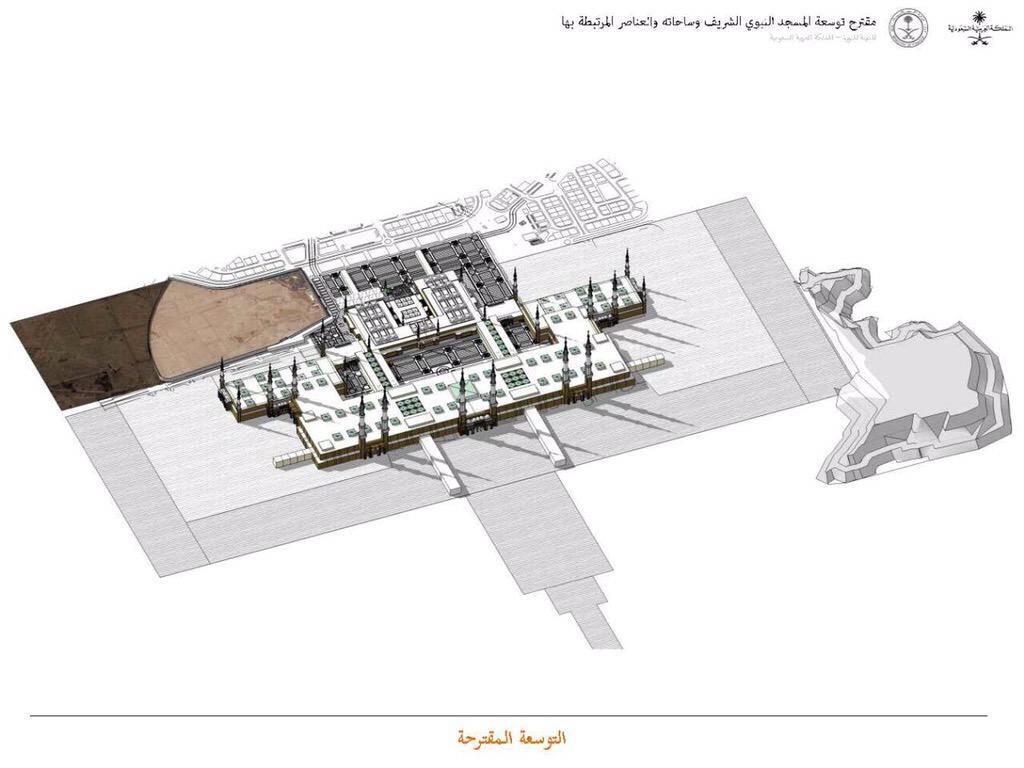
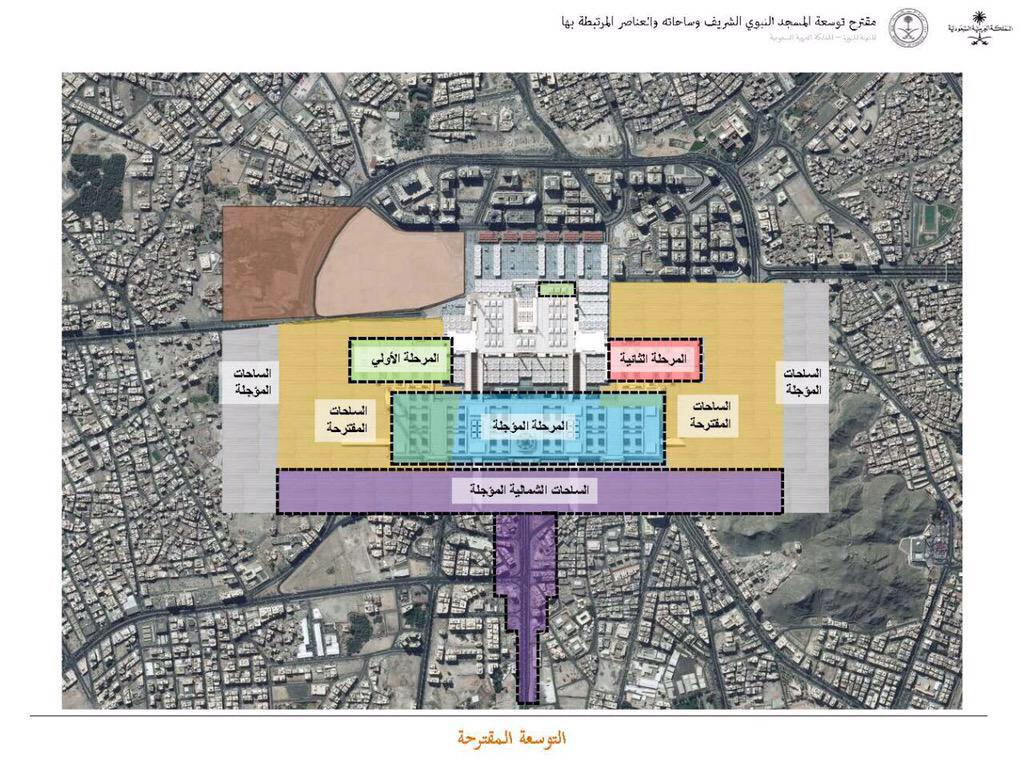
MADINAH: Custodian of the Two Holy Mosques King Salman has approved the revised designs for the Prophet’s Mosque expansion project, which includes expansion of the mosque, Darb Al-Sunnah project (3km stretch between the Prophet’s Mosque and Quba Mosque and rebuilding of the Quba Mosque.
The approval came during the king’s recent visit to Madinah in the presence of Crown Prince Mohammed bin Naif, Madinah Gov. Prince Faisal bin Salman, Deputy Crown Prince Mohammed bin Salman and Abdul Rahman Al-Sudais, president of the Presidency of the Two Holy Mosques.
The Ministry of Finance said the king reviewed the proposals and the project’s designs within the scope of the large-scale expansion project of the Prophet’s Mosque and other related schemes, which also include the Dar Al-Hijra, King Salman Center for Conferences and development of new central area in Madinah.
According to the revised plan, the first phase of development works will be undertaken on the eastern side of the Prophet’s Mosque, followed by development on the western side during the second phase.
This cannot be undone and I am sure it will be greatly appreciated.
We apologise but you have been denied access to report posts in this thread. This could be due to excessively reporting posts and not understanding our forum rules. For assistance or information, please use the forum help thread to request more information. Jazakallah





.jpg)