I do not want to bring up the repeated arguments about joining feet in salah, but due to an incident I encountered I have to seek some clarification. Before I get to that incident I will try to make the post more beneficial. It seems to me that while the salafis may have placed far to much emphasis on joining ankles in salah, others seem to give no regard to standing in close in salah. I have noticed that while (alhamdulilah) I try to touch my shoulder with one brother next to me, and stand with my feet close to his (not touching), the brother on the other side of me never touches my shoulder, and his feet is always far away from mines. Sometimes the brother on the other side is a Maulana or Mufti and still seems to be negligent of standing close in salah.
Now to the incident I encountered. I was praying salah in a salafi Masjid and after the fard salah a brother who I chat with showed me the hadith in the translation of Bukhari concerning joining the feet in salah and indicated that I should practice on this hadith next time I pray in Jamah. Now I do not want to stop him from joining feet in salah if he thinks its the sunnah, but I want to show him this response from Shaikh Uthaymeen on the issue, to let him know that others are not just abandoning the hadith when it comes to joining feet in salah. The response is in arabic/english on Muadh bhai's website, and its source is a book published by darussalam entitled: Islamic verdicts on the pillars of islam, available in pdf. I need to know which translation is more accurate, the one on centralmosque.com or the one in the darussalam publication, or if someone can provide a new translation.
This is the Arabic from centralmosque.com
جواب: الصحيح أن المعتمد في تسوية الصف محاذاة الكعبين بعضهما بعضاً، لا رؤوس الأصابع، وذلك لأن البدن مركب على الكعب، والأصابع تختلف الأقدام فيها، فهناك القدم الطويل، وهناك القدم
القصير، فلا يمكن ضبط التساوي إلا بالكعب .
وأما إلصاق الكعبين بعضهما ببعض فلا شك أنه وارد عن الصحابة –رضي الله عنهم- فإنهم كانا يسوون الصفوف بإلصاق الكعبين بعضهما ببعض ، أي أن كل واحد منهم يلصق كعبه بكعب جاره لتحقق المحاذاة وتسوية الصف، فهو ليس مقصوداً لذاته لكنه مقصود لغيره كما ذكر بعض أهل العلم، ولهذا إذا تمت الصفوف وقام الناس ينبغي لكل واحد أن يلصق كعبه بكعب صاحبه لتحقق المساواة، وليس معنى ذلك أن يلازم هذا الإلصاق ويبقى ملازماً له في جميع الصلاة .
ومن الغلو في هذه المسألة ما يفعله بعض الناس من كونه يلصق كعبه بكعب صاحبه ويفتح قدميه فيما بينهما حتى يكون بينه وبين جاره في المناكب فرجة فيخالف السنة في ذلك، والمقصود أن المناكب
www.central-mosque.com/fiqh/anklshyuth.htm
This is the translation from centralmosque:
Answer: That which is correct is that the relied-upon position regarding the straightening of the row is that the ankles should be in line with each other, not the ends of the toes, and that is because the body is supported upon the ankle, and the feet differ in regard to the toes, because some feet are long, and some feet are short. So it is impossible to ensure straightness except by the ankles (i.e. by the ankles being in line with each other).
As for joining the ankles to the ankles of the others, then no doubt this is reported from the Sahabah, radhiyallahu 'anhum, for they would straighten the rows by joining ankles, that is, every one of them would join his ankle with the ankle of his neighbour to ensure being line, and the straightness of the row. So it is not meant as an aim in itself, but rather as a means of achieving another aim, as some of the people of knowledge have mentioned. Therefore, when the rows are completed and the people are standing, it is befitting for every one of them to join his ankle to the ankle of his companion to ensure straightness. It does not mean that he should continue this joining and remain so for the whole salah.
From the extremism that has occurred with regard to this issue is what is done by some people in that one of them will join his ankle to the ankle of his companion, and he will spread his feet so far apart until there is a gap between his shoulder and the shoulder of his companion, so he will oppose the Sunnah by doing that. But the aim is that the shoulders and ankles should be in line with each other.
This is the translation from the book:
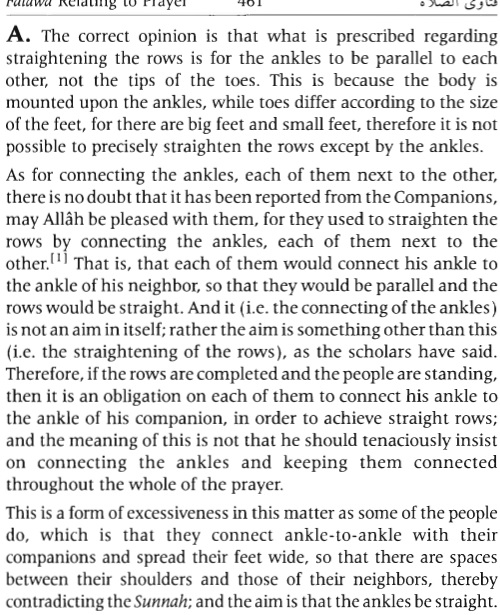
I am mostly interested in this portion ولهذا إذا تمت الصفوف وقام الناس ينبغي لكل واحد أن يلصق كعبه بكعب صاحبه لتحقق المساواة، وليس معنى ذلك أن يلازم هذا الإلصاق ويبقى ملازماً له في جميع الصلاة .