Forum Menu - Click/Swipe to open
 

AL-ANDALUS (SPAIN)

You have contributed 0.0% of this topic

Thread Tools
Appreciate
Topic Appreciation
member2, Yasin, queenie, abu mohammed, sharjan8643
Rank Image
ummi taalib's avatar
Unspecified
2,520
Sister
2,929
ummi taalib's avatar
#16 [Permalink] Posted on 20th December 2010 17:33
Map showing Spain and France with the Pyrenees mountain range forming a natural border between the two countries.


report post quote code quick quote reply
No post ratings
back to top
Rank Image
ummi taalib's avatar
Unspecified
2,520
Sister
2,929
ummi taalib's avatar
#17 [Permalink] Posted on 25th December 2010 21:10
The Fate of the Conquered

Biased historians have bemoaned the ruin of Spain, however historians with an unbiased approach think otherwise. Dr J.A. Conde, has stated: "The conditions imposed on the conquered nation were such that the people found consolation rather than oppression in the presence of the conquerors."

The conquered were not forced to live in ghettos nor were they taken as slaves. They were not prevented from following their faiths and were not forced to convert. Their churches and places of worship were safe as were their possessions and properties. They were not banned from earning a living and could work in the civil service of the Muslim rulers. Jews and Christians were able to contribute to society.

Dr. J. A. Conde says, " But there was yet more: the fidelity of the Arabs in maintaining their promises, the equal handed justice which they administered to all classes without distinction of any kind secured them the confidence of the people in general, as well as of those who held closer intercourse with them: and not only in these particulars, but also in generosity of mind, and in amenity of manner, and in hospitality of their customs, the Arab were distinguished above all other people of those times."

It has to be mentioned that in some campaigns a few churches used for military purposes were either damaged or destroyed, however they isolated instances because the Muslim leaders were quick in controlling lawlessness, arson and pillage. Many cities were submitted voluntarily and they were treated with consideration and even generosity.

The Christians and Jews were permitted to have their own district governors and judges who administered their own laws. However as subjects of the Muslim government they were required to pay Jizia (tax) and this tax was levied on all able-bodied male adults. The women and children, the old, the sick, the blind, the beggars and the priests were exempt from it. As for the Jews, Muslim rule was a haven of security and prosperity.

The Gothic nobility were treated with generosity. The Serfs who were exploited for centuries by the Romans and the Goths continued to work in the fields; not as bounded labour but as free tenants. The slaves bought their redemption from slavery by embracing Islam.

All Historians are unanimous in their acknowledgement of the unique cultural role of the Spanish Muslims. While the rest of Europe was shrouded in darkness, Muslim Spain was a shining example of an enlightened civilisation. Many cities sprang up. Agriculture with sophisticated irrigation systems, architecture, science and literature were all advanced in Spanish cities. While the rest of Europe's cities were filthy and wreaking with diseases, the Spanish cities were hygienic and healthy places to live with many public baths scattered around cities. Muslim craftsmen in Spain were talented. They excelled in the craftsmanship of leather and in making fine textiles. In the late 800's glassmakers in Cordova discovered how to make crystal and exclusive jewellery was crafted.

Spain became a centre of secular knowledge with scholars in every Spanish city. Universities were set up in Granada and many libraries were opened around Spain.

Stanley Lane-Poole says, "Whatsoever makes a kingdom great and prosperous, whatsoever tends to refinement and civilisation was found in Muslim Spain." (The Story of Islamic Spain, page 34)

For Quotations on Islamic civilization in Spain:
www.load-islam.com/artical_det.php?artical_id=490§ion... history

report post quote code quick quote reply
No post ratings
back to top
Rank Image
ummi taalib's avatar
Unspecified
2,520
Sister
2,929
ummi taalib's avatar
#18 [Permalink] Posted on 27th December 2010 20:06
Conquerors of Spain Recalled

Having consolidated the Muslim rule in Spain, Musa proposed to cross into Europe, and return to Damascus after conquering Europe. However Caliph Al Walid did not approve of such an ambitious plan.

The Caliph Al Walid died in 715 C.E. after a rule of ten years. He ranks high among the empire builders of Islam. Under him the Muslim empire had come to extend from Sind to Spain, spread over three continents, Asia, Africa, and Europe.

Sulaiman (715-717 C.E.)
Sulaiman, the new Caliph had differences with Al Walid. When he attained power he reversed the policies of Al Walid and those who had found favour with Al Walid came under cloud, while those who were out of favour with Al Walid came into power.

Musa and his brilliant lieutenant Taariq, the conquerors of Spain, were summoned to Damascus and there disgraced, humiliated and condemned to live in obscurity and poverty. In 716 C.E., Abdul Aziz, the son of Musa who was appointed as the Governor of Spain, was busy in his dawn prayer when he was stabbed to death by a hired assassin.

Even though Taariq bin Ziyaad and Musa bin Nusair were recalled, Muslims were rulers in Spain for a further 750 years.
report post quote code quick quote reply
No post ratings
back to top
Rank Image
ummi taalib's avatar
Unspecified
2,520
Sister
2,929
ummi taalib's avatar
#19 [Permalink] Posted on 3rd January 2011 21:13
Muslim Spain was not a single period, but a succession of different rules. As we have seen, Spain was conquered during the rule of Caliph Al Waleed (of the Umayyad dynasty)and he was succeeded by his brother Sulaiman who recalled the conquerors back and Abdul Aziz, the son of Musa and governor of Spain, was killed.

In the year 750 C.E. the Umayyad rule came to an end and the Abbasid Dynasty took control with Abu Abbas As-Safah as Caliph. The Abbasid period lasted from 750 to 1258 C.E. and is divided into two periods, the Early Abbasids and the Later Abbasids.

Spain (a greater part of it) also came under the rule of the Al Moravids and the Al-Mohads before Muslim rule declined and finally ended in 1492.

What will follow (insha Allah) will be highlights of the history of Muslim Spain under the various rules. Insha Allah the next post will cover Muslim Spain during the Caliphate of Umar bin Abdul Aziz, one of the most pious and inspiring of the Umayyad Caliphs.

report post quote code quick quote reply
No post ratings
back to top
Rank Image
ummi taalib's avatar
Unspecified
2,520
Sister
2,929
ummi taalib's avatar
#20 [Permalink] Posted on 7th January 2011 20:36
Umar b Abdul Aziz 717-720 C.E.

He was the cousin of Sulaiman. His mother was the grand daughter of Umar bin al Khattab, the rightly guided Caliph and Umar bin Abdul Aziz aspired to follow the footsteps of his illustrious great grandfather. He was a devoted Muslim and he set the example of living the Islamic way of life. He enjoined simplicity and austerity in all the affairs of the state and he was very particular in the use of the money from the "bait-ul-maal". He returned all the property which had been confiscated by his predecessors to the rightful owners.

During the reign of Umar bin Abdul Aziz, the Muslim forces led by As-Samh crossed the Pyrennese, and overran the southern province of France. The Muslim forces advanced to Toulouse, the capital of Aquittaine, where a bloody battle was fought in which As-Samh was killed and the Muslims were defeated. Thereafter the command was taken over by Abdur Rahman, who evacuated the Muslim forces from France.

He was poisoned to death at the age of thirty-nine. In spite of his rule lasting barely three years, he lives in history as the ideal Muslim ruler.
report post quote code quick quote reply
No post ratings
back to top
Rank Image
abu mohammed's avatar
London
27,434
Brother
9,578
abu mohammed's avatar
#21 [Permalink] Posted on 7th January 2011 21:08

"ummi taalib" wrote:
Umar b Abdul Aziz 717-720 C.E. He was the cousin of Sulaiman. His mother was the grand daughter of Umar bin al Khattab, the rightly guided Caliph and Umar bin Abdul Aziz aspired to follow the footsteps of his illustrious great grandfather.

SubhanAllah, what a family tree.

report post quote code quick quote reply
No post ratings
back to top
Rank Image
abu mohammed's avatar
London
27,434
Brother
9,578
abu mohammed's avatar
#22 [Permalink] Posted on 9th January 2011 12:00

Taken from http://www.muftisays.com/forums/members-research-group/5056/muslim-inventions.html?pg=3


Defense

Adarga:
A hard leather shield used originally by the Moors of Islamic Spain. The adarga was a traditional defense employed by the Moorish light horseman who used it along with the lance. Throughout the 14th and 15th centuries the adarga was also used by Spanish Christian soldiers including their own light cavalry (la jineta) some of whom adopted Moorish fighting patterns. The adarga was in widespread use until the 16th century and the progress of firearms.
 

report post quote code quick quote reply
No post ratings
back to top
Rank Image
ummi taalib's avatar
Unspecified
2,520
Sister
2,929
ummi taalib's avatar
#23 [Permalink] Posted on 9th January 2011 13:21
From Spain, into France

(The first map at the begining of the thread shows part of France..but if anyone can find a better one please upload)

After the death of As-Samh and the defeat at Toulouse, the next offensive into France was in 725 C.E. The Muslims carried out raids up to Rhone and Saone however they stopped there when Anbasa, the governor was killed and his deputy withdrew the army from France.

After the death of Anbasa, a state of anarchy prevailed in Spain and there were five governors in less than five years.

Hisham was appointed governor in 730 C.E. and Muslims once again resumed the conquest of France. This time they penetrated deep into France and their conquests included Lyons, Macon etc however in the counter attack by the French the Muslims had to withdraw from these cities.

Abdur Rahman al- Ghafiqi was appointed as the next governor and he was next to march into France. After the capture of the city of Arles and then Bordeux, the Muslims overran Burgundy and finally the cities of Lyons and Sens.

The French asked the aid of Charles Martel of Germany and they assembled a large force to oppose the Muslims. In 732 C.E. the Muslims suffered defeat and Abdur Rahman fell fighting. The Western Historians regard this defeat as the turning point in the history of Europe which halted the advance of Islam.

In 734 C.E. the Muslims once again crossed into France and this time took Aragon and Navarre and thereafter the city of Avignon was taken after a short siege. Other campaigns followed under the next governor, Uqba, before the French forces advanced and fought the Muslims. The French resorted to "scorched earth policy" which destroyed many cities which had prospered under the Muslims.

In the meantime civil war broke out in Spain and the administration was paralysed. The French launched an offensive in 751 C.E. and they took cities held by the Muslims. There was no help forthcoming from Spain and only the city of Narbonne was left to the Muslims. The French besieged it with all the sources at their command, and captured the city which ended the Muslim occupation of France. According to "The Story of Islamic Spain" by Syed Azizur Rahman, "The invasion of France was an exercise of futility as it left no impact of any significance."
report post quote code quick quote reply
No post ratings
back to top
Rank Image
ummi taalib's avatar
Unspecified
2,520
Sister
2,929
ummi taalib's avatar
#24 [Permalink] Posted on 10th January 2011 11:19
Back To Spain

Unfortunately squabbles within the Arabs surfaced and instead of the Arabs putting a united front against the enemy, started fighting amongst themselves.

Animosity rooted from pre Islamic times between the Kelbites/Yemenites and the Qaisites or the Northern and Southern Arabs was contained during the time of the Prophet Muhammad sallallaahu 'alayhi wasallam and the four Caliphs. However it surfaced under the Umayyadsa and it was taken to whichever countries were conquered and Spain was no exception.

Then there were the Berbers who revolted in North Africa which had its repercussions in Spain. The Berbers in Spain also rose in revolt against the Arabs. The Berbers were successfully routed however the Syrians with whose help the Berbers were defeated rose against Abdul al-Malik the governor and took power in 741. Civil war broke out. In 747 the bloody Battle of Secunda was fought between the Qaisites and the Yemenites.


Fall of the Umayyads

The years 743 and 744 C.E. were years of anarchy. In less than two years three princes sat on the throne. Where before the Umayyads were a united family, now they began to fight among themselves and this weakened the foundation of the Umayyad rule. Coupled with the anarchy, the end of the Umayyad rule was near.

The Battle of the Zab in 750 C.E. between the Ummayads and the Abbasids where the Umayyad forces were defeated saw the end of the rule of the Umayyad Dynasty. Power was transferred to the Abbasids with Abu al Abbas as the new Caliph. He claimed descent from Abbas, the uncle of Prophet Muhammad sallallaahu 'alayhi wasallam.

He began his reign by a virtual genocide of the Umayyads. Many were hounded out and killed. The idea was to create an atmosphere of non tolerance of any opposition. One of the lucky ones to escape was Abdur Rahman, a grandson of Hisham. He founded the Umayyad Kingdom of Cordova and insha Allah details will follow.

report post quote code quick quote reply
No post ratings
back to top
Rank Image
ummi taalib's avatar
Unspecified
2,520
Sister
2,929
ummi taalib's avatar
#25 [Permalink] Posted on 11th January 2011 20:01
Abdur Rahman (756-788 C.E.)
and the Umayyad Kingdom of Cordova


The story of Abdur Rahman has to be told! (Unfortunately not in as much detail as i would have liked). It runs more like an epic if read in detail with his dramatic flight from Syria, his narrow escapes, long travels through the Libyan sands, perilous sojourns through North Africa and finally his arrival in Spain in 755 C.E. where he founded the Umayyad Kingdom of Cordova - much to the annoyance of the Abbasid Caliphs in Baghdad. (The Abbasids had moved their capital from Damascus to Baghdad). Even the Abbasid Caliph Mansur admired the youthful Abdur Rahman who eluded his enemies, traversed jungles and seas, raised armies and founded a kingdom.

After meeting many adventures Abdur Rahman sought shelter in Morocco with the Berber tribe, Banu Nafoosa, to which his mother belonged. From Morocco, Abdul Rahman sent an emissary to Spain to win support in his favour. The Muslim Arabs in Spain were divided into two warring camps, the Qaisites who supported the government, and the Yemenites who were opposed thereto. The Yemenites decided to support Abdul Rahman. There were some Umayyads in Spain, and they declared for Abdul Rahman. Some Berbers in Spain also decided to espouse the cause of Abdur Rahman. The Yemenites and the Umayyads invited Abdur Rahman to Spain. In 756 C.E. with a Berbers force, Abdur Rahman landed on the shore of Spain at the port of Almonicar. Here he was joined by the Muslims of Spain who had promised to support his cause.

After his arrival in Spain the battle which gave him the sceptre of royalty was fought near Cordova. He entered Cordova in triumph and occupied the official residence of the governor-general. Abdur Rahman was publicly declared "Amir" of Muslim Spain at a brief ceremony in the mosque at Cordova.

His position however was precarious. The Abbasid Caliph claimed Spain to be part of his empire and he ordered the governor of Africa to annex Spain on his behalf. Abdur Rahman himself took to the field and despite the fact that his fate looked grim, he did not loose heart and after a long siege he retaliated with a desperate attack on the Abbasid supporters and won. After this he was firmly established but there was no end to revolts and his army was constantly on the march from one place to another.

It has to be clear at this stage that though Abdur Rahman was the undisputed master of the kingdom, his authority did not extend over the whole of Spain. A part of the Northern territory was already taken back by the Christians before Abdur Rahman's arrival.

Abdur Rahman died in 788 C.E. after an eventful reign of thirty-two years. As the ruler of Spain, Abdur Rahman assumed the title of "Amir". He was a wise and enlightened ruler, a man of great determination and strong will. He possessed an impressive personality. He was highly eloquent and was a fine poet. He was a skilful General; a just ruler; and a wise statesman. The way in which he became the ruler of Spain reads like a romance. He had to struggle against heavy odds, but through his courage, perseverance and iron will he succeeded in carving out a kingdom for himself and his successors in distant Spain across the seas. The Umayyad lost the empire in the east, but Abdur Rahman built an Umayyad state in the west.

He organised the administration on sound lines. He established educational institutions throughout the length and breadth of the country. He constructed hostels where free boarding and lodging was provided to the students. Inns were established in all cities. Public baths were provided in all cities. He established a mint at Cordova to manufacture coins.

He reconstructed the city walls of Cordova, and access of the city was provided through seven gates. Outside Cordova he built a garden place called "Muawiyat-ul-Rusafa" after the villa of his grandfather Hisham at Damascus. He constructed a mosque at Cordova, which had 193 pillars of white marble, 19 arches, and 19 big gates. A lamp made of pure gold burned permanently at the pulpit. He built an aqueduct for the supply of water to Cordova. He built canals, improved agriculture, and sponsored other beneficent activities. He introduced exotic plants in Spain for the first time. He constructed a huge bridge on the Guadelquiver river.

report post quote code quick quote reply
No post ratings
back to top
Rank Image
ummi taalib's avatar
Unspecified
2,520
Sister
2,929
ummi taalib's avatar
#26 [Permalink] Posted on 11th January 2011 20:16
The Umayyad rule in Spain came to an end in 1031 C.E.

After the disappearance of the Umayyad rulers, Muslim Spain came to be split up into numerous small kingdoms, each going its own way and fighting each other. This period is known as "Muluk-ul-Tuwaif" (petty states).This fragmentation of Muslim Spain paved the way for the disintegration of Muslim rule in Spain.


report post quote code quick quote reply
No post ratings
back to top
Rank Image
ummi taalib's avatar
Unspecified
2,520
Sister
2,929
ummi taalib's avatar
#27 [Permalink] Posted on 12th January 2011 12:55
The Al-Moravid Rule in Spain

Towards the close of the eleventh century, while Muslim Spain was falling to pieces, a new power of the Al-Moravids rose to power in Morocco.

With the fall of the Umayyad Caliphate in Spain the country fell prey to anarchy. The split up kingdoms fought among themselves which weakened the Muslim hold on Spain. This provided opportunities for Christian aggression and in order to prevent the Christians some of the Muslim princes of Spain sought the help of Yusuf bin Tashfin, the ruler of Morocco. He responded to the call, crossed over into Spain and defeated the Christians powers.

The divided kingdoms were unable to forge a union and Yusuf annexed Muslim Spain to his empire and thus a greater part of Muslim Spain became the province of the Al-Moravid empire. He was able to reunite much of Muslim Spain.

While he was alive the Christians were pushed back. He enforced Shari'ah law and was very popular with the Scholars. After years of anarchy Spain once again came to enjoy a spell of prosperity under his strong and beneficent rule. However after his death in 1106 C.E. the Al Moravid hold on Spain became weak and Saragossa was captured by the Christians in 1118 C.E.

The Al Moravid rule came to an end in Spain by 1145 as the Al Mohads came to power in Africa and Spain was once again split up into petty states. The Christians raised their heads again and they pillaged and burnt many towns and the Muslim Scholars of Spain appealed to the Al Mohad ruler who came to their aid.
report post quote code quick quote reply
No post ratings
back to top
Rank Image
ummi taalib's avatar
Unspecified
2,520
Sister
2,929
ummi taalib's avatar
#28 [Permalink] Posted on 12th January 2011 20:05
The Al- Mohads

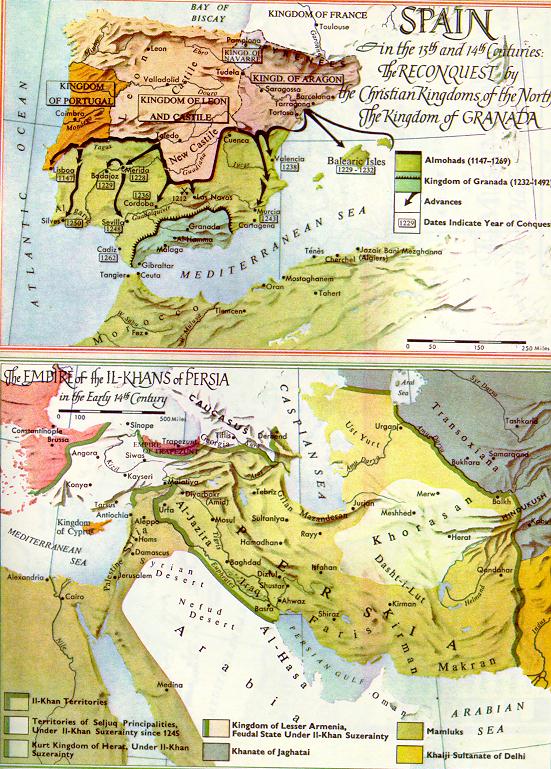
The Al-Mohad rule was founded in North Africa in the early twelfth century. The Muslim Scholars of Spain appealed to the Al Mohad ruler Abul Mumin, for help. He sent an army under Abu Amr Musa whose brilliant campaigns led to many towns being captured. A year later Abul Mumin sent another force under his son, Abu Saeed who conquered Cordova, Almeria, Nibela and finally Granada. By 1148 C.E. the Al Mohads were masters of the whole of Muslim Spain.

In the Thirteenth Century, the Al Mohad ruler Abu Yusuf Yaqub was succeeded by Muhammad Al Nasir. In 1212 C.E. the kings of Castile, Aragon, Portugal, Leon and Navarre joined by the crusaders from France, Italy and Germany marched against the Al Mohads. The Al Mohads were defeated in the battle of Hisa Al-Uqab. This battle marked the beginning of the end of the power of the Al Mohads and also the beginning of the end of Muslim rule in Spain. Al Nasir escaped to Morocco leaving Spain in a state of utter confusion.

The Al Mohad rule lasted till 1269. After the Al Mohads numerous principalities sprang up in Muslim Spain and the Muslims ceased to be the dominant power in Spain.
report post quote code quick quote reply
No post ratings
back to top
Rank Image
ummi taalib's avatar
Unspecified
2,520
Sister
2,929
ummi taalib's avatar
#29 [Permalink] Posted on 12th January 2011 20:08
The Decline and Fall


As long as the Muslims were united, they constituted the largest empire in history; when they fell victim to disunity and developed differences among themselves in the name of religion they fell from power.
When the Abbasid Caliphate fell in Baghdad in 1258 C.E., the glory of Muslim rule in Spain was also over. The great Muslim empire had crumbled and split up into a number of petty principalities which lacked the strength to defend themselves and one by one, succumbed to the advance of the Christian powers until only the south of Spain remained under Muslim rule. Even then the Muslims had not learnt their lesson from history. They made no effort to unite and face the enemy. They fought amongst themselves in spite of the heavy pressures from the Christian powers who launched the "Reconquest" campaign aimed at the expulsion of the Muslims from Spain.


report post quote code quick quote reply
No post ratings
back to top
Rank Image
ummi taalib's avatar
Unspecified
2,520
Sister
2,929
ummi taalib's avatar
#30 [Permalink] Posted on 13th January 2011 10:06
Granada

During this period of decadence and disintegration of Muslim rule in Spain when many minor lords ruled over petty principalities, Muhammad bin Yusuf bin Nasr, a lord of such a principality himself, founded the rule of the Nasrid dynasty which ruled Southern Spain for 262 years. Instead of fighting the Christians he cultivated their friendship and with their help captured Granada and the adjoining territories.

During the period of 1238 to 1260, Ferdinand III of Castile and James I of Aragon liquidated the Muslim principalities of Valencia, Cordova, Seville and Murcia and after 1260, Granada was the only Muslim state left in Spain. However in spite of their patronage the Christians invaded Granada and Muhammad saved himself and his state by becoming a vassal of Castile. Thus independent Muslim rule came to an end in 1260 though Granada survived for more than 200 years as a nominal Muslim state under the vassal of a Christian state. The Muslims expelled from other parts of Spain migrated to Granada.

His son and successor, Abu Abdullah (Muhammad II) enforced shari'ah law as he was a jurist. He had to face rebellion of some of the Arab chiefs and when the Christian powers once again invaded Granada, he sought the help of Abu Yusuf Yaqub, the ruler of Morocco. He landed with his forces and with his help the Christian attack was repulsed.

During the reign of Muhammad III, the son and of Abu Abdullah, the Christians invaded and this time captured Gibraltar and other towns. He made a truce with them with unfavourable terms for Granada which made him unpopular. To increase his prestige he conquered Ceuta in Morocco with the help of the Christians and this in turn made Morocco incite a revolt against Muhammad III and his uncle dethroned him and took control in 1309. He in turn was overthrown by his nephew, Abul Wahid Ismail who proved to be a good ruler. During his reign he took the initiative and attacked the Christians and defeated them. Though this was big triumph for the Muslims and during his eleven years rule Granada enjoyed a spell of prosperity. He was killed in a palace revolution just three days after his victory over the Christians. The Christians had resorted to underhand means of fostering a conspiracy through their agents in Granada.

Granada continued to be under Muslim rule with the Christians constantly attacking. The court of Granada had become a hotbed of intrigues and conspiracy. When Muhammad V came to power in 1354, he purged the court of all suspects by executing, imprisoning or exiling the suspects. He however himself fell prey to the conspiracy led by his stepmother. There was a palace revolution and he saved his life by flight to Morocco. His step brother, Ismail bin Yusuf occupied the throne though his mother was the real power behind the throne. He too fell victim to a conspiracy and met with a violent death.

The next ruler was a tyrant and very unpopular. The Nasrid chiefs invited Muhammad V, who was in Morocco to come back and resume the throne. Thus Muhammad V's second reign began in 1362 in the midst of rejoicing of the people. He made a peace treaty with Castille. He was a just ruler who encouraged education, established hospitals and schools and developed trade and industry. After him, his son continued the treaty with Castille however he too fell prey to a conspiracy.
report post quote code quick quote reply
No post ratings
back to top