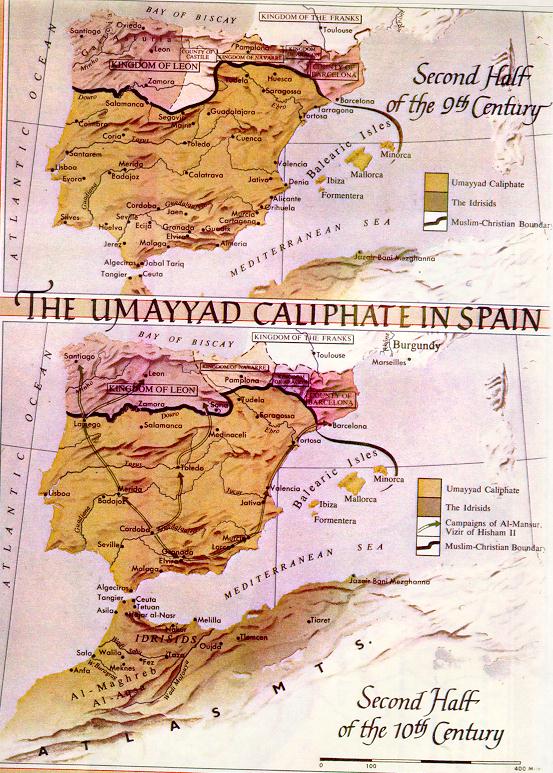
The two sovereign states of Spain and Portugal was in fact a single geographical entity. This part of the world has been known as Iberia to the Greeks, Hispania to the Romans and Al-Andalus to the Muslims. The fertile valleys and mineral wealth attracted wave after wave of invaders, colonisers and conquerors.
After the Greeks, the Celts and the Carthaginians, this area came under the power of the Romans and the coming of the Romans was a great civilising influence. Apart from setting up a strong government, they constructed walled towns, elegant villas, theatres, baths etc. and they built aqueducts for irrigation as well as a network of roads. They introduced Latin out of which the Spanish of today emerged. Eventually the Romans lost their warlike spirit and tenacity and the aristocracy sank into luxury while the subjects groaned under heavy taxation.
Spain then fell prey to the Goths who also abandoned themselves to luxury and vice and the economic and social conditions for the subjects worsened under the Goths.
(More to follow insha Allah but perhaps someone can upload a map at this stage?)
We are taught a lot about history in School and inventions, but what they fail to tell us is about the great Muslim inventions, specialy those from Spain.
Did you know Cardoba as it is known today was known as Qurtubi during the Muslim rule. How many scholars have we heard of with the name Qurtubi. These were all Spanish Scholars.
The inventions deserve a whole new thread. They are amazing, and I believe that the Muslims should be taught about these Muslim inventions, our children will be able to walk with respect rather then being taught about einstien, watt, bell etc.
I was doing some background research on Spain only to feel even more gutted.
The first Mosque to be built after 700 years in Spain was that of the Qadyanis. It is called the Basharat Mosque.
The Basharat Mosque was inaugurated on September 10, 1982 in Pedro Abad (province of C�rdoba) by Mirza Tahir Ahmad (late), fourth Caliph of Ahmadiyya Community (currently fifth Caliph Mirza Masroor Ahmad heads the Community). The mosque is the center of Ahmadiyya-Movement in Spain.
The foundation stone was laid by the 3rd Khalifat-ul Masih, Mirza Nasir Ahmad on October 9, 1980. It is the first purpose-built mosque since the end of Muslim rule over 500 years ago.
The annual gathering of the Ahmadiyya Community in Spain (Jalsa Salana) is celebrated in Pedro Abad.
Little is known of Abu al-Baqa' al-Rundi, a poet from Ronda who died in 1285. This poem was written in the hope of gaining aid from Muslims in North Africa to help battle Christian armies. Although the fall of Seville is its theme, the text was actually written in 1267, after the Nasrid ruler Muhammad ibn al-Ahmar surrendered several cities to Alfonso X. The poet refers to events in ancient Arabian and Persian history as well as to the capture of Seville in his attempt to inspire military support.
1. Everything declines after reaching perfection, therefore let no man be beguiled by the sweetness of a pleasant life.
2. As you have observed, these are the decrees that are inconstant: he whom a single moment has made happy, has been harmed by many other moments;
3. And this is the abode that will show pity for no man, nor will any condition remain in its state for it.
4. Fate irrevocably destroys every ample coat of mail when Mashrifi [1] swords and spears glance off without effect;
5. It unsheaths each sword only to destroy it even if it be an Ibn Dhi Yazan and the scabbard Ghumdan[2]
6. Where are the crowned kings of Yemen and where are their jewel-studded diadems and crowns?
7. Where are [the buildings] Shaddad raised in Iram[3] and where [the empire] the Sassanians ruled in Persia?
8. Where is the gold Qarun[4] once possessed; where are `Ad and Shaddad and Qahtan?[5]
9. An irrevocable decree overcame them all so that they passed away and the people came to be as though they had never existed.
10. The kingdoms and kings that had been came to be like what a sleeper has told about [his] dream vision.
11. Fate turned against Darius as well as his slayer,[6] and as for Chosroes,[7] no vaulted palace offered him protection.
12. It is as if no cause had ever made the hard easy to bear, and as if Solomon had never ruled the world.
13. The misfortunes brought on by Fate are of many different kinds, while Time has causes of joy and of sorrow.
14. For the accidents [of fortune] there is a consolation that makes them easy to bear, yet there is no consolation for what has befallen Islam.
15. An event which cannot be endured has overtaken the peninsula; one such that Uhud has collapsed because of it and Thahlan has crumbled![8]
16. The evil eye has struck [the peninsula][9] in its Islam so that [the land] decreased until whole regions and districts were despoiled of [the faith]
17. Therefore ask Valencia what is the state of Murcia; and where is Jativa, and where is Jayn?
18. Where is Cordoba, the home of the sciences, and many a scholar whose rank was once lofty in it?
19. Where is Seville and the pleasures it contains, as well as its sweet river overflowing and brimming full?
20. [They are] capitals which were the pillars of the land, yet when the pillars are gone, it may no longer endure!
21. The tap of the white ablution fount weeps in despair, like a passionate lover weeping at the departure of the beloved,
22. Over dwellings emptied of Islam that were first vacated and are now inhabited by unbelief;
23. In which the mosques have become churches wherein only bells and crosses may be found.
24. Even the mihrabs weep though they are solid; even the pulpits mourn though they are wooden!
25. 0 you who remain heedless though you have a warning in Fate: if you are asleep, Fate is always awake!
26. And you who walk forth cheerfully while your homeland diverts you [from cares], can a homeland beguile any man after [the loss of] Seville?
27. This misfortune has caused those that preceded it to be forgotten, nor can it ever be forgotten for the length of all time!
28. 0 you who ride lean, thoroughbred steeds which seem like eagles in the racecourse;
29. And you who carry slender, Indian blades which seem like fires in the darkness caused by the dust cloud [of war],
30. And you who are living in luxury beyond the sea enjoying life, you who have strength and power in your homelands,
31. Have you no news of the people of Andalus, for riders have carried forth what men have said [about them]?
32. How often have the weak, who were being killed and captured while no man stirred, asked our help?
33. What means this severing of the bonds of Islam on your behalf, when you, 0 worshipers of God, are [our] brethren?
34. Are there no heroic souls with lofty ambitions; are there no helpers and defenders of righteousness?
35. 0, who will redress the humiliation of a people who were once powerful, a people whose condition injustice and tyrants have changed?
36. Yesterday they were kings in their own homes, but today they are slaves in the land of the infidel!
37. Thus, were you to see them perplexed, with no one to guide them, wearing the cloth of shame in its different shades,
38. And were you to behold their weeping when they are sold, the matter would strike fear into your heart, and sorrow would seize you.
39. Alas, many a mother and child have been parted as souls and bodies are separated!
40. And many a maiden fair as the sun when it rises, as though she were rubies and pearls,
41. Is led off to abomination by a barbarian against her will, while her eye is in tears and her heart is stunned.
42. The heart melts with sorrow at such [sights], if there is any Islam or belief in that heart!
Notes:
[1] Mashrifi swords were proverbial for their excellence.
[2] Saif ibn Dhi Yazan was a pre-Islamic Yemenite king and Ghumdan was his castle.
[3] Shaddad was a king of the legendary people of `Ad of Hadramaut, who built a city called "many-columned Iram" (d. Qur'an 89:6).
[4] Cf. Qur'an 28:76.
[5] Qahtan was the ancestor of the South Arabians.
[6] The slayer of Darius was Alexander the Great.
[7] The Shah of Persia.
[8] Uhud is a mountain near Medinah and Thahlan is a mountain near Mecca ? Perhaps in Iraq (ed.).
[9] Al-Andalus.
At the time the Goths were in power in Spain, the Muslims were firmly established in the whole of northwest Africa except the coastal city of Ceuta, which commands the entrance to the Iberian peninsula, (at this time held by Count Julian on behalf of the Byzantine Emperor). Musa bin Nusair was the governor of North Africa and he was invited to conquer Spain by Count Julian. The reason for Julian approaching the Musa bin Nusair was that he wanted to avenge Roderick the king of Spain for ill-treating his daughter who had been sent to the court of Roderick at Toledo where young women were schooled in courtly etiquette.
In the meantime the Spanish people had also invited Musa bin Nusair due to the oppression of the Vasi Goths of Spain. The Spanish people were poor, discontented and oppressed. They wanted change.
The Muslims established peace and order wherever they went. They did not act as parasites of a conquered land and in fact they planned and set up new cities, developed agriculture and commerce, set up educational institutions and introduced learning. Spain (Andalusia) is an excellent example of this. After the Muslims conquered Spain it soon became a utopia of poets and scientists and in a short space of time it became the centre of the then civilised world. History, Geography, Islamic jurisprudence, philosophy and architecture took on a new dimension and new cities sprang up wherein were built such structures of beauty as the Mosque of Cordova and Alhambra of Granada.
With Count Julian's invitation to Musa bin Nusair and the discontentment of the Spanish people with their rulers the stage was set for a Muslim conquest.
Musa bin Nusair wrote to the Caliph Al Waleed for permission and on receiving it he first sent Tarif ibn Malluk to conduct a preliminary reconnaissance of the Spanish coast. Count Julian supplied the boats and Tarif landed in July 710 AD. After his return, the man commissioned to lead the historic expedition was Taariq bin Ziyaad who had risen to high positions in the army due to his bravery and loyalty.
In 711 AD with an army of 12000, men Taariq bin Ziyaad crossed the narrow straits from Africa to the Spanish coast, barely eleven miles apart, in a flotilla supplied by Count Julian and he landed near the rock (Al- Jabal which dominates the Spanish coast) and thereafter became known as Jabal Taariq (later became Gibraltar). Count Julian accompanied Taariq as a guide.
When the news of Taariq's landing reached Roderick, he immediately left for Cordova. Taariq's army arrived at the banks of the Salado River with Roderick converging in the same direction with a formidable army. Near the Lagoon of La Junda, the two armies were within sight of each other.
History records that Taariq bin Ziyaad delivered a long speech which began.... "Ye Muslims, where can you flee? The sea is behind you and the enemy is in front of you. By Allah, only your courage and patience can now help you." He then set fire to all the boats which had brought them to this land.
The battle began in July 711 AD (Ramadhaan 92 AH) and lasted a week. The right and left wings of Roderick's army collapsed when the commanders deserted their posts and the centre led by Roderick himself from his gilt chariot could not hold on and eventually collapsed. The battle ended in a disastrous rout of the Gothic army and Roderick escaped in a panic. His sandles were found on the bank and he was never heard of again.
Musa bin Nusair commanded Taariq to halt his advances however Taariq pursued his advance in the direction of Toledo, the capital of the Gothic Kingdom. On his way he laid siege to Ecija where some of Roderick's army had taken shelter. The Governor of Ecija was captured and the city capitulated by mutual agreement.
On the advice of Count Julian Taariq sent out some columns of his soldiers toward other cities. Cordova was captured by Mughith al-Rumi who decided to take the city by nocturnal surprise. A soldier climbed up a city wall by taking a bold leap from the top of a nearby tree. With the help of his scarf he pulled up a large number of soldiers and they descended into the city, surprised the guards and opened the city gate for their comrades.
Toledo offered little resistance as many had left for Rome. The Jews opened the gates while the Christians who had remained behind had no spirit to fight. Taariq stayed in Toledo for a short time and after appointing a governor he marched on to reach as far as Alcala de Henares from where he returned to Toledo to receive Musa bin Nusair who had already landed in Spain.
In 711 AD with an army of 12000, men Taariq bin Ziyaad crossed the narrow straits from Africa to the Spanish coast, barely eleven miles apart, in a flotilla supplied by Count Julian and he landed near the rock (Al- Jabal which dominates the Spanish coast) and thereafter became known as Jabal Taariq (later became Gibraltar). History records that Taariq bin Ziyaad delivered a long speech which began.... "Ye Muslims, where can you flee? The sea is behind you and the enemy is in front of you. By Allah, only your courage and patience can now help you." He then set fire to all the boats which had brought them to this land.
I think Taariq was only 17 years old at this time.What great Amirs we had!
It would be prefered if the speech is from an islamic source, rather than an unIslamic source. The Authenticity in this sort of thing is vital. We dont want wanabe heros or students of Islam being mislead & get the wrong kind of info/encouragement.
If I find the full speech from an Islamic source i'll add it..the two books i have dont have the full speech though one can find it on google (which is not recomended)
Regarding the Jews in Spain of whom there was a substantial number, their en mass desertion was one of the reasons of the rapid success of the Muslims. Their lot was a miserable one in Spain. They were not permitted to occupy any public office to employ slaves. A Gothic King had ordered compulsory baptism of the Jews which resulted in their migration to Africa. When they planned a revolt with the help of their brethren across the Straits their plan leaked out and their property was confiscated and their children sold in slavery. Thus the Muslims were seen as God-sent deliverers. They collaborated with the Muslims who put their trust in them and this opened doors to many cities. Certain cities like Cordova, Granada etc. were actually left in charge of the Jews as the Muslims proceeded further.
"The Jews had much cause to complain of the Christian rule under which they had been grieviously oppressed and plundered. They not unnaturally regarded with favour an invasion headed by Semitic warriors of their own kindred, which promised to avenge them on their oppressors and increase their influence" (The History of Islamic Spain, Syed Azizur Rahman)
In 712 CE Musa bin Nusair (with 18000 men) joined Tariq in Spain. Within two years, between them they had conquered the whole of Spain. They had crossed the Pyrenees and began carrying out campaigns in the South of France.
This cannot be undone and I am sure it will be greatly appreciated.
We apologise but you have been denied access to report posts in this thread. This could be due to excessively reporting posts and not understanding our forum rules. For assistance or information, please use the forum help thread to request more information. Jazakallah