Forum Menu - Click/Swipe to open
 

Virtues of Sadaqah (Charity)

You have contributed 0.0% of this topic

Thread Tools
Appreciate
Topic Appreciation
member2, sweetmuslimahk1, Taalibah, abu mohammed
1 guest appreciates this topic.
Rank Image
Seifeddine-M's avatar
London
4,762
Brother
4,174
Seifeddine-M's avatar
#1 [Permalink] Posted on 11th January 2011 21:45
Allah (سبحانه وتعالى) says:

"And whatsoever you spend of anything (in Allah's Cause), He will replace it.'' (34:39)

"And whatever you spend in good, it is for yourselves, when you spend not except seeking Allah's Countenance. And whatever you spend in good, it will be repaid to you in full, and you shall not be wronged.'' (2:272)

"And whatever you spend in good, surely Allah knows it well.'' (2:273)

"O you who believe! Spend of that with which We have provided for you, before a Day comes when there will be no bargaining, nor friendship, nor intercession. And it is the disbelievers who are the Zaalimoon (wrongdoers)." (2:254)

"Those who spend their wealth in the way of Allah and then do not follow up what they have spent with reminders [of it] or [other] injury will have their reward with their Lord, and there will be no fear concerning them, nor will they grieve." (2:262)

"O you who believe! Do not render in vain your Sadaqah (charity) by reminders of your generosity or by injury, like him who spends his wealth to be seen of men, and he does not believe in Allah, nor in the Last Day. His likeness is the likeness of a smooth rock on which is a little dust; on it falls heavy rain which leaves it bare. They are not able to do anything with what they have earned. And Allah does not guide the disbelieving people." (2:264)

"And the likeness of those who spend their wealth seeking Allah's Pleasure while they in their ownselves are sure and certain that Allah will reward them (for their spending in His Cause), is the likeness of a garden on a height; heavy rain falls on it and it doubles its yield of harvest. And if it does not receive heavy rain, light rain suffices it. And Allah is All-Seer of (knows well) what you do." (2:265)

"O you who believe! Spend of the good things which you have (legally) earned, and of that which We have produced from the earth for you, and do not aim at that which is bad to spend from it, (though) you would not accept it save if you close your eyes and tolerate therein. And know that Allaah is Rich (Free of all needs), and Worthy of all praise." (2:267)

"Believe in Allaah and His Messenger (Muhammad), and spend of that whereof He has made you trustees. And such of you as believe and spend (in Allaah's way), theirs will be a great reward." (57:7)

It was narrated that Abu Hurayrah (رضي الله عنه) said: The Messenger of Allaah (صلي الله عليه وسلم) said: "Whoever gives charity equal to a date from good (halal) earnings - for Allaah does not accept anything but that which is good - Allaah will take it in His right hand and tend it for the one who gave it as any one of you tends his foal, until it becomes like a mountain." [al-Bukhaari, 1344; Muslim, 1014]

`Adi bin Hatim (رضي الله عنه) reported: Messenger of Allah (صلي الله عليه وسلم) said, "Protect yourself from Hell-fire even by giving a piece of date as charity.'' [Al-Bukhari and Muslim]

According to one's resource capacity, one can win the pleasure of Allah even by spending a small quantity of wealth in His way.

It was narrated from Abu Hurayrah (رضي الله عنه) that the Messenger of Allaah (صلي الله عليه وسلم) said: "Allaah (سبحانه وتعالى) said: 'Spend, O son of Adam, and I shall spend on you.'" [al-Bukhaari, 5073; Muslim, 993]

Abu Hurairah (رضي الله عنه) reported: Messenger of Allah (صلي الله عليه وسلم) said, "Everyday two angels descend and one of them says, `O Allah! Compensate (more) to the person who gives (in charity)'; while the other one says, `O Allah! Destroy the one who withholds (charity, etc)." [al-Bukhaari, 1374; Muslim, 1010]

`Abdullah ibn `Amr ibn Al-`as (رضي الله عنه) reported: A man asked Messenger of Allah (صلي الله عليه وسلم), "Which act in Islam is the best?'' He (صلي الله عليه وسلم) replied, "To feed (the poor and the needy) and to greet those whom you know and those you do not know.'' [Al-Bukhari and Muslim]

`Abdullah bin `Amr bin Al-`as (رضي الله عنه) reported: the Messenger of Allah (صلي الله عليه وسلم) said, "There are forty kinds of virtue, the highest of which is to gift a (milch) she goat. He who practises any of these virtues, expecting its reward (from Allah) and believing on the verity of the promise made for it, will enter Jannah.'' [Al-Bukhari]

Abu Umamah (رضي الله عنه) reported: Messenger of Allah (صلي الله عليه وسلم) said, "O son of Adam, if you spend the surplus, it will be better for you; and if you retain it, it will be bad for you. You will not be reprimanded for keeping what is enough for your need. Begin with those who are your dependents, and the upper hand (i.e., the one that spends in the way of Allah) is better than the lower hand (i.e., the one that receives charity.)'' [Muslim]

Abu Hurairah (رضي الله عنه) reported: Messenger of Allah (صلي الله عليه وسلم) said, "Wealth is not diminished by giving (in charity). Allah augments the honour of one who forgives; and one who displays humbleness towards another seeking the pleasure of Allah, Allah exalts him in ranks.'' [Muslim]

Abu Kabshah `Amr bin Sa`d (رضي الله عنه) reported: Messenger of Allah (صلي الله عليه وسلم) said, "I swear by Allah for three (qualities) which I am going to tell you about. Remember them well:

(1) The wealth of a man will not diminish by Sadaqah (charity).

(2) Allah augments the honour of a man who endures an oppression patiently.

(3) He who opens a gate of begging, Allah opens a gate of poverty (or he said a word similar to it).''

He (صلي الله عليه وسلم) also said, "Remember well what I am going to tell you: The world is for four kinds of people. (1) One upon whom Allah has bestowed wealth and knowledge and so he fears his Rubb in respect to them, joins the ties of blood relationship and acknowledges the Rights of Allah on him (and fulfills them); this type will have the best position (in Jannah). (2) One upon whom Allah has conferred knowledge but no wealth, and he is sincere in his intention and says: `Had I possessed wealth, I would have acted like so-and-so.' If that is his intention, his reward is the same as that of the other. (3) One whom Allah has given wealth but no knowledge and he squanders his wealth ignorantly, does not fear Allah in respect to it, does not discharge the obligations of kinship and does not acknowledge the Rights of Allah. Such a person will be in the worst position (in the Hereafter). (4) One upon whom Allah has bestowed neither wealth nor knowledge and he says: `Had I possessed wealth, I would have acted like so-and-so (i.e., he would squander his wealth).' If this is his intention, both will have equal sin.'' [At-Tirmidhi]

Abu Hurairah (رضي الله عنه) reported: I heard Messenger of Allah (صلي الله عليه وسلم) saying: "The case of a miserly man and a generous man who gives in charity is similar to that of two persons who are clad in armour from their breasts up to their collar bones. When the generous man gives in charity, his armour expands so much as to cover his fingertips and toes. When the miser intends to spend something the armour contracts and every ring of it sticks to the place where it is (sinks into his flesh). He tries to loosen it but it does not expand.'' [Al-Bukhari and Muslim]

Abu Hurairah (رضي الله عنه) reported: The Prophet (صلي الله عليه وسلم) said, "While a man was walking through a barren land, he heard a voice coming out of a cloud saying: `Irrigate the garden of so-and-so.' Thereupon the cloud drifted in a certain direction and discharged its water over a rocky plain. The streamlets flowed into a channel. This man followed the channel until it reached a garden and he saw the owner of the garden standing in its center, working with his spade spreading the water (changing the course of the water). He asked him: "O slave of Allah, what is your name?'' He told his name, which was the same that he heard from the cloud. The owner of the garden then asked him: "O slave of Allah, why did you ask my name?'' He replied: "I heard a voice from a cloud which poured down this water saying: `Irrigate the garden of so-and-so.' I would like to know what do you do with it.'' He said: "Now that you asked me, I will tell you. I estimate the produce of the garden and distribute one-third of it in charity, I spend one-third on myself and my family and invest one-third back into the garden.'' [Muslim]

Abu Dharr (رضي الله عنه) reported: The Prophet (صلي الله عليه وسلم) said, "In the morning, charity is due on every joint bone of the body of everyone of you. Every utterance of Allah's Glorification (i.e., saying Subhan Allah) is an act of charity, and every utterance of His Praise (i.e., saying Al-hamdu lillah) is an act of charity and every utterance of declaration of His Greatness (i.e., saying La ilaha illAllah) is an act of charity; and enjoining M`aruf (good) is an act of charity, and forbidding Munkar (evil) is an act of charity, and two Rak`ah Duha prayers which one performs in the forenoon is equal to all this (in reward).'' [Muslim]

Asma' bint Abu Bakr (رضي الله عنها) reported: Messenger of Allah (صلي الله عليه وسلم) said to me, "Do not hoard; otherwise, Allah will withhold from you.'' [Al-Bukhari and Muslim]

If we accumulate wealth in a miserly fashion and avoid spending it in the way of Allah (سبحانه وتعالى), He will also restrain the flow of His bounty to us.

Abu Dharr (رضي الله عنه) reported that some of the Companions of the Messenger of Allah (صلي الله عليه وسلم) said to him: "O Messenger of Allah, the rich have taken away all the rewards. They observe the prayer as we do, and they keep the fasts as we do, and they give sadaqah (charity) from their surplus riches." Upon this he (the Prophet - صلي الله عليه وسلم) said: "Has Allah not prescribed for you (a course) by following which you can also do sadaqah? Verily in every tasbih (i.e. saying Subhanallah) there is a sadaqah, every takbir (i.e. saying Allahu Akbar) is a sadaqah, every tahmid (i.e. saying Alhamdulillah) is a sadaqah, every tahlil (i.e. saying Lailaha illallah) is a sadaqah, enjoining of good is a sadaqah, forbidding of evil is a sadaqah, and having sexual intercourse with your wife is a sadaqah." They (the Companions - رضي الله معهم) said: "O Messenger of Allah, is there reward for him who satisfies his sexual passion among us?" He (صلي الله عليه وسلم) said: "Tell me, if he were to devote it to something forbidden, would it not be a sin on his part? Similarly, if he were to devote it to something lawful, he should have a reward." [Muslim]

Ibn Mas`ud (رضي الله عنه) reported: The Prophet (صلي الله عليه وسلم) said, "Envy is permitted only in two cases: A man whom Allah gives wealth, and he disposes of it rightfully, and a man to whom Allah gives knowledge which he applies and teaches it.'' [Al-Bukhari and Muslim]

Envy in the Hadith means "Ghibtah'' the equivalent of which does not exist in English language. What it means is that you wish to enjoy things which others have, such as wealth and knowledge, without wishing that they should be deprived of them to your exclusive benefit. You admire Allah's Blessing over a person and wish to be favoured with it too.

The prohibited form of envy is known as 'Hasad.' It means resentment at the condition of a man enjoying some Divine favour, and to wish it to be finished. Hasad is a corrosive disease of moral nature which snatches away man's peace of mind. It is forbidden because it wipes out one's good deeds. It is mentioned in a hadith: Abu Hurairah (رضي الله عنه) said: The Prophet (صلي الله عليه وسلم) said, "Beware of envy because envy consumes (destroys) the virtues just as the fire consumes the firewood,'' or he said "grass.''
[Abu Dawud]

Jabir (رضي الله عنه) reported: Messenger of Allah (صلي الله عليه وسلم) never said `no' to anyone who asked him for anything.
[Al-Bukhari and Muslim].

This Hadith illustrates the refined morals, sublimity of soul and the generosity of the Prophet (صلي الله عليه وسلم). Had somebody asked him of something, provided it was in his possession, he would never say `no' to him.


What one has given in charity will by no means be wasted, for he will doubtlessly find its reward with Allah on the Day of Resurrection (provided his intention was purely for the sake of Allah).

Charity to non-Muslims:

It is permissible to give charity - other than the obligatory charity (zakaah etc.) - to poor non-Muslims, especially if they are relatives, on condition that they do not belong to people who are in a state of war against us and have not committed acts of aggression that would preclude our treating them kindly.

Imaam al-Shaafi'ee (رحمه الله) said: "There is nothing wrong with giving charity to a non-muslim as a nafl (supererogatory) action, but he has no right to charity from the obligatory (zakaah). Allaah praised people who, as He says '... they give food, inspite of their love for it (or for the love of Him), to the Miskeen (the poor), the orphan, and the captive' [al-Insaan 76:8]." (Kitaab al-Umm)

Giving charity to poor Muslims is preferable and more befitting, because spending on them helps them to obey Allaah, and it helps them in both their worldly and spiritual affairs. This helps to strengthen the bonds among Muslims, especially nowadays when the poor among the Muslims far outnumber the rich. And Allaah is the One Whose help we seek.

However, 'Zakaah' cannot be given to non-Muslims.

There is scholarly consensus (ijma`) that zakat cannot be given to non-Muslims, as mentioned by Ibn al-Mundhir, Kasani, Ibn Qudama, Buhuti, and others.

Muwaffaq Ibn Qudama, a great Hanbali Imam, says in his Mughni:
"We do not know of any difference of opinion among the people of knowledge (ahl al-`ilm) that zakat on wealth cannot be given to a kafir�." Ibn al-Mundhir said, "�There is consensus of all those whose positions we know from the people of knowledge that a non-Muslim (dhimmi) cannot be given any zakat.�"

�This is because the Prophet (صلي الله عليه وسلم) said to Mu`adh (رضي الله عنه) [reported by Bukhari 1365, Muslim 26-27, and elsewhere], �"Tell them that they are obliged to give a charity (i.e. zakat) that is taken from their rich and given to their poor.�"

�The Prophet Muhammad (صلي الله عليه وسلم) specified the Muslims as giving it to their poor, just as he specified that it is only obligatory on their rich.� [Ibn Qudama, al-Mughni, 2.1774] See: Zakat cannot be given to non-Muslims


report post quote code quick quote reply
No post ratings
back to top
Rank Image
Seifeddine-M's avatar
London
4,762
Brother
4,174
Seifeddine-M's avatar
#2 [Permalink] Posted on 11th January 2011 22:05
There are six conditions governing the acceptance, in the sight of Allah, of spending in His way. These are:

1. Spend from halaal (lawful) belongings.
2. Spend according to the prescribed practice (Sunnah).
3. Spend in a proper place.
4. Do not remind of the favour after having done it.
5. Do nothing to insult the reciever.
6. Spend with sincerity of intention, exclusively for the good pleasure of Allah Almighty, never doing it for the sake of name and fame.

[Ma'ariful Qur'an]

"The deeds are considered by the intentions, and a person will get the reward according to his intention."

In every righteous deed, one should seek only the Pleasure of Allah; otherwise, it will not be accepted by Allah.


report post quote code quick quote reply
No post ratings
back to top
Rank Image
Seifeddine-M's avatar
London
4,762
Brother
4,174
Seifeddine-M's avatar
#3 [Permalink] Posted on 5th August 2012 04:59
The Inner Dimensions of Zakat


Excerpts from Imam al-Ghazali's �رحمه الله 'Ihya ul Uloom'

Certain inward attitudes and duties are incumbent on those who seek, through the payment of Zakat, that which leads to good in the Hereafter:

1. Knowing Zakat's purpose and significance

To understand the necessity of paying Zakat, how it represents a test of character, and why it has been made one of the fundamentals of Islam, even though it is a financial transaction and not a physical� act of worship.

Three points deserve consideration here:

(a) Testing the degree of love for Allah

Worldly goods are an object of love in everybody's eyes, being the means by which they enjoy the benefits of this world. Because of them, we become attached to life and shy away from death, even though death leads us to meet the Beloved (Allah).
The truth of our claim to love God is therefore put to the test, and we are asked to give up the wealth which is the apple our eye.

That is why Allah said: "God has bought from the believers their persons and their goods, Paradise being theirs for the price " (part of Quran: 9:111).

Allah also says that true piety means giving away one's wealth, in spite of love for it, to close relatives, orphans, the wayfarer and beggars, and for the emancipation of slaves (see Quran 2: 177) .

(b) The elimination of miserliness
The Divine decree by which Allah bids His servants to spend their wealth, is also significant� in purging the habit of miserliness, which is a deadly sin.

"And whosoever is saved from his own covetousness, such are they who will be the successful" (Quran 59:9).

"He who spends his wealth for increase in self-purification" (92:18)

The habit of miserliness is only eliminated by making oneself accustomed to spending money, for to break an attachment one must force oneself away till a new habit is found.

The purity he acquires is in proportion to his expenditure, to his delight in giving away and to his joy in spending for the sake of Allah.

(c) Expression of gratitude
The third factor is gratitude for benefits received, for the servant is indebted to Allah for personal and material bounties

2. Payment of Zakat at the proper time

The second duty with regards to Zakat concerns the time of payment . A good practice is to anticipate the moment when payment is due. This demonstrates a willingness to comply by bringing joy to the hearts of poor, forestalling the obstacles time might place in the way of charitable action, being aware that there are dangers in delaying payment, as the servant runs the risk of disobedience should he or she postpone beyond the appointed moment.

Whenever the impulse to good arises from within, the opportunity must be grasped at once as the believers heart lies between the two fingers of the All-Merciful. Yet how fickle is the heart! The devil threatens poverty and bids us to commit atrocious and abominable deeds.

Demonic suggestion follows hard on the heels of angelic inspiration. One should therefore seize the opportunity and fix a definite month for giving Zakat (if one is used to paying it all at once.)

One should endeavor to choose one of the most opportune times to pay Zakat, resulting in more closeness to Allah and compounding the value of the Zakat.
One such favorable time would be month of Muharram, since it is the first month of the Islamic year and one of the sacred months. Another is Ramadan.

3. Give In Secret

The third duty is secrecy, for this is farthest removed from hypocritical display and reputation-seeking.

Allah says, "If you disclose your Sadaqat (alms giving), it is well, but if you conceal it, and give it to the poor, that is better for you. (Allah) will forgive you some of your sins. And Allah is Well-Acquainted with what you do" (Quran 2:271).

According to one Hadith, the Prophet صلى الله عليه وسلم said, "Seven people will be shaded under Allah's Throne on the Day on which there will be no other shade: (1) a just ruler, (2) a young person who worships Almighty Allah, (3) a person whose heart is attached to Masajid, (4) two people who love one another for the sake of Allah, and who come together and part for His sake, (5) a man who is called by a beautiful woman of good family, but refuses her, saying "I fear Allah", (6) a person who gives his money in charity so secretly that his left hand does not know what his right hand gives, and (7) someone who remembers Allah privately, so that his eyes brim with tears." (Bukhari, Muslim).

According to one of the scholars, "Three things are accounted among the treasures of righteousness, one of them being to give Alms in secret."

Whenever fame is the donor's objective, his work will be in vain, since the purpose of alms giving is to eliminate miserliness and to weaken the love of wealth. But the love of status has a stronger hold over the soul than the love of wealth, and both of them have deadly consequences in the Hereafter.

4. Give openly

The fourth duty, when one knows that such conduct will tend to encourage others to follow suit, is to let one's giving be seen.

In doing so, however, one must be inwardly on guard against hypocritical motives.
Apart from the expectation of gratitude and the risk of hypocrisy, there is another danger in visible alms giving, namely that of offending a poor man's dignity. It may be hurtful to him to be seen to be needy.

But someone who begs in public is bringing the disgrace upon himself; there is therefore no sense in being wary.

5. Avoid Taunting and Hurting

The fifth duty is not to invalidate one's alms giving through taunting and hurting.
As Allah said, "Do not make your Alms giving void by taunting and hurting." (part of Quran 2: 264).

Taunting is reminding a person of a favor, while hurt lies in making it known. According to others taunting is to exploit a person in return of a gift, while hurt lies in making him feel ashamed of his poverty.

Still others say that taunting means making one's gift an excuse for arrogant behavior.

One should therefore realize that giving alms is actually paying Allah, Great and Glorious is He, what is due, while the poor person is actually receiving his sustenance from Allah.

Anyone who grasps the significance of the three points mentioned above while discussing the purpose and importance of the Zakat, or even one of them, realizes that he is a benefactor only to himself , through spending his wealth either to demonstrate his love of Allah or to purge himself or herself of the voice miserliness, or to give thanks for the blessing of wealth in the hope of receiving more.

6. Adopt humility

The sixth duty to�think little of one's donation, for to regard it highly is to invite that pride which is one of the deadly sins, making good deeds worthless.

It must be recognized that ten of two and-a-half percent is a tiny fraction, and that to pay only this is to content oneself with the least generous level of expense as we have explained above.

This is something to be ashamed of rather to boast about. Even if one rose to the highest level, disbursing all or most of one's wealth, one should still reflect on where it came from in the first place, and for what purpose it is being spent.

For all wealth belongs to Allah. It is to Him that one should be grateful for for being given it and being enabled to spend it, so why pride ourselves on spending for the sake of Allah when it is actually His property?

And, if one's situation is such that one must look to the Hereafter, spending for the sake of spiritual reward, why boast of giving what one expects to receive many many times over?

As for action, one's giving should be done with a sense of shame at one's meanness in holding back the rest of one's wealth from God, Great and Glorious is He.

One's demeanor should be humble and abashed, like that of someone who is asked to hand back a deposit but returns only part of it and holds on the rest.

For all wealth belongs to Allah and He would prefer to see us give all we possess. If He has not commanded His servant to do so, it is only because that would be too hard on them by reason of their greed.

As Allah says: "If He were to ask you of it, and press you, you would covetously withhold, and he will bring out all your (secret) ill wills'" (Quran 47:37).

7. Give the best and the dearest

The seventh duty is to select from one's wealth what is best and dearest to one: the finest and most excellent part, for God, exalted is He. Allah is good and accepts only what is good.

If the offering has been acquired by dubious means, it may not strictly belong to the donor and will then be disqualified.

"O you who believe! Spend of the good things which you have (legally) earned, and of that which We have produced from the earth for you, and do not aim at that which is bad to spend from it, (though) you would not accept it save if you close your eyes and tolerate therein. And know that Allah is Rich, and worthy of all praise." (Quran 2:267).

8. Seek the Worthy and Deserving

The eighth duty is to seek out the truly worthy recipient for one's offering (Sadaqa), rather than be content with just anybody who happens to fall within the eight categories of legally qualified beneficiaries.

For among those generally eligible there are some with special qualities. Attention should be paid to these five qualities:

First, one should seek out those pious people who have renounced the world and devoted themselves exclusively to the business of the Hereafter

Second, the recipient should be chosen from among the people of learning, to support him in his quest for knowledge. Learning is the noblest form of worship, so long as it is based on right intention.

Third, the recipient should be a person who kept his need to himself, not being given to fuss and complaint.

Fourth, the recipient should be someone with a large family or disabled by illness or some other cause.

Fifth, the recipient should be a close relative, whether paternal or maternal.
Each of these points should therefore be taken into consideration, for they represent the desired qualities. Within each quality there are further gradations, so one ought to seek the highest.

If anyone can be found in whom all these qualities are combined, that is the greatest treasure and the supreme prize. If one does one's best and succeeds, one gets a double reward, but even if one fails, there is still a single reward for the effort.


http://tazkiyatips.blogspot.co.uk/2012/07/the-inner-dimensions-of-zakat-imam-al.html?m=1
report post quote code quick quote reply
No post ratings
back to top
Rank Image
Seifeddine-M's avatar
London
4,762
Brother
4,174
Seifeddine-M's avatar
#4 [Permalink] Posted on 6th August 2012 16:05
The Purpose and Significance of Zakat


-�from Imam Ghazali's رحمه الله 'Ihya ul Uloom'

One must understand the necessity and significance of paying the�Alms (Zakat), how it represents a test of character, and why it has�been made one of the fundamentals of Islam, even though it is�a financial transaction and not a physical act of worship.

Three points deserve consideration here:

(a) TESTING THE DEGREE OF LOVE FOR GOD


To pronounce the two sentences of the Confession of Faith�(Shahada)�('There is no god but God - Muhammad is God's�Messenger') is�obligatory as affirmation of the Divine Unity�and testimony to the singleness of the One to Whom all�worship is due. Complete fulfilment of this obligation requires that he who affirms the Divine Unity should direct his love to�none but the One, the Unique, for love tolerates no�partnership. There is little value in mere verbal affirmation.�The degree of love is tested only by separating the lover from�other things he loves.

Now, worldly goods are an object of love in everybody's�eyes, being the means by which they enjoy the benefits of this�world; because of them they become attached to life and shy�away from death, even though death leads to meeting the�Beloved. The truth of our claim to love God is therefore put to�the test, and we are asked to give up the wealth which is the�darling apple of our eye.
That is why God, Exalted is He, said:

'God has bought from the believers their persons and
their goods, Paradise being theirs for the price.' .
[al-Tawbah, 9: 111]

This concerns Jihad, the struggle in the way of God, which�entails a readiness to sacrifice even life itself in longing to meet�God, Great and Glorious is He. The renunciation of wealth is�trivial by comparison.

Once this concept of testing the degree of love is understood�to underlie the spending of wealth and material sacrifice,�people fall into three groups in this respect:


Three types of people regarding spending for the sake of Allah:


Firstly, those who affirm the Divine Unity, fulfil their�covenant and renounce all their worldly goods, setting aside�neither pounds nor pence. They are unwilling to incur the�liability to pay the Alms; so much so that when one of them�was asked the amount due on two hundred dirhams, he replied:

'For ordinary people the legal requirement is five dirhams, but�we must give up everything.'

Thus Abu Bakr, may God be pleased with him, donated all�his wealth, while 'Umar, may God be pleased with him, gave�half of his. When the Prophet, upon him be peace, said to the�latter: 'What have you kept for your family?' he replied: 'An�equal amount.' And when he asked the same question of Abu�Bakr, may God be pleased with him, he said: 'God and His�Messenger.' The Prophet, upon him be peace, then said: 'The difference between you is the difference between your two�answers." For Abu Bakr, the veracious, had borne himself�out completely, keeping nothing back for himself but the�Beloved, i.e. God and His Messenger.


Secondly, at a lower level are those who hold on to their�goods, waiting for occasions of need and seasons of charity.�Their object in saving up is to supply their own needs, without�extravagance, and to devote what is left over to charitable�purposes as the occasion may arise. Such people do not�confine their giving to the prescribed amount of the Alms.

One group of the Successors (the generation following the�Companions, may God be pleased with them) maintained the�view that wealth is subject to other dues apart from the Zakat.

When al-Sha'bi was asked if this was the case, he replied:
'Yes, have you not heard the words of God, Great and�Glorious is He:
"[True piety means . . . ] and giving away one's wealth,
much as one loves it, to close relatives, orphans, the
wayfarer and beggars, and for the emancipation of slaves
. . ." [al-Baqarah, 2: 177]?'

They cited the words of God, Great and Glorious is He:
'And spend from what We have provided them with.'
[al-Baqarah, 2: 3]

as well as His words, Exalted is He:
'And spend from that which We have provided you.'
[al-Munifiqun, 63: 10]
(Wa-anfiqu mimma razaqnakum.)

They maintained that these duties, far from being abrogated by�the 'Verse of zakat' [9:60], form part of the mutual obligations of all�Muslims. In other words, whenever a well-to-do Muslim encounters�one who is in need, it is incumbent upon him to relieve�that need, over and above his payment of the Alms.
The correct legal opinion in this matter is that the relief of�pressing need is a collective duty, resting on the Community as�a whole, since a Muslim cannot be allowed to perish.

It may be argued that a well-to-do person is not obliged to�pay for the relief of want except by way of a loan, and that no�donation can be required of him once he has discharged his due�by giving his Alms. It could also be argued that he is nevertheless�required to make a donation and that lending is�impermissible, i.e. it is not permissible to burden the poor with�the acceptance of a loan. There is no unanimity on this question.


Thirdly, to resort to lending is to descend to the final level of�ordinary people. Those who belong to this third group confine�themselves to the bare fulfilment of duty, neither more nor�less. This is the lowest degree, the limit to which all ordinary�people confine themselves because of their miserliness, their�attachment to money and the feebleness of their love of the�Hereafter, As God, Exalted is He, said:

'If He were to ask your possessions of you, and press you�to give most of them, you would be miserly.'
[Muhammad, 47: 37]

What a difference between a servant whose property and�person God has bought, with Paradise as the price, and one�He does not even ask to give all of it because he is so�miserly!

(b) ELIMINATION OF MISERLINESS

The Divine decree by which God, Glorified is He, bids His�servants to expend their wealth, is also significant in respect of�purging the habit of miserliness, which is one of the deadly�sins. As the Prophet, on him be peace, said: 'Three are�deadly: avarice indulged, passion pursued and self-conceit.' (Al-Manawi)
And in the words of God, Exalted is He:
'Those who are shielded from their own greed, they are
the ones who will prosper.' [al-Hashr, 59: 9]

The habit of miserliness is only eliminated by making oneself�accustomed to spending money, for to break an attachment�one must force oneself away till a new habit is formed.

From this point of view, therefore, Zakat signifies purgation,�in that he who pays the Alms is purged of the deadly�evil of miserliness.] The purity he acquires is in proportion to�his outlay, to his delight in giving away and to his joy in�spending for the sake of God, Exalted is He.

(c) EXPRESSION OF GRATITUDE

The third factor is gratitude for benefits received, for the�servant is indebted to God, Great and Glorious is He, for, bounties both personal and material. Bodily acts of worship�are an expression of gratitude for bodily blessings, while�financial acts of worship express gratitude for material bounty.

How mean one must be to see a poor man in needy straits, and�yet be unwilling to give up two-and-a-half or ten per cent of�one's wealth in token of one's gratitude to God, Exalted is�He, for sparing one the need to beg as others must.


http://tazkiyatips.blogspot.co.uk/2012/07/the-purpose-and-significance-of-zakat.html?m=1
report post quote code quick quote reply
No post ratings
back to top
Rank Image
Seifeddine-M's avatar
London
4,762
Brother
4,174
Seifeddine-M's avatar
#5 [Permalink] Posted on 10th August 2012 18:22
The Messenger of Allaah صلى الله عليه وسلم said:

"Voluntary charity extinguishes the anger of the Lord and prevents an unpleasant death." (Tirmidhi; Ibn Hibban)

report post quote code quick quote reply
No post ratings
back to top
Rank Image
Seifeddine-M's avatar
London
4,762
Brother
4,174
Seifeddine-M's avatar
#6 [Permalink] Posted on 11th August 2012 16:34
"During every night of Ramaḍān, spend at least �1 in charity; if it happens to be Laylah-al-Qadr, you will receive the reward of spending �1 every day for eighty-three years!"

Courtesy of In Shaykh's Company: a blog maintained by the students of
Shaykh Muhammad Saleem Dhorat hafizahullah www.shaykh.org
report post quote code quick quote reply
No post ratings
back to top
Rank Image
Seifeddine-M's avatar
London
4,762
Brother
4,174
Seifeddine-M's avatar
#7 [Permalink] Posted on 15th August 2012 17:34
The Prophet صلى الله عليه وسلم said:

"Make haste in giving voluntary charity, for calamities cannot pass by it." (Tabarani; Razeen)

'Allama Tibi رحمه الله explains that charity functions as a protective shield against calamities. (Mirqat al-Mafatih, 4:390)

Calamities are either blocked or repelled with one's acts of charity. (Provisions for the Seekers)

report post quote code quick quote reply
No post ratings
back to top
Rank Image
Seifeddine-M's avatar
London
4,762
Brother
4,174
Seifeddine-M's avatar
#8 [Permalink] Posted on 15th August 2012 17:42
The Prophet صلى الله عليه وسلم said:

"Guard against the Hellfire, if even with half a date, and whoever does not possess that then with a good word." (al-Bukhari; Muslim)

One should strive to safeguard himself against Hellfire [with any good deed], even if this be by donating half a date in charity. If one does not possess even that, then offering a needy person words of kindness, like a promise to assist later or a prayer for them, should be the least he does. "A good word" can also mean the recitation of various supplications and remembrances (adhkar) in general. (Mirqat al-Mafatih, 10:134)

report post quote code quick quote reply
No post ratings
back to top
Rank Image
Seifeddine-M's avatar
London
4,762
Brother
4,174
Seifeddine-M's avatar
#9 [Permalink] Posted on 12th November 2012 14:00
Allah سبحانه وتعالى says:


"And spend (in charity) of that with which We have provided you, before death comes to one of you and he says: 'My Lord, if only You would delay me for a brief term so I would give charity and be among the righteous.'" (63:10)

Mufti Muhammad Shafi رحمه الله said,

'Coming of death' in this verse refers to 'witnessing the signs of death'. The verse exhorts the believers to make the best of their opportunities to spend in the way of Allah سبحانه وتعالى, in the state of good health and strength, before the signs of death appear, and thus they should have their degrees of rank elevated in the Hereafter. Once death overtakes them, the opportunity to spend will be lost, and the wealth will be of no use. Earlier on it was learned that the word dhikr (remembrance of Allah سبحانه وتعالى) refers to all forms of obedience and following the dictates of Shari'ah, which include spending wealth as due. Despite that, spending wealth on this occasion has been mentioned separately. There may be two reasons for it:

Firstly, one of the major objects that divert man from acting upon the sacred laws of Shari'ah is wealth. Therefore, spending wealth, in the form of Zakah, 'Ushr, Hajj and so on, is specifically mentioned.

Secondly, when a person sees the signs of death, it is not in his power to perform his missed prayers, or his missed Hajj, Ramadan fasts. However, the wealth is in front of him, and he is sure that soon it will slip out of his hand. So he may spend the wealth to compensate his shortfalls in worship and so attain salvation from such shortcomings. Furthermore, charity [sadaqah] is efficacious in averting calamities and punishment.

Sahih of Bukhari and Muslim record on the authority of Sayyidna Abu Hurairah رضي الله عنه that a person asked the Messenger of Allah صلي الله عليه وسلم him: "Which sadaqah attracts most reward?" The Messenger of Allah صلي الله عليه وسلم replied: "To spend in Allah's way when a person is in a state of good health, and yet he fears, in view of future needs, that if he spends the wealth he may become poor." Then he continued: "Do not delay spending in Allah's way until such time when your death reaches your throat, and at that moment you instruct (your heirs), 'Give this much to so-and-so and give this much for such and such work.'"

(...and he says, 'My Lord, if only You would delay me for a brief term so I would give charity and be among the righteous....63:10) Sayyidna Ibn 'Abbas رضي الله عنهما says, in the interpretation of this verse, that if Zakah was due on a person and he failed to pay it, and Hajj was obligatory and he failed to perform it, he will express this desire when death approaches him. He will want a little more time so that he can give sadaqah and 'become one of the righteous'.

In other words, he will also desire that he is given a little more time so that he may act righteously by fulfilling his obligations that he has missed out and repent and ask pardon for the forbidden and abominable acts he might have indulged in. But Allah سبحانه وتعالى makes it clear in the next verse that once his time has come, He will not give any more time to anyone. This desire at that stage is futile.


[Mufti Muhammad Shafi رحمه الله: Ma'ariful Qur'an]
report post quote code quick quote reply
No post ratings
back to top
Rank Image
Seifeddine-M's avatar
London
4,762
Brother
4,174
Seifeddine-M's avatar
#10 [Permalink] Posted on 23rd November 2012 09:49
Makki Ibn Ibraheem رحمه الله says:

"We were in the class of Ibn Jurayj رحمه الله; a beggar came and asked him for some charity.

Ibn Jurayj رحمه الله said to his secretary: 'Give him a dinar.'

The secretary said: 'I do not have anything other than a dinar, if I give it to him then you and your family will remain hungry.'

Ibn Jurayj رحمه الله became angry and said: 'Give it to him.'"

Makki Ibn Ibraheem رحمه الله adds: "We were still in the class when a man brought to him a letter and a sack which was sent to him by one of his friends. The letter read: 'I have sent to you 50 dinars.'

Ibn Jurayj رحمه الله untied the sack and counted the dinars, they totalled 51. Then Ibn Jurayj رحمه الله said to his secretary: 'You gave, and Allah سبحانه وتعالى returned it back to you and added 50 dinars.'"


[at-Tirmidhi]
report post quote code quick quote reply
No post ratings
back to top
Rank Image
Seifeddine-M's avatar
London
4,762
Brother
4,174
Seifeddine-M's avatar
#11 [Permalink] Posted on 17th July 2013 18:52
The Fiqh Of Sadaqat al-Fitr

Mufti Faraz Ibn Adam


The great Hanafi faqih (jurist) Imam Ibn al-Humam mentions: "Sadaqat al-Fitr is compulsory upon every free Muslim." (Sharh Fath al-Qadir, 2:285)

The Evidence

All the scholars base their opinion on the following ahadith:

'Abd Allah Ibn �Umar (Allah be pleased with him) narrates, "The Prophet (Allah bless him and give him peace) enjoined the payment of one sa� of dates or one sa� of barley as Zakat al-Fitr on every Muslim slave or free, male or female, young or old, and he ordered that it be paid before the people went out to offer the 'Id prayer." (Sahih al-Bukhari, 1:409)

'Abd Allah Ibn 'Abbas (Allah be pleased with him) narrates, The Prophet (Allah bless him and give him peace) declared the payment of Sadaqat al-Fitr as obligatory; it purifies the fasting person from any indecent act or speech, and is a source of feeding the poor. If one pays Sadaqat al-Fitr before the salah (i.e. the 'Id prayer), it is considered an accepted charity, if he pays it after the salah, it is considered an ordinary charity."(Sunan Abu Dawud, p. 263)

There are many similar narrations establishing the same ruling.

The pre-requisites of Sadaqat al-Fitr being compulsory

Islam: According to the four schools of thought (madhahib), being a Muslim is a pre-requisite. (Sharh Fath al-Qadir, 2:286)

Free (not being enslaved): All the scholars agree that a slave will not be obliged to dispense of Sadaqat al-Fitr. (Ibid.)

Possessing the quantum (nisab) for Sadaqat al-Fitr: This condition is deduced from the hadith: "Sadaqat isn't compulsory except for he who is well-off." (Musnad Ahmad, 10:7)

What is meant by quantum (nisab) is: that threshold of wealth one must have for Sadaqat al-Fitr to be compulsory. If somebody possesses less than that amount, he will not be obliged to pay Sadaqat al-Fitr.

The Hanafi madhhab is solitary in specifying a set quantum. According to the Maliki, Shafi'i and Hanbali madhahib, one who possesses surplus provisions for the night and day of 'Id for himself and his dependants, will be obliged to discharge Sadaqat al-Fitr. (Mawahib al-Jalil, 3:257; Mughni al-Muhtaj, 1:594; al-Mughni, 4:301)

The specifying of a quantum is based upon the fact that in many places, Sadaqat al-Fitr has been termed as Zakat al-Fitr. For example, the narration of 'Abd Allah Ibn 'Umar in Sahih al-Bukhari has the wording Zakat al-Fitr. Also, the report of Abu Sa'id al-Khudri in Sahih Muslim bears the same terminology. Hence, by way of analogy and the alluded meaning (isharah an-nass), we can conclude that Sadaqat al-Fitr enjoys the same threshold and quantum as that of Zakat.

In principle, there are three types of quanta (nisab) in the Hanafi madhhab, each quantum results in different rulings.

That which obligates Zakat: to possess assets of a productive nature equivalent to the value of 612.36 g of silver.

In this quantum, it is a requirement that the wealth one possesses has the capacity to grow and develop (numuw). Zakat is only compulsory in that asset which is of a productive nature; the asset has the capacity to increase. For example, in the animals which are regarded as zakatable, namely camels, cows and sheep, they grow and increase in reality by reproduction. These assets in reality are of a productive nature, it is witnessed by the eye. Hence, Zakat is obligatory on them. Another form of assets being of a productive nature is innately (hukman); in such assets, the actual asset doesn't multiply or increase, but it inherently possesses the characteristic of being productive; they have the potential to result in a profitable return. Thus, gold and silver fall under this category, likewise cash.

The second type of quantum is to possess any asset beyond ones necessities equivalent to the value of 612.36 g of silver. One who has this will be liable for the following rulings:

Sadaqat al-Fitr becomes compulsory

The receiving of Zakat is impermissible
Animal sacrifice (udhiyyah) becomes compulsory
The financial maintenance of one's family becomes obligatory
For this quantum, it isn't necessary to possess wealth which is of a productive nature, nor is it necessary to be trading in a commodity. Likewise it isn't a condition to possess these commodities for a full lunar year, unlike the first quantum. Whoever possesses this quantum will not be obliged to discharge Zakat, however, he will have to dispense of Sadaqat al-Fitr.

The final quantum is to be in possession of one day's provision. According to some, it is to possess 50 dirhams (153.09 g of silver). This quantum results in:

The impermissiblity of begging
The permissibility of receiving Zakat
In addition, the possessor of this quantum will not be obliged to pay Sadaqat al-Fitr, nor will he have to perform animal sacrifice in the days of Hajj. (Ashraf al-Hidayah, 3:161)

In short, according to the Hanafi madhhab, for Sadaqat al-Fitr to be obligatory, one must possess any asset surplus of one's basic needs which are equivalent to the value of 612.36 g of silver.

Who has to pay

According to the four schools of fiqh, one will have to pay Sadaqat al-Fitr on behalf of himself and his minor dependants when the above conditions are met.

Imam al-Haskafi mentions that a Muslim who meets all the above criteria is required to pay Sadaqat al-Fitr for himself and on behalf of his minor children who do not possess the required quantum. The same ruling applies for those suffering from dementia. (al-Durr al-Mukhtar, p.140)

If one's children who haven't reached the age of puberty possess the quantum, it will be permissible for their guardian to dispense of Sadaqat al-Fitr from their wealth. (Fatawa al-Hindiyyah, 1:211)

A husband will not be responsible to pay Sadaqat al-Fitr on behalf of his wife, nor his mature children. The reason being is that Sadaqat al-Fitr is compulsory on behalf of those whom you have complete guardianship (wilayah) and complete financial maintenance. So as the man has complete guardianship over his minor children and he is totally responsible for all their maintenance, he will be obliged to pay Sadaqat al-Fitr on their behalf. However, a man doesn't have complete guardianship over his wife nor is he responsible for every form of maintenance. As for guardianship and custody, a husband only has custody over his wife in terms of marriage related rights. Likewise, a husband is duty bound to financially maintain his wife in relation to the usual expenditure, clothing, food and shelter. A husband will not be required to pay for anything beyond that.

Similarly, a man doesn't hold complete guardianship over his mature children; they are regarded as adults. Plus, the father isn't obliged to maintain these children financially. Thus, the two elements inducing the obligation of Sadaqat al-Fitr are deficient, so Sadaqat al-Fitr will not be compulsory on the husband on behalf of his wife, nor the father on behalf of his children.

Having said this, it will be permissible for a husband to discharge of Sadaqat al-Fitr on behalf of his wife. Equally a father can pay on behalf of his mature children. (Sharh Fath al-Qadir, 2:289-290)

A woman who has the quantum will be obliged to pay the Sadaqat al-Fitr herself, irrespective whether she is married or not. (Imdad al-Fatawa, 2:110)

Mature children who are in possession of the quantum will also be responsible to pay Sadaqat al-Fitr for themselves.

A point worthy of mentioning here is that a male isn't responsible to pay Sadaqat al-Fitr on behalf of his parents, minor siblings or his relatives. However, if he did dispense of Sadaqat al-Fitr on their behalf, it will be permissible. (al-Fiqh al-Islami wa Adillatuhu, 2:903)

In conclusion, every male and female is responsible to give Sadaqat al-Fitr when they are eligible to do so.

What to give

Islam is way of life which can be practised in all eras and all locations. Many injunctions are based on simple and common articles. For example, the calendar is based on the sighting of the moon, salah is centred on the positioning of the sun, fasting is founded on dawn and dusk, the sentence of an adulterer is executed by stoning. Likewise, the valuation of many monetary advancements within the Islamic code of law, revolve around simple grain and cereal widely available in the markets.

Abu Sa'id al-Khudri (Allah be pleased with him) said, "We would give Zakat al-Fitr on behalf of every minor and adult, the free and enslaved in the era of the Messenger of Allah (Allah bless him and give him peace) one sa� of foodstuff or one saa of cheese or one sa� of barley or one sa� of dates or one sa� of raisins." (Sahih Muslim, 2:106)

'Abd Allah Ibn 'Umar (Allah be pleased with him) reports that the Messenger of Allah (Allah bless him and give him peace) instructed us to give Sadaqat al-Fitr of one sa� of dates or one sa� of barley. 'Abd Allah Ibn �Umar mentions that the Sahabah later gave two mud (� sa� ) of wheat in place of dates and barley. (Sahih al-Bukhari, 1:411)

Shaykh Bashar Bakri Arrabi in his annotation of the great Hanafi work al-Lubab states one sa� equates to 3.2 kg. This is supported by various other texts and commentaries. Thus, � sa� is equivalent to 1.632 kg. (al-Lubab fi 'l-Sharh al-Kitab, p.169)

Based on the aforementioned ahadith, Imam al-Kasani mentions one should give:

1 sa� of barley or
1 sa� of dates or
� sa� of wheat or
1 sa� raisins
(Bada�'i al-Sana�'i, 2:540)

Imam Ibn al-Humam has mentioned that for everything besides wheat one should give 1 sa� and for wheat he should give � sa�. He endorsed that this view is shared by Mu�'awiyah, T�'us, Sa'id Ibn Musayyab, Ibn Zubayr, Sa'id Ibn Jubayr and many other prominent individuals. (Sharh Fath al-Qadir, 2:228)

It is permissible to give the value of the above in cash, instead of the actual grain. However, according to Imam Muhammad al-Shaybani, only the value of wheat should be considered (not the value of barley or dates). (Radd al-Muhtar, 3:322)

By virtue of the inferred meaning (dalalah an-nass), the scholars have pointed out that the goal of Sadaqat al-Fitr is to enrich the poor and suffice their need. This enriching and sufficing is easily done with cash and other commodities. Thus, it will be permissible to give anything which has a value to it. Again, one will give whatever values to 1.6 kg of wheat. (al-Fiqh al-Islami wa Adillatuhu, 2:909-910; Bada�'i al-Sana�'i, 2:543)

So, it is permissible to give the authentically narrated items in their respected quantities or to give the value of 1.6 kg of wheat.

When calculating the price of wheat, one will consider the price and value of the area they dwell in.

Ibn Nujaym al-Misri states, "Commodities will be evaluated in the city or areas there are in." (al-Bahr al-Ra'iq, 2:400)

The time of dispensing Sadaqat al-Fitr

The dispensing of Sadaqat al-Fitr becomes compulsory upon an individual with the break of dawn on the day of Id [al-Fitr, the 1st of Shawwal]. (Bada�'i al-Sana�'i, 2:544)

It is recommended to pay the Sadaqat al-Fitr before attending the place where �Id salah will be performed. (Sharh Fath al-Qadir, 2:305)

It is permissible to pay Sadaqat al-Fitr prior to the day of 'Id. 'Abd Allah Ibn 'Umar said, "People used to give Sadaqat al-Fitr a day or two before the �Id. (Sahih al-Bukhari, 1:411)

In today's climate, it is better and preferable to pay the Sadaqat al-Fitr many days in advance. The whole idea of Sadaqat al-Fitr is to benefit and suffice the poor on the day of 'Id. Discharging of it prior to the �Id salah in the masjid or musallah, as it is common practice in the west, defeats the purpose and objective of Sadaqat al-Fitr. Hence, once should ideally pay the Sadaqah in adequate time so it can reach those who are worthy of it in due time. (Kitab al-Fatawa, 3:362)

If somebody failed to pay Sadaqat al-Fitr prior to the 'Id salah, it will be permissible to discharge of it afterwards. Although to delay it is discouraged and disliked. (Nur al-Idah, p.162)

The Prophet (Allah bless him and give him peace) said: "If one pays Sadaqat al-Fitr before the salah, it is considered an accepted charity, if he pays it after the salah, it is considered an ordinary charity."� (Sunan Abu Dawud, p. 263)

"There is dispute amongst the classical scholars with regards to exactly how many days in advance can Sadaqat al-Fitr be paid. The preferred view is that it will be permissible to pay even before the onset of Ramadan. However, to discharge of it in the month of Ramadan is the most preferred course of action, as all the scholars agree to this." (Kitab al-Fatawa, 3:363)

[B]The recipients of Sadaqat al Fitr

The scholars are unanimous that the recipients of Sadaqat al-Fitr are identical to that of Zakat. This is based on the following verse:

"Zakat expenditures are only for the poor and for the needy and for those employed to collect [Zakat] and for bringing hearts together [for Islam] and for freeing captives [or slaves] and for those in debt and for the cause of Allah and for the [stranded] traveller " an obligation [imposed] by Allah. And Allah is Knowing and Wise." (Surat al-Tawbah v. 60)

The verse contains eight types of people:

Poor (fuqara�): They are those people who do not own in excess of their personal needs any type of wealth that is equal to the value of nisab (612.36 g of silver).

Needy (masakin): According to some scholars, they are those whose economic status is worse than the poor (fuqara�). The difference is a technical difference, but the principle is that neither of them possess in excess of their personal needs any type of wealth that is equal to the value of nisab.
Zakat collectors (�amilin alayha): This refers to those individuals commissioned by the head of the Islamic government to collect Zakat. This isn�'t applicable today.

Those whose hearts are being reconciled (mu�allafah al-qulub): This was an avenue to dispense your Zakat in during the early days of Islam. The Zakat money would be given to three types of people:

Those disbelievers from whom it was perceived that by giving this donation, they would embrace Islam.
To the leaders of the disbelievers in order to save the believers from their evil.

To those who have just accepted Islam. This payment would be made to elevate their spirits.
According to the Hanafi scholars, this avenue is now abrogated. (Sharh Fath al-Qadir, 2:265)

Emancipating slaves (fi 'l-riqab): Zakat money can be used to purchase a slave from his master in order to set him free. Again, this is inapplicable.
Debtors (al-gharimin): This is regarding a person who despite having assets at his disposal, he is overwhelmed with debt and the debt exceeds the value of his assets.

Those in the cause of Allah (fi sabil Allah): According to the majority of scholars, this refers to and is restricted to only those people who are engaged in Jihad (military struggle).

Travellers (ibn al-sabil): This refers to those travellers who are in a desperate situation and have no access to their personal money. Money nowadays can be wired across the globe in a matter of minutes, hence, one who has the ability to receive his money, will not be allowed to take Zakat or Sadaqat al-Fitr.

Currently, only the poor, needy, debtor, the Mujahidin and the travellers are eligible to receiving Zakat and Sadaqat al-Fitr.

http://www.friendsofdeoband.com/?p=2957
report post quote code quick quote reply
No post ratings
back to top
Rank Image
Seifeddine-M's avatar
London
4,762
Brother
4,174
Seifeddine-M's avatar
#12 [Permalink] Posted on 18th August 2014 10:08
Another pillar of Islaam with important ramifications for the purification of the soul is the paying of Zakah. Zakah is to give up a certain percentage of one's wealth to one of the different categories mentioned by Allaah سبحانه و تعالى in the Qur'aan. [1]

Actually, the word zakah comes from the same root as the word tazkiyah in tazkiyah an-nufoos or "purification of the souls." Its meaning is growth, purity and blessing. According to Karzoon, it is called Zakah because it is hoped that it will bring about blessings, purification of the soul and an increase in good deeds.

Zakah, therefore, is both an act of worship in itself, pleasing to Allaah, and a means of assisting in the purification of the soul.

The concept of being obliged to give up a portion of one's wealth for the sake of Allaah سبحانه و تعالى as an act of worship of Allaah سبحانه و تعالى is something that one finds in the message of the previous Prophets (peace be upon them).

It can be concluded, therefore, that the nature and ramifications of this type of act are essential for the purification of the soul, which was the main purpose for which all of those Prophets (peace be upon them) were sent.

It is perhaps for this reason that Zakah is mentioned alongside the prayer in numerous verses of the Qur'aan. In fact, the two are mentioned in eighty-two places in the Qur'aan. For example, Allaah سبحانه و تعالى says,


"But if they repent, establish prayer, and give zakah, then they are your brothers in religion. We explain the Ayat (proofs, evidences, verses, lessons, signs, revelations, etc.) in detail for a people who know." [Soorah at-Tawbah, 9:11]

In sum, although prayer is perhaps universally recognised as a means of self-purification, there is no question that the giving of a portion of one's wealth as an act of worship is also an essential step along the path of purification although not everyone may readily recognise this fact. Its important place in the purification of the soul is touched upon by Shaykh Sulaiman Nadwi رحمه الله who wrote,

"The main cause of spiritual illnesses of human beings is the absence of hope and fear of Allaah سبحانه و تعالى and lack of love and attachment to Him. The cure to these illnesses is Salah [prayer]. There is also another cause of these illnesses, namely, attachment to worldly possessions, riches and wealth, instead of attachment to Allaah. Zakah is the remedy for this second cause of illness."

Although the final form of Zakah was not made obligatory until the eighth year after the Hijrah, in numerous revelations Allaah سبحانه و تعالى made it clear that it must be part of a believer's personality to be willing to give up some of his wealth for the sake of Allaah سبحانه و تعالى. For example, while the Prophet صلى الله عليه وسلم was still living in Makkah, Allaah سبحانه و تعالى revealed the following verses describing the behaviour of those who will receive Allaah's rewards,


"And they give food in spite of love for it to the needy, the orphan, and the captive, [Saying], 'We feed you only for the countenance of Allah. We wish not from you reward or gratitude.'" [Sooratul Insaan, 76:8-9] [2]

Notes:

[1] Allaah سبحانه و تعالى said, "Zakah expenditures are only for the poor and for the needy and for those employed to collect [zakah] and for bringing hearts together [for Islam] and for freeing captives [or slaves] and for those in debt and for the cause of Allah and for the [stranded] traveler - an obligation [imposed] by Allah. And Allah is Knowing and Wise." [Soorah at-Tawbah, 9:60]

[2] Purification of the Soul: Concept, Process and Means
report post quote code quick quote reply
+2 -0Like x 1Winner x 1
back to top
Rank Image
Arfatzafar's avatar
Offline
India
1,269
Brother
1,586
Arfatzafar's avatar
#13 [Permalink] Posted on 18th August 2014 14:32
In the times of Umar (Radiallahu Anhu) there was a severe famine. All the people of Madinah were suffering due to the shortage of food. A caravan made up of a thousand camels loaded with a large stock of food grains belonging to Uthman (Radiallahu Anhu) arrived from Shaam (Syria). Several merchants offered to buy all of it. He asked them what profit they would pay. "Five per cent," they said. He answered that he could get higher profit than that. They began to argue with him, saying that they did not know of any merchant who would offer him more than their quote. He said to them, "I know of one who repays a profit of more than seven hundred to a dirham (Arabian currency)." He then recited the verse of the Noble Quran in which Allah Ta'ala mentioned this profit.

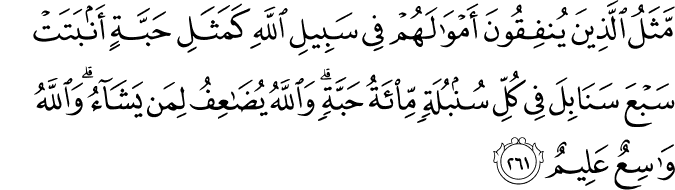
"The likeness of those who spend their wealth in the Way of Allah, is as the likeness of a grain (of corn); it grows seven ears, and each ear has a hundred grains. Allah gives manifold increase to whom He pleases. And Allah is All-Sufficient for His creatures' needs, All-Knower." (2:261).

"O traders! Bear witness with me that I donate all this to the poor people of Madinah!" said Uthman (Radiallahu Anhu).

Source: Related by Shaikh Habibullah Mukhtaar in his book "Bringing Up Children in Islaam" in the chapter of Generosity
report post quote code quick quote reply
+2 -0Like x 2
back to top
Rank Image
Seifeddine-M's avatar
London
4,762
Brother
4,174
Seifeddine-M's avatar
#14 [Permalink] Posted on 19th August 2014 09:30
The lessons and important ramifications of Zakah with respect to the purification of the soul may be summarised in the following points:

(1) The paying of Zakah (as well as the giving of additional charity or sadaqah) is a source of great reward from Allaah سبحانه وتعالى. In other words, Allaah سبحانه وتعالى is pleased with it, blesses it and multiplies it immensely. Allaah سبحانه وتعالى says,


"The likeness of those who spend their wealth in the Way of Allah, is as the likeness of a grain (of corn); it grows seven ears, and each ear has a hundred grains. Allah gives manifold increase to whom He pleases. And Allah is All-Sufficient for His creatures' needs, All-Knower." [Sooratul Baqarah, 2:261]

Hence it draws one closer to Allaah.

[Purification of the Soul]
report post quote code quick quote reply
+1 -0Like x 1
back to top
Rank Image
Seifeddine-M's avatar
London
4,762
Brother
4,174
Seifeddine-M's avatar
#15 [Permalink] Posted on 20th August 2014 10:39
(2) In reality, the payment of zakah should directly help in purifying a person. It also purifies his wealth. Allaah سبحانه وتعالى said to the Prophet صلي الله عليه وسلم,


"Take Sadaqah (alms) from their wealth in order to purify them and sanctify them with it, and invoke Allah for them. Verily! Your invocations are a source of security for them, and Allah is All-Hearer, All-Knower." (Soorah at-Tawbah, 9:103)

Beyond that, it can purify a believer's soul by cleansing him of the diseases of stinginess and miserliness. It also purifies the wealth of the person by removing any evil effect from it. The Prophet صلي الله عليه وسلم said, "Whoever pays the zakah on his wealth will have its evil removed from him." [1] [2]

Notes:

[1] Recorded by Ibn Khuzaima and at-Tabaraani. According to Shaykh al-Albaani رحمه الله, it is hasan. Cf., Saheeh at-Targheeb wat-Tarheeb, (Beirut: al-Maktab al-Islaami, 1982), vol. 1, p. 312

[2] Purification of the Soul
report post quote code quick quote reply
+1 -0Like x 1
back to top


Quick Reply

CAPTCHA - As you are a guest, you are required to answer the following:


In the above image: What's behind the word Yellow? (it's not the sun)