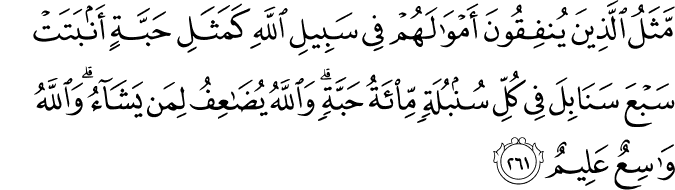
"The example of those who spend in the way of Allah is just like a grain that produced seven ears, in each ear a hundred grains. And Allah multiplies for whom He wills. And Allah is Ail-Embracing, All-Knowing. Those who spend their wealth in the way of Allah, then do not supplement their spending with boasting about favour nor with teasing, they have their reward with their Lord and there is no fear for them nor shall they grieve. Saying something proper and forgiving is better than a charity followed by teasing. And Allah is All- Independent, Forbearing. O those who believe, do not nullify your charities by boasting about favour, and teasing, like the one who spends his wealth to show off before people and does not believe in Allah and in the Last Day. So, his example is like a rock on which there is dust, then came over it a heavy rain and left it barren. They have no ability to gain anything out of what they have done. And Allah does not give guidance to the people who disbelieve. And the example of those who spend their wealth to seek the pleasure of Allah and to make firm their souls is like a garden on a hill on which there came a heavy rain and it yielded its produce twofold. Even if there comes no heavy rain, drizzle does. And Allah is watchful of what you do.Would any of you wish to have a garden of dates and grapes with rivers flowing beneath it, and for him there are all kinds of fruit, and old age befalls him and he has children who are weak, then comes upon it a whirlwind with fire therein, and it is all burnt? This is how Allah makes the signs clear to you so that you may ponder."(2:261-266)
Commentary
This is the thirty-sixth section of Surah Al-Baqarah which begins from verse 262. Left now are five sections of Surah Al-Baqarah out of which the last section carries some basic principles. The earlier four sections, from 262 to 283, have a total of 21 verses which present special instructions and points of guidance concerning financial transactions. If these were to be followed in toto, the problem of an ideal economic order which the whole world is worrying about will be automatically solved. Right now we see capitalism, socialism and communism (despite its fall in U.S.S.R) polarizing or readjusting against each other. The confrontation between these systems has reduced the world to a hotbed of internecine aggression. Stated in these verses is an important aspect of the economic order of Islam. It has two parts:
1) It teaches how to spend that which is extra to your needs to help the poor and the needy. This is known as Sadaqah and Khayrat (roughly translated as charity and alms).
2) It declares that taking and giving of riba (interest, usury) is haram (unlawful) and gives directions on how to stay on guard against it. Out of these sections, the first two consist of the merits of sadaqah and khayrat, inducement towards these, and related injunctions and points of guidance. The last two sections deal with the unlawfulness and forbiddance of riba-based dealings, and with permissible ways of giving and taking loans.
The verses given above make a three-unit statement as follows:
1) The merit of spending in the way of Allah.
2) Conditions which make sadaqah and khayrat acceptable and merit-worthy with Allah.
3) Attitudes that destroy sadaqah and khayrat when good goes and sin stays.
After that there are two similitudes:
1) The first relates to the charities {nafaqat and sadaqat) which are acceptable with Allah.
2) The second relates to the charities {nafaqat and sadaqat) which are unacceptable and invalid.
Thus, these are five subjects that appear in this section. Before we discuss these subjects, it is necessary to know that the Holy Qur'an has pointed out to spending in the way of Allah at several places with the word (infaq: spending) and at several others, with the words (it'am: feeding) or (sadaqah: charity) or (itaa' al-zakat: paying the obligatory zakah properly). A careful look at these Qur'anic words and the way they have been used shows that the words - infaq, it'am and sadaqah - are general and as such incorporate all sorts of charitable spendings that aim to seek the good pleasure of Allah. These spendings may be fard and wajib (obligatory) or nafl and mustahabb (commendable, or desirable, or preferred). It may be noted that the Qur'an has used a distinct word for the obligatory zakah which indicates that there are special requirements in receiving and giving of this particular sadaqah.
In this section, the word used more often is infaq while the word, sadaqah has been used less often, which indicates that the statement here covers general charities and deeds of generosity, and the injunctions given here include and incorporate all sorts of charities and spendings in the way of Allah.
A Similitude Of Spending In The Way Of Allaah
In the first verse it is said that people who spend in the way of Allah 'azza wa jal, that is, in Hajj or in Jihad, or on the poor, on widows and orphans, or on relatives and friends to help them out, can be likened to one who sows a good grain of wheat in the field from which grows a plant on which sprout seven ears and each ear yields hundred grains. As a result, one grain was worth a total yield of seven hundred grains.
The outcome is that one who spends in the way of Allah receives in return (reward in the Hereafter) on the scale of one to seven hundred, that is, spending one cent could bring the merit of seven hundred cents. It appears in authentic and reliable ahadith that the thawab or merit or reward for one good deed is returned ten-fold, and could reach seven hundred-fold. Sayyidna 'Abdullah ibn 'Abbas رضي الله عنه has said: "The reward of spending one dirham in Jihad and Hajj is equal to seven hundred dirhams." Ibn Kathir رضي الله عنه has reported this with reference to the Musnad of Ahmad رضي الله عنه.
To sum up, this verse tells us that spending one unit of money brings forth the reward of seven hundred units.
Conditions That Make Charity A Worship
But, the Qur'an has not, in its wisdom, put this subject in a few clear words. It has rather used the form of a similitude featuring a grain of wheat which has a subtle hint towards the labour of a farmer who can hope to get an yield of seven hundred grains out of one grain sown only when the grain is good, and the farmer sowing it should be fully conversant with the art of farming, and the soil where the grain goes should be good too, because, should even one of these factors remain missing, either this grain will be wasted leaving no grain to come out, or it would just not yield enough to reach the production ratio of one grain to seven hundred grains.
Similar to this, there are the same three conditions for the acceptance and increased return of good deeds generally, and of spending in the way of Allah particularly. These conditions are:
1) That which is spent in the way of Allah should be clean, pure and halal (lawful) for it appears in Hadith that Allah Almighty accepts nothing except what is clean, pure and halal.
2) One who spends should be good in intentions and righteous in deeds. An ill-intentioned and showy spender is like that ignorant farmer who throws away the grain on a spot where it is wasted.
3) The one to whom sadaqah (charity) is given should also be deserving of it. It should not be wasted by spending on the non-deserving.
Thus, the similitude unfolds for us the great merit spending in the way of Allah has, along with the three conditions as well, which stipulate that one should spend from halal earnings, and the method of spending should also conform to Sunnah, and that one should literally search for the deserving in order to spend on them. Just getting rid of what your coffers hold does not entitle you to receive this merit.
The correct and masnun (according to Sunnah) method of giving sadaqah has been pointed out in the second verse. It is said that people who spend in the way of Allah and do neither publicise their favour after having spent, nor cause any pain to those on whom they have spent, their reward is secure with their Lord. For them there is no danger in the future, and no sorrow of the past.
Conditions That Make Charity Go In Vain
Two negative conditions governing the acceptance of sadaqah have been stated in this verse:
1) Do not publicise your favour after spending.
2) Do not consider the receiver practically disgraced, and do nothing to cause him insult or pain.
In the third verse: (saying something proper), these two conditions for acceptance of charitable gifts in the sight of Allah have been further explained. Incidentally, these were introduced in the earlier verse. To repeat, when you spend in the way of Allah, do not show off the favour, and when you give something to somebody do nothing to make him feel insulted, or to cause him pain.
This was explained by saying that it is a thousand times better to offer some reasonable and appropriate excuse before the person who asks, if the giver feels he is unable to give under conditions of duress; and should the person asking anger the giver by impolite behaviour, it is also a thousand times better to forgive than to give him a charity which is followed by giving him pain. Allah Almighty is Himself Ghani and Halim, need-free and forbearing. He needs nothing from anyone. One who spends does so for his own good. That being so, an intelligent human being should keep this in mind while spending in the way of Allah, that he is not favouring anybody, and that he is spending for his own good. And should one sense ingratitude on the part of peopletreated well, he should subject himself to the divine attribute of 'forbearing', show obedience and forgive and forget.
In the fourth verse, the same subject has been taken up differently with a little more emphasis. It was said: Do not waste your charities: verbally - by causing your favour to be known; or practically - by causing pain.
This makes it clear that any form of favour-flashing or needy-bashing, after an act of charity renders such charity null and void. There is no reward for it.
In this verse, one more condition governing the acceptance of sadaqah has been added by saying that one who spends for public exposure, for name and fame, and does not believe in Allah Almighty and the Day of Resurrection, can be likened to be acting in a situation where he sows a grain on a clean rock which has collected a layer of soil, then comes the rain and washes the whole thing clean. Such people will never reap what they have sown and Allah Almighty will not let the disbelievers see the way. From this we know the condition that governs the acceptance of sadaqah and khayrat - spend only to seek the good pleasure of Allah Almighty and with the intention of getting thawab (reward) in the akhirah (Hereafter). Never do it with the intention of having public exposure, name and fame. Spending with the intention of earning name and fame is wasting what you spend. And should a true Muslim, who does believe in the Hereafter, expend something simply for name, fame, and under hypocritical motivation, he too, would not get any thawab (reward) for it. Moreover, there is a hint here in the use of the additional sentence (And does not believe in Allah); perhaps, it aims to suggest that hypocrisy and name-seeking is not just the sort of thing a person who believes in Allah Almighty and the Day of Resurrection would ever do since hypocrisy is a sign of something being wrong with his faith.
The meaning of 'Allah Almighty will not show disbelievers the way' towards the end of verse 264 is that the Qur'anic guidance is universal. It is common to all human beings. But, disbelievers do not take notice of this guidance, rather go a step farther and make fun of it. As a result, Allah Almighty lets them be deprived of the very taufeeq, the ability to accept guidance. The effect is that they do not accept any guidance.
In verse 265, the fifth under discussion, the acts of charity which are acceptable in the sight of Allah Almighty as valid spendings, have been illustrated with an example. It is said that those who spend in the way of Allah, solely and sincerely, to seek nothing but His pleasure, and thu's fortify their selves with steadfastness, are in a situation where there is a fruit farm located on some ftiound, then it is hit by heavy rains, then it brings forth double of its'usual yield. And should it be that the rain is not that heavy, a light drizzle would become sufficient for it and Allah Almighty sees and knows what you do.
Here the merits of spending in the way of Allah, surely with sincerity of intention, and obedience to conditions set, has been made clear through this similitude. The message is: 'Spending with good intention and sincerity, even if it be just a little, becomes enough and helps one receive the gains of the Hereafter.'
In verse 266, the sixth under discussion, the statement, that sadaqah can be rendered void and rejected if one acts against conditions set forth for the acceptance of charitable spendings, has been illustrated with yet another example. It was asked: Does anyone among you like that he owns a fruit farm, growing dates and grapes with streams flowing underneath, and trees laden with all sorts of fruits - then comes old age for the owner and he has children and a family that cannot stand ori their own. Under these conditions comes a whirlwind through the farm with fire in it and which burns the farm out. This is how Allah Almighty brings forth illustrative parallels so that you may think.
It means that spending in charity against given conditions is like hoping to be investing profusely in the Hereafter, but with Allah Almighty this investment comes to naught.
It may be noted that there are a series of qualifications added to this similitude-for instance, 'came his old age, he has children too and the children are young and weak.' These have a purpose. Isn't it that a person, if young, can look forward to having a new farm when his old farm burns out? Then, a person who has no children, and no hope to reactivate his burnt farm, he will not be so worried about his livelihood since a single man can get by even in adversity, one way or the other. Then there is the situation of one who has children, who are good and young with the hope that they would help the father out. In such a situation, a person is not that shocked even if his farm is burnt or plundered since he is free of the needs of his adult children who can themselves carry him through. In short, these three riding restrictions were introduced to describe the intensity of need when it was said that a person who spent his capital and labour and set up a fruit farm; the farm became ready and started yielding fruit as well. In this condition, came his old age and the days of weakness. Now this person has children and family. The children are very young and weak. Under these circumstances, should the farm he groomed burn out, his shock would be severe and the pain caused would be limitless.
Similarly one who has given his charity with hypocrisy is as if he set up a farm. Then came death after which his condition became equal to that of the old man who cannot earn his living and cannot set up the farm all over again. This is because human deeds cease to be after death. Similarly, an old man with children and family needs that his previous earnings be safe so that they can be used during old age. If, in this condition, his farm and his belongings burn out, there will be no limit to his pain and distress. Very much like this, the sadaqah and khayrat, the spendings in charity, which were made hypocritically or for self-promotion, will not come to help him exactly when he would need them most.
Summarising this whole verse, it could be said that ikhlas or sincerity is one big condition governing the acceptance of sadaqah and khayrat with Allah. This sincerity means that one should spend exclusively for the good pleasure of Allah Almighty without any admixture of self-promoting ends.
Now let us look at all the verses in this whole section once again. We shall discover that there are six conditions governing the acceptance, in the sight of Allah, of spendings in His way (sadaqah and khayrat). These are: 1. Spend from halal belongings.
2. Spend according to the prescribed practice (Sunnah).
3. Spend in proper place.
4. Do not remind of favour after having done it.
5. Do nothing to insult the reciever.
6. Spend with sincerity of intention, exclusively for the good pleasure of Allah Almighty, never doing it for the sake of name and fame.
The second condition, that is, spending according to Sunnah, means that one should be careful while spending in the way of Allah that rights due to someone may not be usurped. This is no act of thawab (reward) that one indulges in sadaqah and khayrat (charity) by stopping or limiting the necessary expenses on his family without their assent. Depriving the needy inheritors and bequeathing the whole inheritance or giving out everything in sadaqah and khayrat is against the teachings of Sunnah. Then there are a thousand forms of spending in the way of Allah. The sunnah method requires that the place to spend must be selected carefully giving thought to involved factors of importance, need, urgency etc. Usually people who spend do not bring these into consideration.
The essence of the third condition is that spending at a place or in a cause with even good intention is not good enough. This will not suffice to make it an act of thawab. It is also necessary that the place or cause of spending should be permissible and commendable in the sight of the Shari'ah. If a person was to bequeath his property for impermissible games and amusements he would be deserving of 'adhab (punishment) rather than thawab (reward). This holds good for all other possible avenues of investment which are not desirable in the view of the Shari'ah. (Ma'aariful Qur'aan, Volume 1)
"O those who believe, spend of the good things you have earned and of what We have brought forth for you from the earth, and do not opt for a bad thing, spending only from there, while you are not going to accept it at all, unless you close your eyes to it. And know that Allah is All-Independent, Ever-Praised. Satan frightens you of poverty and bids you to indecency, and Allah promises you forgiveness from Him, and grace as well. And Allah is All-Embracing, All-Knowing. He gives wisdom to whom He wills. And whoever is given wisdom is certainly given a lot of good. And only the men of understanding do observe the advice. And whatever spending you do and whatever vow you make, Allah knows it all. And for the unjust, there are no supporters. If you make the alms open, it is good enough, and if you keep it secret and give it to the needy, it is far better for you. And this will write off part of your sins. And Allah is All-Aware of what you do. It is not for you to put them on the right path. Rather, Allah puts on the right path whom He wills. And whatever good you spend is for your own selves, and you shall not spend but to seek the pleasure of Allah. And whatever good you spend, shall be paid to you in full, and you shall not be wronged. (Let your charities be) for the needy who are confined in the way of Allah, unable to move about in the land. An ignorant person takes them to be rich on account of their abstinence. You know them by their appearance. They do not beg people importunately. And whatever good you spend, Allah is All-Aware of it. Those who spend their wealth night and day, secretly and openly, they have their reward with their Lord, and there is no fear for them, nor shall they grieve." (2:267-274)
Commentary The preceding section dealt with spending in the way of Allah. Now further details related to this appear in the seven verses of the present section. These are as follows:
(1) Verse 267: 'O those who believe, spend ... Allah is All-Independent, Ever-Praised.'
On the basis of the circumstances in which this verse was revealed, the word: (tayyib: plural, tayyibat) has been interpreted to mean 'good' since some people used to bring things which were bad and that was why this verse was revealed. Some commentators have interpreted the word, tayyib (good) to mean halal (lawful) relying on the generality of the word since something is prefectly good only when it is halal (lawful) as well. So, according to this interpretation, the verse emphasizes that the thing given in charity must be from one's lawful income. However, according to the first interpretation, the stress on this condition will have to be proved by other sources. Let us remember that this is for a person who has something good yet elects to spend something not good as (you have earned) and akhrajna (We have brought forth) do indicate that good things are available with the person making charity, while the sentence (and do not opt for a bad thing spending only from there) proves the spending of something not good deliberately. As for the one who just does not possess anything good, he shall be exempted from this prohibition. His giving, even if it be bad, shall be accepted.
Some scholars have deduced from the expression, (what you have earned), the ruling that it is permissible for the father to eat out of the earnings of his son. This is based on a hadeeth:
"Your children are a good part of your earnings, so eat out of the income of your children cheerfully." (Qurtubi)
Injunctions Relating To The Lands Of 'Ushr The word (akhrajna: We have brought forth) in (What We have brought forth for you from the earth) hints that 'ushr is obligatory on 'ushri lands. Based on the generality of this verse, Imam Abu Hanifah has deduced that 'ushr is wajib or obligatory on every produce, big or small, yielded by 'ushri land. The verse (And pay the due thereof on the day of its harvest; 6:141) in Surah Al-An'am is open and clear in support of the obligatory nature of 'ushr.
'Ushr (the tenth or twentieth part) and Kharaj (land tax) are two technical terms used in Islamic Shari'ah. There is a common factor between these two. Both have an aspect of tax in them when levied on lands by an Islamic state. However, there is a difference. 'Ushr is not just a tax. On the contrary, its real nature is more of an act of monetary 'Ibadah (worship) than tax. This is similar to Zakah, for which reason, it is also called (zakah al-ard: the zakah of the land). Kharaj is straight tax which carries no aspect of 'Ibadah. Since Muslims are capable of 'ibadah and are obligated to do that, the part of land-produce taken from them is known as 'Ushr. Since non-Muslims are not obligated with 'Ibadah, that which is levied on their lands is named Kharaj. There is another practical difference between Zakah and 'Ushr -- Zakah becomes due on gold, silver and goods of commercial value after the passage of one year while 'Ushr becomes obligatory immediately after the produce is harvested from the land.
There is yet another difference - 'Ushr is dropped if the land produces nothing, but Zakah remains obligatory at the end of the year on gold, silver and goods of commercial value even if there is no profit at all. This is not the place to discuss details relating to the problems of 'Ushr and Kharaj. These can be seen in books of Fiqh. Incidentally, this humble writer has discussed this subject in some details in his book, Nizam al-Aradi which also contains special injunctions concerning lands in Pakistan and India.
(2) Verses 268-269: "Shaytaan frightens you of poverty ... and only the men of understanding do observe the advice."
When a person is obsessed with the idea that spending in charity will cause him poverty, when he does not pick up the courage to go ahead and spend - even after hearing the warning of Allah Almighty -and continues feeling that he should not spend out of what he has, and when, turning away from the Divine promise, his mind takes him to rely on the promise of Satan, he should better be sure that this apprehension of his is being generated by Satan. He should never say that he has never seen Satan, so how could he take orders from him? Conversely, should he come to think that not only his sins will be forgiven by spending in charities, but also his wealth will be blessed with increase - he should then be sure that this thought has come from Allah for which he should be grateful to Him. Allah's treasure never runs short. He knows fully well - the open, the hidden, the intentions, the deeds - everything about everyone.
Al-Hikmah: Meaning And Explanation
(3) Verse 269: "He gives wisdom to whom He wills."
The word, (al-hikmah: wisdom) appears repeatedly in the Holy Qur'an, and at every place, its meaning has been explained differently. In Tafsir al-Bahr al-Muhit, all positions taken by commentators have been assembled at this point. These come to nearly thirty, however, towards the end it was said that all these positions are close together and there is no contradiction among them. The only difference is that of interpretations. The word, hikmah is the verbal noun of 'ihkam (the first letter, hamzah with kasrah) which means 'to complete what is said or done with all its properties and requisites.'
This is why the verse: 'And Allah gave him the kingdom and the hikmah' (2:251) which concerns Sayyidna Dawud (A.S), was explained in al-Bahr al-Muhit in the following manner: The real meaning of hikmah is to place everything whereto it be�longs and this can only be accomplished ideally thrdugh prophethood. Therefore, hikmah has been interpreted as prophethood here.
Imam Raghib al-Isfahani رضي الله عنه has said in Mufradat al-Qur'an: "When the word, hikmah is used for Allah Almighty, it denotes the comprehensive knowledge and solid creative excellence of all things; and when attributed to the non-Divine, it means the rightly-guided knowledge of what exists, and the action which corresponds to it.
This sense has been interpreted in different words. Somewhere it means, the Qur'an; elsewhere, the Hadith. Then at different places, it carries different meanings, such as "the authentic knowledge", "the righteous deed", "the True Word", "the wisdom", "the understanding of religion", "correctness of opinion" and "the fear of Allah". Incidentally, the last meaning appears in Hadith as well: , that is, "the real wisdom is the fear of Allah". The word, hikmah in the verse: (teaches them the Book and the wisdom - 3:164) has been explained as "Hadith and Sunnah" by the Sahabah and the Tabi'in (the Companions and the Successors). Some commentators hold the opinion that hikmah in the verse (whoever is given wisdom) under discussion covers all these things.
This is the more evident view; more so, since the words of the Qur'an : "And whoever is given wisdom is certainly given a lot of good" do hint in that direction as they mean that the hikmah covers a lot of good. Allah knows best.
(4) Verse 270: "And whatever spending you do ... and for the unjust, there are no supporters."
Here, "and whatever spending you do" covers all spendings - those in which all related conditions are observed and those too, in which all or some conditions are not observed. For instance, it may not be in the way of Allah but be in the ways of sin; or the act of giving may be mixed up with hypocrisy; or may be followed by making a show of the favour before the receiver; or it may not be halal (lawful) and good.
Similarly, all votive offerings (nudhur) come under the general purview of (nadhr: singular: votive offering), for instance, it includes the nadhr of monetary 'ibadah in accordance with which nadhr has been introduced alongwith infaq (spending) and may also include of physical 'ibadah. It may be absolute, or dependent on something else; or it may or may not have been fulfilled. The purpose of saying all this is that Allah Almighty knows all these things and He shall recompense for them duly. This was made known so that people are persuaded to observe limits and conditions and be warned of their non-observance. The word (al-zalimin) in the text refers to the unjust, the transgressors, who do not observe the necessary conditions. To them was given clear warning.
(5) Verse 271: "If you give the alms openly, it is good enough, ... and Allah is All-Aware of what you do".
Obviously, this verse covers all types of charity, whether obligatory or supererogatory, and it is more preferable to perform all of them as secretly as possible. To observe secrecy in a charitable act has religious merits, because it is far from the possibility of riya' (show off), and more graceful for the receiver who can feel shy about receiving charity in public. It is also beneficial from an earthly point of view, because it does not disclose the amount of wealth one owns.
It should, however, be kept in mind that the preferability of observing secrecy is a matter of principle. There may be situations where it becomes more preferable to perform an act of charity openly for some external reasons, such as removing some accusation (of not paying zakah, for instance) or to persuade others to follow the example. Such exceptional cases do not negate the basic principle in any way.
Immediately after the instruction of concealing the 'Sadaqat', the holy verse says, (This will write off part of your sins). It does not mean that the expiation of evil-deeds is confined to the charity made in secret only. In fact, a charity made in public also carries the same benefit. But the reference to expiation here is in the context that even if someone feels a secret charity as useless in this world, he should not feel depressed, because Allah will forgive his sins, and that is a great gain for him.
(6) Verse 272: "It is not for you to put them on the right path ... and you shall not be wronged."
It has been clarified in this verse that a sadaqah given to a non-Muslim also carries a reward in the life to come. As the basic purpose of a Muslim in making a sadaqah is to get that reward, he should not confine himself to giving it to the Muslims only and to avoid giving it to the poor non-Muslims in the hope that this attitude will persuade them towards Islam, because a Muslim is not charged with bringing non-Muslims to the right path. He should seek his own benefit (the reward in the Hereafter) which can also be achieved through giving sadaqah to a non-Muslim.
Let us be clear at this point that sadaqah referred to here is nafl (supererogatory or voluntary charity) which can be given to a dhimmi (a non-Muslim citizen of a Muslim state) as well. The obligatory Zakah is not meant here since it is not permissible to give that to anyone ex�cept a Muslim (Mazhari). It is not permissible to give any kind of sadaqah to a harbi (a non-Muslim citizen of a non-Muslim state) and, however, it is permissible to give the dhimmis all other types of sadaqat, obligatory or supererogatory. Zakah is not included in the verse.
(7) Verse 273: "For the needy who are confined in the way of Allah ... Allah is All-Aware of it'.'
Here the word, al-fuqara (the needy: those who need support for their physical sustenance) covers all those who cannot engage them�selves in other jobs because of their religious preoccupation.
"An ignorant person takes them to be rich on account of their abstinence."
This verse tells us that a faqir (the one who does not own the nisab of zakah) wearing expensive dress will not be taken as 'need-free' because of that. Instead, he would be regarded as faqir. Paying Zakah to such a person will be correct. (Qurtubi)
"You know them by their appearance." This tells us that it is correct to give rulings based on circumstancial evidence. For instance, if a dead body is found wearing zunnar (waist-cord which is a symbol of some pagan religions), and is uncircumcised, it will not be buried in the graveyard of Muslims. (Qurtubi)
"They do not beg people importunately." On the surface, this verse gives the sense that they do not solicit importunately but it does not negate soliciting without importunity, as is the actual interpretation of some commentators. But, in accordance with the consensus of commentators, it means that they just do not ask; (totally refrain from asking) (Qurtubi).
(8) Verse 274: "Those who spend their wealth night and day."
Presented in this verse is the great reward and excellence of those who are used to spending in the way of Allah. They are those who, under all conditions and circumstances, during the day and during the night, secretly and openly, keep spending in the way of Allah in all sorts of ways. By implication, it was also stated that there is no time fixed for charities, i.e., sadaqah and khayrat. There is no restriction of night or day. Similarly, spending in the way of Allah, secretly and openly, is an act of thawab both ways, however, the condition is that it should be done with sincerity (ikhlas), and not to earn name and fame. The excellence of spending secretly is limited to a situation where there be no pressing need to spend out openly; and where such a need does exist, spending there openly is certainly better.
Based on the authority of Ibn 'Asakir, there is a report in Ruh al-Ma'ani which says that Sayyidna Abu Bakr Radhi-Allahu Anh: Allah be pleased with him spent forty thousand dinars in the way of Allah - making it ten thousand during the day, ten thousand during the night, ten thousand openly and ten thousand secretly. Some commentators have said that this very event related to Sayyidna Abu Bakr Radhi-Allahu Anh: Allah be pleased with him was the background of the revelation of this verse. There are other views also regarding the circumstances of its revelation. (Ma'ariful Qur'an)
"Those who take riba (usury or interest) will not stand but as stands the one whom the demon has driven crazy by his touch. That is because they have said: "Trading is but like riba." And Allah has permitted trading, and prohibited riba. So, whoever receives an advice from his Lord and stops, he is allowed what has passed, and his matter is upto Allah. And the ones who revert back, those are the people of Fire. There they remain for ever.
Allah destroys riba and nourishes charities. And Allah does not like any sinful disbeliever. Surely those who believe and do good deeds, establish Salah and Zakah have their reward with their Lord, and there is no fear for them, nor shall they grieve.
O those who believe, fear Allah and give up what still remains of the 'riba' if you are believers. But if you do not, then listen to the declaration of war from Allah and His Messenger. And if you repent, yours is your principal. Neither you wrong, nor be wronged.
And if there be one in misery, then deferment till ease. And that you leave it as alms is far better for you, if you really know. And be fearful of a day when you shall be returned to Allah, then everybody shall be paid, in full, what he has earned. And they shall not be wronged."(2:275-281)
The Prohibition Of Riba (Usury)
From these verses begins the description of the forbiddance of riba and the injunctions relating to its unlawfulness. This issue is very important from different angles. On the one hand, there are the severe warnings of the Qur'an and Sunnah and on the other, it has been taken today as an integral part of the world economy. The desired liberation from it seems to be infested with difficulties. The problem is very detail-oriented and has to be taken up in all possible aspects.
First of all we have to deliberate into the correct interpretation of these verses of the Qur'an and into what has been said in authentic ahadith and then determine what riba is in the terminology of the Qur'an and Sunnah, what transactions it covers, what is the underlying wisdom behind its prohibition and what sort of harm it brings to society.
The second aspect of riba is intellectual and economic. Is it true that riba guarantees the economic development of the world, so much so, that its suspension will categorically result in the destruction of trade and general economic activity? Or, this whole evil cycle is nothing but the brain-child of those heedless of Allah Almighty and the Hereafter. Otherwise, all economic problems can be solved without it as well. Going a step further, we can even say that the economic peace in the world depends on the elimination of riba, let alone the resolution of its problems. Riba is the greatest cause of the economic maladies of the world.
This second aspect involves the discussion of an economic problem under which come long debates which are not related to the interpretation of the Qur'an, therefore, we shall restrict ourselves to dealing with the first aspect only, which requires no less details either.
Here we have a total of six verses which state the prohibition of riba and set forth related injunctions. Out of these, the first sentence of the first verse points out to the sad end of those involved in riba transactions and to the disgraceful and dishevelled nature of their rising on the day of resurrection. It is said that those who consume riba do not stand except like a man who has been driven crazy by the embrace of some satan or jinn. It appears in hadith that the word, la yaqumuna or 'do not stand' means the rising of the dead from their graves on the day of resurrection in the sense that the dealer in riba, when he rises from his grave, will rise like the mad man who has been driven crazy by some satan or jinn.
The first thing we find out from this sentence is that a human being can faint or go mad under the influence of jinns and satans and the observations of those who have had such experience prove it. Hafiz Ibn Qaiyyim al-Jawziyyah Rahmatullahi 'Alayh: Allah have mercy upon him has confirmed that physicians and philosophers have conceded that epilepsy, fainting or madness are caused by several different reasons, one of which, at times, could also be the input of jinns and satans. Those who reject this have no other argument in their favour except that obviously it is too far out to believe.
The second point to be noted here is that the Qur'an does not say that the consumers of riba will rise in a state of madness or insanity. Instead, it refers to a peculiar condition of lunacy or fit or stupefaction - as if someone has been embraced by Satan and driven crazy. Perhaps, this carries the hint that a person struck with lunacy or fit is, at times, found inactive and silent while usually these people will not be found in that dormant state. Instead, they would be identified by their ranting, raving and crazy doings as a result of the satanic touch.
Perhaps, there might be yet another hint here. It is commonly noticed that human senses come to a flat nothing after fainting or insanity following a sickness; the very feeling of pain or punishment is just not there. But these people will not be found in that inert state. On the contrary, they would feel, with full sensitivity, the pain and the punishment like one shadowed by-a demon.
Now, at this point, we have to look for a certain compatibility in crime and punishment. When punishment comes from Allah Almighty, for a person or group, against a certain crime, it is certainly appropriate to the crime. Therefore, raising the consumers of riba, without sense, on the day of resurrection is perhaps indicative of a certain parallelism. Isn't it that the consumer of riba is so drunk with his greed for money that he is neither kind to anyone poor, nor does he blush before anyone for what he does? Since he was really senseless during his lifetime in the world, he was raised on the day of resurrection in that same condition. Or, may be, he was so punished because, in the mortal world, he demonstrated his lack of reason as reason, that is, he declared riba to be like trade; therefore, he was made to rise all deprived of his sanity.
Also noteworthy here is the fact that the verse uses the expression ya'kuluna or 'eating' of riba and, by application, means the taking and using of riba. This may be in eating or clothing or housing and its furnishings. But, it was identified with the act of 'eating' because that which is eaten cannot possibly be retrieved, contrary to other type of uses where things can be taken back. Therefore, total possession and monopoly are expressed through the word, 'eating'. This metaphor is found, not only in the Arabic language, but in Urdu, Persian and several other languages (English: 'eat', or the stronger word, 'devour').
After that, comes the second sentence, in which, giving the reason for this punishment of the consumers of riba, it has been said that these people have committed two crimes. One: They consumed the prohibited (haram) by dealing in riba. Two: They took it to be lawful (halal) and, in reply to those who declared it to be haram, they said that buying and selling is very much like riba. Just as 'profit' is derived from riba, so is profit derived from buying and selling. If riba is haram, trade should be haram too, although it is not prohibited in the sight of anyone.
Here, given the dictates of the situation, they might have said that riba is also like trade so, when trade is halal, riba should be halal too. But they, by changing the style of their statement, took a sort of mocking plunge at those who said that riba was haram, thereby telling them in effect - 'if you say riba is haram, then you must say that trade is also haram'.
In the third sentence, in reply to what these people said, Allah Almighty negated their position by saying that these people regard riba as equal to trade, although there is a world of difference between the two in accordance with the will and command of Allah Almighty. When He has made the one halal and the other, haram - how could they be equal?
Keeping this reply in mind, we should note that the objection raised by those people (the defenders of riba) was based on a purely rational argument. They were simply saying that since both activities aimed at earning profit, their governing injunction should also be one and the same. Praise be to Allah Almighty that He did not answer their rational doubt by a parallel rational explanation. Rather on the contrary, answering in His wisdom, He said that Allah Almighty is the absolute, sovereign master of all and He alone knows the harm and benefit, the good and bad of everything, most comprehensively. When He declares something to be halal, and something else to be haram, you should immediately realize that there must be some loss or harm or evil in that which has been declared haram, even if one does or does not see through it. This is because the actual reality of this whole system, and the benefit and harm that lies therein, can only be encompassed by the same 'Alim (the Knower) and Khabir (the Aware), from Whose reach of knowledge the minutest particle of the world cannot escape. The individuals or groups in this world can identify their expedient gains and their losses, but they just cannot claim to have encompassed the entire range of benefits and harms affecting the whole wide world. There are things that appear to be beneficial for a certain person or group but, when looked at in the perspective of the whole nation or country, the same things prove to be harmful.
Following that, it is said in the third sentence that a person, who had collected some money before riba was declared haram, and who repented after riba was declared haram, and promised to himself that he would not go near it in the future, he then, will find that the amount so collected belonged to him based on the outward dictate of the Shari'ah. Now remains the inward affair, that of his sincere, heart-felt abstinence, or that of his possible hypocritical repentance, that will be retired as a matter between him and His Lord. If the repentance comes from the heart, it will be beneficial in the sight of Allah, otherwise it will pass into nothingness. Common people have no right to doubt about it. However, one who hears good counsel, yet elects to revert to the same erroneous pattern of word and deed, for such people Hell is the place to go since this act of eating riba is a sin. And since their saying, that riba is halal like trade, is kufr, they will, for that reason, live in Hell for ever.
In the second verse (276), it was said that Allah Almighty eradicates riba and lets sadaqdt (charities) grow. Here sadaqat were introduced with riba by virtue of a unique congruity. It will be noted that there is contradiction in the very nature of riba and sadaqah, then their outcomes are also contradictory, and generally, those who engage in these two have contradictory intentions and objectives.
The contradiction in nature can be explained by the fact that in sadaqah one gives to others what belongs to him without any reward or return, while in riba, that which belongs to others is taken without any compensation or return. The intention and the objective of those who are engaged in these two activities is contradictory because one who gives sadaqah elects to lessen or exhaust what belongs to him exclusively for seeking the pleasure of Allah Almighty and for earning merit in the Hereafter; while the riba-taker is eager to collect impermissible increase on the capital he already has. That the outcome of both is contradictory is made clear by this verse which says that Allah Almighty erases the gains obtained through riba or takes away its barakah (blissful abundance); and increases the wealth, or its barakah for the giver of sadaqah. The result is that the objective of the greedy in pursuit of wealth is not achieved, while one who spends in the way of Allah, and who was quite happy with a little decrease in his belongings, finds it full of Divine barakah whereby his wealth increases, or its end-products do, and their benefits accumulate.
At this point, it may be interesting to find out what is the meaning of erasing riba and increasing sadaqat in the verse. Some commentators have said that this erasing and increasing relates to the Hereafter where the riba-consumer will find his wealth of no avail; it might as well become a curse for him; while those who are engaged in acts of sadaqah and khayrat will find that their wealth has become a source of eternal blessings. This is absolutely obvious in which there is no doubt. However, according to the consensus of commentators, the position is that the erasing of riba and the increasing of sadaqah is most certainly related to the Hereafter, but some of its traces are observed in this world as well.
The money or property of which riba becomes a part is sometimes destroyed taking with it all that was before it. This is a common sight in markets of riba and stocks where millionaires and capitalists of yesterday become insolvents and paupers of today. No doubt, there are chances of profit and loss in riba-free business activities and there are many businessmen who face losses in business deals but a loss that turns a millionaire into a beggar is witnessed only in riba markets and stock exchanges. There are so many statements of the experienced and the knowledgeable which say that the wealth collected through riba may increase faster and higher, but it generally does not survive long enough to run through children and their successors. In between, comes some calamity and effaces everything out. Sayyidna Ma'mar said that they have heard from their elders that forty years hardly pass on the riba-consumer when muhaq (major loss) overtakes his wealth.
May be, the wealth or property does not go to ruins outwardly, but this much is quite certain that its benefits, utilities, and blessings will go away. Since this is no secret that gold and silver are not desirable or useful as such. They cannot remove hunger or thirst. They cannot help beat the heat or serve as quilt and wrap in winter. Neither can they be used as clothes or utensils. The only purpose for which a wise person goes through thousands of exercises to procure and secure these can hardly be anything else except that gold and silver are means to procure things that go to make man's life pleasant and that he may live a life of comfort and self-respect. Then comes man's natural wish that his children and relatives should also enjoy the same comfort and self-respect as he did.
These are the sort of things that can be called the benefits and utilities of wealth and property. As a result, we can safely say that one who procures these benefits and utilities has his wealth increased in a sense, even though it may appear to have decreased, and one who procures these benefits and utilities on a lower scale has his wealth decreased in a sense even though it may appear to have increased.
After having understood this, let us compare the two activities of riba dealings and sadaqah and khayrat. It will soon be noticed that the wealth of the riba-consumer, no doubt, appears to be increasing, but that increase is akin to the swelling of the human body. The increase in swelling is after all an increase of the body itself. But no sane person would like to have this sort of increase because he knows that this increase is a certain knock of death. Similarly, no matter how increased is the wealth of the riba-consumer, he remains, for ever, deprived of its fruits, that is, comfort and honour.
Perhaps, at this point, a doubt may bother someone in view of the comfort and status enjoyed by the riba-consumers of today. Here they are with their mansions and villas, living in every luxury money can buy, attended by servants and maids, having the best to eat, drink and sleep - necessities and absurdities all rolled in one. A little thought here would lead every sane person to differentiate between the articles of comfort and comfort itself. There is a big difference between the two. The articles of comfort are made in factories and sold in markets. These can be procured aginst gold and silver, but that which is known as comfort, peace and bliss, is neither made in any factory nor sold in any market. This is mercy (rahmah) which comes directly from Allah Almighty. There are occasions when this cannot be procured no matter how much one holds in his possession. Just think of the comfort of a sound sleep. In order to have it, we can certainly do our best - make a sleep-oriented house which is the best possible, perfect arrangement of air and light, cooling, heating, handsome looking furniture, the bed, the mattress, the pillows, all chosen ideally - but can we be sure that sleep will come just because all this helpful paraphernalia is there? If you have never personally experienced this, there are thousands who cannot sleep due to some disease, and who would say no. Reports from a country, so wealthy and 'civilized' as USA, reveal that seventy per cent people cannot sleep without sleeping pills. There are times when even these do not work. You can buy from stores things to make you sleep but you cannot buy sleep from any store at any price. Similar is the case of other articles of comfort and enjoyment. You can buy these articles against money but it is not necessary that you do experience comfort and enjoyment.
Again, after having understood this, if we look closely at what happens to the consumers of riba, we shall find that they have everything in the world except what we know as real peace and comfort. So intoxicated they are in turning their ten million into fifteen and fifteen into twenty that they have no time to eat, or dress up, or be with their wives and children. There are factories to take care of. There are foreign ships to watch. Anxieties after anxieties chase them day and night. With them they sleep and with them they rise. How terrible of these crazy people who have confused comfort with articles of comfort, and therefore, they are far far away from it.
This is a view of their so-called 'comfort'. Now let us think of their ideas of status, prestige and fair name. The fact is that such people become hard-hearted and merciless. Taking advantage of the poverty of the poor and the low income of the low-income people becomes their very occupation. Like parasites, they suck their blood to feed their own bodies. Since that is that, it is just not possible that people will ever respect them. Revealing are the accounts of the money-lenders of India and the Jews of Syria. If you see them as they are, you will find that their coffers are filled with gold and silver and precious stones yet they are given no respect in any group of human beings in any corner of the world. Moreover, the inevitable outcome of this cruel practice of theirs is that the poor start grudging and hating them, so much so that in the world of today most wars are an expression of this grudge and hate. It is the confrontation between labour and capital that introduced the ideologies of socialism and communism in the world. The subversive activities of communism are a result of this grudge and hate. The whole world has become a burning cauldron of killings and confrontations because of these. This much accounts for their personal comfort and social prestige.
Experience bears out that riba-earnings never make even the life of their children pleasant. Either the earnings go to waste or, because of its curse, they too, remain disgraced and deprived of the real fruits of wealth. People may perhaps be deceived by the example of the riba-consumers of the West, wondering how rich they all are and how do their next and their next generations flourish. To this, I have already answered by presenting a brief outline of their so-called prosperity.
Here it can only be added that they really are like some man-eater who nurses his body by feeding on the blood of other human beings, and then a group of some such people go to live in a community of their own, and you take someone to that locality to show him how healthy and prosperous all of them happen to be. But an intelligent visitor who is interested in the welfare of humanity will never want to limit his visit to this locality alone; on the contrary, he would also want to see those localities where the blood of people has been sucked dry leaving them half dead. One who has seen the totality of such localities can never be happy with the locality of fat man-eaters. He can never say that this act of theirs is the way of human progress; on the contrary, he will have no option but to declare this as destruction of all that is human.
Set against this is the case of those who give sadaqah and khayrat. You will never find them running after money so anxiously. They may have lesser articles of comfort but they shall be found having more satisfaction and peace of heart, which is real comfort, as compared to those who have all those supporting articles. Consequently, they shall be looked at with respect and admiration by every human being of the world.
Allah destroys riba and nourishes charities. In short, the above statement of the verse is very clear in relation to the Hereafter. However, if we wish to understand, with a little effort, it is equally open in respect of this worldly life. This is what is meant by the hadith in which the Holy Prophet Sallallahu 'Alayhi Wasallam: Peace be upon him said: 'No matter how much riba increases, it will decrease ultimately.' (Musnad Ahmad and Ibn Majah)
At the end of the verse (276), it is said: Allah Almighty does not like any disbeliever, any sinner. Here it has been indicated that those who just do not hold riba as haram have fallen into kufr (disbelief); and those who do know it to be haram, yet get involved with it, are sinners, transgressors or fasiq.
The third verse (277) mentions the great reward of peace and comfort that awaits the truly believing and practising Muslims, who are steadfast in Salah and Zakah. Since, in the verse previous to this, the punishment of Hell and the disgrace the consumers of riba will be facing was mentioned, so in accordance with the general style of the noble Qur'an, the merit - in Akhirah - of the believing-practising Muslims, those steadfast in Salah and Zakah, was mentioned alongside.
The gist of the fourth verse (278): "O those who believe, fear Allah and give up what still remains of the riba if you are believers" is that, after the revelation that prohibited riba, the giving and taking of the amount of riba that remained due against anyone was also prohibited.
Explaining this, it can be said that riba was rampant all over Arabia before it was prohibited by revelation. When verses earlier than the present one brought forth its prohibition, Muslims - following their Qur'an-oriented habit - abandoned all their riba-related dealings. But some people had claims of unpaid riba amounts on some others. In that connection, it so happened that Banu Thaqif and Banu Makhzum, two Arab tribes, had mutual riba dealings and people from Banu Thaqif had claims of unpaid riba amounts against Banu Makhzum. When Banu Makhzum became Muslims they, after having made their commitment to Islam, thought it to be impermissible to pay back the amount of riba due. On the other side were Banu Thaqif; their people started pressing their claim. Since these people had become Muslims, but did have a mutual peace agreement, the people of Banu Makhzum told them that they had now entered the fold of Islam and had no intention of spending their Islamic earnings in paying off riba.
This dispute rose in Makkah. That was a time after the conquest of Makkah. Sayyidna Mu'adh Radhi-Allahu Anh: Allah be pleased with him (according to another report, Sayyidna 'Attab ibn 'Asid Radhi-Allahu Anh: Allah be pleased with him was the Amir of Makkah, governor of the city, appointed by the Holy Prophet Sallallahu 'Alayhi Wasallam: Peace be upon him. He reported this dispute in writing to him requesting his guidance. It was in this background that this verse of the Qur'an was revealed, the gist of which is that all previous dealings involving riba should be terminated after entry into the fold of Islam, also no previous riba amount should be realized. The principal was all that could be taken.
When this Islamic law was enforced, the Muslims were already bound by it. The non-Muslim tribes who had accepted the Islamic law as party in peace treaties, they too, were bound by it. But, in spite of this, when the Holy Prophet Sallallahu 'Alayhi Wasallam: Peace be upon him announced this law in his famous Address of the Last Hajj (), he made it a point to say that this law does not carry behind it the financial interest of any individual, or nation, or Muslims themselves. This has been brought into force to reconstruct, reform and better the whole humanity. Therefore, first of all, we let go large amounts of riba owed by non-Muslims to Muslims. Now they too should have no excuse in leaving off the amount of riba they claimed. As he said in his Address: which means that the riba content of all riba dealings made in the age of ignorance stood forsaken. Now everyone will get the principal and no one will get the extra amount of riba. 'Neither shall you be able to do injustice to anyone by charging an increased amount, nor shall anyone be able to do injustice to you by decreasing the amount of your principal.' And the first riba that was surrendered was the riba of Sayyidna 'Abbas ibn 'Abd al-Muttalib Radhi-Allahu Anh: Allah be pleased with him, large amounts of which were due on non-Muslims in the form of Riba. The subject verse refers to this happening and sets out the injunction to leave off all standing riba amounts.
As the verse opens addressed to Muslims, they were first given the command of that is, 'fear Allah.' Given after that was the injunction covering the real issue. This is the same unique style of the Qur'an which distinguishes it from all the law books of the world. When a law, which is somewhat difficult to act upon, is given, it has the prefixes and suffixes of accountability of deeds before Allah Almighty, and the punishment and reward of the Hereafter, so that Muslim minds and hearts become prepared to act upon it; the injunction is announced after that. Here too, the forsaking of the amount of matured riba could weigh heavy on human disposition, therefore, said first was (fear Allah). After that, came the injunction: that is, 'leave off riba that remains.' Towards the end of the verse it was said: that is, 'if you are believers.' Here it was indicated that 'Iman (faith, belief) requires that Divine injunctions should be followed faithfully. Acting otherwise negates 'Iman. Since this injunction was somewhat heavy on temperaments, (Fear Allah) was added before it, and (If you are believers) after it.
After that, in the fifth verse (279), severe warning has been given to those who act contrary to this injunction. They are told if they do not abandon riba, they must face a declaration of war from Allah Almighty and His Messenger. So severe is this warning that any other warning of such severity does not appear anywhere in the Qur'an in relation to any other sin, no matter how great, except kufr (disbelief), of course. The verse then closes with the words: that is, 'if you repent and resolve to leave off the remaining amount of riba in future, you will get your principal.
Neither will you be able to do injustice to anyone by extracting more than your principal, nor will anyone be able to do injustice to you by decreasing or delaying the return of your principal.' Here the receipt of the principal has been conditioned by saying that you repent, and resolve that you will abandon riba in future, and only then, you shall get your principal.
Evidently this indicates if repentance (Taubah) was not done by resolving to give up riba, receiving the principal will no more be in order. Here are the related details. Take the case of a person who just does not believe that riba could be haram and therefore, he does not repent and resolve that he will have nothing to do with riba anymore -then this person goes out of the fold of Islam and becomes an apostate ( : murtadd). The injunction governing an apostate is that his belongings go out of his possession. As a consequence, that which he has earned during the period he was a Muslim, goes to his Muslim inheritors, and that which he earns after involvement with kufr is deposited in the Baytul-Mal (the Exchequer of an Islamic State). Therefore, should his non-repentance be because he considers riba to be halal, he will not be entitled to receive even his principal. And if he does not go to the limit of considering riba as halal but, nevertheless, in actual practice, does not stop getting involved with it and, on top of that, gangs up with his kind and stands in confrontation with the Islamic government, he then is a rebel. His belongings too, are confiscated and placed as trust in the Baytul-Mal, so that it could be given back to him when he repents. Perhaps, it is to point out to such details that it was said in the form of a condition: which implies that, if you do not repent, even your principal will be held back.
After that there is the sixth verse (280) which, in comparison to the anti-human claim of riba, has stressed upon pure moral behavior of showing lenience to the poor and the have-nots. It is said that, if your borrower is too poor to pay back your loan, the provision of Shari'ah is that he be given time until he has the means, and should you forgive him your loan, it is much better for you.
The general habit of riba-consumers is that they, once they know that their borrower is poor and cannot pay the loan back at the appointed time, add up the riba amount in the principal unleashing a vicious series of riba over riba, even increasing the rate of riba in that process.
Here Allah Almighty, the wisest of all law-givers, gave the law that a genuinely poor borrower who is unable to pay back his loan should not be harassed. Instead, he should be given respite until such time that he becomes capable of doing so. Along with it was given the inducement to forgive the loan which is more beneficial for the lender.
The word, sadaqah has been used here by the Qur'an to mean the act of forgiving. The hint given is that this forgiveness will become an act of charity in your case and will bring forth great merit. As for the statement - 'if you forgive, that is better for you' - it can be said that this action was obviously a matter of total loss for them because they were not only being asked to surrender riba but also were going to lose their own principal! Still, the Qur'an called it 'better' (khayr). There are two reasons for this:
1. This betterment will be witnessed soon after the transitory life of this world when, in lieu of this insignificant earning, one will get the eternal blessings of Paradise.
2. Perhaps there may be yet another hint towards the possibility that one will himself see how good comes out of his deeds. There will be barakah (increase, bliss) in what one has. The essence of barakah is that a little serves to take care of a lot more needs, even without a quantitative increase in what one has. As such, it is commonly witnessed that there is unlimited barakah in the wealth of those who spend in sadaqah and khayrat. The little they have serves to take care of so many needs which will never be liquidated with large amounts of money spent by those whose money is haram (unlawful).
Then there is the wealth not blessed with barakah. One never realizes the purpose for which it is spent. Or, it so happens that such rich people have to spend huge amounts of money on undesirable heads such as medicines, treatment and consultancy fees, which is something the poor do not face. First of all, Allah Almighty blesses them with health which frees them from spending on their treatment and, in case they do fall ill, ordinary treatment gives them their health back. Seen from this angle, forgiving the poor person the loan due to him, which is apparently a matter of loss, becomes under this Qur'anic teachings, a beneficial act.
This teaching of giving respite to a poor borrower has also been commended in authentic ahadith some of which are reproduced below. According to a hadith in the Mu'jim of al-Tabarani, a person who wishes to be under the shadow of divine mercy when there will be no other shadow for anyone to hide under, he should treat the poor borrower with lenience and deferment, or forgive him the debt, if it comes to that.
Another hadith similar to this appears in Sahih Muslim as well. It is said in a hadith from the Musnad of Ahmad that the person who grants respite to a penniless borrower will get a daily thawab of sadaqah in proportion to the amount due against that borrower. And this calculation covers the act of giving respite well before the deadline for repayment arrives; and when the deadline for repayment does arrive and the borrower does not have the means to pay, the respite given at that time will bring forth for the giver of respite a daily thawab of giving twice that amount in sadaqah. Another hadeethth says that a person who wishes that his prayer be answered, or his misfortune be removed, he should give respite to the penniless in debt.
In the last verse (281), there appear again the subjects of the fear of the Last Day, its accounting, its rewards and punishment, at which end these verses containing the injunctions of riba. It was said in this last verse: 'fear a day on which all of you will be assembled before Allah when everyone will be fully and equitably recompensed for his deeds and they will not be wronged.'
Sayyidna 'Abdullah ibn 'Abbas Radhi-Allahu Anh: Allah be pleased with himsays that this verse is the last in the order of its revelation. No other verse was revealed after that. Thirty-one days later, the Holy Prophet Sallallahu 'Alayhi Wasallam: Peace be upon him left this mortal world. There are other reports which say that this happened after only nine days.
Upto this point, the explanations have been restricted to the verses of Surah al-Baqarah which concern the injunctions of riba. Dealing with the unlawfulness and prohibition of riba, there are in the noble Qur'an seven verses of Surah al-Baqarah cited above, one verse in Surah Al-'Imran and two verses in Surah al-Nisa'. There is yet another verse in Surah al-Rum the explanations of which differ. Some have taken it too in the sense of usury or interest, while others hold that it has some other connotation. Thus there are ten verses of the Holy Qur'an which carry the injunctions of riba or interest.
Before we get to know the whole truth about riba, it seems appropriate that the translation and explanation of the rest of the verses which appear in the Surahs Al-'Imran, al-Nisa' and al-Rum, should be given here so that it becomes easy for us to understand the true nature of riba in the combined perspective of all these verses. Verse 130, of Surah Al-'Imran (3) reads as follows:
"O those who believe, do not eat Riba, (usury or interest) multiplied many times. And fear Allah, so that you may be successful."
There is a special event behind the revelation of this verse. In pre-Islam Arabia, the general pattern of riba transactions was that loans were given on riba for a set period of time; when that period expired and the borrower was unable to pay it back, he was given an extension of time on the condition that the amount of riba was to be increased. Similarly, if payment was not made even on the expiry of the second deadline, the amount of riba was further increased. This fact is mentioned in general books of Tafsir, specially in Lubab al-Nuqul, on the authority of Mujahid.
The verse was revealed to eradicate this inhuman custom of pre-Islam Arabia. Therefore, by saying (ad'afam' Muda'afatan: multiplied many times) in the verse, their prevailing practice was con�demned and they were warned on their selfishness and anti-community conduct, and naturally so, it was declared prohibited. This does not mean that riba will not be prohibited if it happens not to be multiplied many times, because the absolute prohibition of riba has been very clearly stated in Surah al-Baqarah and Surah al-Nisa', irrespective of its being doubled or multiplied many times. This is like it has been said at several places in the Holy Qur'an: (Do not take a paltry price in exchange of My verses). The expression 'paltry price' was used here to indicate that even if the kingdom of the whole world was taken in exchange for the Divinely revealed verses, the price will still be 'paltry.' It does not mean that taking a paltry price against the verses of the Qur'an is haram, but taking a higher price would be permissible. Similarly, the expression (multiplied many times), has been introduced only to focus attention on their shameful method and it is not a necessary condition for the prohibition.
Moreover, if we think about the prevalent methods of riba, we will reach the conclusion that once the habit of taking riba is settled, the riba does not remain simple riba anymore; it necessarily becomes doubled and multiplied because the amount accrued from riba becomes a part of the total amount owned by the creditor and, when he further circulates this additional amount of riba on interest or usury, the riba becomes multiplied. Should this chain action go on building up, nothing can stop it from becoming (multiplied many times). This way every riba will end up increasing several times.
Having dealt with verse 130 of Surah Al-'Imran, let us now look at the two verses, 160 and 161 of Surah al-Nisa' which concern riba. These are as follows:
So, for the transgression of those who became Jews, We prohibited for them the good things earlier made lawful for them and for their preventing (people) frequently from the way of Allah, and for their taking riba (usury or interest) while they were forbidden from it, and for their eating up the properties of the people by false means. And We have prepared, for the disbelievers among them, a painful punishment.
These two verses tell us that riba was equally prohibited under the law of Sayyidna Musa (A.S). When the Jews opposed it, they were appropriately punished in their worldly life when they started devouring the unlawful just out of greed for the mortal gains of the world, consequently then, Allah Almighty declared some lawful things prohibited for them. Verse 39 of Section 4 in Surah al-Rum is as follows:
'And what you give in usury, that it may increase upon the people's wealth, increases not with God; but what you give in alms, desiring God's Face, - they shall receive recompense manifold.' (30:39)
Some commentators have taken this verse, like others mentioned earlier, to be dealing with interest or usury in view of the use of the word riba meaning 'increase' in the text. According to them, the verse means that money does seem to increase apparently by taking interest, but in fact, it does not. It is like the case of a person whose body gets swollen. Obviously this 'increases' his body but no sane person would be happy with this sort of 'increase'. On the contrary, he would regard it as death in the offing. As compared to this, the giving of zakah and sadaqah does seem to decrease the wealth apparently, but that is no decrease in fact, rather on the contrary, it is the source of thousands of increases. It is like someone who takes purgative as system-cleanser or lets blood as a therapeutic measure; he looks weak on the outside and seems to miss something in his body but those who know regard this 'decrease' to be a fore-runner of his 'increase' in health and strength.
According to some scholars of tafsir, this verse does not refer to the prohibition of usury or interest at all, rather, the word riba' used in that verse refers to a gift presented to someone, not in good faith, but with the intention that it would bring back some better gift in return from the receiver. The gifts of this type are in vogue in some communities at the time of marital ceremonies Since this type of giving is to seek selfish ends and not to seek the pleasure of Allah Almighty, therefore, it was said in the verse that by doing so your wealth may seem to increase, but actually it does not increase with Allah, while that which is given as zakah and sadaqat to seek the pleasure of Allah Almighty goes on to double and redouble with Allah.
According to this explanation, the sense of the verse will match with what was said addressing the Holy Prophet Sallallahu 'Alayhi Wasallam: Peace be upon him in another verse (74:6): that is, do not do favour to anyone with the intention that it may bring to you some added benefit in return.
This second explanation appears to be obviously weightier in connection with this verse of Surah al-Rum. Firstly, because Surah al-Rum is Makki. Although, it is not necessary that every verse in a Makki Surah is revealed in Makkah, yet there exists strong probability that it is so unless proved otherwise. And in case the verse is Makki, it cannot be interpreted to carry the sense of the prohibition of riba be�cause the prohibition of riba came by revelation in Madinah. In addi�tion to this, the subject dealt with earlier than this verse also indicates a tilt towards this explanation. There it was said: which means: 'Give to the relative his due, and to the poor and the wayfarer. This is better for those who seek the pleasure of Allah.'
In this verse, it has been stated that spending on relatives, the poor and the wayfarers can become an act of thawab only on the condition that the intention behind it should be that of seeking the pleasure of Allah Almighty. Then, following that, in the verse under discussion, it was further explained that financial help given to someone with the hope that it will bring back greater return from the receiver of the help is certainly no spending in the way of Allah where the purpose is hardly to seek His pleasure. As a result, this will bring no thawab.
Anyhow, there are, beside this particular verse, several other verses cited earlier which do deal with the prohibition of riba. Out of these, there is the verse from Surah Al-Imran which prohibits doubled and multiplied riba; the rest of the verses state the prohibition of riba as such. These details, at the least, clear this much that riba is haram (unlawful) anyway, be it doubled and multiplied, simple or compound. It may be kept in mind that the degree of its being haram is so severe that a declaration of war has been made on behalf of Allah and His Messenger against those who challenge the injunction.
Some Additional Details About Riba Since riba has become the supporting pillar of the prevailing trading system today, it is commonly noticed that people are usually disposed to balk at the idea of its unlawfulness when confronted with its prohibition under the verses of the Book of Allah and the Traditions of the Holy Prophet Sallallahu 'Alayhi Wasallam: Peace be upon him. Rather than understand and explain its real nature, they tend to diffuse the issue with excuses. I wish to state humbly that the issue has to be first analysed and discussed sanely by taking up each aspect in its proper setting, without which we are sure to end up confusing issues. There are three parts of this discussion:
1. What is the real nature of riba in the Qur'an and Sunnah, and what forms it does it cover?
2. What is the wisdom behind the prohibition of this riba!
3. Granted that riba, no matter how evil it may be, has become a pillar of the economic system all over the contemporary world. Now if we were to abandon it, under injunctions of the Qur'an, how will the system of banking and trade run?
To begin with, the word, (Riba) is a well-known word in the Arabic language. This word was known, not only since the blessed appearance of the noble Prophet Sallallahu 'Alayhi Wasallam: Peace be upon him, but also during the time when Arabia was pagan and the Qur'an was not yet revealed. Moreover, the verses of Surah al-Nisa' also tell us that the word riba and its related dealings were equally well-known during the times of the Torah, where too, it was declared haram (unlawful).
It is obvious that riba was known since ages in Arabia and its envi�rons. Continuous transactions were being made as an established custom. When the Qur'an was revealed, it not only prohibited riba but also gave the information that riba was made unlawful for the community of Musa (A.S) as well. How then, can the nature of this word become something so ambiguous that it starts presenting difficulties in understanding and explaining its meaning and applications?
This is the reason why, in the year of Hijrah 8, when the verses of Surah al-Baqarah relating to the unlawfulness of riba were revealed, there appears no report from the noble Companions anywhere which may indicate that they had to face any doubt in understanding the real nature of riba, and that they had to go as far as to verify it with the Holy Prophet Sallallahu 'Alayhi Wasallam: Peace be upon him himself, something they did in other matters. On the contrary, just as they immediately acted upon the injunction prohibiting liquor the moment it was revealed, very similarly, they abandoned all riba transactions the moment the injunction prohibiting riba was revealed. The Muslims just cancelled all riba amounts that non-Muslims owed to them on all their deals made before the prohibition. Then, the case of Muslims who did not wish to give riba amounts they owed was brought to the court of the Amir of Makkah. He inquired the Holy Prophet Sallallahu 'Alayhi Wasallam: Peace be upon him. The deciding injunction was revealed by Allah Almighty through the verses of Surah al-Baqarah which declared that it was also not permissible now to give or take riba amounts that belonged to the previous times.
Here the non-Muslims might have found the ground to question as to why should they suffer loss of money because of an injunction of Islamic law? Therefore, in order to offset that possibility, the Holy Prophet Sallallahu 'Alayhi Wasallam: Peace be upon him made it clear in his Address of the Last Hajj that this injunction of Islamic law affects, not only the non-Muslims, but also the Muslims in an equal degree. And the very first amount of riba that was written off was the enormous amount which belonged to Sayyidna 'Abbas Radhi-Allahu Anh: Allah be pleased with him, the respected uncle of the Holy Prophet Sallallahu 'Alayhi Wasallam: Peace be upon him.
In short, when riba was prohibited, its meaning was no secret. It was a known practice. It was the same riba as the Arabs used to give and take it and called it as such. The Qur'an made it haram, and the Holy Prophet Sallallahu 'Alayhi Wasallam: Peace be upon him enforced the ruling, not in the form of some moral teaching, but as the law of the land. However, he did include certain forms of transactions under riba which were not generally held to be riba. It was the determining of these very forms that posed difficulties for Sayyidna 'Umar Radhi-Allahu Anh: Allah be pleased with him, and here it was that the leading jurists of Islam differed; otherwise, the real riba, which the Arabs knew by that very name, was never doubted or questioned by anybody as there was no reason to do so.
Now let us find out what riba the Arabs were used to. The renowned commentator, Ibn Jarir has reported from Sayyidna Mujahid that the riba practised in pagan Arabia which was prohibited by the Qur'an consisted of giving loan for a fixed period and then taking a fixed increase over and above the principal. If the loan was not paid back on the fixed date, an extension of time was granted on condition that the riba was to be further increased. The same information has been reported from Sayyidna Qatadah Radhi-Allahu Anh: Allah be pleased with him and from other leading commentators. (Tafsir ibn Jarir, page 62, volume 3)
Abu Hayyan al-Gharnati رضي الله عنه, the famous commentator from Andulusia (Spain) has, in his commentary - al-Bahr al-Muhit, reported the same form of riba prevailing in pagan Arabia, that is, they advanced a loan, took their 'profit' on it, and if the time for repayment was to be extended beyond the first due date, they increased the amount of interest in that proportion. This was called riba. These were the people of the same pagan Arabia who said that taking 'profit' when they give their money on loan should also be permissible similar to buying and selling where taking 'profit' is permissible. The Holy Qur'an declared this to be haram and made it clear that the injunctions governing buying and selling were different.
The same subject has been authentically narrated in all reliable books of Tafsirs such as, Tafsir Ibn Kathir, al-Tafsir al-Kabir and Ruh al-Ma'ani etc.
Ibn al-'Arabi رضي الله عنه has said in Ahkam al-Qur'an: Lexically, riba means increase, and in the verse, it means the increase against which there is nothing in exchange but a loan and its time.
Imam al-Razi رضي الله عنه has said in his Tafsir that riba takes two forms. It could be riba in trading transactions, and in loans. This second form was what commonly prevailed in Jahiliyyah or pagan Arabia. The known practice was that they would give their money on loan to someone for a fixed period of time and receive 'profit' against it every month. If the borrower failed to pay back at the appointed time, the time-limit was extended on condition that the amount of riba was to be further increased. This was the riba of the Age of Ignorance (Jahiliyyah) which was declared haram (unlawful) by the Holy Qur'an.
In Ahkam al-Qur'an, Imam al-Jassas defines riba as follows: The loan given for a certain time on condition that the borrower will pay an increased amount above the principal.
In a hadeeth, the Holy Prophet Sallallahu 'Alayhi Wasallam: Peace be upon him has defined riba by saying: [n]The loan that draws profit is riba.[/n]
This hadith appears in al-Jami' al-Saghir and al-Azizi calls it hasan. To sum up, the giving of loan and then taking 'profit' on it is riba, which was widely known and practised during the Jahiliyyah in Arabia, which was clearly declared haram. by the subject verse of the Holy Qur'an, and which was abandoned by the noble Companions the moment these verses were revealed, and the Holy Prophet Sallallahu 'Alayhi Wasallam: Peace be upon him enforced its prohibition through his judgments in the legal suits. As there was no ambiguity in its connotation, nobody faced any doubt or difficulty in understanding the term.
However, the Holy Prophet Sallallahu 'Alayhi Wasallam: Peace be upon him did include some forms of buying and selling within the range of riba which the Arabs did not take as riba. For instance, in the buying and selling of six commodities on barter basis, he ruled that they be exchanged like for like, equal for equal, and hand-to-hand. Any deviation in measure, more or less, and any credit-oriented transaction with regard to these commodities will also fall within the purview of riba. These six commodities are gold, silver, wheat, barley, dates and grapes.
Under the same principle, the Holy Prophet Sallallahu 'Alayhi Wasallam: Peace be upon him, after the revelation of the verses of riba, ruled that some forms of transactions in vogue known as al-muzabanah [Al-muzabanah () is the sale of fruit upon its tree by taking fruit already plucked on the basis of conjecture.] and al-muhaqalah [Al-muhaqalah () is the sale of grains, such as wheat, chick-peas etc, still in the ears of their standing crop by taking dried and husked wheat or chick-peas on the basis of conjecture. Since conjecture has the possibility of things turning out less or more, it was prohibited.] come under riba, and therefore, declared them to be haram. (ibn Kathir with reference to Mustadrak Hakim, page 327, Volume 1).
Here the question worth consideration was: Are these six commodities particular as such, or there are other commodities also which fall under the same injunction? If there are some, what shall be the the basis for including other commodities under the same rule? What forms shall be taken to have come under riba? This was the difficulty faced by Sayyidna 'Umar Radhi-Allahu Anh: Allah be pleased with him because of which he said: The verse of riba is among the last verses of the Qur'an. The Holy Prophet Sallallahu 'Alayhi Wasallam: Peace be upon him was taken away before he could make its details clear for us. So give up not only riba but also all the doubtful transactions. (Ahkam al-Qur'an, Jassas, page 551 and Tafsir Ibn Kathir, with reference to Ibn Majah, page 328, volume 1).
Here Sayyidna 'Umar Radhi-Allahu Anh: Allah be pleased with him is talking about the particular forms of buying and selling transactions, and their details, which were not taken as riba in Jahiliyyah. Bringing these under the category of riba, the Holy Prophet Sallallahu 'Alayhi Wasallam: Peace be upon him made them haram. As regards the main riba, which was commonly known in Arabia and which was abandoned by the noble Companions and was enforced by the Holy Prophet Sallallahu 'Alayhi Wasallam: Peace be upon him announcing its prohibition publicly during his Address of the Last Hajj, it was not possible at all that Sayyidna 'Umar Radhi-Allahu Anh: Allah be pleased with him would have faced any difficulty or doubt in understanding it. Moreover, when Sayyidna 'Umar Radhi-Allahu Anh: Allah be pleased with him did face doubt in certain forms of riba, he resolved the problem by proposing that the forms where there is the least doubt of riba should also be abandoned.
But it is surprising that some of those who are slavishly impressed by the veneer of glamour, wealth and the interest-based trading system of today, have deduced from this saying of Sayyidna 'Umar that the sense of riba had thus been left abstract and that there is room for personal opinion here, the error of which has already been proved by a lot of material before us. In Ahkam al-Qur'an, Ibn al-'Arabi رضي الله عنه has strongly refuted those who had used the words of Sayyidna 'Umar Radhi-Allahu Anh: Allah be pleased with him to classify the verses of riba as abstract. He says: He who claimed that this verse is abstract did not understand the clear and confident affirmation of the Shari'ah because Allah Almighty sent His messenger to a people of whom he was one, sent him (speaking) in their language, revealed His Book to him so that they comprehend it easily in their language, and in their language the word riba means 'increase'; and in the verse, it means the increase that has no financial consideration against it, (but simply time).
Imam al-Razi رضي الله عنه has said in his commentary that riba is of two kinds - the riba on loans and the riba of taking more on barter. The first kind was well-known in Jahiliyyah and people during those days used to transact it freely. The second kind is what comes through the hadith which rules that increase or decrease in the barter of certain commodities is also included under riba.
It appears in Ahkam al-Qur'an of al-Jassas رضي الله عنه that riba is of two kinds - the riba in buying and selling and the riba without buying and selling. The riba of Jahiliyyah belonged to this very second kind. By definition it means the loan on which 'profit' is taken on the basis of time duration. Ibn Rushd has, in Bidayah al-Mujtahid, taken the same view, and has further proved the unlawfulness of the riba of taking profit' on loans, on the authority of the Qur'an, the Sunnah and the consensus of the Muslim community.
In Sharh Ma'ani al-Athar, Imam al-Tahawi رضي الله عنه has taken up this subject in great detail. He has said that the riba mentioned in the Qur'an is, openly and clearly, the riba that was given and taken on loans, and it was known as riba in Jahiliyyah. After that, it was through the statement of the Holy Prophet Sallallahu 'Alayhi Wasallam: Peace be upon him, and his Sunnah, that the other kind of riba became known, and which was identified with increasing, decreasing or non-cash dealing in particular types of buying and selling activity. That this riba is also haram stands proved by repeated ahadith of the Holy Prophet Sallallahu 'Alayhi Wasallam: Peace be upon him. However, in the absence of fully clear details governing this kind of riba some Companions of the Holy Prophet Sallallahu 'Alayhi Wasallam: Peace be upon him faced difficulty and jurists differed, (op cit., page 232, vol. 2)
Shah Waliullah رضي الله عنه has said in Hujjatullah al-balighah that these are two separate things. One is the riba in real terms, and the other is that which is included in the prohibition of riba. The riba in real terms means something additional claimed over the principal in a transaction of loan. But the hadith has included in the prohibition a transaction of bartering certain commodities whereby an additional measure is claimed in exchange of the same commodity. When it appears in the hadith of Saheeh al-Bukhari that: "There is no riba except in nasi'ah (loan)", it simply means that the real and primary riba, the one that is commonly understood and termed as riba, is nothing but taking 'profit' on loans. Excepting this, all other kinds have been annexed with it by extending prohibition to all of them.
Summing Up The Discussion 1. Riba was already a known transaction before the revelation of the Qur'an. The taking of increase on loans given for a certain time was called riba.
2. The noble Companions, all of them, abandoned this riba the moment its unlawfulness was revealed in the Qur'an. None of them had any difficulty or doubt in comprehending or explaining its meaning.
3. In the barter transactions of six commodities it was declared by the Holy Prophet Sallallahu 'Alayhi Wasallam: Peace be upon him, that whenever any one of these is bartered with a similar commodity, both of them must be equal in weight or measure. Any increase or decrease in such transactions has been declared as included in the prohibition of riba. This much was expressly told by the Holy Prophet Sallallahu 'Alayhi Wasallam: Peace be upon him. But the question was whether this special type of prohibition is restricted to these six commodities alone or it extends to some other commodities also, and if it extends to some other commodities, on what basis one can identify those commodities.
This question needed a deeper insight into the juristic issues involved, and the Muslim jurists came out with different suggestions to answer this question. It was this very question that agitated the mind of Sayyidna 'Umar Radhi-Allahu Anh: Allah be pleased with him. Since the Holy Prophet Sallallahu 'Alayhi Wasallam: Peace be upon him had not stated these rules himself and because doubt lurked therein, Sayyidna 'Umar Radhi-Allahu Anh: Allah be pleased with him regretfully wished how good it would have been if the Messenger of Allah Sallallahu 'Alayhi Wasallam: Peace be upon him had set the relevant rules himself which would have given them peace of mind in doubtful situations. Then he said that not only riba, but also the very doubt of riba, wherever it may be, should be avoided.
4. It is certain that the real and primary riba, which the Muslim jurists have called "riba al-Qur'an" (the riba of Qur'an) or "riba al-Qard" (the riba of loan), is exactly what was known and practised in Arabia, that is, claiming 'profit' on loan against the time allowed for repayment. Other kinds of riba identified in hadith are all annexed to this very riba and come under the injunction governing it. As regards the difference of opinion that rose in the community was exclusively related to this second type of riba deals. The first kind of riba is called 'riba al-Qard' or "the riba of Qur'an"; that it is categorically baram (forbidden) has never been disputed in the Muslim community.
In short, the riba of today which is supposed to be the pivot of human economy and features in discussions on the problem of interest, is nothing but this riba, the unlawfulness of which stands proved on the authority of the seven verses of the Qur'an, of more than forty ahadith and of the consensus of the Muslim community.
The second kind of riba which occurs in buying and selling is neither common in practice, nor requires any discussion here.
Upto this point, effort was made to clarify the meaning of riba as contemplated in the Qur'an and Sunnah, which is the first step towards understanding the problem of interest.
The Wisdom Behind The Prohibition
[color=#000000]Now comes the second part of the discussion which relates to the wisdom behind the prohibition of riba and to the spiritual and economic harms of riba transactions because of which Islam has declared it to be such a major sin.
First of all, we should realize that there is nothing in the entire creation of the world which has no goodness or utility at all. Even in serpents, scorpions, wolves, lions, and in arsenic, that fatal poison, there are thousands of utilities for human beings. Is there anything in this vastness of nature which could really be called bad? Take theft, robbery, villainy, bribery - not one of these remains without this or that benefit. But, it is commonly recognized in every religion and community, in every school of thought, that things which have more benefits and less harms are called beneficial and useful. Conversely, things that cause more harm and less benefit are taken to be harmful and useless. Even the noble Qur'an, while declaring liquor and gambling to be haram, proclaimed that they do hold some benefits for people, but the curse of sins they generate is far greater than the benefits they yield. Therefore, these cannot be called good or useful; on the contrary, taking these to be acutely harmful and destructive, it is necessary that they be avoided.
The case of riba is not different. Here the consumer of riba does have some temporal benefit apparently coming to him, but its curse in this world and in the Hereafter is much too severe as compared to this benefit.
An intelligent person who compares things in terms of their profit and loss, harm and benefit can hardly include things of casual benefit with an everlasting loss in the list of useful things. Similarly, no sane and just person will say that personal and individual gain, which causes loss to the whole community or group, is useful. In theft, and in robbery, the gain of the gangster and the take of the thief is all too obvious, but it is certainly harmful for the entire community since it ruins its peace and sense of security. That is why no human b
"O those who believe, when you transact a debt payable at a specified time, put it in writing. And let a scribe write it between you with fairness. And no scribe should refuse to write as Allah has educated him. He, therefore, should write. And the one who owes should give the dictation, but he must fear Allah, his Lord, and should not curtail anything from it. And if the one who owes is feeble-minded or weak or cannot himself give the dictation, his guardian should dictate with fairness. And have two witnesses from among your men. And if two men are not there, then one man and two women from those witnesses you are pleased with, so that if one of the two women errs the other woman may remind her. And the witnesses should not refuse when summoned. And, be not loath to write it down, as payable at its time, no matter how short or long. That is more equitable with Allah and more establishing for the evidence and nearer to that you fall not in doubt, unless it be a cash deal you carry out among yourselves. In that case there is no sin on you if you do not write it. And have witnesses when you transact a sale. And neither scribe nor witness should be harmed. And if you do, it is certainly a sin on your part. And fear Allah. And Allah teaches you. And Allah is All-Knowing in respect of everything.
And if you are in travel, and find no scribe, then (resort to) security, taken in possession. However, if one of you trusts the other, then the one who has been trusted upon should fulfil his trust, and should fear Allah, his Lord. And do not conceal the testimony. And whoever conceals it, his heart is, surely, a sinner. And Allah is All-Aware of what you do."(2:282-283)
The Qur'anic Injunctions On Loans
An important principle of the Law of Dealings, or the Law of Contracts in modern legal terminology, has been taken up in the verses appearing above. Following this, appears a specific principle of the general rules of evidence. These are times when writing is the rage. The written word has taken the place of human speech but think of the days of fourteen hundred years ago when almost the entire business of the world was conducted verbally. The principle of writing and retaining documents did not just exist. It was the Qur'an which first pointed out to its importance and said: When you transact a debt payable at a specified time, put it in writing.
Two principles have been stated here. These are:
1. A written document should be prepared while concluding a transaction on deferred payment basis, so that it may be availed of in cases of error or refusal.
2. While making a transaction on deferred payment basis, it is necessary that the due date of its payment should be determined. It is not permissible to defer the payment for an indefinite period of time because this can open the doors of dispute. This is why the Muslim Jurists have stressed that the time limit so set should not have any ambiguity at all. It should specify the exact date and month. There should be nothing vague about it, for instance, the time of the harvesting of crops cannot be fixed, because the time of harvesting may vary subject to weather conditions. Since writing was not common in those days (and even after writing has become so common, the majority of world population is the same as does not know how to write), it was possible for the scribe of the agreement to write down what was not intended, thereby causing undue loss or gain to one or the other party. Therefore, it was said: And let a scribe write it between you with fairness.
Firstly, the instruction given here requires that the scribe should not be prejudiced in favour of one of the parties. On the contrary, he should be impartial so that there remains no scope for doubt or concern for anyone. Secondly, the scribe was instructed to write justly. Let him incur no permanent loss on himself by working for the vanishing gain of others. After that, the attention of the scribe has been drawn to the fact that Allah Almighty has given him the ability to write, for which he can show his gratefulness by not refusing to write. As to who should initiate the writing of the document, it was said: And the one who owes should give the dictation. For instance, if a person has made a purchase on credit, then he is the one who should dictate the entries of the document because this will be a written agreement on his behalf. In order to offset the possibility of any addition or deletion in the written document, it was said: 'But he must fear Allah, his Lord, and should not curtail anything from it.'
It some times happens that the person incurring debt is fickle-minded, or superannuated in age, or a minor, or mute, or the speaker of a language not known to the scribe. Since such a person does not have the ability to dictate a document, it was said that, in a situation like this, his wali or guardian should dictate the written agreement. The need for a guardian in respect of the insane and the minor is obvious since all their affairs are handled through a guardian. The guardian of the mute, or the speaker of the language unknown to the scribe could also do this, and should he make somebody his representative, it would still be possible. Here, the word, 'wali' in the Qur'an covers both meanings.
The Rules Of Witnessing
Upto this point the statement was limited to the writing or dictating of documents in transaction. Later on, it is enlarged by saying that the writing of the document should not be taken as sufficient. It should rather have witnesses as well so that, in case there is a dispute, the appearance of witnesses in the court could help resolve it. This is why the Muslim jurists, may Allah's mercy be upon them, have said that simple writing of an agreement is not a conclusive proof in the sight of Islamic Shari'ah. Unless there is an oral evidence of witnesses, as approved by the Shari'ah, on the agreement, no decision could be taken on simple writing. Common courts of today also follow the same practice when they do not take a decision unless there is a verbal evidence to prove the document.
The Number Of Witnesses Now follow some important rules of evidence:
1. It is necessary according to Islamic rules of evidence that there be two men, or one man and two women. One man alone, or only two women are not sufficient witnesses in common dealings
The Qualification Of Witnesses
2. The witnesses should be Muslims. The Qur'anic expression: : 'from among your men' points out in this direction.
3. The witnesses should be trustworthy and just whose word could be relied upon. They should not be sinners and liars. This injunction is contained in: 'from those witnesses you are pleased with.'
Refusing The Act Of Witnessing Is A Sin
After that, the Holy Qur'an directs the people that they should not refuse to be witnesses when it is required from them, since evidence is the way to revive truth and the method to resolved disputes. Even if there is a trouble in giving evidence, it should to be tolerated, taking it as a national duty. Following that, emphasis was laid on writing down the document of deeds. It was said that the agreement, big or small, should invariably be written down: 'And, be not loath to write it down, as payable at its time, no matter how short or long.' Of course, if there is a hand-to-hand transaction, not involving any debt, it could be left unwritten.
However, as a precuationary measure, two witnesses should be taken to confirm the agreement anyway, just in case there arises a dispute between the parties concerned. For instance, the seller may say that the price was not received, or the buyer may charge that he did not receive everything he bought. Evidence of witnesses will serve well in deciding this dispute.
Witnesses Should Not Suffer When the verse began, scribes were instructed not to refuse writing or testifying agreements. In this case, it was possible that people would give them more trouble than necessary.. Therefore, it was said towards the end of the verse:
'And neither scribe nor witness should be harmed.' It means that, in order to protect one's own rights and benefits, one should not disturb the rights and benefits of others. Then it was said: : 'And if you do, it is certainly a sin on your part.'
This tells us that causing harm to the scribe or the witness is prohibited. For this reason, the Muslim jurists have said that the scribe who demands his wages while writing, or the witness who claims his legitimate two-way conveyance allowance, are entitled to get it as a matter of their right. Not paying these dues is included under the scope of harming them, and is, therefore, impermissible. No doubt, under its system of justice, Islam has forced the witnesses to appear in court, and has made the concealment of evidence a grave sin; but at the same time, the other side of the picture has also been duly taken care of, so that people are not made to stay away from testifying. It was the effect of this two-way precaution that truthful and selfless witnesses were available in every case, and cases were decided easily and quickly true to the demands of justice. When the modern world bypassed this Qur'anic principle, the whole court system went to pieces. Real and true witnesses in cases became virtually extinct. Everyone was compelled to shy away from appearing as a witness. The reason is simple. Being identified as a witness means trouble. If the case involves the police and a crime, the chief of the police station would call the witness everyday and any time, and on occasions, would have him sit there for hours. Even in civil courts, the witness is treated as if he was some sort of criminal. Then the dates of the case keep changing endlessly. New dates are given on which the poor witness is bound to come leaving his business, job and needs. If he fails, the threat of an arrest-warrant hangs over his head. Therefore, every decent person engaged in earning his livelihood has been forced to take the appearance in court as punishment for no crime of his, and therefore, he has been left with no choice but to avoid it as far as he can. Professional witnesses are all you get and they make no distinction between the lie and the truth. The Holy Qur'an, after emphasizing these basic ingredients, helps eliminate these malpractices by saying at the end of the verse: 'And fear Allah. And Allah teaches you. And Allah is All-Knowing in respect of everything.'
It will be noted that this verse carries many injunctions. Some Muslim jurists have deduced twenty important juristic rulings from this verse. We should also keep in mind the recurring style of the Qur'an whereby, before and after giving a particular law, it creates an inner impulse to follow Divine injunctions by introducing the fear of Allah and the fear of the Day of Retribution. It is in accordance with this method that the verse was concluded with an exhortation to fear Allah and to remember that there is nothing hidden from Him. If you try any contravention, under any impermissible pretext whatsoever, you will still remain unable to cheat Allah.
The second verse takes up the following two subjects:
1. In cases involving a credit deal, it is quite permissible for a person to keep something as mortgage to secure his debt. But the Qur'anic word (taken in possession) indicates that deriving any benefit out of the thing mortgaged is not permissible for him. The only right the mortgagee has is to keep the thing in his possession until the time when his debt is cleared. Any benefit that accrues from it rightfully belongs to the original owner.
2. Secondly, it was said that the person who knows the correct situation in a disputed matter should not withhold his testimony. If he does withhold it, his heart is a sinner. The heart has been identified as the sinner because somebody might think his sin was restricted to the tongue (which failed to speak up). But it was in the heart that he first decided to do what he did and therefore, the sin of his heart comes first.[Ma'ariful Qur'an]
"And to Allah belongs what is in the heavens and what is in the earth. And if you disclose what is in your hearts or conceal it Allah shall make you account for it, then He shall forgive whom He wills and punish whom He wills. And Allah is powerful over everything."(2:284)
Commentary
The earlier verse mentioned the injunction to reveal evidence and forbade its concealment. This verse is also a complement of the same subject. Here, warning has been given that it is fraram (unlawful) to conceal evidence. 'If you concealed the truth of a matter knowingly, your Lord who is all-Knowing and all-Aware, will make you account for it' - this interpretation of the verse has been reported from Sayyidna Ibn 'Abbas, Ikrimah, Sha'bi and Mujahid (R.A) (Qurtubi).
Taken in the general sense of the words, this verse is universal, and covers all articles of faith, modes of worship and mutual dealings (I'tiqadat, 'Ibadat and Mu'amalat). This is exactly what Sayyidna 'Abdullah ibn 'Abbas Radhi-Allahu Anh: Allah be pleased with him has said in his well-known commentary on this verse.
The verse means that Allah Almighty will make all His created beings give an account of all their deeds. It will include deeds they have actually done, and those they were determined to do but kept them secret in their hearts and were never able to do. This conforms to the report of Sayyidna Ibn 'Umar appearing in Sahih al-Bukhari and Muslim: 'I have heard from the Holy Prophet Sallallahu 'Alayhi Wasallam: Peace be upon him, that the believer will be drawn near his most exalted Lord when Allah Almighty will make him recall his sins one by one and will ask him if he knew that he had committed those sins. The believer will confess. Allah Almighty will say: 'I concealed your sins in the life of the world and never allowed this to be known to others. Today, I forgive that.' He will be given the Book of Good Deeds, while the sins committed by disbelievers and hypocrites will be announced before everybody.
It appears in another hadeeth that Allah Almighty will say on the day of Doom (Qiyamah): 'This is the Day when hidden things will be surveyed and secrets concealed in hearts will be laid out in the open. And (forget not that) My angels charged with writing down your deeds wrote down only those visible on the outside, and I know what angels do not know, nor did they write those in your Book of Deeds. Now I tell you all about it and ask you to stand and answer. I shall forgive anyone I will and I shall punish anyone I will.' True believers will then be forgiven and the disbelievers (kuffar) will be punished. (Qurtubi)
Here a doubt may arise in view of the hadith in which the Holy Prophet Sallallahu 'Alayhi Wasallam: Peace be upon him has been reported to have said: 'Allah Almighty has forgiven my ummah all that they thought of in their hearts unless they said or did it.'
It shows that there is no punishment or wrath on the volition of the heart. Imam al-Qurtubi has said that this hadith relates to the worldly effects of an act. Divorce, freeing of slaves, sales, and gifts are not authentically concluded by a simple volition of the heart unless they are done verbally or practically. Since the verse refers to the effects of an act appearing in the Hereafter, there is no contradiction here. However, other 'ulama have answered this doubt by sfiying that the hadith, in which forgiveness of things hidden in the heart has been mentioned, refers to the involuntary thoughts that enter the human heart without volition; in fact, they would still keep coming even if one tried to stop them. Allah Almighty has forgiven such involuntary thoughts for this ummah. The accounting that has been identified in the above-mentioned verse relates to what man intends and proposes with his choice and volition. It means that he not only nurses these in his heart, but also tries to put into them in practice. It does not matter if he is unable to act upon them due to accidental causes. He will still have to account for these firm intentions on the Day of Doom (Qiyamah). Therefrom things rest with Allah Almighty. He, in His grace, may then forgive anyone He wills and punish anyone He wills, as it has already appeared in the hadith of al-Bukhari and Muslim referred to above.
Since a surface view of the words used in the verse under discussion includes both kinds of thoughts, be they voluntary or involuntary, the noble Companions got extremely worried when this verse was revealed. They asked themselves if involuntary thoughts too became subject to accounting and censure, who could escape and stay safe? When they carried their anxiety to the Holy Prophet Sallallahu 'Alayhi Wasallam: Peace be upon him, he instructed them all to firmly resolve to obey and act in accordance with the Divine imperatives, and say that is, we heard, and we obeyed. The noble Companions, may Allah be pleased with them all, did exactly what they were told to do, upon which the following statement of the Qur'an was revealed: 'Allah burdens not anyone beyond his or her capacity.'
This verse clarified that involuntary thoughts will not be subjected to accounting and censure. This gave the noble Companions their peace of mind. This hadith has been reported in Sahih Muslim on the authority of Sayyidna Ibn 'Abbas (Qurtubi). The whole verse is coming next.
According to al-Tafsir al-Mazhari, out of the deeds made fard (obligatory) or haram (unlawful) for human beings, some have a physical aspect. Included there are Salah, Sawm, Hajj and all dealings. Then there are injunctions and deeds that relate to man's heart, his inner dimension, his batin. Everything concerning matters of belief and articles of faith ('Iman and I'tiqad) belongs right there. As for kufr and shirk, disbelief and polytheistic associationism, they are most unlawful and impermissible; and these too belong to the human heart. Also related to the heart are good morals, such as, humility, patience, contentment, generosity and many more. Similar is the case of bad morals, such as, arrogance, envy, grudge, greed and the craze for worldly gains and others of their kind. All these are absolutely haram (unlawful) in a certain degree. They too do not relate to man's outward physique - his limbs, his body parts. They belong to the heart, to the batin, the inner dimension.
In this verse, it has been made known that the way an accounting of outward deeds will be taken in Qiyamah, very similarly, inward deeds too will have to be accounted for. Even unintentional sins will be called to account. The placement of this verse at the end of Surah al-Baqarah has great wisdom behind it because Surah al-Baqarah is such an important and consequential Surah of the Holy Qur'an, that a fairly large part of Divine injunctions appears in it. It gives important fundamental and subsidiary instructions regarding life in this world and in the life to come. Then it holds within its fold details concerning Salah, Zakah, Sawm, Qisas (even retaliation), Hajj, Jihad, Taharah (prescribed state of purity), Talaq (divorce), 'Iddah (waiting period), Khul' (divorcement sought by wife), Rada'ah (suckling), unlawfulness of liquor and interest and methods which are permissible or impermissible in matters of loans and deals. It is for this reason that, in hadith, this Surah has also been called (Sinam al-Qur'an: the highest peak of the Qur'an).
Let us bear in mind that ikhlas or pristine sincerity is the essence behind what we do in carrying out all these injunctions. In other words, doing something or abstaining from something should both be for nothing but the pleasure of Allah Almighty. On no account should these be tainted with a desire for public recognition or some other selfish motives. It is obvious that ikhlas (sincerity) is related to human heart, the batin. If ikhlas is there, everything comes out right. It was for this reason that man was warned through this verse at the end of the Surah, by telling him that, in carrying out obligations or in abstaining from the prohibited, it was quite possible to dodge people around, to find an excuse and to get away with it. But, Allah Almighty is 'Alim and Khabir (All-Knowing and All-Aware). Nothing is hidden from Him. Therefore, let one do what one must but let him be sure that there is someone there - his Raqib and Hafiz, the One Who is watching and guarding over him, and Who is recording all that is happening to him, externally and internally, and a full accounting of which has to be given on the day of Resurrection. The noble Qur'an, by cultivating this unique spirit in human beings, has posted on human hearts a sentry on guard, in the form of the fear of Allah and the concern of the Hereafter. So, before and after every law, the sentry whistles, as a result of which, they are scared of breaking any Divine Law even in the darkness of nights and the privacy of homes.[Ma'ariful Qur'an]
Tafseer Of Surah al-Baqarah (2), Verses 285-286 (END)
"The Messenger has believed in what has been revealed to him from his Lord, and the believers as well. All have believed in Allah, and His angels and His Books, and His Messengers. "We make no division between any of His Messengers," and they have said: "We have listened, and obeyed. Our Lord, Your pardon! And to You is the return."
Allah does not obligate anyone beyond his capacity. For him is what he has earned, and on him what he has incurred.
"Our Lord, do not hold us accountable, if we forget or make a mistake and, Our Lord, do not place on us a burden such as You have placed on those before us. And our Lord, do not make us bear that for which we have no strength. And pardon us. And grant us forgiveness. And have mercy on us. You are our Lord. Help us, then, against the disbelieving people."(2:285-286)
Commentary These are the last two verses of Surah al-Baqarah. Great merits have been attributed to these two verses in authentic ahadith. The Holy Prophet Sallallahu 'Alayhi Wasallam: Peace be upon him has said that one who recites these two verses during the night, they will be sufficient for him.
As narrated by Sayyidna Ibn 'Abbas Radhi-Allahu Anh: Allah be pleased with him, the Holy Prophet Sallallahu 'Alayhi Wasallam: Peace be upon him said that Allah Almighty has sent forth these two verses out of the treasures of Paradise and the 'Rahman had already written them by His own hand two thousand years earlier than the creation of all things and beings. One who is able to recite them after the Salah of 'Isha', they will stand for Tahajjud in his case. As it appears in the Mustadrak of al-Hakim and in Bayhaqi, the Holy Prophet Sallallahu 'Alayhi Wasallam: Peace be upon him said that Allah Almighty has concluded Surah al-Baqarah with these two verses, which have been given to me in His grace from out of the special treasure that lies under the 'Arsh' (Divine Throne). Therefore, you should make special effort to learn these verses, and at the same time, teach your women and children how to recite them. This is why Sayyidna 'Umar and Sayyidna 'Ali (R.A) said that they thought that anybody who has any sense in him would never go to sleep without having recited these two verses.
Meaning-wise, these verses have many special features. One of the distinct ones is that they come at the end of Surah al-Baqarah where most of the injunctions of Shari'ah appear briefly, or in detail, such as, those dealing with the articles of faith, modes of worship, mutual deal�ings, morals and social living etc. Here, the first of the two verses opens with words of praise for the Muslims who are true and obedient, those who said yes with all their heart to all injunctions ordained by Allah, and were all set to carry them out. In addition to being an as�sertion of Allah's infinite mercy, the second verse also answers the doubt which started bothering the noble Companions when verse 284, the one preceding these two, was revealed. The words of the said verses, as mentioned earlier briefly, were: , that is, whether you manifest that which is in your hearts, or conceal it, Allah will call you to account for it. Here the verse was actually referring to the accounting of whatever one does with his or her choice and volition. Unintentional thoughts and errors were just not included under its purview.
However, the words of the Qur'an were general because of which people surmised that man will be taken to account even for thoughts that entered his mind without his intention. Nervously excited, the noble Companion presented themselves before the Holy Prophet Sallallahu 'Alayhi Wasallam: Peace be upon him and said: 'Ya Rasul Allah, till now we thought that we shall be called to account for only those deeds that we do with our will and choice, and we shall not be called to account for thoughts that cross our minds involuntarily. But this verse seems to tell us that every thought that enters our minds will be subject to accounting. This way it is extremely difficult to escape punishment.' Although, the Holy Prophet Sallallahu 'Alayhi Wasallam: Peace be upon him knew the correct intended meaning of the verse but he, in view of the generality of its words, did not elect to say anything on his own. Instead, he waited for the Wahy (revelation) and instructed the Companions that they should obey whatever Allah Almighty ordains for them. It may be easy or difficult to carry out, but it is not the way of a true Muslim to show the slightest of hesitation in accepting Allah's command when it comes. As soon as you hear the command of Allah, say: , that is, 'We have listened, and obeyed. Our Lord, Your pardon! And to You is the return.'
The noble Companions did exactly what they were told by the Holy Prophet Sallallahu 'Alayhi Wasallam: Peace be upon him, although their minds were still ticking with the apprehension that building a security shield against involuntary intrusions of thoughts was enormously difficult indeed! Thereupon, Allah Almighty revealed these last two verses of Surah al-Baqarah. Here the first one praises Muslims while the other gives a correct explanation of the verse that created doubt in the minds of the noble Companions. Now let us look at the words of the first verse. These are: The Messenger has believed in what has been revealed to him from his Lord, and the believers as well. All have believed in Allah and His angels and His Books and His Messengers. "We make no division between any of His Messengers," and they have said: "We have listened, and obeyed. Our Lord, Your pardon! And to You is the return."
The first seven words of this verse admire the Holy Prophet Sallallahu 'Alayhi Wasallam: Peace be upon him. It may be noted that the verse does not address him by his name, but, by calling him 'Rasul', his honour and dignity have been made clear. The word, 'the believers' follows immediately after that. It means that just as the Holy Prophet Sallallahu 'Alayhi Wasallam: Peace be upon him firmly believes in the revelation (Wahy) from Allah, so do the true Muslims in general. The style chosen for this sentence is also worth consideration. The major part has been used to describe the state of the 'iman (belief) of the Holy Prophet Sallallahu 'Alayhi Wasallam: Peace be upon him, then, the 'iman (belief) of the general Muslims has been described separately. This indicates that, although the Holy Prophet Sallallahu 'Alayhi Wasallam: Peace be upon him and all Muslims share in the wealth of 'iman as such, still there is a great difference between the two in terms of the relative degrees of 'iman. The knowledge of the Holy Prophet Sallallahu 'Alayhi Wasallam: Peace be upon him is based on seeing and hearing while the knowledge of other Muslims takes the form of 'iman bil ghayb or 'believing without seeing' as based on the 'ru'yah' or 'seeing' of the Holy Prophet Sallallahu 'Alayhi Wasallam: Peace be upon him.
After that come details of the 'iman (belief) which was common between the Holy Prophet Sallallahu 'Alayhi Wasallam: Peace be upon him and the Muslims in general. This 'iman consisted of the belief that Allah Almighty does exist and that He is One and that He is endued with all the perfect attributes, and that there are angels, and that all Scriptures and all Messengers sent by Allah are true.
After that it was clearly stressed that the 'believers' of this ummah (Muslim community) will do nothing as was done by past communities when they planted seeds of discord among messengers of Allah by accepting some as prophets and by denying that status to others. The Jews accepted that Sayyidna Musa (A.S) was a prophet, the Christians accepted that Sayyidna 'Isa (A.S) was a prophet, but that the Last of the prophets, Sayyidna Muhammad Sallallahu 'Alayhi Wasallam: Peace be upon him was a prophet was not accepted by them.
Praised here is the distinction of this ummah which is made of people who do not reject any prophet. This is followed by words of admiration for what the noble Companions had said when so directed by the Holy Prophet Sallallahu 'Alayhi Wasallam: Peace be upon him: We have listened, and obeyed. Our Lord, Your pardon! And to You is the return.
After that comes the second verse where the doubt, which could have risen during the comprehension of some sentences in the previous verse, has been removed in a style that is very special. It will be recalled that the question was as to how one would escape punishment if thoughts concealed in hearts were also made subject to accounting. It was said: 'Allah burdens not anyone beyond his or her capacity.' Therefore, thoughts that enter the heart without one's intention and control and are not translated into action, stand all excused in the siglft of Allah Almighty. Deeds, that are undertaken with choice and volition will be the only ones apprehended and called to account.
A little detail will show that there is an outward aspect of human deeds which concerns what is done with the hand, head, eye, tongue and other parts of the body. This is further divided into two kinds. The first reflects what is done with choice and volition. This is voluntary, such as, to speak by choice or to beat somebody by choice. The second kind is involuntary, that which just issues forth without choice or volition, for instance, saying something other than what one actually intended to say, or a palsied hand moving unintentionally caused pain to somebody. Here everyone knows that accounting and retribution, reward and punishment are particularly related to voluntary deeds. As far as non-voluntary deeds are concerned man is neither obligated nor constrained therein, and certainly, there is no thawab (reward) or 'adhab (punishment) on them.
Similarly, the deeds relating to one's heart are also of two kinds. The first one is voluntary, for instance, the belief in kufr and shirk, which one has implanted firmly in one's heart with intention and choice, or the arrogance one assumes as a result of conscious and wilful self-pride, or the making of firm resolution to start drinking. The second kind is the non-voluntary, for instance, the entry of some evil thought in one's heart without volition and intention. Here too, the accounting, the reckoning and the reprehensibility covers voluntary deeds only, and does not cover non-voluntary deeds.
By this explanation given by the Qur'an itself, peace was restored in the hearts of the noble Companions. They were satisfied that there was no accounting, reckoning, punishment or reward on non-voluntary thoughts. The same subject has been further clarified towards the end by saying: , that is, man is rewarded for what he intends to do and is punished for what he elects to do.
But it should be borne in mind that the drive of the meaning of this verse is that, one will initially face direct reward or punishment for what is done with intention and volition. However, the indirect coming of reward or punishment after any such deed which was not intended, is not contrary to this. This provides an answer to the doubt that there are times when man faces reward or punishment even without intention and volition. In this context, several other verses of the Qur'an and many reports from ahadith prove that one who does something good which persuades others to act similarly, then its reward will continue reaching the original doer of the good deed as long as the later followers of the original deed continue with their good deeds. Similar is the case with one who gives currency to an evil way; he too will be incurring its curse as the original innovator of this evil way when later people follow him, and keep getting involved with the sin for all times to come.
Similarly, narrations in hadith prove that one can transmit the reward of one's good deeds to any other person. It is clear that in all these situations, man is receiving reward or punishment without intention and volition.
Here is an answer to this doubt. It is obvious that this reward and punishment did not reach a person directly, but it reached him through the medium of another person. In addition to that, one's own act and choice do surely play a role in making another person a medium of thawab for onself. The reason is that whoever adopts a good or evil way initiated by someone, then in his doing, there certainly is a role played by the voluntary act of the original person, even if he did not intend to release such particular effect. Similar is the case of a person who does his isal al-thawab (the prayer for transmittal of reward) for somebody only when he has done him some favour. In view of this, the said reward and punishment of somebody else is, in reality, the reward and punishment of one's own deeds.
The noble Qur'an, towards the far end, teaches Muslims to make a special du'a or prayer in which forgiveness has been sought on commission of some act because of forgetfulness or neglect or mistake. It was said: Our Lord, do not hold us accountable, if we forget or make a mistake.
Then it was further said: Our Lord, do not place on us a burden such as You have placed on those before us. And our Lord, do not make us bear that for which we have no strength. Indicated here are the severe restrictions placed on the Bani Isra'il (Israelites), such as, a piece of cloth could not be made fully pure unless cut or burnt, or that repentance could not be accepted without killing. Alternately, it could mean that punishment should not visit us as it visited the Bani Isra'il following their evil deeds.
In short, Allah Almighty bestowed His best when He promised the acceptance of all these prayers through His Rasul, the last among the prophets, may the peace and blessings of Allah be upon him.[Ma'ariful Qur'an]
"With the name of Allah the All-Merciful, the Very-Merciful. Alif Lam Mim. [1] Allah: There is no god but He, the Alive, the All-Sustaining. [2] He has revealed to you the Book with the truth confirming what has been before it, and sent down the Torah and Injeel [Whenever the Holy Qur'an speaks of the 'Torah and the Injeel' it refers to the original books revealed to the prophets Musa and 'Isa (Moses and Jesus (A.S)). This should not, therefore, be confused, with the present Old and New testaments.] (the Evangile) earlier to give guidance to mankind, and sent down the Furqan (the Criterion of right and wrong). Surely, those who have rejected the verses of Allah, for them there is severe punishment. And Allah is Mighty, Lord of Retribution. [4] Surely, Allah is such that nothing is hidden from Him, either in the earth or in the heaven. [5] He is the one who shapes you in the wombs as He likes. There is no god but He, the Mighty, the Wise."[6](3:1-6)
This is the first section of Surah 'Al-'Imran, the third Surah of the Holy Qur'an. It will be recalled that at the end of the Surah Al-Fatihah a prayer for guidance to the straight path was made. After that, by beginning the Surah Al-Baqarah with (That Book which has no doubt in it), it was pointed out that the prayer made in Surah Al-Fatihah for guidance to the straight path has been accepted and Allah Almighty has sent down this Qur'an which provides guidance to the straight path. Then came many injunctions of the Islamic law tak�en up briefly or in details. As a corollary to this, frequent mention was made of the hostility of the disbelievers and the need to confront them. Towards the end, this sequence was concluded with (Help us, then, against disbelieving people) - in the mode of prayer. Since the prayer was made in order that Muslims could confront and prevail over the disbelievers, it was in consonance with that prayer that, in the following Surah 'Al-'Imran, the text deals with the modalities of dealing with disbelievers, as well as, with the need to carry out Jihad against them, verbally and physically. This is, so to speak, an elaboration and extension of (Help us, then, against disbelieving people).
A Summary Of Meanings
These first five verses of Surah 'Al-'Imran explain the doctrine of Tauheed, the Oneness of Allah, which is the basic point of difference between Islam and other religions and between a disbeliever and a true Muslim. Those who believe in the Oneness of Allah (and in all His prophets (A.S)) are Muslims and those who do not so believe are known as disbelievers or non-Muslims. The first verse of this section presents a rational proof of the Oneness of Allah; the second verse, the reported proof [In the terminology of Islamic theology, a proof based on rational argument is called rational proof while a proof based on a verse of divine book or on a declaration made by an authority or a report narrated by a trustworthy person is called a reported proof.], followed by an answer to some doubts nursed by disbelievers towards the later part.
The first word, Alif Lam Mim at the head of the first verse be�longs to the special set of words used by the Qur'an which are words of hidden meaning and are known as Mutashabihat, the real meaning of which is a secret between Allah and His Messenger Sallallahu 'Alayhi Wasallam: Peace be upon him, and the details of which appear a little later in the section. In the words (Allah: there is no god but He) which follow immediately, the doctrine of the Oneness of Allah has been put forth as a categorical declaration. It means that there is absolutely nothing worthy of wor�ship other than Allah.
Then come the words (the Alive, the All-Sustaining) which lay out a rational proof of the Oneness of Allah. The essence of the argument is that worship means to present oneself before some�body in utter submission and humility. It, therefore, requires that the one who is being worshipped must occupy the highest point of honour and power and who has to be most perfect from all angles. From this it is obvious that anything which cannot sustain its own being, rather is dependent upon somebody else for its very existence, could hardly claim to have any honour or power in its own right. Therefore, it is crystal clear that all things in this world which have no power to come into being by themselves, nor can they sustain it - be they idols carved in stone, or water, or trees, or angels and apostles - none of them is worthy of worship. The only Being worthy of worship is the One who has always been Alive and Present and shall always live and sustain. Such a Being is none but Allah; there is none worthy of worship but Him.
Verse 3 which follows carries the reported proof of the Oneness of Allah. Briefly stated, it means that the principle of Tauhid as described in the Holy Qur'an is not something peculiar to the Qur'an or the Prophet of Islam. On the contrary, Allah Almighty has sent Scriptures such as the Torah and the Injeel, and His prophets, in earlier times. And this was they all professed and this was they all brought as the message. When the Qur'an came, it simply confirmed their truth. It did not present any new claim which could pose problems for people in its understanding or acceptance.
The last two verses further fortify the doctrine of Tauheed on the ground that the attributes of encompassing knowledge and unlimited power are strong proofs of His being the One who possesses the eternal and all-encompassing knowledge and whose power controls every�thing, and that He is the only One who rightly deserves to be worshipped. Any one having imperfect knowledge and limited power can�not be entrusted with this exalted station.
Tauheed: A Consistent Belief Preached By All The Prophets (A.S) Verse 2 gives a reported proof in some detail. The agreement of a large number of people on a certain principle from the very beginning of humanity may be taken as a natural proof of it's reality, if they be�long to different times and places, having no means of communicating with each other.
Keeping this in view, we see that Sayyidna Adam (A.S) was the first prophet who presented the message of Tauhid before human be�ings. That the message would remain effective after him through his progeny is not difficult to conceive. But, after a passage of time when the ways of the progeny of Sayyidna Aadam (A.S) shifted away from the original message, there comes Sayyidna Nooh (A.S) (Noah) who calls people towards the same principle. After a long passage of time, Sayyidna Ibraheem, Isma'eel, Ishaaq and Ya'qoob (A.S) born in Iraq and Syria rise with the same call. Then follow Sayyidna Moosa, Haroon and other prophets (A.S) in that order who all subscribe to the same principle of Tauhid and invite people to the same. Then, after another long passage of time, Sayyidna Isa rises with the same call. In the end, it is Sayyidna Muhammad al-Mustafa Sallallahu 'Alayhi Wasallam: Peace be upon him who graces the world with the common call of all prophets.
This is the golden chain of prophets from Sayyidna Adam to the Last of the Prophets (A.S) upto whose time some one hundred and twenty four thousand blessed prophets were born in different periods, speaking different languages, living in different countries. All of them told and taught the same truth. Most of them did not even have the chance to meet each other. They were in an age when, communication through writing was not in vogue, which could make it possible for one prophet to have access to the books and writings of another and might help him to pick up the call of the earlier prophets as his own. Instead, what happened is that everyone from among them appeared centuries apart from each other, and had no source of informa�tion about other prophets, except the revelation received by him from Allah Almighty. The consensus of such a large group of persons consisting of not less than one hundred and twenty four thousand men of different times and places may be enough for establishing the principle, even regardless of their intrinsic trustworthiness. But when one looks at the personal qualities of the noble prophets, and at the highest possible standards of truth and justice set by them, one has to believe that their message is true and their call authentic.
It is narrated in some ahadith that some Christians came to the Holy Prophet Sallallahu 'Alayhi Wasallam: Peace be upon him and engaged him in a conversation about religion. The Holy Prophet Sallallahu 'Alayhi Wasallam: Peace be upon him, by the will of Allah, present�ed these two verses as arguments confirming the Oneness of Allah. The Christians had no answer to refute them.
Lastly, while referring to the absolute power and wisdom of Allah Almighty, verse 6 invites one's attention to the fact that Allah shapes all men and women in the wombs of their mothers according to His supreme wisdom which has created billions of men and women with clear distinguishable features establishing the identity of each individual distinct from all others. He is, therefore, the only One who should be worshipped.[Ma'ariful Qur'an]
"He is the One who has revealed to you the Book. A number of its verses are Muhkamat (of established meaning) - and those are the principal verses of the Book - and others, Mutashabihat (whose definite meanings are unknown). Now those who have crookedness in their hearts go after such part of it as is mutashabih seeking (to create) discord and searching for its interpretation while no one knows its interpretation except Allah. And those well-grounded in knowledge say: "We believe therein; all is from our Lord." And only the men of understanding do observe the advice."[7] (3:7)
Moving from the affirmation of the principle of Allah's Oneness, the text now answers some doubts raised against it. As stated briefly a little earlier, this verse was revealed in a specific background. Once a group of Christians came to the Holy Prophet Sallallahu 'Alayhi Wasallam: Peace be upon him and started talking about religion. The Holy Prophet Sallallahu 'Alayhi Wasallam: Peace be upon him refuted their doctrine of Trinity in details and proved the Oneness of Allah with reference to the eternal existence, the perfect power, the all-encompassing knowledge" and the most unique creativity of Allah Almighty who had to be One and indivisible. The Christians had to accept these premises and once Tauhid was proved, the converse, that is, the belief in Trinity was also proved untenable. The Christians then expressed their doubts about some words of the Holy Qur'an in which Sayyidna 'Isa (A.S). Jesus Christ has been called 'Ruhullah' (the Spirit of Allah) or 'Kalimatullah' (the Word of Allah), which according to them led to prove that Sayyidna Isa had a share in the divinity of Allah.
Through this verse, Allah Almighty has put an end to these doubts by saying that such expressions are in the category of Mutashabihat where the outward meaning is not intended; they are, rather, a secret between Allah and His Messenger, the reality of which cannot become manifest to others for whom it is not even appropriate to go about determining the possible meanings of these words. One has to have faith in them by believing that whatever Allah Almighty has elected to mean through them is the truth. It is not permissible to dig deeper and mount further researches in this direction.
Meaning Of Muhkam And Mutashaabih Allah Almighty has, by mentioning 'Muhkamaat' and 'Mutashaabihaat' right there in the beginning, pointed out towards a general principle which, if understood, could eradicate many doubts and disputes. The principle is that the Holy Qur'an has two kinds of verses; one is known as the Muhkamat (of established meaning) and the other as the Mutashabihat (whose definite meanings are unknown).
Muhkamat is the name of verses the meaning of which is open and clear to one who knows the rules of Arabic grammar fairly well. But when the meanings and explanations of particular verses are not clear to such'a person, then, such verses are called the Mutashabihat. (Mazhari, v.2)
Allah Almighty has called the first kind of verses, that is, the Muhkamat - : 'Umm al-Kitab' (which has been translated literally as 'mother verses') meaning thereby that such verses are the very root and essence of all teachings, and the meanings and explanations of which are free of doubt or ambiguity.
Since the exact intention of the second kind of verses, that is, the Mutashabihat, remains ambiguous and uncertain, therefore, the correct method of their interpretation would be to harmonize them with the first kind, that is, the Muhkamat. Then, the rule is that any inter�pretation of the Mutashabihat which goes against the first kind should be rejected absolutely and only that interpretation should be given credence which is not against the verses of established meaning: (Muhkamaat). For example, the Holy Qur'an has clarified the position of Sayyidna 'Isa (A.S) ( Jesus Christ) by saying (he is nothing but a servant upon whom We have bestowed Our blessing - 43:59), or as elsewhere in the Qur'an, by (the example of 'Isa before Allah is like that of Adam whom He created from clay - 3:59).
These and several other verses like them show it clearly that Sayyidna 'Isa Masih (A.S), is a chosen servant of Allah created by Him. Therefore, the claim of Christians investing him with godhood and sonship is not correct.
Now, if someone closes his eyes towards all these verses which have an established meaning and unnecessarily coils with the expressions, (the Word of Allah) and (a spirit from Him) and their likes from the category of Mutashabihat (verses whose definite meanings cannot be ascertained) and starts deducing from them meanings which are against the Muhkamat of Qur'an and other consistent statements, then, that would be a simple case of going astray and being obstinate.
The real meanings of Mutashabihat are known to Allah alone. It is He who, in His mercy and favour, informs anyone He chooses of whatever part of the unknown He wills. Therefore, it is not correct to try and impose a certain meaning based on one's personal opinion.
The purpose of the statement, 'now those who have crookedness in their hearts...' is that people who are gentle in nature do not go about investigating much about Mutashabihat. Instead, they accept these verses and simply believe in them taking these as the true Word of Allah. They realise that He, due to some wise considera�tion of His, did not reveal to us their meaning. This approach is, indeed, the safest and the most cautious. But, quite contrary to this, there still are people with crookedness in their hearts. They, with eyes closed, go on investigating and deliberating on Mutashabihat to justify meanings that suit their fancies so that they can lead people astray. For such people, stern warnings have appeared in the Qur'aan and Hadeeth.
Sayyidah 'A'ishah Radhi-Allahu Anha: Allah be pleased with her says that the Messenger of Allah Sallallahu 'Alayhi Wasallam: Peace be upon him said: 'When you see people busy investigating into the Mutashabihat, stay away from them because these are the same people Allah has talked about (in the Qur'an).' (Bukhari, v.2)
In another hadeeth, he said: 'I have three apprehensions about my people (ummah): (1) That they become wealthy and start to envy each other resulting in rifts and bloodshed; (2) that the Book of Allah is tri�fled with (that is, even the uninitiated and ignorant claim its perfect understanding through translations) and that which is not supposed to be understood (Mutashaabihaat) becomes the very object of deliberations and investigations although Allah alone is the One who knows their meaning; (3) that they allow their knowledge, once it has increased, go to waste by forsaking efforts to increase it further.' (Ibn Kathir with reference to Tabarani)
Who are the ones 'well grounded' in knowledge as identified towards the end of the verse? Muslims scholars have offered different explanations in this connection. The weightier position is that the reference here is to ahl al-sunnah wa al-jama'ah, the main body of Muslims who give credence only to that interpretation and explanation of the Holy Qur'an and Sunnah which has been authentically reported from the blessed Companions, the righteous generations following them and upon which there is the consensus of the Muslim community, and who believe that the Muhkamat (verses of established meaning) of Qur'an are its axis and centre, and who, humbly confessing their limitations of knowledge and insight, leave to Allah the real meanings of Mutashabihat which are beyond their comprehension and conceptualization. They are never proud of their knowledge, howsoever perfect it may be, nor of the strength of their faith. Instead of that, they constantly pray to Allah seeking steadfastness from Him, and His grace and mercy. They do not have mischief-prone temperaments which would instigate them to follow Mutashaabihaat alone as the object of their intellectual pursuit. They take both, the Muhkamaat and the Mutashaabihaat, to be the truth because they firmly believe that both kinds of verses have emanated from one single source. But, the need to find out the meanings of the Muhkamat was, of course, useful and essential for us. This Allaah Almighty has not kept secret. The meanings of such verses have been made very open and clear. Since Allah Almighty has elected not to disclose the meanings of Mutashabihat to us due to some wise consideration of His, it is simply not necessary for us to find it out. That we believe in them as they are is quite sufficient. (Abridged from Mazhari) [Ma'ariful Qu'ran]
"Our Lord, do not let our hearts go crooked after You have given us guidance, and bestow upon us mercy from Your own. Surely, You, and You alone, are the Be-stower. Our Lord, You are going to assemble all the people on a day in which there is no doubt. Verily, Allah does not go back on His promise."(3:8-9)
Sequence
The previous verse mentioned 'those well-grounded in knowledge' who, in spite of their excellent knowledge, were not proud of their excellence. Instead of that, they elected to have faith in what comes from their Lord. The present verse mentions yet another excellence of theirs - that they pray for steadfastness on the right path, not for any worldly gains, but for salvation in the life-to-come.
Commentary The first verse (8) shows us that guidance and straying are from Allah alone. When Allah intends to guide someone, He makes his heart tilt towards what is good and right; and when He decides to let someone go astray, He turns his heart away from the straight path.
This is just as it was said in a hadeeth of the Holy Prophet Sallallahu 'Alayhi Wasallam: Peace be upon him: 'There is no heart which is not there in between the two of Allah's fingers - He makes it firm on the truth as long as He wills, and turns it away from the truth when He wills.'
He is Allah, absolute in power. He does what He wills. Therefore, those who are concerned about how to remain firm in their faith, they go to the source - requesting and praying Allah for steadfastness. The Holy Prophet Sallallahu 'Alayhi Wasallam: Peace be upon him always used to pray for it as it appears in a hadeeth: (O reverser of hearts, make our hearts firm on the faith chosen by You). (Mazhari) [Ma'ariful Qur'an]
"Surely, those who disbelieve, their wealth and their children shall not at all suffice them a bit against Allah. And those are the fuel of the Fire [10] - a case similar to that of the House of Pharaoh and those before them. They denied our signs. So, Allah caught them for their sins. And Allah is severe at punishment. [11] Say to those who disbelieve: 'You shall soon be overcome and gathered into Hell. And it is an evinbed to rest."[12](3:10-12)
Sequence
The text now shifts from the verbal confrontation with disbelievers on the warnings about the coming physical encounter as pointed out in verse 12 - 'You shall soon be overcome (by Muslims)' - while the verses earlier (10 and 11) serve as the introduction.
Commentary
Some readers of verse 12 just cited, above may have some doubt about disbelievers being overcome because this is not the case with all disbelievers of the world. But, this doubt is unfounded as the disbelievers referred to here are the disbelievers and Jews of that particular time - from among whom, the pagans were overcome when killed or taken prisoners, and the Jews were overcome through killing or imprisonment as well as through Jizya and extradition. Therefore, this 'overcoming' of disbelievers mentioned in the verse simply does not refer to disbelievers universally.[Ma'ariful Qur'an]
"There was a sign for you in the two groups Who faced each other: One group fighting in the way of Allah, and the other disbelieving, seeing themselves as twice of them, with open eyes. And Allah gives strength with His help to whomsoever He wills. Indeed, there is a lesson therein for those who have eyes."[13](3:13)
Sequence
In the previous verses, the disbelievers were informed that they will be overcome. Now, cited in this verse is an example of how the prophecy has been fulfilled.
Commentary
This verse refers to the Battle of Badr in which the disbelievers had about 1000 men, 700 camels and 100 horses, while the Muslim mujaahideen were just over 300, having a total of 70 camels, 2 horses, 6 armours and 8 swords. The encounter was certainly strange as each combating group saw the opponent being twice its own numbers. The sighting of so many Muslims inspired awe in the hearts of the disbelievers, while Muslims who saw the disbelievers as twice of them turned to Allah more fervently. They had hopes of Allah's help, and ultimate victory, because they had placed their total trust in Allah, were steadfast and sincerely believed in the promise of Allah revealed to them in the following words:
'If there be among you a hundred patient ones, they shall overcome two hundred.' (8:66)
If the actual number of disbelievers which was three times more than their own were to be realized by Muslims, they may have been overawed. This state of sighting the numbers of the other group as twice its own was at a particular time. At another time each of the two combating groups felt the other one as low in numbers, as it would appear later in Surah al-Anfal.
To sum up, it can be safely said that making a small group of people with very little to fight against a much stronger group and score a victory, as prophecied in Makkah, is an unusual event full of lessons for the observant and the discerning. [Ma'ariful Qur'an]
"It has been made attractive for people to love the desires; that is, the women, the children, the hoarded heaps of gold and silver, the branded horses, the cattle and the tillage. That is an enjoyment of the worldly life. And with Allah lies the beauty of the final resort. [14]
Say: "Shall I tell you what is far better than that? For those who fear (Allah), there are with their Lord gardens beneath which rivers flow where they shall live for ever, and wives purified, and approval from Allah. And Allah is watchful over His servants" [15] - those who say: "Our Lord, surely we have believed, so forgive us our sins and save us from the punishment of the Fire" [16] (and those who are) the patient, the truthful and the devout, who spend (in Allah's way) and who seek forgiveness in pre-dawn hours."[17](3:14-17)
Sequence
That the hostility of disbelievers should be countered with Jihad against them was the theme in several previous verses. Now, in these verses the text explains the reason why the disbelievers indulge in hostility against Islam and Muslims. The reason for this and for all evil deeds is, in fact, the love of the worldly life. There are all sorts of people who line up against the truth - some driven by greed for wealth or power, some goaded by lust and some in defence of false ancestral customs. All this is just to grab a share in the temporal enjoyments of the present life which has been described in these verses.
Commentary
The Limits Of One's Love For Wordly Enjoyments
The Holy Prophet Sallallahu 'Alayhi Wasallam: Peace be upon him has said that the love of dunya (worldly life or worldly enjoyments) is the main source of all errors. The first verse here names some of the most desired things and says that they have been made to look attractive and therefore, people go after them enticed by their glamour brushing aside any concerns for the life to come, if there be any.
It will be noted that things named here are the center of attraction for human beings, out of which, women come first and then the children. For whatever man goes about procuring is because of the needs of his family - wife and children - to share it with him. Then come other forms of wealth and possessions - gold, silver, cattle and tillage - which attract people secondarily.
Why has man been made in a way that he is temperamentally at�tracted to these things? The answer is that Allah has done so in His ultimate wisdom. Let us consider:
1. If man was not naturally inclined to and even enamoured with these things, all wordly business would have gone topsy-turvy. Why would someone sweat on farms and fields? Why would a wage-earner or an entrepreneur burn themselves out in an industry, or a businessman would put his capital and labour in buying and selling things? The secret was that the people of the world were made to grow and survive through this instinctive love for such things whereby they would go about collecting and preserving these. The worker goes out to earn some money. The well-to-do goes out to hire a worker for his job. The trader brings forth his best merchandise for display waiting for a customer to earn something from. A customer goes to the shopping mall to buy things he needs to live or be happy with. If we think about it, we shall realize that it was the love for what is desirable in this mortal world which brought them out of their homes, and in this silent process, gave the world a strong and ongoing social system.
There is yet another element of wisdom behind it. If man had no liking for the blessings he finds in the mortal world, he would obviously have no taste or desire for blessings promised in the world to come. That being the case, why would he ever take the trouble of doing what is good and thus become deserving of Paradise, and not doing what is evil and thus become safe from Hell?
There is still another element of wisdom which is more significant for consideration here. Is it not that man, with love for these things in his heart, has been put to a test as to who becomes engrossed in the enjoyments of the present life and forgets the life to come, and who comes to realize the real and temporal nature of these things, shows concern for them only in proportion to his needs, and then channels all his efforts into deeds that would make his next life good and safe? The wisdom behind the adornment of such things has been pointed out elsewhere in the Holy Qur'an itself:
'We made whatever there is on the earth its adornment so that We can test as to who among them acts best.' (18:7)
The verse cited above clearly shows that the glamourizing of such desirable things is an act of God based on many wise considerations.
However, as for verses where such glamourization of things has been attributed to Satan - for example, (the Satan has made their deeds look attractive to them - 8:48; 16:63; 27:24; 29:38.) - there the reference is to things that are evil, religiously and rationally; or, the reference is to a false sense of adornment which is evil because it transgresses the limits set by Allah: Otherwise, it is not absolutely bad to adorn the lawful things. In fact, there may be a few benefits in doing so. Therefore, this act of placing attraction in things in some verses has been attributed to Allah, as stated above.
Let us summarize our discussion so far and see how it works for us in our practical life. We now know that Allah created, in His grace and wisdom, all good things of life in this world, made them look attractive and - worthy of man's effort to acquire them so that man can be tested. This is one of Allah's many acts of wisdom to see whether the man gets swayed by the glamour of the fleeting enjoyment of things, or remembers the Creator of these things, or the man forgets the very Creator of his own being as well. Aided by this realization, does man make these things a medium through which to know and love Allah; or, is it that he would elect to get totally lost in the love for these known transitory things, and forget all about the real Master and Creator before Whom he must appear on the Last Day and account for whatever he did.
On the one hand is a person who has the best of both worlds. He enjoys the blessings of the present life and uses its means for success in the life to come. For him, the enjoyments of the mortal world did not become a road-block; rather, they proved to be the milestones which led him safely into a prosperous Hereafter. But, for the other person these very things became the causes that led him to squander his chance of having a good life in the Hereafter, and also became the very cause of perennial punishment. Frankly, if we were to look a little deeper, we would realize that these things become a sort of punishment for him right here in this world as well. For such people, the Holy Qur'an says:
'So, their wealth and children should not attract you. Allah wants to punish them with these in this lowly life -' 9:55.
Thus, the lesson is that we can seek good things of life with moderation and even store them in accordance with our genuine needs. In this lies the ultimate good of this life and the life to come. Using them in prohibited ways, or indulging in them so excessively that one forgets the post-death reality of Akhirah is nothing but self-destruction. The poet-sage, Maulana Rumi has illustrated this very eloquently when he said;
He says that things of this world with which we surround ourselves are like water, and the heart of man is like a boat in it. As long as the water remains beneath and around the boat, it is good and helpful, and certainly guarantees the very purpose of its being there. But, if water gets into the boat, it makes the boat capsize and destroys all that was in it. Similarly, man's wealth and possessions are means of convenience for his role in this world and in the life to come - provided that they do not enter into his heart, sit there, and kill it in the process. Therefore, the verse under discussion, immediately after mentioning some specially desirable things of the world, presents the essential guideline for human beings by saying:
'That is an enjoyment of the worldly life. And with Allah lies the beauty of the final resort.' (3:14)
In other words, it means that all these things are there simply to serve a purpose in man's mortal life in the present world and certainly not to have him fall in love with things for their own sake, for the real beauty of the experience lies in one's ultimate resort with Allah in blissful eternity enjoying what would never perish, diminish or weaken.
In the second verse that follows (15), the same subject has been further cleared by saying:
'Say: "Shall I not tell you what is far better than that? For those who fear Allah, there are with their Lord gardens beneath which rivers flow, where they shall live for ever, and wives purified, and approval from Allah. And Allah is watchful over His servants."
Here, the address is to the Holy Prophet Sallallahu 'Alayhi Wasallam: Peace be upon him who is being asked to tell those who become obsessed with imperfect and perishable blessings they find in the present life that he is in a position to lead them on to far better blessings. These shall be the lot of those who fear Allah and are obedient to Him. These blessings are, 'gardens beneath which rivers flow, wives purified and favours from Allah' - the last being the ultimate man can and should aspire for.
It will be recalled that in the preceding verse (14), the total count of blessings that infatuate man was given as six - women, children, heaps of gold and silver, fine horses, cattle and tillage. As compared to that, only three blessings of the Hereafter, that is, the gardens of Paradise, wives purified and the approval from Allah have been identified. Out of the rest, children were not mentioned because man loves children during his life in the world as children help and strengthen him in what he does and through them his name lives on. But, in the Hereafter he would not need such help, nor would he 'die' in which case he may have to look for an heir. Apart from this, whoever has children would have them all in the Paradise. Whoever has no children in the mortal world would, to begin with, just not have the desire to have them in the Paradise. Should someone desire that he may have children, Allah Almighty would bless him with children. According to a hadith in Jami' al-Tirmidhi رضي الله عنه, the Holy Prophet Sallallahu 'Alayhi Wasallam: Peace be upon him said: 'If a dweller of Paradise wishes to have children, the process of pregnancy, birth and growth of the child will be completed in no time and he would have what he wished for.'
Similarly, gold and silver were not mentioned in relation to the Paradise because gold and silver are needed in the mortal world as material things are bought against them or anything else one needs can be procured through them. In the Hereafter, there will be just no need to buy anything or sell anything or pay for anything. Instead of that, whatever the dweller of Paradise needs will be instantly provided. Incidentally, the Paradise itself is not without gold and silver.
Some sayings of the Prophet Sallallahu 'Alayhi Wasallam: Peace be upon him mention that some places of Paradise will have bricks of gold and silver masoned one after the other. However, in view of the uniqueness of that life, gold and silver were not considered worth mentioning.
Now the horses. In the world of our experience, horses help cover distances. In the other world, there is no travel and no riding but, sound hadith reports do prove that fine horses will be presented before the dwellers of Paradise on Fridays which they will ride to go and meet friends and relatives. As is evident, horses were not worth mentioning in this context, which is also true about catties and farms and their produce. The services they provide have already been provided in the Paradise by Allah Almighty without their medium.
However, should there be someone there who for some unnecessary reason wishes to try farming, he will have his wish granted. As it appears in some reports in al-Tabarani, everything needed for farming will be assembled instantly for such a person. Thereafter the whole process of ploughing, seeding, ripening and cutting will be accomplished in no time and he will have what he wished for before him. So, among the blessings of the Akhirah, the mention of'wives purified' was considered sufficient because the Holy Qur'an has another promise for the people of Paradise: (And for them there is what they wish for). After such a comprehensive declaration, there remains no need to individually mention any particular blessing. Those that have been mentioned are blessings already there without any need to ask for these.
The last and most important blessing mentioned is the approval of Allah Almighty - something one cannot easily conceptualize - after which there is no danger of displeasure from Allah. According to a hadith, when the people of Paradise would have settled down there, happy and content without having any desire remaining unfulfilled, Allah Almighty will speak to them asking if they are happy and if they need anything. They will say: Our Lord, You have given us everything, what else could we ever need. Allah Almighty would say: Now I give you the greatest of all blessings - you all have My approval that I will never be displeased with you, and nearness for ever.
Since the danger of Allah's displeasure does not exist in Paradise there is also no danger that the blessings of Paradise will ever be taken back or reduced.
It is the very subject of these verses that the Holy Prophet Sallallahu 'Alayhi Wasallam: Peace be upon him has summarized in the following hadeeth: 'Wordly life is cursed and cursed is what is in there, except what is used to seek the pleasure of Allah'. According to another narration: '... except the Dhikr (Remembrance) of Allah and what Allah likes and except 'Alim (religious scholar) and Talib 'Ilm (student in religion);'
This hadeeth has been reported by Ibn Majah رضي الله عنه and al-Tabarani رضي الله عنه on the authority of Sayyidna Abu Hurairah Radhi-Allahu Anh: Allah be pleased with him. [Ma'ariful Qur'an]
"Allah bears witness that there is no god but He - and (so do) the angels and the men of knowledge - being the One who maintains equity. There is no god but He, the Mighty, the Wise. [18]
Truly, the religion in the sight of Allah is Islam. And those who have been given the Book did not differ (among themselves) except after the knowledge had come to them, (and all this) due to envy against each other. And whoever denies the verses of Allah, then, Allah is swift at reckoning.[19]"(3:18-19)
The subject of Tauhid (Oneness of Allah) which began with the opening of Surah 'Al-'Imran reappears in the first verse in a very special manner. Out of the three witnesses mentioned here, the evidence of Allah Almighty is in a figurative sense. It means that the being and the attributes of Allah and the manifestations of His power and creativity all over are open signs of His Oneness. Then there are the Messengers and Books sent by Allah, all confirming that truth. The second testimony mentioned is that of angels who are close to Allah. They carry out His instructions and bear testimony (knowing and seeing) that Allah alone is worthy of worship.
The third witness is that of the men of knowledge. This expression, ulul-'ilm, means the blessed prophets and men who have the knowledge of Islam. Imam al-Ghazali رضي الله عنه and Ibn Katheer رضي الله عنه find this a matter of great honour for 'Ulama for Allah has mentioned their witness along with His, and that of angels. It is also possible that the term, ulul-'ilm (the men of knowledge) may, in an absolute sense, be referring to those who, by conducting an inquiry based on sound intellectual principles, or by deliberating into this universe, could acquire the knowledge of the unity of Allah Almighty - even if they are not 'alim or 'men of knowledge' in the traditional sense, whose knowledge is acquired under a formal discipline from Islam's own original sources. The next verse (19) clearly settles that the only faith (din) acceptable to Allah is Islam. Thus, totally excluding any other faith or religion as acceptable to Allah, the verse completes the subject of Allah's Oneness, any opposition to which is doomed.
Related Considerations: Merits of the Verse meaning "Allah Bears Witness"
The verse beginning with: 'shahidal-lahu' has a special elegance. Imam al-Baghawi رضي الله عنه, the renowned mufassir reports that two leading Jewish scholars came to Madinah from Syria. With the township of Madinah before them, they started talking to each other about the looks of the place which matched the prophecy in Torah that the last of the prophets would be living here. Later, they came to know that someone very pious lives here and whom people refer to as the prophet. They went to see the Holy Prophet Sallallahu 'Alayhi Wasallam: Peace be upon him. Their very first sight of him reminded them of all attributes which Torah had predicted he would have. They presented themselves before him and said: "You are Muhammad?" He said: "Yes." Again, they said: "You are Ahmad?" He said: "Yes, I am Muhammad, and Ahmad." Then they said: "We are going to ask you a question. If you answer it correctly, we shall embrace Islam." He said: "Go ahead and ask." They asked: "Which is the greatest witness in the Book of Allah?" This verse of 'shahadah' (witness) was revealed as an answer to this question. He recited it for them. Both of them embraced Islam immediately.
According to a hadeeth in the Musnad of Ahmad, when the Holy Prophet Sallallahu 'Alayhi Wasallam: Peace be upon him recited this verse in 'Arafat, he said right after that: And to that, O my Lord, I too am a witness. (Ibn Kathir)
And a narration from Imam al-A'mash رضي الله عنه says: 'Whoever recites this verse and then says: (And to that, O my Lord, I too am a witness), Allah Almighty will say to the angels on the Last Day: 'My servant has made a promise while I am the Foremost to keep a promise when I make it, so let my servant be admitted into Paradise.' (Ibn Kathir)
Another hadith from Sayyidna Abu Ayyub al-Ansari Radhi-Allahu Anh: Allah be pleased with him narrates that the Holy Prophet Sallallahu 'Alayhi Wasallam: Peace be upon him said: 'Whoever recites Ayah al-Kursi (2:255) and the Ayah: Shahidal-lahu (3:18) and : Qulil-lahumma malik al-mulki upto bighairi hisab (3:26,27), Allah Almighty will forgive all his sins, admit him to Paradise and take care of seventy (i.e. plenty) of his needs, the simplest of these being his forgiveness.' (Ruh al-Ma'ani with reference to Dailami)
Deen and Islaam: An Explanation of the Two Words The word, Deen has more than one meaning in the Arabic language, one of them being 'the way'. In the terminology of the Qur'an, the word, Din is used to stand for principles and injunctions which are common to all prophets from Sayyidna Adam (A.S) to the last of the prophets, Sayyidna Muhammad al-Mustafa Sallallahu 'Alayhi Wasallam: Peace be upon him. The words, 'shari'ah' or 'al-minhaj' or the word, 'madhhab' from among the later-day terms, are used to cover subsidiary injunctions, which have been different during different ages and different communities. The Holy Qur'an says: Allah made you follow the same religion with which He bound Nuh (and other prophets) - 42:13.
This tells us that the din of all our blessed prophets was one and the same, that is, belief in the most perfect Being and Attributes of Allah, in His being free of all shortcomings and that He alone is worthy of worship, believing in this from the depth of one's heart and confirming it verbally; belief in the Day of Judgement, in the final reckoning of deeds, the reward and the punishment and in Paradise and Hell and in every prophet and messenger sent by Him and in all commandments and injunctions brought by them, believing all this in one's heart and confirming such belief verbally as well.
Now the real meaning of the word, Islam is to submit oneself to Allah and be obedient to His commands. Given this meaning, those who believed in the prophets and messengers of their time and were obedient to the commands of Allah they brought to them, were all entitled to be called Muslims, and their religion was Islam. It was in this sense of the word that Sayyidna Nuh said: (I have been commanded that I be from among the Muslims - 10:72) and there�fore, Sayyidna Ibrahim (A.S) described himself and his community as Muslims when he said: (Our Lord, make us Muslims, the submitting ones to Thee, and from our progeny a community of Muslims submitting to Thee - 2:128). And it was in this very sense of the word that the disciples of Sayyidna 'Isa (A.S) said: (And bear witness that we are Muslims - 3:52)
Sometimes this word is applied particularly to the deen and shari'ah, the religion and the law brought finally by the last among the prophets, Sayyidna Muhammad al-Mustafa Sallallahu 'Alayhi Wasallam: Peace be upon him. This law abrogated all previous ways in religion and this shall sustain right through the Day of Judgment. Given this meaning of the word Islam, it becomes particular to the religion brought by the prophet of Islam and to the large community of his followers. In a well-known hadeeth of Jibra'il (A.S), the Holy Prophet Sallallahu 'Alayhi Wasallam: Peace be upon him has explained Islam in this very manner.
The word, 'Al-Islam' as it appears in the verse here carries the likelihood of both meanings. If the first meaning is taken, it would mean that the only religion acceptable with Allah is Islam, that is, becoming obedient in complete submission to the commands of Allah, believing in all prophets of all times and in whatever commandments they brought, by acting accordingly. Although, the religion brought by Hadhrat Muhammad Sallallahu 'Alayhi Wasallam: Peace be upon him has not been specially identified here, yet, in persuance of the general rule, once the last among the line of prophets had been sent, the belief and practice of all injunctions he brought becomes binding, and inclusive under this rule. As such, the outcome will be that the religion acceptable during the period of Sayyidna Nuh was what he brought; during the period of Sayyidna Ibrahim, what he brought. Similarly, the Islam of the period of Sayyidna Musa was what came in the form of the tablets of Tor ah and the teachings of Moses and the Islam of the period of Sayyidna 'Isa was what came as Injil and the teachings of Jesus (A.S). At the end of this chain of prophets, the Islam of the period of Sayyidna Muhammad Sallallahu 'Alayhi Wasallam: Peace be upon him, the last among the prophets, shall be what took shape on the pattern given by the Qur'an and Sunnah.
Now if we take the second meaning of Islam, that is, the Shari'ah the way and law brought by the last of the prophets Sallallahu 'Alayhi Wasallam: Peace be upon him , the verse would come to mean that in this period of time only that religion of Islam which is true to the teachings of the noble prophet Sallallahu 'Alayhi Wasallam: Peace be upon him is the one acceptable. No doubt, previous religions too, during their age of currency, were known as Islam, but they are now abrogated. So, the end-result is the same both ways, that is, during the age of every prophet, the religion acceptable in the sight of Allah is that particular Islam which conforms to the revelation and teachings credited to that prophet. No religion, other than this, even if it be a previously abrogated one, is acceptable and certainly not deserving of being called "Islam" at a later stage. The Shari'ah of Sayyidna Ibrahim was the Islam of his times. When the time of Sayyidna Musa came, the abrogated laws of that code did not remain the Islam of his time.
Similarly, any laws of Moses abrogated during the time of Sayyidna 'Isa were not to be labelled as Islam any more. It is exactly like this when laws and injunctions of previous religious codes were abrogated during the time of the Last of the prophets Sallallahu 'Alayhi Wasallam: Peace be upon him , they no more remained valid as Islam. Therefore, whatever meaning of Islam is taken, general or particular, in relation to the community being addressed by the Holy Qur'an, the outcome of both is nothing but that, following the appearance of the noble Prophet Sallallahu 'Alayhi Wasallam: Peace be upon him, the only religion which shall be deserving of the name, Islam, will be the one that conforms to the Qur'an and the teachings of the blessed recepient of revelations and that alone shall be acceptable in the sight of Allah. Since no other religion is acceptable to Allah, it cannot become a source of salvation either. This subject has appeared in the Holy Qur'an in many verses separately. The exact words used in one such verse are: whoever seeks a religion other than Islam, it will not be accepted from him (and what is done under its dictates shall be wasted).
Salvation in Our Times Depends on Islam: Even Good Deeds and Morals from a Non-Muslim are Not Acceptable These verses have very clearly hit at the root of the atheistic approach which endeavours to bracket Islam and disbelief (kufr) on the same footing in the name of tolerance preached by Islam, thereby claiming that every faith of the world - Judaism, Christianity, even paganism - can each become the source of salvation, on condition that its followers perform good deeds and observe good morals. This, in reality is a veiled attempt to demolish a principle of Islam and to prove that Islam is nothing of substance. It is something limpid and imaginary which could be moulded to fit into whatever religion one chooses, even if it is kufr or disbelief! The verses of the Holy Qur'an, those appearing here and a large number of others, have very explicitly stressed that the light and darkness cannot be the same. Similarly, it is grossly absurd and impossible that Allah would like disobedience to and rebellion against Him just as He likes obedience and submission. Whoever denies even one basic principle of Islam, he is, without any shadow of doubt, a rebel to Allah and the enemy of His Messengers, no matter how impressing he may appear in his other deeds and formal morality. Salvation in the Hereafter depends, first of all, on obedience to Allah and His Messenger. Whoever remains deprived of it, not one of his deeds is credible. The Holy Qur'an says for such people: 'We shall not assign weight to their deeds on the Day of Judgement.' - 18:105.
In verse 19: after declaring that 'the religion in the sight of Allah is Islam', the text moves on to explain why the people of the Book went about disputing the prophethood of Sayyidna Muhammad Sallallahu 'Alayhi Wasallam: Peace be upon him and challenging Islam as false. They did this, not because they had any doubts in this connection for they knew the truth of the matter through their own scriptures, but because they were scared of losing their ground against Muslims. So, it was their malice towards Muslims, their love for power and influence and their arrogant self-image as traditional leaders which drove them to these altercations.
Finally, it was said: 'whoever denies the verses of Allah (as the people of the Book did), then, Allah is swift at reckoning'. The swiftness of this reckoning can be well imagined as it starts initially soon after death when man passes into the state known as 'barzakh'. But the detailed accounting for one's deeds shall take place on the Day of Judgement when he will have to account for his doings in the minutest detail. Then, the penchant for disputing truth will be exposed. The people who denied the truth will discover their worth and the punishment it calls for shall become known to them. [Ma'ariful Qur'an, Volume 2]
"Then, if they argue with you, say: "I have submitted myself to Allah, and (so did) those who have followed me," And say to those who have been given the Book, and to the unlettered: "Do you submit?" If they submit, they will be on the right path. And if they turn back, then you have only to convey. And Allah is watchful over His servants.[20]" (3:20)
The Surah began with the confirmation of Divine Oneness and the refutation of Trinity. Answered here are argumentations in which the disbelievers and deniers among the people of the Book persist - even after the truth of Islam has been proved conclusively. The advice against such ongoing and unnecessary disputations is that the acceptance or rejection of disputers should be of no use to a believer who simply has to declare that he and those with him have entered the fold of Islam being in no doubt about its truth. The Holy Prophet Sallallahu 'Alayhi Wasallam: Peace be upon him was entrusted with the mission of calling the people of the Book, the Jews and Christians, and the disbelievers of Arabia to submit to Allah and embrace Islam which will be for their own good for they will be on the right path. In case they continue to "maintain their hostile attitude, the Holy Prophet Sallallahu 'Alayhi Wasallam: Peace be upon him has been comforted here by saying that his duty is only limited to conveying the message of Allah and His commandments. That the message does not seem to get across to them, as they elect to reject rather than accept, should really not be a matter of concern for him. This is something Allah will take care of in His own way for He is in full sight of what His servants are doing.[Ma'ariful Qur'an]
"Surely, those who disbelieve the verses of Allah and slay the prophets unjustly and, from people, slay those who bid justice, to them give tidings of a painful punishment. [21] Those are the ones whose deeds have gone waste in this world, and in the Hereafter, and for them there are no helpers.[22]"(3:21-22)
In the earlier part of the Surah, the text mostly beamed at the Christians. In verse 20, 'those who have been given the Book' includes both Christians and Jews. Now, verses 21-22 here, talk about some of the unusual doings of Jews. Ruh al-Ma'ani while commenting on this verse reports a hadith from the Holy Prophet Sallallahu 'Alayhi Wasallam: Peace be upon him as narrated by Ibn Abi Hatim رضي الله عنه. While explaining this verse, he said that Bani Isra'eel slew forty three prophets at one and the same time. One hundred and seventy pious elders stood up asking them to uphold justice. They slew them as well on the same day. (Bayan al-Qur'an)
In verse 21, 'those who disbelieve the verses of Allah' refers to Jews who did not believe in the Injeel and the Qur'an. 'Slay the prophets unjustly' means that they know that they are doing so without justice. 'Those who bid justice' are people who teach moderation in deeds and morals.
Because of this whole set of their terrible deeds, verse 22 says that all their good deeds have gone waste both here and there, and when they are punished, they will find no one to assist them.[Ma'ariful Qur'an, Vol. 2]
This cannot be undone and I am sure it will be greatly appreciated.
We apologise but you have been denied access to report posts in this thread. This could be due to excessively reporting posts and not understanding our forum rules. For assistance or information, please use the forum help thread to request more information. Jazakallah