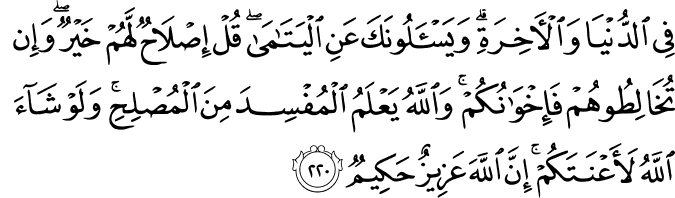
"All men used to be a single Ummah. Then Allah sent prophets carrying glad-tidings and warning and sent down with them the Book with the Truth to judge between people in what they disputed. And none but those to whom it (Book) was given disputed it after clear signs had come to them, led by envy against each other. Then Allah, by His will, guided those who believed, to the truth they disputed. And Allah guides whom He wills to the straight path." (2:213)
Earlier, the real cause of the opposition to truth has been identified as the love of the worldly life. Now, the present verses point out that, all along the lanes of time, Allah has been showing clear signs to establish the true faith, yet the seekers of the mundane benefits have been working against it to safeguard their material interests.
Commentary Stated in the verse is the fact that there was a time when all Hu�man beings used to belong to one single community having common religion and belief - a faith, true and natural. Then came differences in temperaments and tastes, opinions and thoughts, consequently giving birth to contradicting beliefs, making it impossible to distinguish the true from the false. It was in order to make truth distinct from error and to show people the straight path of truth that Allah Almighty sent prophets with Books and revelations. After what the prophets (A.S) did by way of moral education, people split apart in two groups. The first group welcomed the guidance sent by Allah Almighty and accepted to follow the prophets (A.S). These are known as true Muslims.
The second group belied the Scriptures and the prophets and refused to follow them. These are known as kafirs or disbelievers. The opening statement in the verse translated as 'all men used to be a single ummah', needs some explanation. Imam Raghib al-Isfahani has said in his al-Mufradat that the word, ummah signifies a set of people gathered together for reasons of faith, time or place. This element of unicity could be that of beliefs and ideas, or that of presence in a geographical area at a given time, or that of heredity, language, colour and its likes. So, the sense of the statement is that there was a time when all human beings used to be a composite group. Two considerations emerge here which need elaboration:
Firstly, what sort of unity is stipulated in this verse? Secondly, what was the time when this unity existed? The first question was settled by the last sentence of this very verse which mentions the differences that came up later on, and that the prophets were sent to determine the true way out of the multiplicity of ways. It is obvious that the prophets and Scriptures sent to resolve these differences were not dealing with the differences in issues of heredity, language, colour, country or period. Instead, it was the difference of ideas and beliefs. This comparative examination tells us that the unity mentioned in this verse means the unity of ideas and the unity of beliefs.
So, as the sense of the verse appears now, there was a time when all human beings belonged to one set of beliefs. What was that set of beliefs? Two possibilities exist here. Either they were united under the belief of God's Oneness, or lived together under a state of disbelief and error. However, according to the majority of commentators, the weightier opinion is that all of them were united under the belief of God's Oneness. A verse to this effect appears in Surah Yunus as well:
"All men used to be a single ummah. Then, they split. Had it not been the initial will of your Lord (that the true and false and the good and bad shall exist simultaneously in this mortal world) all their disputes would have been settled once for all (leaving no trace of the enemies of truth)." (10:19)
In Surah al-Anbiya', it was said:
"This ummah of yours is a single ummah and I am your Lord. So, worship Me." (21:92)
Also in Surah al-Mu'minun, it was said:
"This ummah of yours is a single ummah and I am your Lord. So, fear Me." (23:52)
All these verses indicate that the unity referred to here is the unity of belief and faith in the true religion.
Now, we have to determine the period of this universal human unity. The commentators of the Holy Qur'an among the blessed Companions, Ubayy ibn Ka'b and Ibn Zayd (R.A) said that the period refers to the period of ' 'Azal' (eternity without beginning) when the spirits of all human beings were created and asked (Am I not your Lord?) to which every soul without exception said, 'Yes, You are our Lord'. That was the time when all human beings were on one true belief the name of which is Islam, the Faith. (Qurtubi)
The blessed Companion 'Abdullah ibn 'Abbas Radhi-Allahu Anh: Allah be pleased with him said that the period of this unity of belief dates back to the time when Sayyidna Adam came into this world with his wife. They had children who multiplied. All of them believed in the religion of Adam and followed his teachings, specially that of God's Oneness. All of them, except Qabil (Cain), were obedient to the religious law.
In the Musnad of al-Bazzar, there appears an addition to the statement of Sayyidna Ibn 'Abbas Radhi-Allahu Anh: Allah be pleased with him cited above which says that this unity of belief prevailed from the time of Sayyidna Adam to that of Sayyidna Idris. Upto that time all of them followed Islam and Tauhid, and the period in between them is that of ten qarns. Probably, qarn means a century which sets the period at one thousand years.
Some others have said that the period dates back to the time of the deluge in the days of Sayyidna Nuh in which all living were swept away except those who had boarded the ark with Sayyidna Nuh. When the flood subsided, those who survived were all Muslims, monotheists and followers of the true faith.
In reality, all these three statements are not contradictory; all three periods were such that people were one community and followed the true faith.
The second sentence in the verse says:
"Then Allah sent prophets carrying glad-tidings and warning and sent down with them the Book with the Truth to judge between people in what they disputed."
It is worth noting that the first sentence said that all men used to be a single ummah, and in the second, this statement has been ramified by saying that Allah sent prophets and Books to resolve disputes. Obviously, the two sentences do not seem to synchronize because the cause of sending prophets and Books is the disputation of people, which did not exist at that time. However, the answer is very clear. The verse means that during the early period of human life, people adhered to one true faith, later on differences crept in, which led to disputations following which came the need to send prophets (A.S) and Books.
Something still remains. When mention has been made of a single ummah above, why is it that the incidence of differences hasvnot been mentioned? Those who are blessed with some insight into the wisdom behind the style of the Holy Qur'an would not find it difficult to answer the question, for the Holy Qur'an, while relating past events, does not report the whole story anywhere, instead, it eliminates parts in between, which could be understood contextually. For instance, there is the prisoner in the story about Sayyidna Yusuf (A.S) who, after his release, came to the king and asked that he be sent to Sayyidna Yusuf (A.S) in order to seek an interpretation of the royal dream. This proposal of the prisoner is all that the Holy Qur'an relates, then, the conversation begins with . The text does not say that the king liked his proposal and sent him to the prison-house to see Sayyidna Yusuf (A.S) and that he reached there, then, addressed him. The fact is that reading the text with sentences earlier and later makes all this simple to understand.
Similarly, the mention of differences after the mention of a united community in this verse was not considered necessary because the advent of disputes is something known by the whole world all the time. What needed to be expressed was that, before all these overflowing disputes, there was a time when all human beings used to follow one true religion. This is what was stated. Now, the disputes visible all over the world were not something that should have been expressly identified. This was unnecessary. Nevertheless, very pointedly it was said that Allah Almighty did provide for the removal of these disputes through guidance.
The words of the text say: that is, 'Allah Almighty sent prophets', who were to carry glad-tidings of eternal peace and bliss to those who follow the true Faith and to give warning of the punishment of Hell to those who turn away from it. Then, Allah helped prophets through His revelations and Books which were to make truth distinct from error in matters of beliefs and ideas. The text, after that, points out to the outcome. Inspite of the prophets and Books with open truths, the world split itself into two groups. There were some who did not accept this clear guidance, and strangely enough, the first to deny this guidance were those to whom these prophets and verses were sent, that is, the Jews and the Christians. Far more astonishing is the fact that there was no possibility of any doubt or misgiving in Scriptures which were neither beyond their understanding nor were likely to throw them into confusion. In fact, these people knew and understood it, yet it was their lust for taking an opposite stand which made them deny it.
Then, there was the second group who were enabled to follow the straight path by Allah Almighty and they became the ones to say yes to the lead given by prophets, messengers and divine books sincerely and whole-heartedly. These very two groups have been identified in Surah al-Taghabun as follows:
"Allah Almighty created you, then, some of you became disbelievers and some of you, believers." (64:2)
To sum up, the gist of the sense in the verse (All men used to be a single ummah) is that all human beings were initially and universally followers of the true faith. Then, temperamental multiplic�ity gave way to the promotion of self-interest which caused disputes to surface, so much so that a time came when beliefs too were disputed which in turn reached a point when the very root, the fine line of distinction between the true and the false, got all mixed up.
Thereupon, Allah Almighty sent prophets (A.S) and His Books to guide people to the right path and to bring them back to the same true faith on which human beings already were. But, despite all guidance and very clear signs, there were some who dutifully followed these and there were others who, out of their obstinacy and hostility, took the road of denial and deviation.
Injunctions And Related Considerations
1) The verse tells us that Allah Almighty sent His prophets and Books into this mortal world for no other purpose but that people, who had left the single ummah following the true faith and branched out into different sects, should again be assembled into the same one community. Whenever people wavered from the right path, Allah sent a prophet, and a Book so that they act accordingly. The coming of prophets as a medium of reform and salvation continued when they again deviated which resulted in the coming of another prophet and another Book with the express purpose of putting people back on the right track, that is, on the straight path shown by their Lord. This is like health, a single fact of life as compared to diseases which are too many. When a certain disease showed up, Allah prescribed the appropriate medicine and regimen. Another disease brought another set of treatment.
Finally, came the most comprehensive of all prescriptions, one that will be ideally successful against all diseases until such time that Allah wills to keep this world going. This perfect prescription, a compre�hensive blueprint of all diagnostic considerations, treatment par excellence, the most complete of all previous prescriptions which pre-empts all future possibilities of treatment, is none but .that of Islam. For this came the last of the prophets Sallallahu 'Alayhi Wasallam: Peace be upon him, and with him came the Qur'an. There used to be the recurring problem of Scriptures being interpolated, prophetic teachings being lost which necessitated the sending of new prophets and new Books in the past. This was set right when Allah Almighty Himself took the responsibility of seeing that the Holy Qur'an remains protected against interpolations or changes.
Then, to make sure that the teachings of the Holy Qur'an remain intact in their original form and live right through the Day of Doom, Allah Almighty promised to create and sustain a set of people from the community of Muhammad Sallallahu 'Alayhi Wasallam: Peace be upon him, a group which will always adhere to the true Faith, keep circulating the correct teachings of the Qur'an and Sunnah among Muslims all over the world without ever flinching against any opposition or hostility. Therefore, after this, it was inevitable that the doors of prophethood and the coming of revelation be closed for ever. So, came the final proclamation, that of the end of prophethood.
Let there be no misgiving that during the course of history the coming of prophets and Books were ever a source of division or dissension between people. What is true, as stated earlier, is that all prophets and divine Books aimed at assembling people around one true faith to which they initially adhered.
2) We also discover here that the two-nation theory of Muslim and non-Muslim, the identification of nationhood on the basis of religion is exactly what the Qur'an aims to support in cited above. Along with it, we can also clearly see that the real foundation of the two-nation theory stands on raising a united nationhood, which flourished in the very beginning and which was based, not on the factor of the country of origin, but on believing in the Truth and following the straight path. The Qur'anic statement: (All men used to be a single ummah) stresses that there used to be real national unity in the beginning of the world when people followed the true faith. Disputes came later. Then came the prophets who invited them to that real unity. Those who rejected their call cut themselves off from this united nationhood and were known as a separate nation.
3) The third lesson we learn from this verse is that evil people have always elected to oppose every prophet and every divine Book and have been even eager to line up their maximum forces against them.
This being the customary situation allowed to prevail by Allah Almighty, people who have the strength of faith in their hearts should not feel bad about the chronic pursuit of intrigues and hostility by the evil ones against them. Very simply, just as the disbelievers took to the ways of their elders in the form of denial, hostility and prophet-bashing, all true Muslims on the straight path should take to the consistent practice of their elders, the great prophets (A.S), by staying patient against injuries inflicted on them, nevertheless, keep calling them to the true Faith with wisdom, sound advice and good grace. Perhaps, it is because of this congruity of purpose, that the next verse counsels Muslims to maintain a stance of forbearance and patience against all situations of distress. (Ma'ariful Qur'an)
"Do you think that you will enter Paradise despite that there have not yet come upon you circumstances as of those who have passed away before you? They were afflicted by hardship and suffering and were so shaken down that the prophet, and those who believed with him, began to say: 'When the help of Allah (will come)'? Behold, the help of Allah is near."(2:214)
The previous verse has said how hostile the disbelievers have been to prophets and believers and, in a way, has comforted Muslims hurt by the mockery of disbelievers that there is nothing new about this antagonism. This has been there all the time. Further from this point, the present verse recounts the enormous amount of suffering faced by past prophets and believers at the hands of hostile disbelievers. This too is to console Muslims that they should be patient against the hostility of disbelievers as ideal happiness can only be achieved by getting ready and working hard for the Hereafter.
Commentary
There are two things worth serious attention in this verse:
1) Apparently, this verse seems to indicate that nobody shall enter Paradise unless he goes through hardships and sufferings, although, Qur'anic statements and sayings of the Holy Prophet Sallallahu 'Alayhi Wasallam: Peace be upon him prove that many sinners will enter Paradise simply because of the grace, mercy and forgiveness of Allah Almighty, and that they shall undergo no hardship either.
This is because hardship and suffering have different levels. The lowest degree is to resist against one's own desiring self and the Satan, or to strengthen the bases of one's beliefs by countering the forces working against the true Faith. This degree of achievement is within the grasp of every Muslim. Further on, there are the middle and the higher levels. The degree of one's strenuous effort shall be the degree of one's entry in to Paradise. Thus, nobody remains untried by effort and struggle and the resulting hardship and suffering.
In a hadith, the Holy Prophet Sallallahu 'Alayhi Wasallam: Peace be upon him has said: "The hardships faced by the prophets are the hardest faced by men, after that, by those closer to them."
2) The second point one must note here concerns the prophets and their followers. That they reached a point of suffering when they cried out as to when will the help of Allah come, was not because of any doubt since that would be against the dignity of their station. In fact, the call was made in the background of Allah's promised help for which the time and place was left undetermined. As such, using these words in a state of distress indicated the desire for early help. Making such a prayer is not against one's trust in Allah (tawakkul) or against the station of prophethood. On the contrary, the fact is that Allah Almighty favours the earnest supplication of his servants. Who else other than the prophets and the pious of the community would be more deserving of what Allah likes? (Ma'ariful Qur'an)
"They ask you as to what they should spend. Say: "Whatever good you spend is for parents, kins, orphans, the needy and the wayfarer. And whatever good you do, Allah is all-aware of that.""(2:215)
Commentary
Imperatives such as - 'leave disbelief and hypocrisy and enter Islam completely','listen to none when it comes to obeying the command of Allah', 'spend your wealth and give your life to seek the pleasure of Allah' and 'show fortitude against all sorts of hardships and sufferings' - have been emphatically mentioned in previous verses. Now, from this point onwards, there appear some details concerning this obedience which relate to one's wealth, life and other matters of marriage and divorce. All these form part of the general theme of righteousness which continues.
This statement of details is very special as these come in answer to questions raised by the noble Companions before the Holy Prophet Sallallahu 'Alayhi Wasallam: Peace be upon him. The answer to questions asked came directly from Allah through the medium of the Holy Prophet Sallallahu 'Alayhi Wasallam: Peace be upon him. If this were to be said in other words, one could say that the Fatwa (religious ruling) was given by Allah Almighty Himself. This too is correct because Allah Almighty has, in the Qur'anic verse: 'Say: Allah answers you about them...' (4:127) attributed the act of giving Fatwa to Himself. Therefore, there is nothing strange about this attribution.
It is also possible to say that these fatawa (plural of fatwa) come from the Holy Prophet Sallallahu 'Alayhi Wasallam: Peace be upon him, which have been communicated to him through revelation. Anyway, what has to be realized is that the religious injunctions described in this section as answers to some questions asked by the noble Companions carry a significance of their own. Throughout the Holy Qur'an, such special injunctions in the form of questions and answers appear at nearly seventeen places. Seven out of these happen to be right here in the Surah al-Baqarah, one in Surah al-Ma'idah and one in Surah al-Anfal. These nine questions are from the noble Companions. Then come two questions in Surah al-A'raf and one each in Surah Bani Isra'il, Surah al-Kahf, Surah Ta-Ha and Surah al-Nazi'at making a total of six questions, which were asked by the disbelievers. All these have been answered in the Holy Qur'an.
The blessed Companion and commentator of the Holy Qur'an, 'Abdullah ibn 'Abbas has Radhi-Allahu Anh: Allah be pleased with him said: 'I have not seen a set of people better than the Companions of the Holy Prophet Sallallahu 'Alayhi Wasallam: Peace be upon him who, (despite their great attachment to matters of Faith and their deep love for and close relationship with the Holy Prophet Sallallahu 'Alayhi Wasallam: Peace be upon him) asked very few questions.' The questions asked relate to a total of thirteen problems only, which have been answered in the Holy Qur'an because these noble souls never asked a question unless absolutely necessary (Qurtubi).
In the present verse (215), the istifta' or questions asked by the noble Companions has been reported in the words,: 'They ask you as to what they should spend'. The same question has been repeated in verse 219 in the same words: but the answer to this one question has been given differently in the present verse (215) and later on, in verse 219.
Therefore, it is necessary to first understand the wisdom behind the two answers to one single question. This wisdom becomes clear by looking at the background in which these verses were revealed. For instance, the present verse was revealed in a particular situation when the Companion, 'Amr ibn, Jamuh had asked the Holy Prophet Sallallahu 'Alayhi Wasallam: Peace be upon him, the question: . (Ibn al-Mundhir - Mazhari) that is, 'what do we spend from our wealth, and where?' According to a narration reported by Ibn Jarir, this question was not that of Ibn Jamuh alone, rather, it was from Muslims in general. The question has two parts, that is, what and how much should be spent, and where should it go or who should be the recepients.
Let us now look at the second verse (219) which begins with the same question. The background of its revelation as narrated by Ibn Abl Hatim is as follows. When the Holy Qur'an commanded Muslims to spend in the way of Allah, some Companions (R.A) came to the Holy Prophet Sallallahu 'Alayhi Wasallam: Peace be upon him and requested an elaboration of the injunction. They wished to find out what 'money' or which 'thing' they should spend in the way of Allah. This question has one simple unit of inquiry, that is, what should they spend. Thus, the two questions somewhat differ in their approach. The first question consisted of the 'what' and 'where' of spending. The second question is restricted to what' only. The Qur'anic answer to the first question shows that the second part of the question, that is, where should they spend, has been given more importance and answered frontally and clearly. However, the first part of the question, that is, what should they spend, was answered as a corollary, and considered sufficient.
Now let us go back to the two parts as they appear in the words of the Holy Qur'an. About the first part, that is, where should they spend, it has been said: 'Whatever good you spend is for parents, kins, orphans, the needy and the wayfarer.'
Then, the other part of the question, that is, what should they spend, was answered as a corollary through the words,: 'And whatever good you do, Allah is all-aware of that'. The hint is that Allah Almighty has not placed any restriction on you as to the amount of what you should spend. The fact is whatever you spend in accordance with your capability will become deserving of a matching reward with Allah.
In short, the considered explanation of the heads of expenditure was given in the first verse (215), perhaps, in view of the real concern of the questioner about where to spend. Then, the question, what should they spend, was answered as a corollary and considered sufficient. The later verse (219) where the question was limited to what 'money' or what 'thing' should they spend was answered by saying: (Say: "The surplus"). These two verses yield some rules of guidance about spending in the way of Allah.
Rulings
1) These two verses are not concerned with the obligatory zakah because the threshold of holdings for the obligatory Zakah is fixed, and the obligatory ratio of spending under it has also been fully determined through the Holy Prophet Sallallahu 'Alayhi Wasallam: Peace be upon him. None of these two have been specified in the verses under discussion. This tells us that the two verses refer to voluntary charities (al-Sadaqat al-nafilah). This also removes the doubt about the inclusion of parents as recepients of spending under verse 215, although, giving Zakah to parents is not permissible under the teaching of the Holy Prophet Sallallahu 'Alayhi Wasallam: Peace be upon him. The reason is simple. These two verses have nothing to do with the obligation of Zakah.
2) Another rule of conduct which emerges from this verse is that even the gift given or food served to parents and other near of kin, if the intention is to obey Allah Almighty in doing so, will be included under spending in the way of Allah and will deserve reward with Him.
3) Consideration should be given, while making voluntary charities, to spending only what is extra to personal needs. Spending while hurting one's own family, over-riding their due rights and subjecting them to straightened circumstances is no act of merit. Similarly, one who does not pay back his debt yet goes on squandering money in voluntary charities is not liked in the sight of Allah.
The statement about spending 'the surplus' (al-'afw), that which is extra to needs, has been interpreted as an obligatory injunction by the blessed Companion Abu Dharr al-Ghifari and others. According to them, it is not permissible to hold in one's possession any money or materials surplus to needs even after paying of zakah and fulfilling all rights due; it is necessary (wajib) to give everything extra to needs as charity (sadaqah). However, the majority of Companions, their successors (the Tabi'een) and the great imams of the Faith interpret the Qur'anic verses in question to mean that whatever has to be spent in the way of Allah should be surplus to needs. It does not mean that one has to give in charity (sadaqah) everything surplus to need as something necessary or wajib. Moreover, this later position is what the consistent practice of the blessed Companions proves. (Ma'ariful Qur'an)
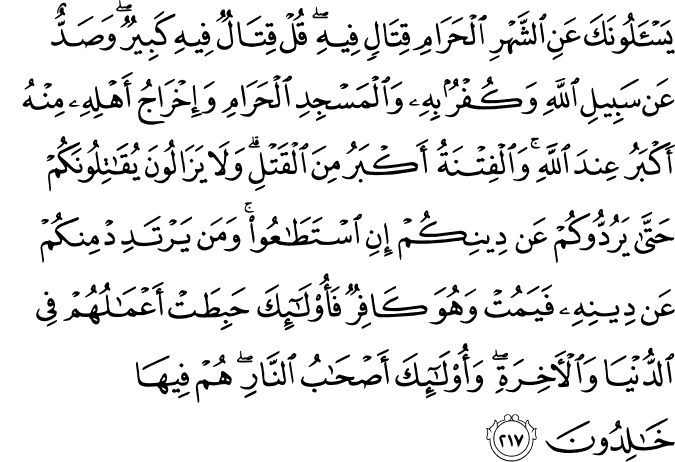
"Fighting is enjoined upon you, while it is hard on you. And it could be that you dislike something, when it is good for you, and it could be that you like something when it is bad for you. Allah knows and you do not know. They ask you about the sacred month, that is, about fighting in it.
Say, "Fighting in it is something grave but, in the sight of Allah it is far more grave to prevent from the path of Allah, to disbelieve in Him, and al-Masjid al-Haram, and to expel its people from there and Fitnah (to create disorder) is more grave than to kill." And they will go on fighting you until they turn you away from your faith if they could. And whoever of you turns away from his faith and dies infidel, then they are those whose deeds have gone waste in this world and in the Hereafter. And they are people of the Fire. They shall be there for ever.
As for those who believed and those who migrated and carried out jihad in the way of Allah, they do hope for Allah's mercy and Allah is Forgiving, Very-Merciful."(2:216)
Explanation In Brief Verse 216 establishes the obligatory nature of Jihad even though it may be burdensome for some temperaments. In this case, the truth is that it is Allah Almighty who knows the reality of everything while man does not possess the full range of that knowledge. Therefore, one should not decide on things being good or bad as prompted by personal desires, rather, one must say yes to the command of Allah and follow it consistently as the most expedient course of action.
Verse 217 begins with a question which was asked by some disbelievers from the tribe of Quraysh. It has been reported that some Companions of the Holy Prophet Sallallahu 'Alayhi Wasallam: Peace be upon him were by chance confronted by disbelievers while on a journey. During the engagement, one disbeliever got killed at their hands. The day this happened was the first of the month of Rajab which, according to the calculation of the Companions, was the 30th of the Jumada al-Ukhirah. It may be noted that Rajab is one of the 'sacred' months. So, the disbelievers taunted Muslims by saying that they did not even honour the sanctity of the 'sacred' month. The Muslims were worried and asked the Holy Prophet Sallallahu 'Alayhi Wasallam: Peace be upon him about it. According to some narrations, as stated above, some disbelievers themselves came to the Holy Prophet Sallallahu 'Alayhi Wasallam: Peace be upon him and raised the question as a matter of objection.
The answer given is that 'fighting in a sacred month, is something grave' (but, Muslims did not do so intentionally, instead, this came to pass inadvertantly because of a misunderstanding about the date). Moreover, what the disbelievers have committed is more grave than this, because the disbelief, the placing of idols in the Holy Mosque and the expelling of Muslims from there is a greater evil than killing a disbeliever in a state of war.
Injunctions And Related Considerations
1) The injunction declaring Jihad as obligatory appears in the first of the three verses under comment in the words: "Fighting is enjoined upon you..." which means that 'Jihad has been made obligatory on you'. These words apparently seem to say that Jihad is obligatory on every Muslim in every condition. Some other verses of the Qur'an and the sayings of the Holy Prophet Sallallahu 'Alayhi Wasallam: Peace be upon him, however, have clarified that this obligation is not absolute, that is, every Muslim is not charged to perform it as Fard 'Ayn, (absolute and mandatory obligation on every Muslim) instead, it is Fard 'ala al-Kifayah whereby, should a group of Muslims come forward to discharge this obligation, other Muslims would be considered absolved from it.
However, should there remain just no group ready to discharge the obligation of Jihad at any time or in any country, the result will be that all Muslims will fall into the sin of abandoning an obligation. The saying of the Holy Prophet Sallallahu 'Alayhi Wasallam: Peace be upon him in the hadith: means that it is necessary that there be, right upto the Day of Doom, a group of Muslims which keeps discharging the obligation of Jihad. Another verse of the Holy Qur'an says: "And Allah has given precedence to mujahidin, who carry out jihad with their properties and lives, over those who sit away, and Allah has promised good for both." (4:95)
Here, the promise of good has been extended to those also who may not be able to take part in Jihad because of some compulsive excuse or because of engagement in some other religious service. It is obvious that the promise of good would have never been made for those who are absent from Jihad, in the event that it were an absolute obligation on every individual Muslim. Similarly, this is what appears in another verse: "Why could a small group from every large community of yours not come forward so that they pursue understanding in religion?" (9:122)
Here, the Holy Qur'an itself suggests a division of work whereby some Muslims carry out Jihad and some keep serving the cause of religious education. This can be done only when Jihad is Fard 'ala al-Kifayah and not Fard 'Ayn.
In a hadith appearing in al-Bukhari and Muslim, it is said that a person sought the permission of the Holy Prophet Sallallahu 'Alayhi Wasallam: Peace be upon him to take part in Jihad. He asked him: 'Are your parents alive?' He said, 'Yes, they are alive.' He said: 'Then, go. Serve your parents and earn the reward of Jihad'. Incidentally, this also tells that Jihad is a Fard 'ala al-Kifayah. When a group from among the Muslims is staunchly discharging the obligation of Jihad, remaining Muslims can engage themselves in other services and duties. But, should there come a time when the 'Imam' or the leader of Muslims gives a general call under the compulsion of need and invites all Muslims to take part in Jihad, then, Jihad becomes an absolute obligation on everybody. In Surah al-Taubah, the Holy Qur'an says: "O those who believe, what has happened to you that, when you are asked to come out in the way of Allah, you become heavy?" (9:38)
This verse carries the injunction relating to the general call of Jihad mentioned above. In the same way, should it be that disbelievers, God forbid, invade an Islamic country and the group engaged in defence is not fully capable of it, being weak or insufficient in number, then, at that time as well, this obligation becomes 'contagious', passing on from that first group to all Muslims close by, as an equally effective obligation. And in case, they too are weak or incapable, the obligation will pass on to Muslims close to them. This situation may reach a point when Jihad becomes an absolute obligation on each and every individual Muslim all over the world. It is in view of these verses from the Holy Qur'an that the majority of Muslim jurists and scholars of hadith have set up the rule that Jihad is Fard 'ala al-Kifayah under normal conditions.
2) Therefore, as far as Jihad remains a Fard Kifayah, it is not permissible for the off-spring to go for Jihad without the permission of their parents.
3) It is not correct for one who has a debt to pay to take part in this Fard Kifayah until such time that he clears his debt off. But, should there come a time when, either due to a general call for Jihad or an aggressive encirclement of Muslims by the disbelievers, Jihad becomes Fard 'Ayn, an absolute obligation on all, then, no condition such as that of the permission of parents or of the husband or of the creditor remains operative. Towards the end of this verse, it is as a mode of persuasion that Jihad has been identified as something which may, temperamentally, appear 'hard' but one must remember that human intelligence and effort fails so many times when it comes to the outcome. It is not at all surprising that the most intelligent person around may take the beneficial to be harmful and vice versa. If everyone was to look back into the events of his or her life, it will be noticed right there that there was something they were going after as beneficial turned out ultimately to be very harmful, or there was something they were avoiding as harmful which later on proved to be very beneficial.
This scenario of human reasoning and planning failing time and again is a matter of repeated experience, therefore, it was said that fighting in the way of Allah may obviously appear to be a loss of life and property, yet the time will come when realities will be unveiled and we shall find out that this loss was no loss, instead, it was the ultimate in gain, and a source of eternal peace.
The Injunction Relating to Fighting in the 'Sacred' Months
The second of the three verses under comment here proves that fighting is forbidden in Rajab, Dhul-Qa'dah, Dhul-Hijjah and Muhar-ram, the four 'sacred' months. In the same way, there are several verses of the Holy Qur'an where fighting has been very clearly forbidden during the sacred months, for instance: 'Four of them are sacred. That is the right religion' (9:36). Then there is the saying of the Holy Prophet Sallallahu 'Alayhi Wasallam: Peace be upon him in the famous address of the Last Hajj: 'Four (months) from among them are sacred, out of which three are consecutive and the (fourth) is Rajab of Mudar.' These Qur'anic verses and hadith narrations prove that fight�ing is haram in the four months mentioned and this forbiddance is good for ever.
In this connection, 'Ata ibn Abi Rabah (A.R) , a leading early exponent of Qur'anic exegesis declared on oath that this injunction is there to stay for ever. Several others among the respected Successors (Tabi'in) regard this injunction as provenly unabrogated, but in accordance with the ruling of the majority of Muslim jurists as stated by al-Jassas,this injunction is one of the abrogated ones as maintained by a consensus of jurists and fighting is no more forbidden in any month.
Now comes the question as to which verse of the Holy Qur'an abrogates this injunction. Jurists have taken different positions in this respect. Some say the verse: 'And fight the disbelievers, all of them' (9:36) abrogates it. Many others regard the verse: 'Slay the disbelievers wherever you find them' (9:5) as its abrogator. They have taken the word: here in the sense of 'anytime' meaning thereby that the disbelievers should be killed in whatever month or time they are found. Some have said that the abrogator of this injunction is the very conduct of the Holy Prophet Sallallahu 'Alayhi Wasallam: Peace be upon him since he himself besieged the city of Ta'if during the 'sacred months' and it was during the 'sacred months' that he sent the noble Companion 'Amir al-Ash'ari on the military expedition of Awtas. On these grounds, Jurists in general, regard this injunction as abrogated, al-Jassas (A.R) calls it: 'This is what the majority of the jurists says'.
Ruh al-Ma'ani, under comments on this verse, and al-Baydawi, under the explanation of the first section of Surah al-Bara'ah have reported a consensus of the community on the abrogation of the forbiddance of fighting during the 'sacred months' (Bayan al-Qur'an).
However, al-Tafsir al-Mazhar! answers all these arguments by saying that the sanctity of the 'sacred months' is clearly present in the verse known as Ayah al-sayf or the Verse of the Sword, that is:
'The number of months, with God, is twelve (mentioned) in the book of Allah, the day that he created the heavens and the earth; four of them are sacred' (9:36).
Of the verse relating to fighting, this verse was the last one to be revealed and the Address of the Last Hajj which was delivered only 80 days before the Holy Prophet Sallallahu 'Alayhi Wasallam: Peace be upon him passed away clearly indicates the sanctity of the 'sacred months'. For this reason, the verses quoted cannot be regarded as abrogative of this injunction. Moreover, the siege of Ta'if did not take place in the month of Dhul-Qa'dah. It was in Shawwal, therefore, this too cannot be regarded as its abrogator.
But, it can certainly be conceded that the absolute forbiddance of fighting in the 'sacred months' which seems to reflect from the verse referred to holds an exception whereby it would become permissible for Muslims to defend themselves, or counter attack the aggressor if disbelievers themselves start the fighting during these months. This much, then, can be termed as abrogated, which finds a clarification in the verse: 'The holy month for the holy month' (2:194).
The gist of the discussion is that initiating a fight during these months is forbidden for ever, but in the event that disbelievers mount an attack on Muslims, then, Muslims are permitted to fight back in their defence. Al-Jassas (A.R) has reported the narration of the blessed Companion Jabir ibn 'Abdullah Radhi-Allahu Anh: Allah be pleased with him who said that the Holy Prophet Sallallahu 'Alayhi Wasallam: Peace be upon him did not fight in any of the 'sacred months' until such time that the initial fighting was started by the disbelievers.
The Evil Consequences of Apostasy
Towards the end of the verse (217), it has been said that the act of turning into an apostate after having become a Muslim shall be dealt with under the injunction: that is, they shall be those whose deeds have gone waste in this world and in the Hereafter.
Here are some injunctions relating to the apostates:
1) Some examples of 'deeds going waste in this world' are that the wife of an apostate goes out of the bond of marriage; if a relative of an apostate dies a Muslim, he gets no share in the inheritance; all obligations such as prayers and fasting fulfilled in one's state of Islam are reduced to nothing; for such a person funeral prayers are not offered and he or she is not buried in the graveyard meant for Muslims. 'Deeds going waste in the Hereafter' means that one gets no reward for acts of worship and enters the Hell to stay there for ever.
2) Should an apostate become a Muslim once again, at least this much is certain that he could hope to salvage himself away from Hell in the Hereafter, while during the remaining tenure of his life in the mortal world, the injunctions of Islam will be operative for him. But, there is a difference of opinion among jurists about what would happen to a person who has already done his Hajj - would it be obligatory on him, given the capability, to do it all over again, or would it not? Similarly, in the Hereafter, would the reward for his previous religious performances, such as prayers and fasting, revert back to him, or would they not? Imam Abu Hanifah (A.R) says that it is obligatory on him to do his Hajj again and he does not subscribe to the opinion that he will be rewarded for his previous prayers and fastings while Imam Shafi'i (A.R) differs on both issues.
3) For one who is basically a disbeliever, the position is that the reward for his good deeds in a state of disbelief is held in abeyance. If there comes the time when he embraces Islam, he gets a matching reward for all such deeds, but in the event that he dies an infidel, everything goes waste. The Hadith statement: 'You have embraced Islam with all the good deeds which you have performed earlier' means just this.
4) In short, the fate of an apostate is worse than that of an original disbeliever. This is why Jizyah can be accepted from an original disbeliever while a male apostate who does not return to Islam is killed. If the apostate is a woman, she is imprisoned for life. The reason is that their conduct insults Islam and the insult of such a binding authority deserves no less a punishment.(Ma'aariful Qur'aan) The evidence that the apostate is to be executed is the words of the Prophet (peace and blessings of Allaah be upon him): "Whoever changes his religion, execute him." (Narrated by al-Bukhaari, 2794). What is meant by religion here is Islaam (i.e., whoever changes from Islam to another religion).
Al-Bukhaari (6922) narrated that Ibn 'Abbaas said: The Messenger of Allaah (peace and blessings of Allaah be upon him) said: "Whoever changes his religion, put him to death."
Al-Bukhaari (6484) and Muslim (1676) narrated that 'Abd-Allaah ibn Mas'ood said: The Messenger of Allaah (peace and blessings of Allaah be upon him) said: "It is not permissible to shed the blood of a Muslim who bears witness that there is no god except Allaah and that I am the Messenger of Allaah, except in one of three cases: a soul for a soul (i.e., in the case of murder); a previously-married person who commits zina; and one who leaves his religion and separates from the main body of the Muslims."
Tafeer Of Surah al-Baqarah (2), Verse 219 (Part 1)
"They ask you about wine and gambling. Say, "In both there is great sin, and some benefits for people. And their sin is greater than their benefit."(2:219)
Commentary
This verse forms part of the series of questions asked by the noble Companions. These are as they appear in this Surah along with the answers given. Here, the question is about wine and gambling which has been answered by Allah Almighty by pointing out that the use and practice of these two things breeds major sins while people may also get some benefits from them, but the sin they release is far too grave than the benefit they give, implying that both these are worth abandoning.
Since these two issues are very serious, they need a somewhat detailed inquiry into their nature and the injunctions relating to them.
The Prohibition of Wine, and Related Injunctions When Islam came, drinking was common practice as part of the general state of Jahili customs. When the Holy Prophet Sallallahu 'Alayhi Wasallam: Peace be upon him emigrated to Madinah, people of that city were also accustomed to wine and gambling. Common people were infatuated with these in view of their obvious benefits. They had no idea of the evils inherent in these practices. However, it is the usual practice of Allah that there are, in every nation and in every country, sensible people who use reason to control their temperaments. They would not go'near an emotional urge if it goes against the dictates of reason. In this regard, the station of the noble Prophet Sallallahu 'Alayhi Wasallam: Peace be upon him; was way high, for he had a built-in distaste for things which were going to be declared haram later on. Even among the blessed Companions there were some who had not touched wine during the days it was an open practice.
It was after reaching Madinah al-Tayyibah that some Companions became deeply concerned about the evil effects of these two involvements. It was due to this concern that Sayyidna 'Umar al-Faruq Radhi-Allahu Anh: Allah be pleased with him and Mu'adh ibn Jabal Radhi-Allahu Anh: Allah be pleased with him along with some Ansari Companions presented themselves before the Holy Prophet Sallallahu 'Alayhi Wasallam: Peace be upon him and told him how wine and gambling not only spoil man's reason but also cause financial loss and sought his advice in this connection. It was in answer to their question that the present verse was revealed. This is the first verse in which the elementary step to stop Muslim from wine and gambling was taken.
What the verse says is clear from its translation, and its explanation which follows immediately. It may be added here that the word, 'Ithm' or sin includes everything that may become a preliminary to sin. For instance, wine dulls senses and weakens the power of reason, something basic to human excellence. Human reason acts as a brake against human indulgence in evil deeds. Once reason is blocked out, the door is opened for all sorts of evil deeds.
It will be noted that drinking has not been clearly identified as something unlawful in this verse, but its evils has certainly been pointed out, which may lead man into many sinful activities. In a way, this takes the form of a good counsel urging man to abandon it. That is why, soon after the revelation of this verse, some noble Companions took this good counsel of the Holy Qur'an so seriously that they stopped drinking then and there. There were some others among them who thought that the verse, in fact, has not declared wine as haram; it has, instead, identified it as a cause of sin in as much as it does lead to evils religiously undesirable, so, if they can manage to keep themselves immune from such evils, what harm could there be if they continued drinking?
Consequently, so they did, until came a day when the blessed Companion, 'Abd al-Rahman ibn 'Aws (R.A) invited some of his friends from among the noble Companions at his home. When dinner was over, everybody started drinking wine as usual. In the meantime, came the time for Maghrib salah. Everybody stood up for salah and selected one of them to lead the prayers. The Imam began his recitation from the Holy Qur'an, but drunk as he was, he recited the Surah al-Kafirun all wrong. Thereupon, the second step against drinking was taken and the following verse was revealed:
"O those who believe, do not go near Salah when you are intoxicated." (4:43)
Here, drinking was declared to be absolutely unlawful at the time of the Salah. Other times remained open. Some of the noble Companions had totally stopped drinking following the revelation of the first verse deducing from it that something which stops one from Salah cannot hold any good at all. And now that Salah has been prohibited in a state of intoxication, one should keep his distance from that which deprives one from Salah. However, since wine was not forbidden clearly and explicity during hours other than those of Salah, there were some who continued drinking during other hours until when there occured yet another incident. This time it was the blessed Companion, Itban ibn Malik who invited some Companions, Sa'd ibn Abi Waqqas being one of them. Once the dinner was over, wine was served in accordance with the custom. Then, turning to another customary Arab practice at that time, the intoxicated party started talking poetry and began reciting their respective accomplishments and excellences.
The Companion Sa'd ibn Abi Waqqas Radhi-Allahu Anh: Allah be pleased with him recited a Qasidah [An Arab poetical form introduced by the modern poet, Garcia Lorca in the West.] poem in which he satirized the Ansar (helpers) of Madinah and eulogized his own tribal affinities. This made an Ansari youngman angry and he hit Sa'd Radhi-Allahu Anh: Allah be pleased with him with a jaw-bone from a camel causing severe injury on his head. Sayyidna Sa'd Radhi-Allahu Anh: Allah be pleased with him came to the Holy Prophet Sallallahu 'Alayhi Wasallam: Peace be upon him and complained against that Ansari youngman. At that time, the Holy Prophet Sallallahu 'Alayhi Wasallam: Peace be upon him raised his hands in prayer and said: , that is, 'O Allah, give us a clear and conclusive guidance in the matter of wine'. Thereupon, the third verse regarding wine, that of Surah al-Ma'idah, was revealed with details declaring wine to be absolutely unlawful. The verse is as follows:
"O you who believe! wine and gambling and stone altars and drawing of lots with arrows are only an abomination, a work of Satan; so shun it, that haply you may prosper." (5:90)
The Gradual Forbiddance of Wine
Being supreme in His authority, Allah alone knows the real wisdom behind all divine imperatives, but a close look into the Islamic legal code reveals that the Shari'ah of Islam has left ample room for human emotions when following its dictates. This is to give man the least possible inconvenience. The Holy Qur'an has itself said: 'Allah does not obligate anyone beyond his or her capacity' (2:286). It was the demand of this mercy and wisdom that made Islam go slow on forbidding wine.
The gist of the Qur'anic history of forbidding wine through a gradual process is that it has revealed four verses on the subject. As said earlier, one of these verses belongs to Surah al-Baqarah, the explanation of which you are reading through now. Here, wine has been identified as sin-prone, a corrupting agent. The mention of wine has been left at that point. It has not been 'forbidden'. This, in a way, is a manner of saying that the habit of drinking is worth leaving, but the direct command to quit drinking was not given.
The second verse: 'do not go near salah when you are intoxicated' (4:43) appears in Surah al-Nisa'. Here, wine was declared to be unlawful during salah hours. At other times, the choice remained open.
The third and the fourth verses belong to Surah al-Ma'idah. In these two, as mentioned earlier, wine was declared to be unlawful clearly and absolutely.
The Shari'ah of Islam used the method of gradual prohibition of wine for the simple reason that it would have been much too hard on human temperament to cut away from the habit of a life-time, specially so the habit of addiction to intoxicants. Scholars have said: : that is, it is harder to change an ongoing habit for man than it is for a child used to suckling at his mother's breast. So, moving wisely, Islam first stressed on its evil, then prohibited it only at the time of salah and finally after the passage of a certain time, it was absolutely forbidden.
However, the wisdom that required a gradual process before the prohibition had equally required that once the prohibition is promulgated, it should be implemented with its full force. That is why the Holy Prophet Sallallahu 'Alayhi Wasallam: Peace be upon him, in the early stages, warned people against the use of wine and told them how it invited divine punishment. He said that wine was the source of evils and indecencies and one who indulges in it can go on to commit even the worst possible sins. In a hadith, he said 'Wine and Faith cannot be combined.' These narrations appear in al-Nasa'i.
In the Jami' of al-Tirmidhi, there is a narration from the blessed Companion Anas Radhi-Allahu Anh: Allah be pleased with him which reports that the Holy Prophet Sallallahu 'Alayhi Wasallam: Peace be upon him has cursed ten people in relation to wine, being the crusher or presser or squeezer, the distiller, the user, the server, the carrier, the receiver (the one for whom it is carried), the seller, the buyer, the giver (as gift), and the one who uses the income arising from it.
This verbal teaching and persuasion was not all that he stopped at, he took practical steps and made a legally binding proclamation that whosoever has any wine in possession should deposit it at an appointed place.
The Matchless Obedience of the Blessed Companions (radiallaahu 'anhum ajma'een) As soon as the first order came to them, the noble Companions, obedient and responsive as they were, lost no time and took out all wine stored in their homes for personal use and poured it out on the streets then and there. Sayyidna 'Abdullah ibn 'Umar, Radhi-Allahu Anh: Allah be pleased with him has reported that at the time when the proclaimer appointed by the Holy Prophet Sallallahu 'Alayhi Wasallam: Peace be upon him, went around the streets of Madinah announcing that wine was forbidden, whoever had a vessel of wine in his hands, threw it away right where he was and whoever had cups or goblets or flasks of wine in the house, brought these out and smashed them off. Sayyidna Anas was happily busy serving wine to a gathering of friends at that time. Present there were great Companions like Abu Talha, Abu 'Ubaydah ibn Jarrah, Ubaiyy ibn Ka'b and Suhayl (R.A). When the voice of the proclaimer struck their ears, everybody present said, 'Now, pour all this wine down on the ground and break all cups and goblets and ewers and pitchers.' In some narrations it is said that it was immediately with the announcement that wine had become unlawful that everyone who had a cup of wine reaching close to his lips was electrified and threw it away right there.
That day, wine was flowing down the streets of Madinah like a stream of rainwater, and as a result of that, it remained usual in the streets of Madinah for a long time that rains would reactivate the smell of wine soaked in the ground, as well as its colour, which would show up on the surface.
When people were ordered to deposit whatever wine they had at a given place, not much was left there to deposit except the limited stock of wine casks and bags, available in the market for commercial sales. So obedient were the noble Companions that they deposited those too at the designated place without the least hesitation. The Holy Prophet Sallallahu 'Alayhi Wasallam: Peace be upon him went there personally and slit many leather wine-bags with his own blessed hands and let the rest be slit apart by other Companions.
Another Companion, a businessman who imported wine from Syria happened to be on a business trip in Syria. He had taken his entire capital with him against which he bought a stock of wine for commercial sales. When he returned with his cargo, he came to know that wine had been declared haram before he could enter the city limits of Madinah. Having heard about the ban on wine, the Companion who was a model of devotion and sacrifice, and who was also returning home after investing all his capital and labour hoping to make a big profit out of it, quietly stacked it on a wayside hillock, came down to see the Holy Prophet Sallallahu 'Alayhi Wasallam: Peace be upon him asking him about this stock of his: 'What should I do?' The Holy Prophet Sallallahu 'Alayhi Wasallam: Peace be upon him ordered him, in accordance with the Divine command, that he should tear out all those leather bags and pour the wine in them down on the ground. This wonderful lover of Allah and His Messenger did not hesitate for a moment.
Using his own hands, he poured forth all his invested capital on the sands of that hill-slope. This too is a great miracle of Islam, and a demonstration of mind-boggling and virtually unrivalled obedience that came about during this episode. Imagine how difficult it is to shake off the habit of being used to something while these people were chronically habituated to consuming wine and could not stay away from it even for a little while. For them, it was just that command from their Lord proclaimed by His prophet which brought about such an instant change in their habits that they started hating the same wine and gambling they were so addicted to.
Islamic Strategy for a Social Change
The verses above and the events connected with them present before us a model of active Muslim response to the law making wine unlawful. One may call it a miracle of Islam or a unique outcome of prophetic teaching and training or the inevitable end-product of Islamic methodology of social change, the fact is that its effectiveness was phenomenal. Compared to this was the attempt at prohibition made in the United States with the support of experts, lobbies, law, media and constitutional amendment which failed in the face of much increased use of liquor making the authorities cancel their plans. What is the secret behind this enormous difference?
The secret is that Islam has never depended on law alone as the tool of social reform. Law not being sufficient, it has first prepared and fine-tuned the minds of its people tempering their attitudes with the golden prescription of a deep devotion to and worship of their Creator, moderation in worldly living and a genuine concern for the life to come. The great revolution brought in this manner produced matchless men who would eagerly come forward to sacrifice their life, property, honour, anything and everything at one call from their prophet. This task of preparing men who would match the mission continued throughout the Makkan period by means of rigorous spiritual training. Once such a devoted group of people was ready, then came the law. No doubt, the Americans too did their best utilizing the vast powers of the media, but they had everything with them except the concern for the life to come while the concern for the Hereafter was the very life-blood of Muslims.
The golden prescription is still there, very much valid, waiting for peaceless people round the world to use it. Let the wise think.
The Good and Evil of Wine
The 'good' in wine is popularly known as a certain taste and a feeling of well-being, professed increase of temporary energy, and a given glow on the face. Being transient, these benefits hardly stand against the array of evils it breeds. Take the human body first. Drinking caus�es mal-function of the stomach, reduces desire to eat, affects facial contours, inflates the waistline, hurts the liver and the kidneys and becomes a contributor to all sorts of diseases. Reason does not work under the influence of hard drinks which goes beyond the time one claims to have become sober. The hangover turns out to be as bad. Wine, a tempting stimulant and a much romanticized poison works slowly, inspite of the spirited defence put up by its users. The fact is that drinking not only harms them but affects their children as well.
Socially, drinking may become the cause of mutual malice and enmity which is a great evil in the sight of Islamic law. It is for this reason that the Holy Qur'an particularly mentions this evil in Surah al-Ma'idah:
"The Satan only wants that hositility and hatred come to stay between you through wine and gambling." (5:91)
One of the most harmful drawbacks of drinking shows up when a person under its influence lets out his guarded secrets. It becomes much more disasterous if the culprit happens to be a state functionary in possession of vital government secrets. Passing these out to an enemy agent can cause great damage to the state through a coup, a political loss or a challenge to national defence. Clever spies are always on the look out for such opportunities.
So, the habit of drinking is not only an evil in itself but a mother of other evils as well making men ready to commit the worst possible crimes against their fellow-beings.
The physical evils of drinking are too well-known to recount here while its spiritual evils are equally obvious. Wine is harmful because the Holy Qur'an says: 'It prevents you from remembering Allah and from the Salah'. Then, the question asked by the Holy Qur'an is: 'Would you then desist?'
The Forbiddance of Wine: A Complete View
Upto this point, we have discussed four verses of the Holy Qur'an which deal with the unlawfulness of wine, and its forbiddance. It seems appropriate that yet another mention of intoxicants made by the Holy Qur'an in Surah Al-Nahl in a different context should be brought into focus here so that we have all Qur'anic statements concerning wine and intoxicants in one complete frame of reference.
The said verse is as follows:
"And of the fruits of the palms and the vines, you take therefrom an intoxicant and a good provision. Surely, in that there is a sign for a people who understand." (16:67)
In verses preceding the one above, mention was made of Allah's blessings which cause production of human food through unique mechanisms. It was said:
[B]"And surely in the cattle there is a lesson for you; We give you to drink of what is in their bellies, between filth and blood, pure milk, sweet to drinkers." (16:66)
The text uses the word, 'nusqikum' which means 'We gave you milk to drink' implying that it needs no further human processing. Following this, it was said that man procures things to eat, as well as, makes things which benefit him. Here, the hint is that human processing plays some part in procuring what he eats and in making what he uses to his advantage. And it is as a result of the entry of the human factor that two types of things were produced. One of these is an intoxicant known as wine while the other is 'a good provision', such as the dates and the grapes which can be used fresh off the palms and vines or can be dried and stored for later use. In short, Allah Almighty, in His perfect creativity, gave man fruits such as dates and grapes and gave him the added right to use them as food. Now what he makes out of them is his choice, either make intoxicants out of them and thereby spoil his reason, or use them for food and energy. According to this explanation, this verse cannot be used to argue in support of the lawfulness of intoxicating wine. The reason is simple. Here, the purpose is to describe the gifts of nature and to point out to the different forms in which they could be used which is all part of the same Divine blessing.
For instance, consider all that man eats and things man uses to his advantage. There are many who use these in ways that are impermissible but, the incidence of someone using things wrongfully does not preclude a blessing from remaining a blessing. So, the context of the statement needs no details as to which use is permissible or impermissibe, however, there is a subtle indication embedded here too. If we look at how 'sakar: intoxicant' has been counter-poised by 'rizqan hasana': 'a good provision', we would realize that an intoxicant is not a good provision. The majority of commentators take sakar to mean something that intoxicates. (Ruh al-Ma'ani, Qurtubi and Jassas)
There is a consensus of the Ummah that these verses are Makkan while the unlawfulness of wine was revealed later on in Madinah al-Tayyibah. Even though wine was lawful at the time these verses were revealed and Muslims used to indulge in wine generally yet, even at that stage, a hint was made in the verse that indulging in wine is not good. Later on, came the Qur'anic command which clearly and forcefully made wine unlawful.
The Prohibition of Gambling
The word, maisir is an infinitive and lexically means 'to distribute'. One who distributes is called yasir. During the days of Jahiliyyah, several types of games of chance were common in Arabia. In one of such games, they used to slaughter a camel following which they would gamble while distributing shares from the meat. Some used to get more than one share while others remained deprived of even one. The one who thus remained deprived had to pay for the whole camel. The meat was, of course, distributed among the poor; the gamblers did not use it themselves.
The catch in this particular game of chance was that it benefited the poor while, at the same time, it demonstrated the philanthropy of the gamblers. That is why this game was considered a matter of pride by them. Anyone who would not participate in it was chided as miserly and wretched.
It is because of the relevance of distribution that Qimar is given the name of Maisir. All Companions, and Successors to them, hold the unanimous view that the word, Maisir includes all forms of Qimar or gambling and that all of them are haram or unlawful. Ibn Kathir in his Tafsir and al-Jassas in Ahkam al-Qur'an report that the blessed Companions 'Abdullah ibn 'Abbas, Ibn 'Umar, Qatadah, Mu'awiyah ibn Salih, 'Ata and Ta'wus (R.A) said: 'Qimar (of all kinds) is Maisir - even the games of children with dices and walnuts.'
Sayyidna Ibn 'Abbas Radhi-Allahu Anh: Allah be pleased with him said: that is, Mukhatarah (to put something on stake) falls under Qimar (jassas). Ibn Sirin said: 'That which involves stakes is included in Maisir' (Ruh al-Bayan).
Mukhatarah or 'stake' is a deal which revolves between profit and loss, that is, there may be a chance that one gets a lot, and also, that one gets nothing. This is very much like what we find in all sorts of modern lotteries. All these types are included under Qimar and Maisir or gambling, and are haram. Therefore, Maisir or Qimar or gambling has been defined as a deal in which the act of making a person the owner of something of value depends on a contingency the two sides of which are equal, and consequently, there are two equal possibilities of taking total profit Or absorbing total loss (Shami, Kitab al-Khatar wa l'ibahah, volume 5, page 355). For instance, it is quite possible that the penalty falls on A, and it is also possible that it falls on B.
To sum up, the rule is that all kinds and forms in vogue - in the past or current today or likely to emerge in the future - shall all be called Maisir and Qimar and gambling. Prize-awarding cross-word puzzles (in which the participants are charged a fee) and commercial lotteries, the generally known among whatever other forms they may have, are all included under gambling. However, should there be a prize offered by one side only, stipulating that it will be given to one who performs a certain feat, that would not matter subject to the condition that no fee is taken from that person. The reason is that, in this case, the deal does not hang between benefit and harm, but hangs between benefit and no benefit.
Therefore, in authentic ahadith, chess and backgammon and their likes have been declared unlawful where money or property is staked in a win or lose situation. Should there be money staked in playing cards, that too will be included under Maisir.
In Sahih Muslim, there is a report from the blessed Companion Buraydah Radhi-Allahu Anh: Allah be pleased with him which states that the Holy Prophet Sallallahu 'Alayhi Wasallam: Peace be upon him said that one who plays backgammon is like one who dyes his hands in the flesh and blood of pork. Sayyidna 'Ali Radhi-Allahu Anh: Allah be pleased with him said that chess is included in Maisir, that is, gambling. Sayyidna 'Abdullah ibn 'Umar Radhi-Allahu Anh: Allah be pleased with him said that chess is much worse than backgammon. (Tafsir ibn Kathir)
During the early days of Islam, gambling was permissible like drinking. When the verses beginning in Surah al-Rum were revealed where the Holy Qur'an foretold that the Byzantines have no doubt lost to their rivals - the Persians, but, after a few years, the Byzantines will prevail once again. When the disbelievers of Makkah denied the prophecy, Sayyidna Abu Bakr al-Siddiq Radhi-Allahu Anh: Allah be pleased with himchallenged them with a bet, something like Qimar, proposing that should the Byzantines prevail in so many years the disbelievers will have to pay a certain amount. The bet was approved. When this prophecy of the Qur'an actually came to pass, Sayyidna Abu Bakr Radhi-Allahu Anh: Allah be pleased with him made sure that he got the waged amount from the disbelievers and brought it to the Holy Prophet Sallallahu 'Alayhi Wasallam: Peace be upon him who expressed his pleasure with what had happened but asked him to give away the bet-money in charity. This is significant because Allah had kept His Messenger Sallallahu 'Alayhi Wasallam: Peace be upon him protected from something that was permissible at that time but was going to be made impermissible later on. This is why he always kept aloof from wine and gambling, and there were particular ones among the noble Companions (radiallaahu 'anhum) who also remained protected against these.
It appears in a narration that the angel Jibra'il told the Holy Prophet Sallallahu 'Alayhi Wasallam: Peace be upon him that Allah Almighty likes four character-traits in Ja'far al-Tayyar Radhi-Allahu Anh: Allah be pleased with him. He asked Sayyidna Ja'far al-Tayyar Radhi-Allahu Anh: Allah be pleased with him as to what these four traits were. He said, 'Till now, I have never talked about these before anyone. Now that Allah Almighty has told you about them, I submit and relate these four to you. I saw that wine ruins reason, so I never went near it. I saw that idols cause no benefit or harm to anyone, so I never indulged in idol-worship even during the days of Jahiliyyah. Since I have an acute sense of honour concerning my wife and daughters, so I never committed adultery. Then, I realized that lying is unbridled meanness, and a terrible disgrace, so I never told a lie even in Jahiliyyah'. (Ruh al-Bayan)
Social Ill-Effects of Gambling The Holy Qur'an has said the same thing about Qimar or gambling as it has said about wine, that is, in it, there are some benefits as well, but the harm it brings is greater than its benefits. Everyone knows this sort of benefit can make a pauper an overnight millionaire, but there are very few people who know how evil the practice is economically, socially and spiritually.
In gambling, speaking briefly, the gain of one person is dependent upon the loss of the other. The total gain of the winner is an outcome of the total loss of the loser because this transaction does not increase the (national) wealth or production. The amount of wealth remains as it was. What happens through this game of chance is that one is sucked dry of his wealth which then reaches the other, therefore, Qimar is a blanket undoing of a people, and the death of human morality. Isn't it that man, who should be an agent of public good, a model of sympathy and sacrifice, stoops to the level of a beast while gambling, and starts seeing his life in the death of his brother, and finding delight in his distress, and searching for gain in his loss, and goes about harnessing all his abilities to promote his selfishness?
Contrary to this are the permissible forms of transactions in trade where parties buy and sell releasing profits for both. Then, wealth circulates and increases through exchange of commercial commodities and the buyer and seller both find it beneficial.
To begin with, gambling is harmful because the addicted gambler comes to be deprived of the very habit of earning his livelihood, because he always keeps dreaming that he will simply sit and grab what belongs to the other person in no time through a bet, specially so as it involves no hard work. Some scholars have said that gambling has been called Maisir (as derived from the word 'yusr' meaning 'easiness') because one can easily take possession of what belongs to the other through it. Even if gambling deals revolve around a small number of people such as two or four, their harmful effects mentioned above show up very clearly.
But, here we are in this modern age, called 'the age of progress' by those handicapped by superficial vision and lack of insight into its aftermath, where we see wine of all sorts given new names and labels, where ever-new kinds of interest and ever-innovative corporate methods to promote it have been invented, commandeered and given the safe name of 'banking'; so it is with gambling where thousands of dubious forms have found currency. Some of these are so highly collective that the amount of contribution from a whole nation keeps adding up bit by bit, and in case there is a loss, that gets spread out over everybody and thus does not become conspicuous. When an amount from this total 'take' reaches the hands of one person, his gain appears to be prominent, therefore, people tend to look at his personal gain but pay no heed to the collective loss of their nation or country.
Consequently, they are trapped into believing that these new kinds may as well be valid, although present here are all those harmful effects which are found in gambling confined to a small group of two or four people. Looked at from another angle, the harm brought by this large-scale gambling is much worse than that released by the older form of gambling, for its evil effects are far-reaching and spell out the ruin of a whole nation. As evident, the natural result of this practice will be that wealth belonging to the common people of the community will go on decreasing while the capital of some capitalists will go on increasing further.
Inevitably then, the entire wealth of the nation will shrink and come to be concentrated into the hands of a limited number of individuals and a limited number of families. This can be witnessed everyday in stock markets and in other forms of Qimar. Now, Islamic economic strategy has an important principle of its own. It declares that every deal which siphons the wealth of a whole community out into the coffers of a few capitalists is haram, unlawful and forbidden. The Holy Qur'an itself, while stating the principle of the distribution of wealth, has proclaimed: . It means that the principle of distributing spoils of war among different segments of the society given by the Holy Qur'an aims to make sure that wealth does not shrink and concentrate in the hands of a few capitalists.
Gambling, like wine, becomes the cause of mutual disputes reaching the limits of hatred and animosity, so fatal in a civilized society. To quote once again, the Holy Qur'an mentions the evil of gambling in the following words:
'The Satan only wants hostility and hatred to come to stay between you through wine and gambling, and to prevent you from remembering Allah and from the Salah.' (5:91)
The effect of gambling, like that of wine, is that one gets recklessly involved in it, becoming unable to attend to the remembrance of Allah, and the prayer. Perhaps, this is why the Holy Qur'an has elected to mention wine and gambling side by side in an identical manner since Qimar or gambling has an intoxicating pull of its own which makes one ignore the concern of what is good or bad for him.
As partly mentioned earlier, the basic evil in gambling is that one can falsely devour what belongs to others through this method without any reasonable compensation or brotherly consideration. This is what the Holy Qur'an prohibits in the following words: (And do not eat up each other's property by false means) (2:188).
The destroyer of many a home, the ill effects of gambling do not remain restricted to the gambler alone. They affect his whole family and become contagious to a much larger social circle because people may have entered into transactions, contracts and loan deals with him which will hurt all concerned in the event of his becoming insolvent.
Finally, in the background of rising social addiction to various Qimar forms, it is useful to keep in view that this evil distorts one's natural attitude to work and rivets it on imagined gains. Rather than concentrate on his physical or mental skills to increase his earnings steadily, one starts getting fixed on finding ways and means to usurp the earnings of others.
That is why the Holy Qur'an has said: the evils of wine and gambling are greater than their benefits.
Some Juristic Rules and Related Notes
1) In this verse, the acknowledgement of some benefits of wine and gambling has been combined with the instruction to desist from them which helps us deduce the rule that the presence of material benefits in some thing or act is not contrary to its being declared haram under the Islamic law. We know that a certain medicine or food item is called harmful if its harmful effects are far stronger than its benefits. If this was not so, nothing in this world, not even the worst, would turn out to be totally devoid of any benefit.
A deadly poison, the snake and the scorpion and the wild beasts, they all have their benefits but, speaking generally, they are called harmful and people are told to watch out against them. Similarly, keeping in view the essential sense, things the evils of which are greater than their benefits are declared haram or unlawful under the Shari'ah. None of the crimes such as theft, robbery, adultery, kidnapping and fraud are devoid of some benefit, for had they been totally benefitless no sane person would ever go near them, even though the most perfect people in all such crimes are those known for their tact and intelligence.
This tells us that some or the other benefit does show up in all crimes but, since their harmfulness is greater than their benefit, no sane person stands up to declare them as useful and permissible. It is under this principle that the Shari'ah of Islam has made wine and gambling unlawful.
2) This verse also provides the rule that the elimination of evil takes precedence over the acquisition of benefit, that is, should something give a certain benefit along with causing some harm, it becomes necessary to abandon the benefit in order to stay safe against the harm. In other words, a benefit which comes with harmfulness attached to it is ignored. (Ma'ariful Qur'an, Volume 1)
"They ask you about wine and gambling. Say, "In them is great sin and [yet, some] benefit for people. But their sin is greater than their benefit." And they ask you as to what they should spend. Say, "The surplus". This is how Allah makes His verses clear to you, so that you may ponder on this world and the Hereafter. And they ask you about the orphans. Say, "To work for their good is good. And if you live with them jointly, they are, after all, your brethren. And Allah knows the one who makes mischief distinct from the one who promotes good. And if Allah had wished He would have put you in trouble. Surely, Allah is Mighty, Wise.
And do not marry the 'Mushrik' women unless they come to believe; and a Muslim slave-girl is better than a 'Mushrik' woman, even though she may attract you; and do not give (your women) in marriage to 'Mushrik' men unless they come to believe; and a Muslim slave is better than a 'Mushrik' even though he may attract you. They invite to the Fire when Allah invites, by His will, to the Paradise and to forgiveness, and makes His verses clear to the people, so that they may observe the advice."(2:219-221)
The first part of verse 219 related to the question asked about wine and gambling, a detailed explanation of which appears in previous pages.
The second part of the verse appearing here relates to another question -- about how much should be spent in charity. The answer given is 'al-'afw' which has been translated here as 'the surplus'. It means that one should not, by such spending, get into personal trouble in the material life of this world, or by wasting away somebody's due right, get into the pain of answerability in the life to come.
Verse 220 features yet another question in a series of several posed by the noble Companions. This question relates to the combining of the cost of maintenance of orphans. Since there was general lack of carefulness about the rights of orphans in pagan Arabia, as elsewhere, warning was given that consuming what belongs to the orphans is like filling bellies with embers of Hell.
Consequently, the recepients of this warning were so scared that they, out of preventive measure, started preparing and storing meals given to orphans separately. In case the child ate less, food was left over and, naturally so, got decomposed. The reason: It was not permissible for them to use food which belonged to the orphans, nor did they have the right to give what belonged to the orphans in charity. This was a matter of sheer discomfort and a source of loss to the orphans as well. Therefore, the situation was brought to the notice of the Holy Prophet Sallallahu 'Alayhi Wasallam: Peace be upon him following which came the guidance given in this verse.
It is being said here that the purpose is not to compromise the welfare of the orphaned children. Since their welfare is served better through a joint expense system, there is nothing to worry about, for they are brothers-in-faith and brothers do share.
The above permission has been hemmed by a warning that Allah watches over the performance of guardians in this matter. He could have, by setting up a harder code of conduct, put them in trouble because He is All-Powerful. But, He has provided an easier code of conduct because He is All-Wise and does not obligate people with what they cannot do.
Verse 221 carries an injunction relating to marriage with Mushrikin (those who associate partners with Allah). The commentary which follows explains the injunction in some detail.
Inter-Marriage Between Muslims and Kuffaar is Prohibited
In the verses under discussion an important ruling has been given. It states that the marriage of Muslim males with Kafir (disbelieving in Islam) females and the marriage of Kafir females with Muslim males is not permissible. The reason is: Kafir males and females become the cause that leads man. into the Hell. Marital relations demand mutual love and harmony and without these the real purpose behind such relationship remains unrealized. If such close relations of love and affection are established with Mushrikin or disbelievers, the inevitable effect will be that Muslims may emotionally tilt towards Kufr and Shirk or, in a lesser degree, the very abhorrence of Kufr and Shirk may just not remain there in their hearts. Consequently, they too, may get involved with Kufr and Shirk and thereby end up in Hell. Therefore, it was said that these people call everyone to come to Hell while Allah Almighty calls man to Paradise and to His forgiveness and, for this purpose, states His injunctions openly and clearly so that people follow the wise counsel. Let us consider a few points at this stage:
1) If the word, Mushrik in this verse is taken to mean non-Muslims as a whole it would be necessary to exempt non-Muslim women of the Ahl al-Kitab (the people of the Book) from the purview of this injunction, because it is expressly stated in another verse that:
"And good women from among those given the Book before you (marriage with whom is lawful for you)." (5:5)
But if the word Mushrik is taken to mean specially those non-Muslims who are not from amongst the Ahl al-Kitab (People of the Book i.e. the Jews and the Christians), this verse needs no exception, because it covers only those non-Muslims who do not believe in any prophet and scripture.
2) Let us take the second important point. The Qur'an forbids marital relations between Muslims and disbelievers for the reason that such close relations could become the source of involvement in Kufr and Shirk. Now this is apparently true of all non-Muslim groups. Why then, the women from amongst the Ahl al-Kitab (the Jews and the Christians) have been excluded?
The answer is obvious. The difference the people of the Book have with Islam is relatively lesser and lighter as compared with other non-Muslims. Islamic belief is tripolar, that is, Tauhid (Oneness of God), Akhirah (Hereafter) and Risalah (Prophethood). Out of these, if we consider the belief in Akhirah, even the Jews and Christians from amongst the people of the Book agree with Muslims in accordance with their original faith, wherein, very similarly, it is kufr (infidelity) even in their original faith to attribute partners with God. That the Christians, in their love for Sayyidna Isa (A.S), and in their over-enthusiasm towards respecting him, entered the borders of Shirk, is a different matter.
Now the basic difference that remains is that they do not believe in Muhammad as His Messenger Sallallahu 'Alayhi Wasallam: Peace be upon him. In Islam, this belief is cardinal. Without it, no one can become a true Muslim. However, the fact remains that the difference the people of the Book have is lesser and lighter as compared with other non-Muslim groups. Therefore, the danger of corruptibility is not that great here.
3) A question may be raised here that the difference between the people of the Book having been declared lighter, it was made permissible for Muslim men to marry their women. So the converse of this proposition, that is, the marriage of Muslim women with non-Muslim people of the Book, should also be permissible.
But a little reflection will be sufficient to establish the basic difference between the two situations. Women are somewhat weaker by nature. Then the husband has been given a controlling and care-taking role. So the likelihood of a woman being impressed by his beliefs and views is not that remote. Therefore, should a Muslim woman stay in a marriage relationship with a non-Muslim Kitabi, (Christian or Jew) the chances of her belief being spoiled are strong.
Contrary to this, should a non-Muslim Kitabi woman (Jew or Christian) live married to a Muslim man, it is unlikely in principle that her ideas will impress the husband. Is someone takes to a converse position in total disregard of the normal principles and falls prey to his wife's instigation, it will be because of his own fault.
4) Let us clarify another doubt which may be raised here. The marital relations may influence both the parties equally. Therefore, if there is an apprehension that a Muslim spouse will be influenced by his or her counterpart in the matter of faith, there is also a counter possibility that the non-Muslim spouse will be influenced by his or her Muslim spouse, whereupon he or she will embrace Islam. Both possibilities being equally open, the marital relations between Muslims and non-Muslims should not have been prohibited.
But the wisdom behind this prohibition is that where the danger of a harm and the hope of a benefit are equally applicable, then the reasonable attitude will be to pay more attention to preventing harm than to seeking benefit. There is a well-known Persian saying: i.e. A wise man does not eat the antedote with certainty and the poison with doubt. On the basis of this principle, the hope of the non-Muslim spouse embracing Islam has been ignored, and the apprehension of a Muslim spouse being impressed by the anti-Islamic faith or behaviour has been effectively taken care of.
5) The fifth point worth considering is that the meaning of the per�mission to Muslim men to marry Jewish and Christian women under formal nikah (marriage contract) is simply to state that such nikah, if made, will become valid and the children born out of this wedlock will be ligitimate. But there are statements in ahadith which prove that even this nikah is not viewed with favour. The Holy Prophet Sallallahu 'Alayhi Wasallam: Peace be upon him has said that a Muslim should seek to marry a woman who fully observes Islamic faith and conduct -- so that she becomes for him a source of strength in their joint pursuit of their faith, and their progeny may have the opportunity to grow up under their care as practising Muslims. When marriage with a non-practising Muslim woman was not looked at with favour, how would it become favourable in the case of some non-Muslim woman? This is why Sayyidna 'Umar al-Faruq Radhi-Allahu Anh: Allah be pleased with him, on learning that such marriages are finding alarming cur�rency in Iraq and Syria, stopped these with an executive order which pointed out that such marital relations cause corruption in Muslim families both religiously and politically. (Kitab al-Athar-lil-Imam Muhammad).
The effect of such marriages in contemporary times when non-Muslim people of the Book, the Jews and the Christians, have a record of political deception, political marriages, entry into Muslim families with persuasion techniques and spying objectives is too obvi�ous and has been admitted by Christian writers themselves as reported in some details by Major General Akbar in his book, Hadith-e-Difa', with proper references. It appears that Sayyidna 'Umar Radhi-Allahu Anh: Allah be pleased with him was virtually looking into the future as it would come to be.
Specially in our days, there is another important reason for avoiding marital relations with the People of the Book. If the lives of a majority of contemporary Europeans (and Americans), who are called Jews and Christians, and are registered as such in their census records, were researched it will be discovered that an enormous lot of them have nothing to do with Christianity or Judaism. They are atheistically irreligious. They do not believe in Sayyidna Isa (A.S), or in the Bible. They do not believe in Sayyidna Musa (A.S), or in the Torah -- not even in God or a Day of Judgment. It is obvious that such people do not come under the purview of the Qur'anic injunction permitting marriage (with the people of the Book). Nikah (marriage) with their women is absolutely haram (unlawful). It is clear that such people do not qualify for the exception given in the Qur'anic verse:
And good women from among those given the Book before you (marriage with whom is lawful for you).
Therefore, nikah (marriage) with their women, like those of other non-Muslims, is absolutely haram (unlawful).
Special Notes from Bayan al-Qur'an by Maulana Ashraf 'Ali Thanavi 1) It is not correct to marry women from among the group of people who, on the basis of their name and identity, are considered from among the people of the Book but are not proved to be so after a scrutiny of beliefs. For instance, common people these days take white westerners to be generally Christians although some of their beliefs have turned out to be totally atheistic under critical observation. How can people who do not believe in God, in the prophethood of Jesus Christ and in the Bible as revealed scripture be Christians?
Marrying a woman from such a group of people is not correct. Those who marry women from the West without finding out what is involved therein make a gross mistake.
2) Similarly, it is not correct to give a Muslim woman in marriage to a man who, in his outward status, is supposed to be a Muslim but whose beliefs are identical with those of a non-Muslim. And should such corruption of beliefs occur after having been married, the nikah or the marriage-contract breaks ipso facto. For instance, a large number of Muslims, in ignorance of their religion and under the influence of the so-called 'modern thinking', ruin their beliefs. It is, therefore, obligatory for the guardians of a girl that they should first investigate into the beliefs of the proposer before they accept the proposal.
"And they ask you about menstruation. Say: "It is an impurity. So, keep away from the women during menstruation; and do not have intimacy with them until they are cleansed. But when they are cleansed, then go unto them from where Allah has commanded you. Surely Allah loves those who are most repenting, and loves those who keep themselves pure. Your women are for you a soil to cultivate. So, come unto your soil from where you will, and advance something for yourselves, and fear Allah and know that you are to meet Him and give good news to the believers." (2:222-223)
No Sexual Intercourse During Menstruation
The basic purpose of these verses is to declare the prohibition of having sexual intercourse with a woman in a state of menstruation. If someone committed sexual intercourse in such a state either unknowingly or carelessly, he has to make Taubah (repentance). In this context it has been said in the verse 222 that "Allah loves those who are most repenting."
The verse 223 points out to the lawful ways of having sexual intercourse with one's woman. The permission of such intercourse has been subjected to two conditions. Firstly, it should take place at a time when the woman is pure from her menstruation. Secondly, carnal intercourse is not allowed at all. This verse begins with a comprehensive remark: "Your women are for you a soil to cultivate." Here the woman has been compared with a soil, while the husband has been compared with a cultivator. This is to indicate that the sexual intercourse has not been allowed for satisfying the sexual lust only, but also to make it a valid source for having children. By using this expression the Holy Qur'an has given a subtle indication to the prohibition of carnal intercourse, even with one's wife, because it can never be a productive act, and there is no question of 'cultivation' therein.
Subject to these two conditions (namely, the purity of the woman from her menses, and avoiding the carnal intercourse) one can enjoy whatever way he wishes to have sexual intimacy with his wife. In this context, it has been said, "Come to your soil from where you will". It indicates that in so far as the ultimate place (of penetration) is a 'soil' (which stands for the female vagina which is productive like a soil), one can elect whatever way he likes to reach this ultimate place. Thus, lying over the woman or beside her or beneath her, acceding to the vagina from any side, front or back, sitting or kneeling -- all these and similar other positions are allowed while performing sexual intercourse subject to the two conditions mentioned above. (Ma'ariful Qur'an)
"And do not make Allah, through your oaths, a barrier against your doing good, fearing Allah and setting things right between people. And Allah is All-Hearing, All-Knowing."(2:224)
The Verse warns those who swear in the name of Allah that they will not do some vituous deeds or that they will not effect a compromise between two groups. The Verse reminds them that by this behaviour they are using the name of Allah as a barrier against the good deeds, which is a severe violation of the sanctity of the name of Allah, and they must avoid it in any case. (Ma'ariful Qur'an)
"Allah does not hold you accountable for what is ineffectual in your oaths, but holds you accountable for what your hearts have caused. And Allah is Forgiving, Forebearing."(2:225)
Note
The laghw or ineffectual oath has two meanings:
(i) In the first case it means a false oath sworn without volition over something in the past, or it could have been sworn with volition while the oath-taker considers it to be true in his supposition. For example, guided by his information and supposition, one ends up declaring on oath that a certain person has arrived while that person had not arrived in reality.
Similarly, if someone swears on oath for some�thing in future unintentionally, while he has been actually wanting to say something else, but the words of oath come out of his lips mistakenly, this type of oath also falls in this category. All these three types are not an act of sin and that is why they are called laghw or ineffectual. This act will not be reprehensible in the Hereafter (Akhirah). As compared to this, the oath which has been declared reprehensible is the one that has been uttered intentionally knowing it to be false. This is known as ghamus (perjury), and is an act of sin, but according to the Hanafiyyah, it does not require kaffarah or expiation.
Therefore, laghw, in the sense explained earlier, involves no kaffarah more obviously, (because it is not a sinful act). The verse under discussion exclusively takes up these two categories that carry no kaffarah.
(ii) Laghw also means that which has no kaffarah. It will be called as laghw because it does not entail the liability of Kaffarah in this world.
Given this meaning, the word, laghw is inclusive of ghamus, which being an act of sin, however, does not require kaffarah.
As compared to this, the oath that requires kaffarah is called mun'aqidah (that which is established, confirmed: fait accompli). For instance, if someone intentionally declares on oath to the effect that he or she would or would not perform a certain act, then, acting contrarily requires kaffarah. (Bayan al-Qur'an)
"Those who swear to abstain from their wives have four months of waiting. Therefore, if they revert back, Allah is Most-Forgiving, Very-Merciful. And if they resolve to divorce, Allah is All-Hearing, All-Knowing." (2:226-227)
Note If someone takes an oath that he will not have sexual intercourse with his wife, the case has four situations:
(A) No time-limit was fixed.
(B) A time-limit of four months was fixed.
(C) A time-limit of more than four months was fixed.
(D) The limit was identified as less than four months
So, situations A, B and C are termed in Shari'ah as 'eelaa'. The injunction covering these situations is: If the oath-taker breaks his oath within four months and resumes sexual intercourse with his wife, he will have to come up with kaffaarah for his oath while his nikaah (marriage) remains intact. And should it be that the time-limit of four months did expire and the oath-taker did not break his oath, an irrevocable divorce on his wife will become effective, that is, taking her back without remarriage does not remain correct any more. However, if they, by mutual consent, enter into marriage this will be correct. Halaalah (an intermediary marriage of the woman with a third person) is not required. The injunction in the fourth situation is: If the oath is broken, kaffaarah will be required and if the oath is completed, the marriage, even then, will remain valid. (Bayan al-Qur'an) (Ma'ariful Qur'an)
"And the divorced women shall keep themselves waiting for three periods. And it is not legal for them to conceal what Allah has created in their wombs, if they do believe in Allah and in the last day. And their husbands are best entitled to take them back in the meantime if they want a settlement. And women have rights similar to what they owe as recognized, though for men there is a step above them. And Allah is Mighty, Wise." (2:228)
A Great Verse Defining The Status Of Man And Woman
This verse contains a rule of Shari'ah concerning the mutual rights and duties enjoined upon men and women and explains the degree of their role. Important details of this very rule appear before this verse, and again, after the verse, through several sections.
The Place Of Women In Islaam
At this point, it seems pertinent to explain to some extent the status given by Islam to women. If understood in its full perspective, it will certainly lead to the conclusion that a just and moderate social system would not have required more than this. It may be noted that this is the crucial place, any deviation or departure from which becomes a great danger for man's life here and in the Hereafter.
Deliberation would reveal that two things serve as the necessary basis for the survival and development of this world. These are: woman and wealth. But, a look at the other side of the coin shows that this twosome is also a source of disturbance, bloodshed and tribulation. Further deliberation would easily help one reach the conclusion that although these two, given their real place in life, are instrumental in the progress of this world, yet, as and when, they are aimlessly moved away from their real place, they are capable of shaking the world like an earthquake.
The Qur'an has given man a way of life, a system. Both these human factors have been assigned their correct respective places in a way that they yield the maximum benefits to the total exclusion of peacelessness. The proper place of wealth, the sources of its acquisition and the ways of spending it, as well as, a just system of the distribution of wealth is a regular field of knowledge. A detailed discussion of this subject will Insha Allah appear on some other occasion. My published treatise entitled, 'The Distribution of Wealth' could serve as an indicator of basics.
Being discussed here, at this point, is woman and her rights and duties. About this, the verse under reference states: As there are rights of men over women which must be given, so there are rights of women over men which must be given. However, the quantum of difference that must be recognized here is: Men have a 'step' above women. Almost the same subject has appeared in Surah Al-Nisa' in this manner:
"Men stand care-takers of women, since Allah has made some of them excel the other, and because they have spent of their wealth." (4:34)
The status of women in pre-Islamic society Before Islam, in the age of ignorance (Jahiliyyah), it was common practice that women were equated with articles of home use. They would be bought and sold like cattle. She had no right whatsoever in relation to her marriage. She had to go where she was sent by her guardians. Far from being entitled to some share in the inheritance from her relatives, she herself was treated as a piece of inheritance like any other household item. She was considered as something owned by men while she owned nothing. And, even that which she allegedly owned she could not spend without the permission of men.
However, her husband had all the right in the world to spend that which belonged to her as and how he elected to do so. She did not even have the right to question. So much so that some groups from amongst the European countries which are considered to be among the most civilized in the world today had reached the limit where they did not even accept that women were human beings!
Women had no place in religion. They were considered unfit for worship, and for Paradise. In some synods of Rome, it was decided after mutual consultations that she was a dirty animal which had no soul. Usually, it was considered permissible for a father to kill, or even, bury her daughter alive. In fact, this act was judged to be a mark of honour and a standard of nobility. There were some who held the opinion that anybody who killed a woman did not have to pay blood-money or be charged with retaliatory action. And should the husband die, the wife too was burnt alive with his dead body. Following the birth of the noble Prophet (sallallaahu 'alaihi wa sallam) and before his prophethood, in the year 586, France showed its compassion for women by passing a resolution, of course after great deliberation and controversy, that woman is after all a human being, but she has been created for the sole purpose of serving man!
created for the sole purpose of serving man! In short, the whole world, and all nations and religions that inhabited it, had been treating women with callousness that makes one tremble with fear. For this poor creature, there was no reason, no justice, anywhere.
Ransomed be our lives for him who came as mercy for the worlds (sallallaahu 'alaihi wa sallam), and for the true religion which opened the eyes of the people of this world, taught man to respect man, made justice and equity the law, men were made responsible for the rights of women parallel to their own rights on them. Woman was made free and independent. She became the owner of her life and property, similar to men. No man can, even if he be a father or grandfather, force a woman to marry someone. Should she be given in marriage without her consent, the act remains dangling on her consent. If she says no, it stands annulled. No man has any right to spend anything from that which belongs to her, without her consent and approval. After the death of her husband or after having been divorced by him, she becomes independent and she cannot be compelled by anyone for anything. She gets a share in the inheritance of her relatives just like men. To spend on her and to keep her happy has been declared an act of 'ibadah (worship) under the blessed law of Muhammad, on him be peace and blessing. Should the husband fail to give the rights due, she could, through an Islamic court, force him to do so or to divorce her.
Man's Guardianship Is Essential For Peace And Order
Not giving women their due rights was ranked as injustice, oppression, stinginess and villainy which was erased by Islam. Similarly, leaving them to go their way with an unbridled liberty from the guardianship and care of men, and to make them earn their own sustenance and life support amounts to wasting her rights and destroying her genius. Neither does she deserve that fate in view of her physique nor does that great mission of bringing up children and the charge of family management, which has been naturally entrusted to her, deserve it.
In addition to that, women are, when deprived of the guardianship and care of men, a great danger for the whole human society, a situation that is bound to create all sorts of disturbances, including riots and bloodshed, as a matter of daily routine. That is why the noble Qur'an, while stating the mandatory rights of women, also declared: men are a step above women which, in still other words, amounts to saying that men are responsible for them as their caretakers.
As it was in the first age of ignorance before Islam, all nations of the world, by keeping women as a household item or a dumb animal, had fallen prey to this mistake. So it came to pass that, following Islam's age of decadence, there started a later age of ignorance. Here the first mistake is being matched by yet another mistake, as a reaction in the opposite direction, when efforts are being made continuously to get rid of even this much degree of precedence men have over women. As a result, obscenity and shamelessness became common, the world became a home of conflicts and disorder, and bloodshed became so cheap that the first age of ignorance remained no match anymore. There is an Arab saying: The ignorant man never stays on moderation. If he decides to stay from acting excessively, he slides into a behaviour of neglect. This is the prevailing attitude in the world of today. There was that time when they were not even prepared to call or understand women as a member of the human race. Now they have advanced to the limit that the 'yoke' of man's guardianship and caretaking of women, which is perfectly wise and suitable universally for men, and women, is being thrown away, the ill consequnces of which are becoming visible everyday. And believe it, unless they bow down before this noble statement of the Qur'an, such disorders will go on increasing day by day.
Governments today make new laws incessantly to bring peace into the world. New institutions are established for this purpose. Millions are spent but the source of disorders goes unnoticed by them. If a Commission of Inquiry was to be established to determine the causes of disorder, bloodshed and internecine wars, it is likely that the cause of more than fifty percent of such crimes will turn out to be woman and her unbridled freedom. But, in the contemporary world, the prevailing pursuit of desires has confounded even the best of minds. No corrective check against the worship of desires is even entertained.
May Allah Almighty enlighten our hearts with the light of faith and help us act according to the guidance given in His Book and in the conduct of the Holy Prophet (sallallaahu 'alaihi wa sallam) because that is our blessed capital both in in this world and in the Hereafter.
A Conflict And Its Resolution
We find out from this verse that the Qur'an tells the husband and wife about duties assigned to each, whereby men have been placed under obligation to give women their rights, in the same manner as women have been placed under obligation to give men their rights. This indicates that each party should watch out on the fulfillment of its respective duties rather than go after demanding rights. And should they succeed in doing so, the very issue of demanding rights will cease to exist, because the duties of men are the rights of women and the duties of women are the rights of men. When duties are taken care of, rights will be automatically fulfilled. These days the root of all troubles lies in the attitude of people who are alert to their rights but negligent of their duties.
As a result, rights are demanded on a war footing as is evident from the current confrontation between governments and masses, husbands and wives and between other authorities and their challengers. This indicator of the Qur'an has modified the confrontational aspect of the issue by stressing that everyone should make all possible effort to fulfil his or her duties and when it comes to his or her own rights try to overlook any infringements gently, forego and forgive. If this teaching of the Qur'an could become common universal practice, homes, families, even countries and governments will find that most of their conflicts have been resolved for good.
Man's Higher Position Over Woman Is For Discipline Only
A universal system in the world, the human nature and the best interests of women themselves required that men be not only given a particular sort of controlling and care-taking right over women, but that it be rather made incumbent on them. This is what has been stated in the verse: Men stand care-takers of women.' But, this does not necessarily entail that all men are superior to all women because being superior in the sight of Allah wholly depends on belief and good conduct. In Divine dispension, the increase or decrease in degrees operates in synchronization with the degrees of belief and conduct. Therefore, in matters relating to the Hereafter, it is not necessary that men alone should continue to have that step or degree above women. This too is possible and, as elaborated in Qur'anic verses and Hadith narrations, this is what would come to pass - that some women, through their obedience to and worship of Allah, will become superior to many men with their degree of precedence rising higher than many a men.
Although the Holy Qur'an, while describing the injunctions of Shari'ah, according to its own clear stress, declares that men and women are absolutely equal and the injunctions where there is some difference have been expressly explained, but the address is generally to men and the gender used is masculine. This treatment, however, is not peculiar to the noble Qur'an. Governments too, use the masculine gender in their laws fairly commonly, although the law is universally applicable to men and women both.
One immediate reason for this is the very difference identified in the verses of the noble Qur'an, that is, for men there is a step above women.
The second consideration, perhaps implied here as well, may be that satr (concealment) is better even when there is a discussion about masturat (women: the concealed ones). But, when women realized that the noble Qur'an does not address them directly at various places like it does address men, the venerated mother of the faithful, Sayyidah Umm Salmah (radiallaahu 'anhaa) pointed this out to the Holy Prophet (sallallaahu 'alaihi wa sallam) and thereupon the following verse of the Surah Al-Ahzaab was revealed: "Submitting men and submitting women, believing men and believing women, obedient men and obedient women ..." (This appears in details in Nasa'i, Musnad Ahmad and Tafsir Ibn Jarir etc.) where women were clearly and expressly identified along with men which implies that the status of women is no less than men in obedience to Allah and in His worship, in being near Him and His approval, and in the ranks of Paradise.
According to a report in Tafsir Ibn Kathir, some Muslim women came to the the blessed wives of the Holy Prophet (sallallaahu 'alaihi wa sallam and asked about the general absence of any mention of Muslim women in the Holy Qur'an, while it does mention men at several places, and also refers to the blessed wives of the Holy Prophet ig, from among women. Thereupon, the verse referred to above was revealed.
To sum up, it can be said that a certain measure of precedence and authority in regulating the affairs of worldly life is for the good of women and that wisdom so dictates. Other than that, there is no difference in the reward and retribution for deeds, good or bad, and in the degree of merit attained in the Hereafter.
The same subject appears in the noble Qur'an with much more clarity in the following manner: "And whosoever male or female, does a righteous deed, while he (or she) is a believer, we shall assuredly get him (or her) to live a goodly life." (16:97)
After these preliminary remarks let's ponder over the words of the original verse under discussion. It was said: "And women have rights similar to what they owe" that is, their rights are incumbent upon men similarly as the rights of men are incumbent upon them. Here the rights of women were mentioned before the rights of men, one reason for which is that man after all, given his physical power and God-given precedence, manages to wrest his rights from women anyway. The concern should be for the rights of women since they cannot habitually wrest their rights by force.
There is yet another hint here which suggests that men should take the first step to give the rights of women. However, the similarity and equivalency declared by the use of the word mithl (like, similar) in the text here could just never mean that the kind of job men do should also be done by women, or vice versa, because the distribution of work and respective duties for men and women are naturally different. In fact, it means that it is obligatory that rights belonging to both be observed equally and mutually and that the punishment for any negligence or shortcoming be also equal.
It is worth observing at this point how the noble Qur'an has, in a sentence so small, miniaturized a whole roster of rights and duties since all rights women have over men and all rights men have over women are included under the sense of this verse. (Muhit)
Simply by adding one more word (bil-ma'roof: justly, uprightly, kindly, courteously, according to the practice approved by the Shari'ah, or simply - "as recognized", a closer expression used in the accompanying translation of the verse) the possible occurrence of mutual controversies was eliminated. It was established that rights should be given using the ma'ruf method because the meaning of ma'ruf includes that which is neither prohibited nor impermissible under the dictates of the Shari'ah nor does it have any element of hardship or excess under common habit or custom or 'urf. The purport is that observing the routine of legal provisions is not enough, instead, it will be examined that, according to 'urf or customarily approved practice, the other party does not in any case suffer from pain or loss. That which is judged to be a source of pain and loss, in view of 'urf, will be forbidden and remain impermissible, for instance, coldness, indifference or such behaviour or conduct which causes pain. These can hardly be covered under an article of law but the word bi I'ma'ruf does encompass them. After that it was said: 'Though for men there is a step above them.' The well-known meaning and sense of this verse is that despite the rights of the parties being equal, Allah Almighty has bestowed upon men a certain degree of precedence and authority over women. That there is great wisdom in doing so has been hinted at by the use of the words: "And Allah is Mighty, Wise" towards the end of the verse. Giving the meaning of this sentence, Sayyidna 'Abdullah ibn 'Abbas (radiallaahu 'anhumaa) has added that Allah Almighty has given men a degree of precedence as compared to women, therefore they should act with much more forbearance. Even if women fall short of giving them their rights, the degree of their precedence is such that they should bear by it, be patient and do nothing to desist from giving them their rights. (Qurtubi) (Ma'ariful Qur'an)
"Divorce is twice; then either to retain in the recognized manner or to release in fairness. And it is not lawful for you to take back anything from what you have given them, unless both apprehend that they would not beable to maintain the limits set by Allah. Now, if you apprehend that they would not maintain the limits set by Allah, then, there is no sin on them in what she gives up to secure her release. These are the limits set by Allah. Therefore, do not exceed them. And whosoever exceeds limits set by Allah, then, those are the transgressors. Thereafter, if he divorces her, she shall no longer remain lawful for him unless she marries a man other than him. Should he too divorce her, then there is no sin on them in their returning to each other, if they think they would maintain the limits set by Allah. And these are the limits set by Allah that He makes clear to a people who know."(2:229-230)
Commentary
The injunctions governing talaq (divorce) and nikah (marriage) appear in several verses throughout the Qur'an but the verses mentioned here consist of cardinal rules of procedure in cases of divorce. To understand these, it is necessary to know the status of Nikah in the Shari'ah of Islam.
Marriage, Divorce And The Rules Governing Them
One commonly known aspect of Nikah (marriage) is that of a mutual transaction and contract similar to transactions in buying and selling and in loans and payments. The second aspect is that of Sunnah and 'Ibadah. On this, there is a consensus of the whole ummah that nikah, being far above ordinary transactions and contracts, has the status of 'Ibadah and Sunnah (the act of worshipping Allah and following in the footsteps of the Prophet - sallallaahu 'alaihi wa sallam).
Therefore, in order that nikah be duly solemnized, there are, by the consensus of the ummah, some peculiar conditions which are not found in ordinary transactions of buying and selling.
First of all, nikah cannot take place between any man and any woman. Governing this, there is an absolute law of the Shari'ah under which several categories of men and women cannot be joined together in the bond of marriage.
Secondly, for all transactions and contracts, in order that they be concluded and finalized, witness is no condition. A witness is needed when parties differ, but nikah is not such a transaction. Here, in order that it be concluded, the physical presence of witnesses is a pre-condition. If a man and woman, the two of them mutually agree to have their marriage solemnized without witnesses, and even if, any one of the two never differs or retreats, that marriage is, according to the Shari'ah, still invalid, unless both respond to the proposal and acceptance before witnesses. However, the Sunnah is that 'nikah' must be solemnized with a public announcement. Similarly, there are many other conditions and rules of decorum that are either necessary or masnun in marriage.
According to Imam Abu Hanifah رضي الله عنه, and several other leading Muslim jurists, the aspect of 'Ibadah (worship) and Sunnah in nikah dominates over the aspect of transaction and contract. Evidences from the Qur'an and Sunnah support it.
After this brief familiarity with the real nature of marriage, let us understand divorce. The outcome oftalaq (divorce) is to terminate the transaction and contract of nikdh (marriage). Just as the Shari'ah of Islam, by giving nikdh the status of an act of 'Ibadah, has kept it at a level higher than common transactions and contracts and has imposed on it several restrictions, very similarly, the termination of this deal has not been left free, as in common transactions, where the parties may terminate the deal as and when they elect to do so, and go on to make a fresh deal with someone else. It has rather made a pointedly wise legal framework which has been described in the verses under reference.
According to the drift of Islamic teachings, the transaction and contract of nikah should be for the whole life-span. The point of departure where it has to be broken or terminated should never be reached because the discontinuation of this deal affects not only the parties involved but goes on to destroy children, and their children, and at times, it may even cause whole families and tribes to end up with disturbed relations, which in turn, badly infects the whole society. Therefore, the teachings of the Qur'an and Sunnah have taken all necessary steps to remove impediments that may cause the breaking of this deal. The focal drive of instructions given in the Qur'an and Sunnah covering all problems and situations relating to the married couples is that this relationship should always keep on becoming stronger and stronger and may just never break. Should disagreements crop up, instructions were given to first try and understand each other's point of view and talk it out, and in the event of failure, ways of restraint, hard advice and warning were identified.
Should the tussle become serious and these elementary steps do not bring a resolution of crisis, the parties were then expected to set up a panel for arbitration comprising of the members of their immediate families who could help patch up the differences. The emphasis on making members of the family as sole arbitrators in the verse 'Then send one arbitrator from his people and one from her people' is certainly very wise since the tussle, if it escapes the immediate family circle, will only aggravate the situation and the parties may draw further apart.
But there are occasions and situations when all efforts for reconciliation fail and the parties in conflict rather than benefit by the desired results of the nikah relationship, feel that being married together is a mutual punishment. Under such conditions, terminating this husband-wife relationship becomes, in itself, a way-out promising comfort and peace for the parties. Therefore, the Shari'ah of Islam did not, as did some other religions, patently confirm that the marriage relationship must remain unbreakable under all conditions. Going a step ahead, it has framed a specific law for divorce and the dissolution of marriage. The right of divorce was given to man alone in whom the ingredients of thought, end-perception and forbearance were more pronounced than in a woman. This free choice was not given in the hands of women so that the disposition of being overtaken by transitory emotions, which is more pronounced in women as compared to men, may not become the cause of divorce.
But women too, were not totally deprived of this right lest they are left with no alternative but to keep groaning under the cruelty of her husband. She was given the right to take her case to a court presided by a judge who qualifies as such under the rules of Shari'ah, present her complaint, prove her case, and get the marriage annulled, or secure a divorce. Then, as it is, Allah Almighty did entrust man with the free choice of divorce, but at the very first instance, it was declared that the use of this choice was very much detested and disapproved in the sight of Allah. It was permitted only in extreme situations of compulsion. It appears in Hadith: "Divorce is the most detested of lawful things with Allah."
The second restriction placed stipulated that this choice should not be used in extreme anger or fleeting displeasure. It was due to this wisdom that the pronouncing of divorce was forbidden during the period of menstruation, as well as, during a tuhr (the state of purity) in which the husband has had sexual intercourse with the wife. The pronouncing of divorce during menstruation and in a tuhr marked by intimacy was forbidden on the basis that it would become the contributing reason to elongate the 'iddah or 'waiting period' of the woman, which will aggravate her pain and worry. For these two situations, the noble Qur'an has this to say: Divorce ~ if it has to be given ~ should be given at a time when the 'iddah of the woman does not become longer without any reason. If divorce became effective during menstruation, that particular menstruation will not be counted in 'iddah. The count of 'iddah will begin from the next menstruation. And in a tuhr marked with intimacy, the chances of pregnancy exist, which would elongate the period of 'iddah, upto the time of delivery. Another reason for fixing the time of tuhr, mentioned earlier for the pronouncement of divorce is that it is quite possible that in the meantime the anger goes away, forgiveness and recompense follow and the very idea of divorce is withdrawn.
Now under the third restriction, the method adopted in breaking the marriage- contract and its annulment was not kept identical with that of the transactions and contracts of common buying and selling activity which releases the parties concerned of all obligations instantly once the contract is annulled. The first deal is all over and everybody gets the option to enter into another contract with some other party. In fact, in order to sever the marriage-relationship, talaq has been subjected to three stages. Then it was topped with the restriction of 'iddah since a lot of residual effects of the Nikah-relationship will remain active until the completion of 'iddah. Another marriage will not be lawful for the woman. Some restriction on the man would also continue.
The fourth restriction stipulates if divorce was given once or twice in clear and unambiguous words, nikah did not break instantly on the pronouncement of talaq; the marriage relationship continues till the completion of 'iddah. If the husband revokes the talaq, the previous nikah will remain valid.
This choice of ruju' (revocation or the act of taking back one's divorced wife) was restricted to only one or two taldqs, so that some cruel husband may not make a practice of giving talaqs, and then take her back and keep her as some captive. Therefore, came the injunction: If someone pronounces the third talaq as well, he now has no choice of ruju' (revocation), that is, he cannot take his wife back. In fact, even if they wish to remarry after mutual agreement, their being joined together in marriage a second time is not lawful, except in a peculiar manner which has been described later on.
The verses under study consist of important injunctions relating to this system of divorce. Now let us ponder over the words of these verses. In the beginning of the verse it was first said: 'talaq is twice'. Then, in the process of these two talaqs. a certain flexibility was provided by virtue of which the marriage was not totally annulled; instead, the man has the choice to return to his wife and retain her in his marriage. Or, he may elect not to do his ruju' (revocation) from the earlier pronouncements, allow the 'iddah to be completed and once the 'iddah is over, the marriage relationship will be terminated. This subject was stated in the words (then either to retain in the recognized manner or to release in fairness) that is, either, one must revoke divorce and retain his wife in his marriage, or, allow her 'iddah or the waiting period to be completed nicely and generously so that she can become free.
The third talaq (pronouncement of divorce) still remains unmentioned while the text takes up another problem in between, which generally comes up for- discussion under such conditions. The problem is that there are some cruel husbands who neither wish to retain their wives, nor care about their rights, nor give them divorce. The wife is placed in a situation of duress while the husband, taking advantage of her helplessness, demands some money or property from her, or as a last resort, demands that the mahr (dower) be forgiven, or returned in lieu of divorce. The Qur'an declares this to be haram (unlawful). It was said: it is not halal (lawful) for you that, in return for talaq, you take back from them money or mahr (dower) or anything else given by you.
However, one exception was made in which forgiveness or return of mahr (dower) was made permissible. Where the woman feels that she cannot do justice to the rights of her husband because of difference in temperaments and the man too, feels the same way, then this becomes a situation in which it is also permissible that divorce be given or taken in lieu of the forgiveness or return of mahr (dower).
After dealing with the above problem, the third talaq was mentioned in this manner: if that person goes on to pronounce the third talaq as well (something not liked by the Shari'ah), the transaction of nikah shall stand totally annulled. He has exhausted his choice to revoke his divorce and take his wife back. And since he transgressed the limits of Shari'ah by unnecessarily giving the third talaq, he must now have his punishment whereby it is not possible for them to remarry each other even if both of them agree to do so. Now, in order that they could remarry each other, the condition of such nikah is that the woman (after completing her period of Iddah following talaq) should enter into marriage with another man, fulfil matrimonial obligations and live with this other husband.
Thereafter, if by chance that other husband also divorces her (or dies), she could remarry the first husband after completing her 'iddah. The last sentence of the verse says: Should he too divorce her, then there is no sin on them in their returning to each other.
Detailed Injunctions Regarding Three Divorces At A Time
A close look at the style of the noble Quran makes it explicitly clear that the right method of pronouncing talaq stipulated by the Shari'ah is that one should, at the most, reach the limit of two talaqs and it is not appropriate to reach to the extent of a third talaq. After the use of words ^v'j^kJI in verse 229, the third talaq is identified in the words (Then, if he divorces her) wherein the letter 'alif noon' (if) is note-worthy. Here the hint in question is visibly present. Otherwise, the third talaq could simply be expressed by saying: 'The divorces are three.' Now the text, to the exclusion of expressions to this effect, has an expression of its own which carries a clear hint that one should not reach the stage of the third talaq.
This is why Imam Malik رضي الله عنه and several other jurists did not just permit the third talaq. They call it talaq al-bid'ah (the innovated talaq: divorce without the authority of the Qur'an and Sunnah). Some other jurists have ruled that three talaqs are permissible only on condition that these three talaqs be pronounced separately in three tuhrs (the state of post-menstrual purity). In the terminology used by these jurists this too has been termed as talaq al-sunnah. But none of them are proposing by this term that giving three talaqs in this manner is desirable, and is according to the Sunnah. In fact, this was given the name of talaq al-sunnah as opposed to talaq al-bid'ah for the simple reason that this form does not amount to bid'ah (an innovation in settled religious practice).
The gist of that which stands proved regarding the talaq count, on the authority of the guidance given by the Qur'an and Sunnah, and the practice of the Companions of the the Holy Prophet (sallallaahu 'alaihi wa sallam) and their followers is this: When no option, except that of talaq, is left, the best method of pronouncing talaq is to pronounce one talaq during the state oftuhr (purity) in which sexual intercourse has not taken place. Then, let this one talaq stay as such. As soon as the 'iddah finishes, the nikah relationship will automatically be finished with it. The Muslim Jurists have called it al-talaq al-ahsan and the respected Companions of the Holy Prophet (sallallaahu 'alaihi wa sallam) have declared it as the best method of talaq. Ibn Abi Shaybah رضي الله عنه has reported from Sayyidna Ibrahim al-Nakha'i رضي الله عنهthat the noble sahabah favoured the method in which, after giving one talaq, nothing is done thereafter and the 'iddah of talaq - three menstruation periods - are allowed to expire so that the woman would become free.
From the words of the noble Qur'an mentioned earlier, the permission to pronounce upto two talaqs can also be deduced, but by the use of the word ^ljp'(twice) it has been pointed out that two talaqs should not be given in one utterance and at one time but should be given separately in two tuhrs (states of purity). The use of (Two talaqs are permissible) could also have helped prove the permission of two talaqs but the word suggests that the two talaqs should be given at two separate occasions, that is in two separate tuhrs (states of purity). (Ruh al-Ma'ani) (Note: The use of the adverb, 'twice' to stand for the Qur'anic word, 'marratan' in the accompanying translation is to cover this element of sequence and deferment for, lexically, 'twice' means - on two occasions or two times.)
In short, the limit of two talaqs stands proved from the words of the Qur'an. Therefore, by consensus of Imams and fuqaha' (Muslim Jurists), this talaq is included in Sunnah, that is, it is not a bid'ah (innovation). That the third talaq is undesirable is clearly indicated in the Qur'anic diction itself. That this is undesirable has not been questioned by anyone.
As to how detested and reprehensible the third talaq is stands proved by a hadith of the Holy Prophet (sallallaahu 'alaihi wa sallam). Imam al-Nasa'i رضي الله عنه reports on the authority of Mahmud ibn Labid رضي الله عنه that: The noble Prophet (sallallaahu 'alaihi wa sallam) was told about a man who had divorced his wife by pronouncing three talaqs simultaneously. He rose in anger, then said: 'What is this game being played with Allah's Book while I am present amongst you?' In the meantime, a man stood up and said: 'Ya Rasulallah! should I not kill him?' (Nasa'i, Kitab al-Talaq, vol. 2, p. 98)
(Note: Haafidh Ibn al-Qaiyyim رضي الله عنه has ruled that the isnad of this hadith is saheeh according to the conditions prescribed by Muslim (Zad al-Ma'ad). 'Allamah al-Mardini رضي الله عنه , in his al-Jauhar al-Naqi, calls the sanad of this hadith - saheeh, Ibn Kathir رضي الله عنه terms the isnad as excellent and Ibn Hajar رضي الله عنه finds this 'narrated by the reliable'.)
Based on this, Imam Malik and some other leading fuqaha' (jurists) have ruled that the third talaq is absolutely impermissible and that it is talaq al-bid'ah (a divorce based on innovation in religious practice and not supported by the Qur'an and Sunnah). Other Imams, by saying that three talaqs given in three tuhrs (states of purity) are included under sunnah talaq, have though excluded it from the purview of talaq al-bid'ah, but there is no difference of opinion as to its being undesirable.
To summarize, it can be said that the three stages of falaq (divorce) established by the Shari'ah of Islam in the form of three talaqs, do never mean that crossing these three stages are necessary or better. Instead, the intent of the Shari'ah is that the very initial step towards divorce is a detestable and reprehensible act. If such a step has to be taken under dire compulsion, it is only proper that its lowest possible stage, that is, one (pronouncement of) talaq be considered sufficient, allowing 'iddah (the waiting period) to take its course. Once the 'iddah is over, this very one talaq will become sufficient to sever the husband-wife relationship and the woman shall become free to marry another person. This method of talaq is called ahsan, that is, the best. In this method there is wisdom, and an element of advantage as well, since the option of reconciliation will remain open for the parties concerned in the event only one talaq has been given in clear words to that effect. Only taking the talaq back before the expiry of 'iddah will be sufficient to sustain the nikdh. And after the 'iddah has expired, the nikah will, no doubt, be broken and the woman set free, but there still will remain room for reconciliation between them, and should they reconcile and wish to remarry each other, the fresh nikah could be solemnized immediately.
But, should a person who does not stick with this method of ahsan talaq and goes on to pronounce one more talaq in clear and unambiguous words during the period of 'iddah, he then, completes two stages of the severance of nikah, which was unnecessary, and certainly not approved by the Shari'ah. However, two stages stand completed anyway. But the position, inspite of the completion of these two stages, stays where it was, that is, the choice of raj'ah (revocation) or return (to one's wife) during the period of 'iddah remains open and a fresh nikah could be made by the mutual agreement of the parties concerned after the expiry of the period of 'iddah. The only difference is that the husband has, by reaching the count of two talaqs, broken one more chain of his choices and arrived at the borderline from where the pronouncement of just one more talaq by him would end the matter for ever.
For one who has gone through these two stages of talaq, the instruction given later is: 'Then either to retain in the recognized manner or to release in fairness.' Here two injunctions have been communicated through the words. Firstly, revocation during 'iddah does not require fresh nikah; instead, only imsak, that is, retaining one's wife by revoking the talaq is sufficient. If this was done, the marriage relationship will stand reinstated on the very basis of the previous nikah.
Secondly, through this, the husband was instructed to take steps to effect his raj'ah (revocation) only if he intends to correct the situation and looks forward to living in peace and harmony; if not, he should pass this option so that the marriage relationship ends following the completion of'iddah. The concern here is that raj'ah (revocation) may not be done just to harass the woman without any intention of correcting the situation.
To match this, it was said (::). The word, Tasrih means to untie, to free, to release. Through this, it was pointed out that in order to sever relations, no additional talaq, or for that mater, no other action is necessary. That the 'iddah (waiting period) expires without revocation is, in itself, sufficient to end the marriage relationship. Abu Dawud رضي الله عنه reports on the authority of Abu Razin al-Asadi that, following the revelation of this verse, a man asked the Holy Prophet (sallallaahu 'alaihi wa sallam) 'Allah Almighty has said: (Divorce is twice). Why the third talaq was not mentioned here?' He said: 'The expression (To release in fairness) which follows immediately, is the third talaq.' (Ruh ai-Maani). It means, according to the consensus of 'ulama', that the act of the total severance of marriage relationship which would come out of the third talaq, would be taken care of by this mode of action, that is, by not revoking the divorce during the period of'iddah. Now, just as, by placing the restrictive condition of (in recognized manner) along with (retaining), the instruction was given that the wife, if retained after the revocation of talaq pronouncement {raj'ah), should be retained in good grace. Very similarly, by placing the restrictive condition of jUlit (in fairness) along with (release), the instruction was given that talaq is the dissolution of transaction and gentlemen go through their transactions and contracts in good taste and manners and in the event dissolution of contract becomes necessary, that too, should not be done with anger or altercation, instead, that should be done with charity, kindness and grace, for instance, while saying goodbye to the divorced wife, let her depart with some presents, such as clothing and its likes.
This is mentioned in the Qur'an: 'So, give them benefit - the rich man according to his means and the poor one according to his means.' (2:236)
And, if he, in spite of this, elects not to do so, rather, going a step farther, pronounces the third talaq as well, he now has reached a dead end where he has, quite unreasonably and unnecessarily, done away with all his options, ignoring in that process, graces allowed by the Shari'ah. The punishment he now deserves is that raj'ah (revocation) will not be possible, and without the wife marrying someone else, the couple's being re-united in marriage will also be not possible.
Three Divorces Given Unlawfully Are Effective
The immediate, rational and conventional answer to this question is that the nature of an act in being a crime and a sin does not stop it from taking effect anywhere. Killing unjustly is a crime and a sin. But one who is shot with a bullet, or struck with a sword, gets killed after all. His death does not wait to discover if the bullet was fired legally or illegally. Stealing is a crime and a sin by the consensus of all religions, but that which has been stolen as such leaves the possession of the owner anyway. Similarly, all sins and crimes are hemmed in by the same situation - that their being sin and crime does not stop them from taking effect.
In accordance with the dictates of this principle, the false steps takers such as, the ignoring of concessions given by the Shari'ah and shooting upto three talaqs unnecessarily, bypassing all choices of talaq one has, no doubt, became a cause of anger for the Holy Prophet (sallallaahu 'alaihi wa sallam) as stated in the previous report, and for this reason, this act was considered 'undesirable' by the consensus of the ummah, and impermissible' by some; but, if inspite of all this, someone has taken such a step, it should bring forth the same effect as would be that of a permissible talaq, that is, three talaqs become effective and not only the choice of raj'ah (revocation) but also the very choice of fresh nikdh stands negated.
And the decision of the Holy Prophet (sallallaahu 'alayhi wa sallam) is a testimony that he, in spite of his showing anger against giving three divorces, enforced the three talaqs, several incidents relating to which appear in books of ahaadeeth, The 'ulama' who have written regular books on this subject have collected these incidents therein. Recently, "Umdah al-Athath' , a book written on this subject by Maulana Abu al-Zahid Muhammad Sarfaraz رضي الله عنه has been published and is sufficient enough. Quoted here are only three ahaadeeth.
The report by Mahmud ibn Labid رضي الله عنه mentioned earlier with reference to al-Nasa'i رضي الله عنه does record the expression of extreme anger by the Messenger of Allah (sallallaahu 'alaihi wa sallam) on the giving of three talaqs at one time, so much so, that some sahabah (Companions) thought that the person deserved being killed. But this is not reported anywhere that he ruled the man's talaq to be a revocable talaq and let the man have his wife back.
On the contrary, the second report that follows clearly indicates that the Holy Prophet (sallallaahu 'alaihi wa sallam) has enforced the three simultaneous talaqs of Sayyidna 'Uwaymir رضي الله عنه in spite of displeasure. Very similarly, Qadi Abu Bakr ibn al-'Arabi رضي الله عنه has, in relation to the previously quoted hadith of Mahmud ibn Labid رضي الله عنه, reported that the Holy Prophet (sallallaahu 'alaihi wa sallam) had enforced his three talaqs similar to the three talaqs of Sayyidna 'Uwaymir رضي الله عنه. His words are: 'So, the Holy Prophet (sallallaahu 'alaihi wa sallam) did not reject it. He enforced it instead. As it appears in 'Uwaymir al-'Ajlani's hadith of Li'an, the Holy Prophet (sallallaahu 'alayhi wa sallam) had enforced his three talaqs and had not rejected it.'
The second hadeeth, that of Sayyidah 'Aa'ishah (radiallaahu 'anha) appears in Saheeh al-Bukhari in the following words: A man pronounced three talaqs on his wife. When the woman married elsewhere, the other husband also divorced her. The noble Prophet (sallallaahu 'alaihi wa sallam) was asked: 'Is this woman halaal (lawful)?' He said: 'Not unless the other husband has had intimacy with her as was done by the first husband.'
The words of the the report indicate that the three talaqs were given at the same time. Commentaries on Hadeeth, such as Fath al-Bari, 'Umdah al-Qari, al-Qastalani, confirm this reading of the report, that is, three talaqs were given at the same time. And the hadeeth carries the decision thereupon, that the Holy Prophet (sallallaahu 'alaihi wa sallam) made these three talaqs effective and ruled that, unless there occurs marital intimacy with the second husband, she will not become lawful for the first husband, simply by having been divorced by the former.
The third report is that of Sayyidna 'Uwaymir al-'Ajlani رضي الله عنه, who did his Li'aan) (sworn allegation of adultery) against his wife in the presence of the Holy Prophet (sallallaahu 'alayhi wa sallam), and following that, he said: So when they were through with Li'aan, 'Uwaymir رضي الله عنه said: 'I shall be telling a lie if I retained her.' Then, he gave her three talaqs before the Holy Prophet (sallallaahu 'alaihi wa sallam) could give his verdict. (Saheeh al-Bukhari including Fath al-Bari Saheeh Muslim page 289, volume 1)
And Abu Dharr رضي الله عنه has, on the authority of Sayyidna Sahl ibn Sa'd رضي الله عنه, reported this incident in the following words: 'Then the Holy Prophet (sallallaahu 'alayhi wa sallam) enforced it, and that which happened in the presence of the Holy Prophet (sallallaahu 'alayhi wa sallam) became established as Sunnah.' Sa'd رضي الله عنه says: 'On this occasion, I was present when this occured before the Holy Prophet (sallallaahu 'alaihi wa sallam). So, following that, the pracvice became common that they should be separated after which the two should never be united.' (Abu Dawood) In this hadeeth, it is proved with full clarity that the Holy Prophet (sallallaahu 'alayhi wa sallam) has enforced the three simultanously-pronounced talaqs of Sayyidna 'Uwaymir رضي الله عنه ruling these as three.
And in the previous report of Mahmud ibn Labid رضي الله عنه as well, as corroborated by the report of Abu Bakr ibn al-'Arabi رضي الله عنه, it is mentioned that three talaqs were enforced but, even if this was not so, at least this much is not reported anywhere that the Holy Prophet (sallallaahu 'alaihi wa sallam) ruled it to be one revocable divorce pronouncement, and allowed the husband to retain his wife.
To sum up, the three ahadeeth under reference prove that, despite the fact of three simultaneous talaqs which invited the extreme anger of the Holy Prophet (sallallaahu 'alaihi wa sallam), their consequence, in any case, was that all three talaqs were ruled effective.
The Action Taken By Sayyidna Farooq Al-A'zam
Now the above discussion proves this much that holding three talaqs as three was a decision of the Holy Prophet himself (sallallaahu 'alaihi wa sallam). However, at this point, an incident related to Sayyidna Faruq Al-A'zam (radiallaahu 'anh), which has been reported in Saheeh Muslim and several other books of Hadeeth, raises a problem. The words are: 'It has been reported from Sayyidna ibn 'Abbas (radiallaahu 'anhuma) that during the times of the Holy Prophet (sallallaahu 'alaihi wa sallam) and during the first two years of the caliphate of Sayyidna 'Umar (radiallaahu 'anh) three talaqs were taken as one. So, Sayyidna 'Umar (radiallaahu 'anh) said: 'People are becoming haste-prone in a matter in which there was a room for deferment for them. Therefore, it would be appropriate if we enforce it on them.' Then he enforced it on them. (Saheeh Muslim, page 477, volume 1)
This declaration of Sayyidna 'Umar al-Farooq (radiallaahu 'anh) was made publicly in the presence of Sahaabah (Companions) and Tabi'een (their successors) (radiallaahu 'anhum ajma'een) -- after consultation with Sahabah having expertise in Fiqh. Rejection or hesitation by any one of them has not been reported. Therefore, Imam Ibn 'Abd al-Barr al-Maliki رضي الله عنه has reported a consensus on this; the following words appear in al-Zurqani Sharh al-Mu'atta: 'The overwhelming majority of the scholars of Shari'ah is of the view that three simultaneous talaqs become effective.' In fact, Ibn 'Abd al-Barr رضي الله عنه, while reporting ijma' (consensus) on this, has said: 'The contrary of this is not worth consideration.' (al-Zurqani: Sharh al-Mu'atta: page 167, v.3)
And Al-Nawawi رضي الله عنه says in Sharh Muslim: Imam al-Shafi'ee رضي الله عنه, Imam Malik رضي الله عنه, Imam Abu Hanifah رضي الله عنه, Imam Ahmad رضي الله عنه and a large number of earlier and later 'ulama' have said that three talaqs do become effective. And Taw'us رضي الله عنه and some Zahiri adherents have said what becomes effective with this is one talaq only. (Sharh Muslim, page 475, volume 1)
Imam al-Tahawi رضي الله عنه says in Sharh Ma'ani al-Athar: So, Sayyidna 'Umar (radiallaahu 'anh) addressed people on this subject publicly, and present among those were Companions of the Holy Prophet (sallallaahu 'alaihi wa sallam) who knew about the method practiced prior to this during the time of the Holy Prophet (sallallaahu 'alaihi wa sallam). But no one from among them challenged it and no one from among them rejected it. (Sharh al-Ma'ani p. 29, v.2)
In the event cited above, no doubt, the course of action for the Muslim community has been laid down with the consensus of Sahaabah and Tabi'een (radiallaahu 'anhum), warning that giving three talaqs simultaneously is certainly a cause of the anger of the Holy Prophet (sallallaahu 'alaihi wa sallam), and therefore undesirable, but despite this, anyone who commits this mistake will end up finding that his wife has become unlawful for him, and thereafter, not to become lawful again, unless she goes through the process of marrige and divorce with another man.
Intellectually and theoretically, two questions arise here. First: As stated earlier with the support of several hadeeth reports, it stands proved that the Holy Prophet (sallallaahu 'alaihi wa sallam) has himself enforced three talaqs on those who gave three talaqs simultaneously. They were not permitted by him to revoke the divorce pronouncements or enter into a fresh marriage contract.
What would then be the meaning of what Sayyidna 'Abdullah ibn 'Abbas (radiallaahu 'anhuma) said in relation to this incident, that is, during the times of the Prophet (sallallaahu 'alaihi wa sallam), during the Siddiqi caliphate, and upto to two years, during the Faruqi caliphate, three talaqs were taken as one when Sayyidna Farooq al-A'zam (radiallaahu 'anh) gave the ruling about three talaqs.
The second question is that if it is accepted that three talaqs were taken as one during the times of the Holy Prophet (sallallaahu 'alaihi wa sallam) and the Siddiqi caliphate, how it was that Sayyidna Farooq al-A'zam (radiallaahu 'anh) changed this decision? And even if, supposedly, a mistake was made by him, how did all the Sahaabah present there accept it?
Both these questions have been answered variously by respected fuqahaa' and muhadditheen. The most clear and unburdened answer given is the one by Imam Nawawi رضي الله عنه which he has reported in Sharh Muslim calling it 'the most authentic' suggesting that this executive order of Sayyidna Farooq al-A'zam (radiallaahu 'anh) and the total agreement (Ijmaa') of the noble Sahaabah (radiallaahu 'anhum) upon it, should be related to a particular form of three talaqs in which someone might say three times: 'You are divorced, you are divorced, you are divorced' - or he might say: 'I divorce you, I divorce you, I divorce you'.
This situation, meaning-wise, has two possibilities. (1) The pronouncer may have said these words with the intention of giving three talaqs. (2) The three repeated pronouncements were simply for the sake of emphasis without any intention of giving three talaqs, and it is obvious that the knowledge of intention can come only through the statement of the pronouncer. During the blessed times of the Holy Prophet (sallallaahu 'alaihi wa sallam), truth and honesty were common and dominant. If, after using such words, someone stated that he did not intend to give three talaqs, instead, the words were said repeatedly just for the sake of emphasis, the Holy Prophet ig, would then confirm his sworn statement and rule that this was only one talaq.
This is corroborated by the hadeeth of Sayyidna Rukana رضي الله عنه which says that he had divorced his wife with the word, 'albattah'. This word was spoken for three talaqs in common Arab usage but the sense of three was not clear in it. Sayyidna Rukana رضي الله عنه said: 'I never intended three talaqs with this word. In fact, I wanted to give one talaq'. The Holy Prophet (sallallaahu 'alaihi wa sallam) put him on oath to which he swore. Then, he ruled it to be only one talaq.
This hadeeth appears in al-Tirmidhi رضي الله عنه, Abu Dawud رضي الله عنه, Ibn Majah رضي الله عنه and al-Darimi رضي الله عنه with different chains of authorities and in different words. Some of the words also indicate that Sayyidna Rukana رضي الله عنه had given three talaqs to his wife. But, Abu Dawud رضي الله عنه has preferred the position that Sayyidna Rukana رضي الله عنه, in reality, had given talaq by using theword 'albattah'. Since this word was used for three talaqs in common usage, some narrator has interpreted it as three talaqs. In any case, this hadith proves, as generally agreed upon, that the Holy Prophet (sallallaahu 'alaihi wa sallam) ruled Sayyidna Rukana's talaq to be one only when he declared on oath that he did not intend to give three talaqs. This too, indeed, proves that he had not pronounced the words of three talaqs explicitly and clearly, otherwise there would have remained no possibility of his having not intended three talaqs and consequently, there would have been no need to question him.
The incident clarifies that if the words of talaq had two possibilities about whether the husband had actually intended to give three talaqs or he had used the words of divorce thrice just for the sake of emphasis, and had actually intended to give one talaq only, the Holy Prophet (sallallaahu 'alaihi wa sallam) ruled only after a solemn declaration under oath, that it was one because those were the days of truth and honesty and the chance that someone would take a false oath was far too remote. This practice continued during the caliphate of Sayyidna Siddeeq al-Akbar (radiallaahu 'anh) and during the first two years of the caliphate of Sayyidna Farooq al-A'zam (radiallaahu 'anh). It was during his time that Sayyidna Farooq al-A'zam (radiallaahu 'anh) realized that the standard of truth and honesty was on the decline now, and according to the prophecy made in hadith will further decline in the future. On the other hand, incidents became numerous wherein those who pronounced the words of divorce three times started declaring that their intention was that of one talaq only. It was then realized that should the practice of ruling (three talaqs as) one talaq following confirmation of the statement of intent by the pronouncer of talaq continue like this into the future, it will not be too far when people start misusing this concession given by the Shari'ah and go about lying that their intention was for one talaq just to take a wife back. All Sahaabah (radiallaahu 'anhum), finding the intelligence and far-sightedness of Sayyidna Farooq al-A'zam (radiallaahu 'anh) in the management of religion (deen) as correct, agreed with him. These were blessed people who knew the thinking of the Holy Prophet (sallallaahu 'alaihi wa sallam).
They came to the conclusion that, should he be present in their particular time, surely he too, would not rule on the basis of the intention hidden in hearts and on the statement given by the person concerned. Therefore, the law he made for this purpose declared that whosoever repeats the word of talaq three times will find his very three talaqs ruled as effective. His contention -- that he had intended to give only one talaq - would not be considered (in the courts) as valid.
In the foregoing incident related to Sayyidna Farooq al-A'zam (radiallaahu 'anh), the words of the report themselves confirm the subject under discussion. He said: People are becoming haste-prone in a matter in which there was a room for deferment for them. Therefore, it would be appropriate if we enforce it on them.
This explanation of the executive order of Sayyidna Farooq al-A'zam (radiallaahu 'anh), and the consensus of the noble Sahaabah (radiallaahu 'anhum) on it, is confirmed by Hadeeth reports as well. It automatically supplies answers to the two questions referred to above.
The problem is resolved as we know that a particular talaq (divorce) given by the word 'three', or the repetition of the word talaq with the intention of 'three', were ruled as three after all - even during the time of the Holy Prophet (sallallaahu 'alaihi wa sallam). The ruling of 'one' concerns a talaq in which thalaath or 'three' is not mentioned clearly or in which the act of giving three talaqs is not admitted and instead, it is claimed that the count of three was for emphasis only.
Then the other question - when the Holy Prophet (sallallaahu 'alaihi wa sallam) had already ruled three divorce prnouncements to be one, why did Sayyidna 'Umar (radiallaahu 'anh) act otherwise and how did the noble Companion agree with it? - is also eliminated because, in this particular situation, Sayyidna 'Umar (radiallaahu 'anh) has blocked the indiscriminate use of the leave given by the Holy Prophet (sallallaahu 'alaihi wa sallam). God forbid, there is no trace of doubt here about any decision of the Holy Prophet (sallallaahu 'alaihi wa sallam) having been reversed. Now that all doubts have been removed, let Allaah be praised.
The purpose here does not warrant going into comprehensive and exhaustive details on the subject of three talaqs. That appears in extensive details in Hadeeth commentaries and several 'ulamaa' have explained it in detailed treatises. Here, this much is sufficient to understand the subject. And Allaah ('azza wa jal) is our supporter and helper. (Ma'aariful Qur'aan)
"And when you have divorced women, and they have reached (the end of) their waiting period, then, either retain them as recognized or release them as recognized. And do not retain them with wrongful intent resulting in cruelty on your part. And whoever does this actually wrongs his own self. And do not take the verses of Allah in jest, and remember the grace of Allah on you and what He has revealed to you of the Book and the wisdom giving you good counsel thereby. And fear Allah, and be sure that Allah is all-knowing in respect of everything. And when you have divorced women and they have reached (the end of) their waiting period, do not prevent them from marrying their husbands when they mutually agree as recognized. This is how advice is given, to one of you who believes in Allah and in the Hereafter. This is more pure and clean for you. And Allah knows and you do not know." (2:231-232)
Commentary
In the previous two verses, it will be recalled, important rules of the law of talaq (divorce) were given. Also delienated there was the just and moderate system of divorce in Islam. Now some other relevant injunctions and rulings have been mentioned in the verses under discussion (231 - 232).
Special Instructions For Revocation Of Divorce Or Annulment Of Marriage
The first rule given in the first verse is: When women divorced revocably reach near the completion of their 'iddah (waiting period), the husband has two choices; either he may revoke his divorce and let her continue to be married to him or he may not revoke his divorce, discontinue the nikah relationship and release her totally.
But along with both these choices, the noble Qur'an places a restriction which requires that a wife, if retained, must be retained in accordance with a manner well-recognized and should it come to a parting of ways, even then, the parting should be in accordance with the rule as approved by the Shari'ah. Here, the word (in fairness), which appears separately at both the places, suggests that there are some conditions and rules governing the choice of retaining, similarly as there are, in the choice of releasing. When choice is made from either of the two options, it must be done in accordance with the method prescribed by the Shari'ah and not under the heat of spot anger or sentiments. Some of these rules of Islamic law appear in the Qur'an itself. Rest of the details have been given by the Holy Prophet (sallallaahu 'alaihi wa sallam)
For instance, should the thought of ugly consequences of separation after the incident of divorce produce a change of heart in favour of revoking it and keeping the marriage intact, then the Shari'ah has a method. It stipulates that the purpose in doing so should be to wash out past anger and displeasure and resolve to live anew in good family relationship with intention to give her the due rights. The purpose should not be to hold the woman in captivity or to harass and torture her. Therefore, the following words were said in the verse under reference: 'do not retain them with intent to harm them unjustly'.
The other method of raj'ah (revocation) has been mentioned in Surah Al-Talaq: 'And let two trustworthy persons from amongst you be witnesses; then, let witness be given if needed, precisely for the sake of Allah, (without fear or favour).' (65:2)
It means that anyone intending to take his wife back by raj'ah (revocation) should invite two trustworthy Muslims to act as witnesses. Out of the many advantages it has, one is the possible use of these witnesses in case there is a legal claim against raj'ah filed by the woman. Moreover, if the rule of having witnesses on raj'ah is not observed there is a possibility that someone, out of selfishness or Satanic instigation, comes up with a claim, even after the 'iddah has expired, that he had already done his raj'ah (revocation) before the expiry of 'iddah (waiting period). In order to eradicate these evils, the Holy Qur'an has directed that the act of revocation should have two trustworthy witnesses.
Looking at the other side of the matter, it is also possible that hearts remain heavy and anger does not go away even after the long span of 'iddah which has given them sufficient time for thinking. So, a termination of relationship may seem to be the choice, in which case the danger of hostile emotions flaring up is acute, which again may become contagious - starting from two persons, it could envelope two families and could become, for both, a danger for both this world and the Hereafter. To offset this danger, it was briefly said: 'Or release them in fairness,' that is, if you have to leave or free a wife and sever your relationship with her, that too, must be done in accordance with the recognised method. Some details of this method are given in the noble Qur'an itself; rest of the details stand proved through what the Holy Prophet (sallallaahu 'alaihi wa sallam) said and did. For instance, in the preceding verse, it was said: do not take back (without a valid ground admitted by the Islamic Law) that which you have already given to the woman as mahr (dower), in return for the divorce, or go about demanding some other compensation.
Then, in the following verse, it was said: 'for all divorced women, there is some benefit as recognized rightly due on those who fear Allah'. The explanation of: mata' or compensatory benefit to be given to a divorced wife is that she should be given some present or cash or a set of clothing at the least. Thus the fulfillment of some rights of the divorced wife has been made mandatory for the divorcing husband while the fulfillment of some others has been assigned to him in the form of kind treatment and good conduct. This is a chaste lesson in high morals and social manners which points to the fact that, just as the marriage was a transaction and mutual contract, the divorce is the termination of a transaction. There is no reason why the termination of this transaction should be a hotbed of enmity and hostility. The final annulment of the transaction should also be done decently and compassionately, that is, following talaq, the divorced wife should be given some benefits.
The details of this 'benefit' are that he should allow her to stay in the family house during 'iddah, pay for her total sustenance, pay the full amount of mahr (dower) if still unpaid while intercourse has already occurred; and in case the incident of divorce has occurred before intercourse, then half of the dower should be paid in good cheer. All these are obligatory rights which have to be given to a divorced woman necessarily; however, it is not only desirable but excellent as well, if the divorced wife, on her parting day, goes with some cash or at the least, with a set of clothing as parting gift. Subhan Allah, what a decent teaching it is ~ all that customarily causes quarrels and fights and takes families to ruin has been so wisely transformed into everlasting goodwill and peace.
After all these injunctions, it was said: anyone who acts against these divine commands will harm none but himself. It is obvious that Hereafter (the life to come) will be the place where every injustice and cruelty will be avenged in the sight of Allah and the oppressor is not going to move one step forward unless the oppressed is avenged. If we ponder with discernment and hindsight, we shall discover that, if some oppressor gets away with his cruelty against the oppressed, the evil consequences of this act do disgrace him, more than often, right here in this world. He may or may not comprehend it, but fairly often, he is overtaken by misfortunes which make him taste at least some retribution of his oppression during his life of the mortal world. This is what Shaykh Sa'di, may Allaah have mercy be on him, said in a Persian couplet: The oppressor presumed that he had hit me. But his weapon boomeranged back into his neck while it sailed past me!
The noble Qur'an has an approach which is wise, and a style that is special, when it does not describe law in the manner penal laws of the world are described. It rather explains its injunctions in a sympathetic and persuasive manner, showing its wisdom and describing the series of losses man suffers while acting against it, which, if duly understood, will render one incapable of embarking on such crimes. So, behind every law there comes the reminder that man must fear Allah and that man should never forget his accountability in the Hereafter.
Do Not Make Marriage And Divorce A Plaything The second rule presented in this verse is that the word of Allah should not be taken lightly as some amusement: 'And do not take the verses of Allah in jest.' According to one explanation of the expression -- playing games with the verses of Allah or making a mockery of it - means acting against Divine ordinances in matters of marriage and divorce. The second explanation reported from Sayyidna Abu al-Darda' (radiallaahu 'anh) is that some people during pre-Islam Arabia would give divorce or free a slave, then they would go back on their word and start saying that this was all in fun; talaq (divorce) or 'itaaq (to free a slave) was not intended. Thereupon, this verse was revealed which gave the ruling that anyone going through divorce and marriage, even if it be playfully or jokingly, would find these enforced and the plea of 'having no intention' will not be accepted as valid.
The Holy Prophet (sallallaahu 'alaihi wa sallam) has said that there are three things in which acting seriously, or in jest, are both equal: One -- talaaq (divorce); two - 'itaaq (to free a slave); three - nikaah (marriage) (reported by ibn Marduwayh from Ibn al-'Abbas and Ibn al-Mundhir from 'Ubadah ibn al-Samit). This hadeeth has been reported from Sayyidna Abu Hurayrah (radiallaahu 'anh) in the following words: 'There are three things which take effect equally whether done seriously or jokingly. These are: The marriage, the divorce and the revocation of divorce.' (Mazhari) The Islaamic law governing these three is: Should a man and a woman go through the process of offer and acceptance before witnesses, even if it be without any intention or just in jest, the marriage stands solemnized anyway. Similarly, if divorce is given in clear words, without any intention, or just in jest, divorce takes effect; or revocation, if done, becomes valid too. Similarly again, if a slave is playfully declared to be free, the slave becomes free. Jest or fun are not taken as valid excuses.
After stating this injunction, the noble Qur'an then educates man, in its unique style, how he should obey Allah Almighty and fear the consequences of the life to come {akhirah). It was said: And remember the grace of Allah on you and what He has revealed to you of the Book and the wisdom giving you good counsel thereby. And fear Allah, and be sure that Allah is all-knowing in respect of everything' - It means: He knows the secrets hidden in your hearts, your intentions and your purposes. Therefore, when you have to release your wife from your marriage bond by giving divorce, you should do so with the intention of avoiding mutual disputes, loss of mutual rights and doing injustice, and not with the intention of releasing anger on your wife or disgracing or hurting her.
The Basic Rules Of Giving A Divorce
The third rule identified in this verse is: Should a man be left with no other option but divorce, then the basic and true method in the view of Shari'ah and Sunnah is that he should give one revocable divorce in clear and unambiguous words so that the choice of taking the wife back remains open. Words that cause sudden severance of marriage relationship should not be spoken. This is known as al-talaq al-ba'in, the divorce that cannot be revoked. In addition to this, reaching three talaqs must be avoided following which even fresh marriage between the couple becomes haram (unlawful). This point is indicated by the use of the universal and unqualified words in (when you have divorced women), because the injunction contained in this verse covers only one or two revocable talaqs. It does not concern the irrevocable three talaqs; but the Holy Qur'an, by not mentioning any related qualification, has suggested that the real talaq (divorce) is none other than the revocable talaq as approved by the Shari'ah. Other forms are not devoid of repugnance or undesirability.
Rules Of The Remarriage Of The Divorced Women
The second verse stops the unjust treatment meted out to divorced women, that is, they are discouraged to marry again. In some cases the first husband generally opposes the idea of his divorced wife marrying someone else and considers this to be a violation of his honour. In some families, even guardians of the divorced woman stop her from marrying a second time - some of them often do that out of greed hoping to let her marry only when there is some financial gain for them. There are times when the divorced woman agrees to remarry her former husband but the guardians and relatives develop a sort of hostility towards him after the incident of divorce. As such, they oppose their remarriage even after both of them agree to it. Stopping free women, without any valid reason admitted by Islamic law, from marrying at their choice, is a grave injustice whether it comes from the former husband or from the guardians of the woman. This injustice has been prevented through this verse.
This verse was revealed in the background of an incident of this nature. It appears in Saheeh al-Bukhaari that Sayyidna Ma'qil ibn Yasar (radiallaahu 'anh) had given his sister in marriage to someone. He divorced her and the period of'iddah expired as well. Following that, this man was sorry for what he did and wished to remarry her. His wife, that is, the sister of Ma'qil ibn Yasar (radiallaahu 'anh) also agreed to it. When this man talked to Ma'qil about it, he said, of course, in anger against the man's act of divorce: 'I did you an honour. I gave you the hand of my sister and you did this to me. You divorced her. Now you have come again to me so that I can let you marry her once again. By Allah, she will not go back in your nikah now.'
There was another incident concerning a cousin of Sayyidna Jabir ibn 'Abdullah (radiallaahu 'anh) similar to the one above. Thereupon, this verse was revealed in which the approach of Ma'qil and Jabir (radiallaahu 'anhuma) was declared to be undesirable and impermissible. The noble Sahaabah (Companions) (radiallaahu 'anhum) were true lovers of Allah Almighty and His Messenger (sallallaahu 'alaihi wa sallam). Such was the beneficence of the verse that Ma'qil ibn Yasar's anger cooled down as he heard it. He himself went to his former brother-in-law and gave his sister in his marriage once again and then gave kaffaarah (expiation) for his oath. Similarly, Jabir also carried out the instruction.
Keeping in view the form of address used here, this verse includes husbands who have given a divorce as well as the guardians of the women. Both have been commanded: 'do not prevent them from marrying their husbands when they mutually agree with fairness.' They may even be their previous husbands who had divorced them or they may be others. But a condition has been imposed here which is: 'when they mutually agree with fairness.' It means: When a man and woman agree to marry in accordance with the rules set by the Shari'ah, then, do not stop them from getting married. Here it was hinted that the absence of an agreement between the two, or compulsion from any quarter, is a valid reason for people around to stop them. Or, it may be that there is mutual agreement of the couple but it is not in accordance with the method prescribed by the Shari'ah. For instance, the couple may agree to live together without marrying; or may, in between them, enter into a new nikah illegitimately after three talaqs. Still more, should there be an intention to marry another husband during the period of 'iddah, every Muslim, specially those closely related to the man and woman concerned, have a right to stop them from doing so. In fact, it is waajib or obligatory to stop them within the limits of one's ability.
Similarly, if a girl wishes to marry outside her kaf (equal, like) without the permission of her guardians, or wishes to enter into nikah (marriage) on a dower which is less than her mahr al-mithl (a dower approximately similar to the one customary in her family) then this affects the family. Since she has no right to do this, her consent is also not in accordance with the method prescribed by the Shari'ah. In this situation, the guardians of the girl have a right to stop her from thismarriage. However, the words: 'When they mutually agree' do point out that a sane and pubert girl cannot be given in marriage without her consent or permission.
Towards the end of verse 232 there are three sentences appearing one after the other. The first one is: 'These injunctions are for those who believe in Allah and the Last Day.' Here it was hinted that the necessary outcome of believing in Allah and the Last Day, (the Day of Judgment) is that man should observe, practice and be bound by these Divine injunctions in toto. Those who fall short in following these injunctions should realize that their 'Iman or belief is in disarray. In the second sentence, it was said: 'adherence to these injunctions is for you a modality of purity and cleanliness.' It has been suggested here that the result of acting contrary to these injunctions is defilement with the pollution of sin, and involvement in discord and strife; for instance, if sane, pubert and young girls were categorically prevented from marriage, it would, on one hand, be an act of cruelty to them and a denial of their rights and on the other, this would put their modesty and chastity in danger. Thirdly, if God forbid, they get involved in sin, the resulting curse will also fall on those who prevented them from marrying. And it is quite possible that, much before the curse of the life to come (the akhirah), the misfortune of these helpless women may drive men to the outside limits of wars and murders, as is not uncommon even now. If that happens, much before the curse of the akhirah, their deeds will become a curse for them right here in this world. And if they were not, categorically at least, prevented from marriage, but were forced to enter into marriage with a person not of their choice and liking, that too will result in perpetual hostility, discord and strife, or talaq (divorce) and khul' (Divorce at the instance of wife against compensation). Its unpleasant effects are obvious. It was, therefore, said that in not preventing them from marrying the husbands of their choice there is for you easy access to purity and cleanliness.
In the third sentence it was said: 'and Allah knows (that which is good for you) and you do not know'. The purpose of this statement is that people who prevent divorced women from marrying see some benefits coming to them according to their conjecture, for instance, the notion of retaining honour and prestige or the hope of extracting some money on the pretext of their marriage. In order to remove this Satanic deception and unjust expediency, it was said: Allah Almighty knows very well what is suitable or beneficial for you -- so, when injunctions are given, these considerations are already taken care of. Since you do not know the reality of things and the end of affairs, you go ahead with your imperfect thoughts and faulty opinions, taking such things to be suitable or beneficial at times, while in them there is nothing but ruin and destruction for you. The assumed honour and prestige that you uphold will be rolling in dust if divorced women were to go out of control. And when you think of illegitimate monetary gains, it is likely that these may get you involved in intrigues and conflicts which may become dangerous not only for your money but also for your life.
The Qur'anic Strategy About The Enforcement Of A Law
At this point here, the Holy Qur'an presents a law to the effect that preventing divorced women from marrying as they choose is prohibited. Now, in order that acting in accordance with this law becomes easy, and that a climate of acceptance is generated in the public mind, these three sentences have followed after the initial declaration of the law. In the first sentence man is induced to be ready for action in accordance with this law by warning him against the accountability of the Day of Judgment and the subsequent punishment of crimes. In the second sentence, man is persuaded to abide by the law by telling him about evils caused by acting against it and many a harm that such contravention may bring to humanity. In the third sentence it was said that your own betterment lies in abiding by the law given by Allah Almighty. If, in acting against it, you have some expedient gain in mind, that then, is an outcome of your short-sightedness and insensitivity to consequences.
This manner and style of the Holy Qur'an does not end here; in fact, it runs throughout all injunctions. When a law is identified, along with it comes the warning that Allah is Almighty and that there is accountability and punishment in the Hereafter. With the beginning ill fi, and the end of each law there are affixes and suffixes like (Fear Allah) and (Allah is All-Aware of what you do) and (Allah is watchful of what you do). The Qur'an is, for the whole world, and for the generations to come till the Day of Doom (Qiyamah), a complete code of life, and a law covering all aspects of living. Of course, it does describe restrictive ordinances and legal punishments, but the manner in which these are handled is unique, not to be found in the law books of the whole world. The diction it has is more sympathetic than authoritarian. In the description of each law, there is an objective approach that no man should, by disobeying it, become deserving of punishment. This is not something like the governments of the contemporary world which make a law, publish it and then anyone who acts against it is left out to go through his punishment.
Moreover, a rather long-term benefit that comes out of this method of Qur'an and its special style, is that man, once he has sensed it, does not start abiding by the law simply because he knows that acting against it would bring some sort of punishment in the mortal world; much contrary to this, he starts worrying about the displeasure of Allah Almighty and the punishment that would come in the Hereafter (akhirah) and this very concern of his renders his outside and inside, his open and his secret, all even - one and indivisible. He cannot act against the law even at a place where there are no chances at all of his being policed, openly or secretly, because he believes that Allah Almighty, great is His Majesty, is present everywhere, watching and knowing everything down to the minutest particle. This is the reason why every Muslim abided by the law considering it to be an ideal of his life as a result of the principles of clean social living taught by the Qur'an.
Aside from identifying limits and restrictions of law, the distinction of a Qur'anic system of government is that by using the tools of persuasion and warning, it raises the standards of human morals and character to heights where legal limits and restrictions become second nature to him, before which he makes his personal desires and preferences take the back seat. A hard look into the history and governments of nations and the roster of crimes and punishments they offer would show that law alone has never reformed any nation or individual. The police and the army alone have never succeeded in rooting crimes out unless the fear of Allah Almighty and the realization of His supreme greatness is impinged on human hearts. That which helps prevent crimes is, in reality, the fear of Allah and the fear of accountability on the Day of Judgment. If this is not there, nobody can keep anybody away from crimes.
"And mothers suckle their children full two years; it is for one who wants to complete the (period of) suckling. And on him, to whom the child is born, falls the provision of food and clothing for them (the mothers) with fairness. Nobody is obligated beyond his capacity. No mother shall be made to suffer on account of her child, nor a man to whom the child is born, on account of his child. And on the heir it falls likewise. Now, if they want to wean, with mutual consent, and consulation, there is no sin on them. And if you want to get your children suckled (by a wet-nurse), there is no sin on you when you pay off what you are to give, as recognized. And fear Allah and be sure that Allah is watchful of what you do."(2:233)
The Injunctions Of Suckling The Children By The Mothers
This verse contains injunctions relating to rada'ah or the suckling of children. It will be recalled that in verses appearing earlier and later than this, the injunctions of talaaq (divorce) have been taken up. In between, there appear injunctions relating to the suckling of children, because it generally happens that issues concerning the feeding and upbringing of children are disputed following a divorce. Since these disputations lead to violence, this verse offers moderate injunctions which can be carried out easily and appropriately by man and woman both. For the two situations of suckling and weaning, whether these show up during the period of marriage, or after divorce, a system was suggested which helps stop mutual bickering, or injustice to any of the parties. For instance, it was said in the first sentence of the verse: 'And mothers suckle their children for full two years' -- unless there be some strong compelling reason which leads to weaning before that time.
Some rules concerning radd'ah or suckling of children come out from this verse; these are:
Suckling Of Children Is An Obligation Of The Mother Naturally suckling is an obligation of the mother. If she does not feed without a valid reason or because of some hostility or displeasure, she will be a sinner. And she cannot accept any payment for suckling from her husband, as long as she is married to him because that is her own duty.
The Total Period of Suckling The second rule is about the total period of suckling which is two years. Unless there be some special reason, it is the right of the child that this period be completed. From this we also know that the total time given for suckling is full two years after which suckling should not be done. However, on the basis of some verses of the Qur'an and reports from ahadith, Imam Abu Hanifah ruled that if it was carried on over a period of 30 months or two and a half years, all the legal effects of suckling shall be applicable and if this was done because of the weakness of the child, a legitimate excuse, it would then be no sin either. But breast-feeding a child after completing two and a half years is unanimously haraam (forbidden).
In the second sentence of this verse, it was said: And on him, to whom the child is born, falls the provision of food and clothing for them (the mothers) with fairness. Nobody is obligated beyond his capacity. The first point that must be noted here is that the Qur'an uses the word waalidaat for mothers but while referring to the father, it opts for 'to whom the child is born' leaving out the smaller word waalid although the said word, 'waalid' (father) does appear elsewhere in the Qur'an, for instance: '(Fear the Day) when no father shall be of avail to his child' (31:33). But the use of al-mawludi lahu in place of walid in this setting. has a secret behind it. The whole of Qur'an has a unique method and style so it does not describe any law in the way governments of the mortal world do. It rather presents it in a sympathetic and affectionate manner, a manner in which it could become easy for human beings to accept it and act accordingly. Since the father has been obligated to pay for the expenses of the child, even though the child belongs to the father and the mother both, it was possible that the father could take this injunction to be somewhat burdensome, therefore, the expression al-mawludi lahu ('to whom the child is born') was preferred over walid ('father'). The meaning of this expression 'to whom the child is born' - suggests that, no doubt both father and mother share in the birth of the child, but the child is, however, ascribed to the father. The lineage comes from the father. Now that the child is his, the responsibility of the child's expenses should not be heavy on him.
Responsibilities Of Mothers And Fathers
The third rule of Islamic law given in this verse is: While suckling the child is certainly the responsibility of the mother but the sustenance of the mother, inclusive of all necessities of life, is the responsibility of the father and this responsibility continues as far as the marriage or the post-divorce waiting period of wife ('iddah) continues. When divorce and 'iddah have matured, the responsibility of the husband towards the expenses of his wife will end, but the father will con tinue to be obligated to pay for the suckling of the child. (Mazhari)
The Standard Of Wife's Liabilities
When the husband and wife are both affluent, matching expenses will be obligatory. When both are poor, correspondingly matching expenses will be obligatory. On this much there is total agreement. However, the Muslim jurists differ if both have a different financial status. Following al-Khassaf, the author of Hidayah has ruled that should the woman be poor and the man rich, her expenses will be medial, that is, higher than those of the poor and lower than those of the rich. According to al-Karkhi, the status of the husband will be the criterion. In Fath al-Qadir, fatwa has been reported on this position from many jurists. (Fath al-Qadir, pp 422, v.3)
In the verse under discussion, after stating injunctions, the Qur'an says: 'no mother shall be made to suffer on account of her child, nor a man to whom the child is born, on account of his child.' It means that the father and mother of the child should not stonewall each other. For instance, the mother may be unable to suckle the child due to some excuse but the father may start forcing her to do so, hoping that she being the mother of the child, would finally melt down and suckle the child. Or, take the case of a mother who has no excuse, yet she refuses to suckle the child hoping that the poor husband, being the father of the child would, in one way or the other, find the means to have the child suckled elsewhere.
Forcing Or Not Forcing A Mother For Suckling
The fifth rule deduced from (No mother shall be made to suffer on account of her child) appearing above is that it is not permissible for the father to compel the mother to suckle the child if she refuses to do so under some excuse, or need. And if the child refuses to be suckled by another woman, or also refuses to feed on any milk other than that of his or her mother, the mother_will then be compelled to feed the child. This rule we know from (nor a man to whom the child is born, on account of his child).
Wages Of Suckling For A Divorced Woman
The sixth rule that we learn about is: If the mother demands wages to suckle, she has no right to do that as long as she is married to her husband or is within the post-divorce waiting period. Here her maintenance, which is the responsibility of the child's father, is enough in itself. Asking for additional wages amounts to harming the father. The situation changes if the post-divorce waiting period has expired and the responsibility of maintenance is all over. Now, if this divorced woman demands from the father wages to suckle her child, the father will have to pay it - since not doing so amounts to a loss to the mother. However, the condition is that she should ask for the same amount of wages as is taken by some other woman. If she asks for more, the father will have the right to engage a wet-nurse to suckle the child in her place.
The Responsibility Of Suckling An Orphan Later in the subject verse, it is said: If the father is not alive, the responsibility for arranging to have the child suckled falls on the person who is the legal heir (warith) of the child and a mafyram (person with whom marriage is prohibited for ever); that is, those who are entitled to be inheritors of the child, if he dies, would be the ones responsible for his sustenance in the absence of the father. If, there be more than one heir like him, everyone will share that responsibility in proportion to their share in the inheritance. Imaam Abu Hanifah رضي الله عنه explained that assigning the responsibility of having the orphaned child suckled to the heirs also tells us that the sustenance of a minor child will continue to be, even after weaning, a charge of the heirs since there is nothing special about milk, the purpose is to have the expenses of the child covered. For instance, if the mother of the orphaned child and his grandfather are both alive, these two then, are his mahram, and heirs as well.
Therefore, the maintenance of the child shall be borne by both of them in proportion to their share in the inheritance, that is, the mother will bear one-third and the grandfather, two-thirds. Herefrom we also know that the right of the orphaned grandson on his grandfather is much stronger than the rights of his own adult sons, since he is not responsible for the sustenance of his adult child, while the sustenance of the orphaned grandson is obligatory on him. However, a grandson has not been given a share in inheritance in the presence of sons, because it is against the principle of inheritance and justice, as giving a share to the farther in presence of the nearer children is not rational in itself and is certainly, against the hadith (for the nearest male) in Saheeh al-Bukhari. Nevertheless, the grandfather does have the right to make some provision in his will for the orphaned grandson, if he feels there is need to do that. This will could even turn out to be higher than the share of sons. Thus the need of the orphaned grandson was taken care of, while at the same time, the principle of inheritance ~ that in the presence of the nearer, the farther should not receive ~ remained intact.
The Injunctions Of Weaning
After that, it is said in the subject verse: if the mother and father of the child, after mutual consultation and agreement, decide that they have to wean the child earlier than two years, because of the inability of the mother or some sickness of the child, then there is no sin involved here as well. The condition of 'mutual consultation and agreement' was placed for the reason that in weaning the child, his or her welfare should be the paramount concern. Making the child a target-board of mutual differences and quarrels is undesirable.
Injunctions Of Suckling By A Nurse
In the end, it is said: If you wish, for some expedient reason, to have your children suckled by a wet-nurse in place of the mother, even then there is no sin in doing so. However, the condition is that the wages settled with the wet-nurse be paid in full. If the wages were not paid as settled, the sin thereof will rest with the parents. From this we learn that should a father realize that the feed of the mother, who is willing to suckle, is not good for the child, he has the right to stop the mother from suckling and get a wet-nurse to do that. From this we also learn that the wages or salary of the woman employed for suckling should be negotiated and settled clearly so that there is no dispute later on; and then let the settled wages be handed over to her at the appointed time and let there be no postponement or evasion.
After stating all these injunctions relating to rada'ah (suckling), the Qur'an once again returns to its special manner and style whereby it brings into focus the fear of Allah Almighty and the concept of His all-encompassing Knowledge so that acting in accordance with law becomes easy, and one remains bound by it under all conditions, seen or unseen. It is said: 'keep fearing Allah and know for sure that Allah Almighty is fully watching over your open and secret, and your seen and unseen, and He is aware of all intents and purposes hidden in your hearts.' Any party that acts against these injunctions of suckling and weaning or takes a decision in this connection disregarding the welfare of the child, shall deserve punishment. (Ma'arful Qur'an, Volume 1)
"And those among you who pass away and leave wives behind, their wives keep themselves waiting for four months and ten days. So, when they have reached (the end of) their waiting period, there is no sin on you in what they do for themselves as recognized. And Allah is All-Aware of what you do. There is no sin on you if you hint as a proposal to the women or conceal it in your hearts. Allah does know what you will mention to them. But do not make a promise to them secretly, except that you speak in a recognized manner. And do not resolve upon a contract of marriage until the prescribed time is reached. And be sure that Allah knows what is in your hearts. So, fear Him and be sure that Allah is most Forgiving, Forbearing."(2:234-235)
Some Injunctions Relating To 'Iddah
1) For one whose husband dies, it is not correct to wear perfume or make-up or use kohl* or hair oil, beauty-treat unnecessarily, apply henna and dress gaudily. It is also not correct to talk about the second marriage in clear and unambiguous words as appears in the succeeding verse. In addition to this it is also incorrect to stay overnight in homes other than one's own. The text's "yatarabbasna bi anfusihinna" translated as "keep themselves waiting" hint towards these avoidances. And this is also the injunction for the woman who has received an irrevocable divorce, that is, in which revocation is not possible. However, it is not right for her to go out of the house even during the daytime unless there is an extreme compulsion.
2) Another rule most people are not aware of is: If the husband dies on the night of the new moon, these months will be completed in accordance with the lunar calendar. Their being of 29 or 30 days makes no difference. But, if he died after the night of the new moon, all these months will be completed as of 30 days each. In all, 130 days will be completed. And when this period expires, and the same time when the death occurred comes, 'iddah will be over. And now a word concerning what was said about women - "There is no sin on you in what they do for themselves as recognized." This teaches us that it becomes obligatory on others to stop one who acts against the Shari'ah, of course, if they have the ability or power to do so. Otherwise, these people too become sinners. And the expression, bi I 'ma'ruf ('with fairness' or 'as recognized') means that the marriage solemnized should be correct, and permissible according to the Shari'ah; all conditions of its being lawful should be observed.
* (Surma: collorium, claimed to be an inorganic lead compound - 'Galena', which has been erroneously translated as 'Antimony' by Western writers. Since 'Antimony' is a known ingredient of modern sophisticated explosives, this age-old eye-cosmetic has gone out of fashion and favour.)
This cannot be undone and I am sure it will be greatly appreciated.
We apologise but you have been denied access to report posts in this thread. This could be due to excessively reporting posts and not understanding our forum rules. For assistance or information, please use the forum help thread to request more information. Jazakallah