Forum Menu - Click/Swipe to open
 

Ma'ariful Qur'an

Jump to page:

You have contributed 0.0% of this topic

Thread Tools
Appreciate
Topic Appreciation
2ak, Taqwah, Yasin, Seifeddine-M, sweetmuslimahk1, Mujaahid, queenie, abu mohammed, ibn Ismail, abuzayd2k
29 guests appreciate this topic.
Rank Image
Seifeddine-M's avatar
London
4,762
Brother
4,175
Seifeddine-M's avatar
#346 [Permalink] Posted on 5th April 2012 11:21
Tafseer Of Surah an-Nisa, Verses 92-93


"It is not for a believer to kill any believer, except by mistake. And whoever kills a believer by mistake, then, a believing slave has to be freed and the blood money paid to his family, unless they forgo it. And if he (the victim) belongs to a people hostile to you and is a believer, then, a believing slave has to be freed. And if he (the victim) belongs to a people between whom and you there is treaty, then, blood money is to be paid to his family, and a believing slave to be freed. And whoever does not find one has to fast for two consecutive months. This is a relenting from Allah. And Allah is All-Knowing, All-Wise. [92]

And whoever kills a believer deliberately, his reward is Jahannam where he shall remain for ever and Allah shall be angry with him and shall cast curse upon him and he has prepared for him a mighty punishment."[93]
(4:92-93)

Commentary

Sequence of Verses


Linked with earlier verses dealing with fighting and killing, all forms of killing, in the first instance, are eight in number because the person killed is covered by one of the four conditions which follow. Either, he is a Muslim; or, he is a Dhimmi (a free, protected, non-Muslim resident of a Muslim state); or, he is beneficiary of a peace pact and has been assured of the protection of his life, property, honour and religion; or, he is a belligerent disbeliever. Then, killing is of two types: intentional, or accidental. Thus, we see that there are only eight possible forms of killing:

1. The intentional killing of a Muslim.

2. The accidental killing of a Muslim.

3. The intentional killing of a Dhimmi.

4. The accidental killing of a Dhimmi.

5. The intentional killing of a person with whom there was a pact of peace.

6. The accidental killing of a peace pact beneficiary.

7. The intentional killing of a belligerent disbeliever.

8. The accidental killing of a belligerent disbeliever.

Injunctions covering some of these situations have appeared earlier; some find mention later, and some others are contained in Hadith. Thus, the injunction relating to the first situation enforceable in this life, that is, the obligatory duty of taking 'even retaliation' (qisas) from him finds mention in Surh al-Baqarah and the injunction applicable to the Hereafter follows a little later in verse 93 beginning with: (And whoever kills....).

The second situation appears in Verse 92 from (It is not for a believer to kill any believer) to (and if he i.e., victim was a believer...).

The injunction covering the third situation appears in a hadith from Darqutni where the Holy Prophet Sallallahu 'Alayhi Wasallam: Peace be upon him has been reported to have subjected a Muslim to 'even retaliation' (qisas) to compensate a Dhimmi (non-Muslim resident of a Muslim state)

The injunction for the fourth situation appears also in verse 92: (and if he is from the people with whom you have a peace treaty). The fifth situation has already been taken up in verse 90 of the previous section under: (then Allah has not made it permissible for you).

The injunction governing the sixth situation has been mentioned alongwith the one relating to the fourth situation because the peace covenant is general and covers the permanent and the temporary both. Thus, it includes Dhimmi and Musta'min both, [Dhimmi is a non-Muslim person permanently and legally living in an Islamic state while Musta'min is a non-Muslim who lawfully enters an Islamic state for temporary stay (Muhammad Taqi Usmani)] irrespective of their permanent or time-bound guarantee of peace and protection. (Al-durr-al-Mukhtar Kitab al-diyat)

The injunction relating to situations 7 and 8 is already evident from the very legalization of Jihad itself which has appeared earlier (86) because belligerent disbelievers are killed intentionally. If killed accidentally, its justification will stand proved in a higher degree. (Bayan al-Qur'an)


Three Kinds of Homicide and Their Respective Injunctions


1. Qatl al-'Amad (Intentional Killing) which is done with obvious intention by a weapon made from iron or is like a steel weapon in its ability to cut off parts, such as, a sharp-edged bamboo or a sharp-edged piece of rock and things like that.

2. Qatl Shibh al-'Amad (Quasi-Intentional Killing) which is, no doubt, done intentionally - but, not with a weapon which could cut off parts.

3. Qatl al-Khata' (Accidental Killing). It can happen under intention and conjecture when someone aims at a man taking him to be land game or belligerent disbeliever. Or, it can happen actually when one did aim at land game but ended up striking a man down. Here, Khata' or accident means intentional. So, this covers the second and the third kind both. Both entail the obligation to pay diyah (blood money), and sin as well. But, the two kinds do differ in the later two consequences. The diyah in the second kind of killing is 100 camels of four types, that is, 25 of each type. The diyah of the third kind of killing is also 100 camels, but it has to be of five types, that is, 20 of each type. However, if diyah is paid in cash, the amount to be realized is ten thousand dirham or one thousand dinar.

This holds good for both kinds. However, the second kind is more sinful because of the intention of killing while it is lesser in the third kind because it is the result of simple heedlessness (as in Hidayah). As such, the obligatory nature of (to free a slave) arid the word, taubah (repentance) in the verse 92 support this position.

The fact is that the ground reality of these three kinds is conditioned by Islamic laws as promulgated in the mortal world. As for their being intentional or non-intentional in terms of their being sinful, it depends on the volition of the heart and the intention to commit the act. The punishment due against such sin is known to Allah alone. According to His knowledge these terms, the first kind may become non-intentional; and the second, intentional.


Rulings


1. The amount of diyah (blood money) mentioned above applies to a male homicide victim. In case of a woman, it is half of it. (as in Hidayah).

2. The diyah of a Muslim and Dhimmi is equal. The Holy Prophet Sallallahu 'Alayhi Wasallam: Peace be upon him has said: (Marasil of Abu Dawud, as quoted by Hidayah).

3. Kaffarah (expiation) in the form of freeing a slave or fasting has to come from the killer himself. As for diyah (blood money), it is the responsibility of those who are his caretakers. In the terminology of the Shari'ah, they are known as : al-'Aqilah, those responsible for paying blood money.

Let there be no doubt at this point as to why the burden of a crime committed by the killer should be transferred to his guardians and supporters while they are innocent. The reason is that the guardians of the killer are not totally faultless in this case. Their shortcoming is that they did not take necessary steps to stop him from venturing into such gross heedlessness against human life. Moreover, the fear of having to pay blood money, it is likely, will make them take all necessary precautions in the future so that such recklessness does not repeat itself

4. In the act of freeing a slave (Kaffarah: Expiation), a bondman and a bondwoman are equal. The Qur'anic word Raqabah, denoting a slave, is general. However, their physique should be sound and they should not be deformed in any way.

5. The diyah of the person killed shall be distributed as part of the inheritance determined by the Shari'ah. A legal heir who forgives his share will cause the diyah to be forgiven upto the limit of his share. If all legal heirs forgive it, the whole diyah will stand forgiven.

6. The diyah of a person killed who has no legal heir as recognized by the Shari'ah will be retired to the Bayt al-Mal (State Treasury) because diyah is inheritance and inheritance is governed by this very ruling. (Bayan al-Qur'an)

7. As for people bound by a mutual covenant, be they Dhimmis, free non-Muslim citizens of a Muslim country; or, the Musta'min, (those given guarantee of peace for a temporary period of time) the diyah obligatory in their case is valid only when people belonging to that Dhimmi or Musta'min are present. If they have no such people, or such people be Muslims, then, given the fact that a Muslim cannot inherit from a disbeliever, this diyah, therefore, shall be deemed as non-existant.

Thus, should he be a Dhimmi, his diyah shall be reitred into the Bayt al-Mal because the inheritance of a heirless Dhimmi - which includes diyah - goes to the Bayt al-Mal (as in al-Durr al-Mukhtar); otherwise, it will not be obligatory (Bayan al-Qur'an).

8. If continuity is broken in fasting due to sickness or some other reason, then, one will have to fast afresh. But for a woman, this continuity will not be deemed as broken because of her menstruation.

9. If, for some valid excuse, one does not have the strength to fast, then, he should keep repenting until his strength returns.

10. In intentional killing, there is no provision for this Kaffarah (expiation); one should repent. (Bayan al-Qur'an)
[Ma'ariful Qur'an]
report post quote code quick quote reply
No post ratings
back to top
Rank Image
Seifeddine-M's avatar
London
4,762
Brother
4,175
Seifeddine-M's avatar
#347 [Permalink] Posted on 6th April 2012 12:33
Tafseer Of Surah an-Nisa, Verses 94-96


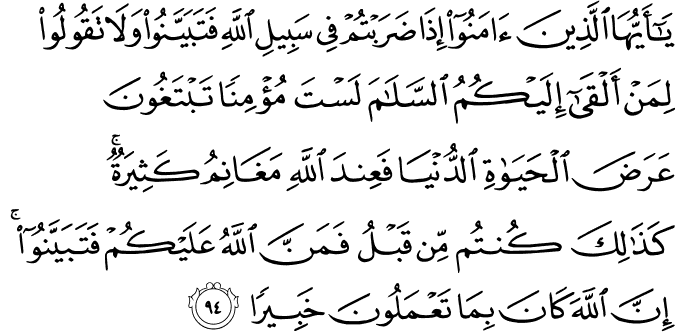
"O those who believe, when you go out in the way of Allah, be careful, and do not say, to the one who offers you the salam* 'You are not a believer" seeking goods of the worldly life. So, with Allah there are spoils in abundance. In the same state you were before; then Allah favoured you. So, be careful. Surely, Allah is all-aware of what you do. [94]

Those among the believers who sit back, except the handicapped, are not equal to those who fight in the way of Allah with their riches and their lives. Allah has raised the rank of those, who fight with their riches and their lives over those who sit; and to each Allah has promised good. And Allah has given precedence to those who fight over those who sit in giving them a great reward [95]

-- high ranks from Him and forgiveness and mercy. And Allah is Most-Forgiving, Very-Merciful."[96]
(4:94-96)

*Salam: the word prescribed by Islam for greeting, i.e. As-saalamu 'alaykum...


Commentary

Sequence of Verses


Stern warning has been given against the killing of a Muslim in previous verses. Now it is being said that the apparent profession of Islam is all that is needed for a Muslim to be regarded as a Muslim obligated to observe the laws of the Shari'ah. So, it is necessary to abstain from the killing of a person who professes Islam. Furthermore, it is also not permissible to dig deep into his inward state of belief just because of some suspicion and to keep waiting for a definite proof of his certitude in faith in order that Islamic laws can be applied in his case. This is what happened during some battles with disbelievers when some Companions were unable to observe the fine line of distinction in this rule.

On those occasions, there were some people who presented themselves as Muslims but some Companions took their profession of Islam as a lie and killed them, taking their belongings as war spoils. Allah Almighty condemned this in discretionary practice. However, an admonition was considered sufficient and no severe warning was revealed for them against this act because the Companions did not know the rule clearly till that time. (Bayan al-Qur'an)


Signs of Islam are Sufficient to Identify a Muslim


In the first of the three verses cited above, the guidance given is that in the case of one who professes to be a Muslim, no Muslim is allowed to interpret his declaration of Islam as hypocrisy, without certain knowledge and proof. This verse (94) was revealed in the background of certain episodes relating to some Companions where they had not taken the correct line of action.

So, it has been reported from Sayyidna 'Abdullah ibn 'Abbas in Tirmidhi and the Musnad of Ahmad that a man from the tribe of Banu Sulaym met a group of the noble Companions who were going on a Jihad mission. This man was grazing his goats. He offered salam greetings to the group which was a practical demonstration of his being a Muslim. The Companions thought that this man was just pretending in view of the situation before him. Thus, taking his profession of Islam as a ruse to save his life and property whereby he could get away from them by tricking them with greeting in the Muslim style, they killed him and appropriated the herd of his goats as war spoils which they took to the Holy Prophet Sallallahu 'Alayhi Wasallam: Peace be upon him. Thereupon, this verse was revealed. It laid down the rule: Do not take anyone who greets you by offering salam in the Islamic manner as a pretender and never assume, without valid proof, that his profession of Islam was a trick and never take possession of his property as spoils, (ibn Kathir)

There is another narration from Sayyidna 'Abdullah ibn 'Abbas which has been reported by al-Bukhari briefly and by al-Bazzar, in details. According to this narration, the Holy Prophet Sallallahu 'Alayhi Wasallam: Peace be upon him, sent out a group of mujahidin which included Sayyidna Miqdad ibn al-Aswad. When they reached the designated spot, everyone present there ran away. The only man left there had a lot of valuable things with him. Facing the Companions, the man recited the kalimah: (I testify that there is no god but Allah). But, Sayyidna Miqdad Radhi-Allahu Anh: Allah be pleased with him, assuming that the man's heart was not behind his verbal declaration of faith and that he was doing it simply to save his life and property, killed him. One Companion from among the group present admonished him for what he had done: He had killed a person who had testified that there is no god but Allah. He declared that he will make it a point to relate this incident before the Holy Prophet Sallallahu 'Alayhi Wasallam: Peace be upon him when and if he would have the honour of returning to him.

Finally, the group returned to Madinah and reported the incident to the Holy Prophet Sallallahu 'Alayhi Wasallam: Peace be upon him who called for Sayyidna Miqdad and gave him a stern warning. He said: 'What would you say on the Day of Doom when the kalimah of will stand as a plaintiff against you?' The verse (do not say to the one who offers you salam, "You are not a believer") was revealed on this occasion.

Other incidents, apart from the two mentioned here, have been reported with reference to this verse, but respected scholars of Tafsir do not admit of any contradiction in these narrations, for these events as a whole could have been the cause of the revelation.

The words of the verse are: (offer you salam). If the word, salam in the text is taken to mean 'salam' in the technical sense (Muslim greeting or salutation), it applies to the first event more suitably. However, if 'salam' is taken to mean submission or surrender to the will of Allah in the literal sense, then, this meaning applies to both events equally. Therefore, salam in the present textual setting has also been translated in the sense of submission and obedience to Allah.


It is Impermissible to Take a Decision Without Investigating Into Related Facts of an Event


The first sentence of the verse (94) carries a general rule which must be followed by all Muslims: Let no Muslim do anything summarily as based on guess alone. The words of the verse are: (when you go out in the way of Allah, be careful). Acting on conjecture is likely to land one in trouble. The restriction of travel in the verse is there because these events came to pass during the state of travel. Or, it may be because doubts crop up during travel to previously unvisited places as compared with the city of residence where things and people are generally familiar. Otherwise, the basic rule, in travel or while resident, is general, that is reacting to any situation without proper investigation is not permissible. In a hadith, the Holy Prophet Sallallahu 'Alayhi Wasallam: Peace be upon him has said: "To act sensibly is from Allah and to rush through is from Shaytan" (al-Bahr al-Muhit)

The second sentence: (seeking goods of the worldly life) in verse 94 is a prescription for weakness which caused this false step. The weakness was their desire to acquire worldly wealth through collecting spoils. But, immediately after, it was pointed out that Almighty Allah has set aside many more spoils destined for them. Why, then, should they bother about material gains? By way of further admonition, they were asked to recollect that there were so many among them who would not have dared to come out openly with their faith in Islam.

It was only when Allah favoured them that they were delivered from the encirclement of disbelievers and were able to profess Islam openly. Keeping this situation in mind, would it not be possible that the person who is saying at the sight of the Muslim army, might really be an adherent of Islam from the early days but was unable to profess it freely fearing reprisals from the disbelievers. When he saw the Muslim army, he lost no time in doing so. If they looked into their own situation, they would realize that there was the time when they had recited the Kalimah and had called them Muslims, the Shari'ah of Islam had never asked them to first prove their being Muslims. There was no such condition. They were never asked to let their hearts be examined. They were not ordered to produce a proof of their Islam before they could be declared as confirmed Muslims. Quite contrary to all this, the simple recital of the Kalimah of Islam: was considered good enough to recognize them as Muslims. Keeping this in mind, it was their duty that they should now take anyone who recites the Kalimah before them as a Muslim.


The Meaning of Not Taking a Muslim to be a Kafir


From this verse comes the important ruling that anyone who professes Islam and declares that he is a Muslim - by reciting the Kalimah or by associating himself with some marked feature of Islam such as the Adhan and the Salah - should be treated as a Muslim. All Muslims must deal with him as they would do with any other Muslim. They are not supposed to wait and worry about finding out whether such a person has embraced Islam with all his heart or it has been done out of expediency.

In addition to that, this is a case in which even his doings will not serve as the criterion. Suppose, someone skips Salah, does not fast and is involved with all sorts of sins - still, no one has the right to say that he has gone outside the pale of Islam or to treat him as one would treat a disbeliever. Therefore, the great Imam Abu Hanifah said: (We do not call 'the people of the Qiblah' Kafirs because of some sin). Similar statements appear in hadith narrations also, such as, 'Do not say that 'the people of Qiblah' are Kafirs, no matter how sinful and evil-doing they may be.'

At this point, there is something everyone should understand and remember, clearly and particularly. This relates to the authority of the Qur'an and Sunnah from which it is proved that calling or taking someone who calls himself a Muslim to be a Kafir is not permissible. It clearly means that until such time he says or does something which provides the positive proof of Kufr (disbelief), his profession of faith in Islam shall be deemed as sound and he will continue to be taken as a Muslim and, for all practical purposes, he will be dealt with as one would deal with Muslims. No one will have the right to debate what goes on in his heart or how sincere or hypocritical he may or may not be.

But, there may be a person who professes Islam, attests to faith, yet disgraces himself by uttering words of disbelief or prostrates before an idol or denies an injunction of Islam which is absolute and obvious, or takes to a religious way or mark of disbelievers - such a person will certainly be declared a Kafir because of his deeds which prove his infidelity. It will be noticed that, the word (be careful or investigate) in the present verse provides a hint to this effect, otherwise, the Jews and the Christians all claimed to be believers. Then, there was Musaylimah, the Liar. He was declared to be a Kafir with the consensus of Companions, and killed.

As for him, he was not only a professor of the Islamic creed but a practicing adherent of Adhan and Salah as well. In his Adhan, he had the Muezzin say: (I testify that there is no god but Allah) which was duly followed by (I testify that Muhammad is the Messenger of Allah). But, while he did this, he also claimed to be a prophet and a messenger who received revelations. This was an open denial of the binding injunctions of the Qur'an and Sunnah. It was on this basis that he was declared to be an apostate and a Jihad force was sent against him with the consensus of the Companions.

In short, the correct course of action when faced with this problem is: Take everyone who recites the Kalimah and adheres to Islam (ahl al-Qiblah: the people of Qiblah) to be a Muslim. Peeking into his heart is not our business. Let Allah be the judge. But, when you see one professing faith yet doing things to the contrary, take him to have become an apostate subject to the condition that such deeds be, absolutely and certainly, contrary to the dictates of Faith and that it admits of no other probability or interpretation.

Finally, we can now see that 'the reciter of the Kalimah' (Kalimah-go) or Ahl al-Qiblah (the people of Qiblah, meaning Muslims who universally turn to the direction of Holy Ka'bah when praying) are technical terms applied solely to one who, after his professing Islam, does nothing by his word and deed which can be classed as infidelity.


Some Injunctions About Jihad


The second verse (95) takes up some injunction related to Jihad. It says that people who do not participate in Jihad without some valid excuse cannot be equal to those who fight in the way of Allah staking everything they have, even their lives. In fact, Almighty Allah has raised the ranks of those who fight in the way of Allah over those who do not. However, along with this declaration of the precedence of Mujahidin, it was also said that Almighty Allah has promised good returns for both groups. Both shall be blessed with Paradise and Allah's forgiveness - the only difference between them will be that of ranking.

According to leading exegetes, this verse tell us that Jihad is Fard 'ala al-Kifayah under normal conditions. Fard Kifayah, as opposed to Fard 'ala al'Ayn (an obligation for every individual), is an obligation of sufficiency. It means that should some people fulfill it, the rest of Muslims stand relieved subject to the condition that those engaged in Jihad must be sufficient for that Jihad. If the situation is otherwise, Jihad will become an obligation (Fard 'Ayn) on all Muslims living in the neighbouring areas who will have to come forward to help the Mujahideen.


The Definition of Fard Kifayah


In the terminology of the Shari'ah, Fard 'ala al-Kifayah refers to obligations the fulfillment of which is not mandatory on every individual Muslim. Instead, if some fulfill it, that will be good enough. Most activities of a collective nature fall under this category. Teaching of religious sciences and their wider dissemination is also an obligation of this nature - if some people are devoted to the fulfillment of this obligation and their number is fairly sufficient, then, other Muslims are absolved of this duty. But, should it be that just about nobody is discharging this obligation wherever there be the need to do so, then, everyone becomes a sinner.

The Salah for the deceased, the bathing and shrouding of the body is also a collective obligation, for a brother fulfills the rights of a Muslim brother and this is how it is supposed to be, a requirement of the Islamic law. The making of Masajid and Madaris (mosques and religious schools) and running programmes of public welfare are included under this very injunction, that is, if some Muslims do that, the rest stand absolved of the obligation.

Generally, injunctions related to collective needs have been, of necessity, classed as Fard Kifayah by the Shari'ah of Islam so that all duties can be discharged under the principle of distribution of work. Thus, some people would be engaged in Jihad, others in education and da'wah activities and still others in attending to various other Islamic or human needs.

The statement (and to each, Allah has promised good) in this verse gives peace of mind to those who are engaged in religious duties other than Jihad. But, this injunction is operative in normal conditions when the Jihad waged by some people is sufficient for defence against the enemy attack. Should it be that their Jihad needs additional support, Jihad becomes an absolute obligation on neighbouring Muslims in the first instance. If this support too turns out to be still deficient, Jihad becomes an absolute obligation on Muslims living nearby in their proximity. Finally, just in case, they too are unable to meet the challenge from the enemy, the mantle of Jihad duty falls on the shoulders of other Muslims to the limit that there may come a time when every Muslim from the East and the West may have to participate in the Jihad as solemn religious obligation.

The third verse (96) too recounts the same degrees of precedence that the Mujahidin have over others.


Ruling


Jihad is not obligatory on the lame, the crippled, the blind, the sick and on others who are excusable under the Islamic law. [Ma'ariful Qur'an]
report post quote code quick quote reply
No post ratings
back to top
Rank Image
Seifeddine-M's avatar
London
4,762
Brother
4,175
Seifeddine-M's avatar
#348 [Permalink] Posted on 9th April 2012 07:18
Tafseer Of Surah an-Nisa, Verses 97-100


"Those whom the angels take while they had wronged themselves, (to them) the angels said, "What were you (involved) in?" They said, "We were oppressed in the earth." They said, "Was" not the earth of Allah wide enough that you might have sought refuge in it?' As for such, their shelter is Jahannam. And it is an evil place to return [97]

- except the oppressed, men and women and children, who cannot manage a device nor can find a way. [98]

As for such, it is likely that Allah would pardon them. And Allah is Most-Pardoning, Most-Forgiving. [99]

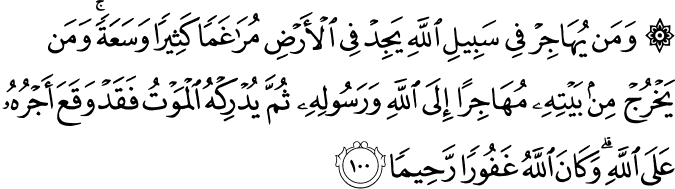
And whoever migrates in the way of Allah shall find in the earth many a place to settle and a wide dimension (of resources). And whoever leaves his home migrating for the sake of Allah and His Messenger and death overtakes him, then, his reward is established with Allah. And Allah is Most-Forgiving, Very-Merciful."[100]


Commentary

The Definition of Hijrah


In the four verses cited above, the merits, blessings and injunctions of Hijrah have been described. Lexically, Hijrah, Hijran and Hajr mean 'being displeased with something and leaving it'. In common parlance, the leaving of one's home country is known as Hijrah. In the terminology of the Shari'ah, leaving Dar al-Kufr (Homeland of disbelievers) and going to Dar al-Islam (Abode of Islam) is called Hijrah (Ruh al-Ma'ani).

In Sharh al-Mishkah, Mulla 'Ali al-Qari has said: Leaving a home country for religious reasons is also included under Hijrah (Mirqat, p. 39, v.l).

From the verse (59:8): 'Those who have been driven away from their homes ...' revealed about emigrating Companions, we know if disbelievers of a country forcibly expel Muslims because they are Muslims, this too will be included under Hijrah.

From this definition, we learn that Muslims migrating from India to Pakistan who came here out of disgust for Dar al-Kufr at their own choice or were driven away by non-Muslims simply because they were Muslims, are all 'Muhajirs' in the Islamic legal sense. But, those who have moved to benefit from business or employment opportunities are not entitled to be called 'Muhajir' in that Islamic legal sense.
Then, there is the hadith from al-Bukhari and Muslim in which the Holy Prophet Sallallahu 'Alayhi Wasallam: Peace be upon him has been reported to have said:

"The Muhajir is one who leaves everything Allah and His Messenger have prohibited."

The full sense of the saying becomes clear from the first sentence of this very hadith which is as follows:

"A Muslim is the one from whom all Muslims remain safe - (safe) from his tongue and (safe) from his hands." (Tirmidhi, Kitab al-'Iman)

As obvious, it means that a true and staunch Muslim has to be the one who hurts none. Similarly, a true and successful Muhajir is the one who does not consider migration from his home country as the ultimate obligation. He should, rather, leave everything else the Shari'ah has declared to be unlawful or impermissible. Said poetically, it would be saying something like: (When you change into the Ihram garment, better change your heart too!)


The Merits of Hijrah

Just as the verses about Jihad are spread out all over in the Holy Qur'an, Hijrah too has been mentioned many times in most of the Surahs. A cumulative view of these verses shows that there are three kinds of themes in verses relating to Hijrah. Firstly, there are the merits of Hijrah; secondly, its worldly and other-worldly blessings; and thirdly, warnings against not migrating from Dar al-Kufr despite having the ability to do so.

As for the merits of Hijrah, there is a verse in Surah al-Baqarah:


As for those who believed and those who migrated and carried out Jihad in the way of Allah, they do hope for Allah's mercy and Allah is Forgiving, Very-Merciful - (2:218).

The second verse appears in Surah al-Taubah:

And those who believed and emigrated and took up Jihad in the way of Allah with their wealth and lives are greater in rank in the sight of Allah - and they are the successful ones - (9:20).

The third verse belongs to Surah al-Nisa' and appears right here as part of the set of verses under study:

And whoever migrates in the way of Allah shall find in the earth many a place to settle and a wide dimension (of resources). And whoever leaves his home migrating for the sake of Allah and His Messenger and death overtakes him, then, his reward is established with Allah. And Allah is Most-Forgiving, Very-Merciful - (4:100).

According to some narrations, this last verse was revealed about Sayyidna Khalid ibn Hizam at the time of the migration to Ethiopia. He had left Makkah on his way to Ethiopia with the intention of Hijrah. Enroute, a snake bit him which caused his death. In short, the three verses cited above have clearly emphasized Hijrah from Dar al-Kufr (migration from the Abode of Disbelief) and the many merits it has.
In a hadith, the Holy Prophet Sallallahu 'Alayhi Wasallam: Peace be upon him has said: meaning: Hijrah will undo all sins which may have been committed before it.


The Blessings of Hijrah


As for blessings, a verse from Surah al-Nahl says:

And those who migrated for the sake of Allah after they were subjected to injustice, to them We shall give a good place to be in the world while the reward of the Hereafter is certainly great - only if they had realized! (16:41)

The fourth verse of the set of four verses (97-100) appearing at the head of this part of the Commentary deals with approximately the same subject. There it has been said:

And whoever migrates in the way of Allah shall find in the earth many a place to settle and a wide dimension (of resources).

The word 'muragham' in the verse is a verbal noun which means 'to move from one land to the other' and the place to which one moves and settles is also called 'muragham'.

Both these verses quoted above tell us about the open and the hidden blessings of Hijrah where Almighty Allah has promised to everyone who migrates for the sake of Allah and His Messenger that He shall open new opportunities in the world for them and give them a good home to settle. As for the rewards and ranks of the Hereafter, they are beyond any reach of expectation or imagination.

The words which promise 'a good place to be' in the world have been interpreted variously. Mujahid explains it as 'lawful sustenance', Hasan al-Basri as 'good home' while some other commentators have interpreted it as 'superiority in excellence, honour and power over antagonists.' The truth of the matter is that all these elements are included within the sense of the verse. World history bears witness that whoever has left his homeland for the sake of Allah, to him Almighty Allah has given a home far better than what he had earlier, far more honour and far more comfort. Sayyidna Ibrahim (A.S) migrated to Syria from his homeland in Iraq - Allah gave him all those things. Sayyidna Musa and the Bani Isra'il migrated from Egypt, their homeland for the sake of Allah, then He gave them the land of Syria, a better homeland. Then, they got Egypt too. When our master and the last of the prophets, Sayyidna Muhammad Sallallahu 'Alayhi Wasallam: Peace be upon him and his Companions left Makkah for the sake of Allah and His Messenger, these blessed emigrants found the best of shelter in Madinah, far better than Makkah.

There they had honour and power and peace and prosperity. Of course, this does not include the transitory hardship faced during the early period of Hijrah. But, soon after that, the blessings, which were showered on these people and which continued through several generations, shall be the proper yardstick in this matter.

Events related to the poverty and hunger of Noble Companions so well-known belong generally to the early period of Hijrah; or, go as what can be called volitional acceptance of poverty, a dignified attitude of readiness to live with less (Faqr). In other words, they just did not like worldly wealth and property as a result of which they lost no time in spending what they received, in the way of Allah. This was very much the state in which the Holy Prophet Sallallahu 'Alayhi Wasallam: Peace be upon him lived. His lack of means and patience in hunger were simply voluntary. He just did not choose to be rich. Nonetheless, during the sixth year of Hijrah, after the conquest of Khyber, things had changed and sufficient means of sustenance were available for the Holy Prophet Sallallahu 'Alayhi Wasallam: Peace be upon him and his family. The same was the case with all righteous caliphs. When they reached Madinah, Allah had given them everything they needed. But, when Islam needed their support, Sayyidna Abu Bakr radiallaahu anh came forward and donated everything he had in his house. The Mother of the Faithful, Sayyidah Zaynab would give away all her stipend money to the poor and the needy and remain satisfied living indigently. For this reason, she was called 'The Mother of the Needy'.

On the other side, no less in number were the rich ones among the Companions who left wealth and property behind. There were many among the Companions who were poor in their home-city of Makkah but Allah Almighty made them rich and happy after Hijrah. Sayyidna Abu Hurairah Radhi-Allahu Anh: Allah be pleased with him can be cited as a good example. When he was appointed the governor of a province, he used to enjoy talking about his past with unusual relish. He would formally address himself and say: 'O Abu Hurairah, you are the same man, the servant of a tribe. Your salary was what you could eat. Your duty was to walk with those who rode on a journey and your duty was to collect firewood for them when they broke their journey at a certain stage. Today, because of Islam, you are here, so high from so low, and they call you the Commander of the Faithful!

In summation, it can be said that the world has openly witnessed the fulfillment of the promise Allah has made in the Qur'an. However, the verse has put a condition that they must be 'true emigrants for the sake of Allah', a substantiation of Hajaru fillah. This kind of emigrant should have not migrated for the sake of wordly wealth, office, power, recognition, honour or influence. Otherwise, in a hadith of al-Bukhari, the Holy Prophet Sallallahu 'Alayhi Wasallam: Peace be upon him has also been reported to have said: 'Those who migrate for the sake of Allah and His Messenger, their migration is precisely for Allah and His Messenger.' It means that this is the correct mode of Hijrah the merits and blessings of which appear in the Qur'an. As for those who migrate to make money or marry a woman, their compensation against Hijrah is exactly what they migrated for.

In our time, some groups of muhajirin (emigrants) who are living in distress are either in that transitory stage of the early period of Hijrah which is usually marked with hardships, or they are not Muhajirs in the real sense. They should correct their intention and take charge of the circumstances under which they live. After their intention and their corresponding deeds have been corrected, they shall witness the truth of Allah's promise with their own eyes.
[Ma'arifu; Qur'an]
report post quote code quick quote reply
No post ratings
back to top
Rank Image
Seifeddine-M's avatar
London
4,762
Brother
4,175
Seifeddine-M's avatar
#349 [Permalink] Posted on 10th April 2012 11:05
Tafseer Of Surah an-Nisa, Verses 101-104


"And when you travel in the earth, there is no sin on you in shortening your Salah if you fear that the disbelievers would put you in trouble. Surely, the disbelievers are an open enemy for you. [101]

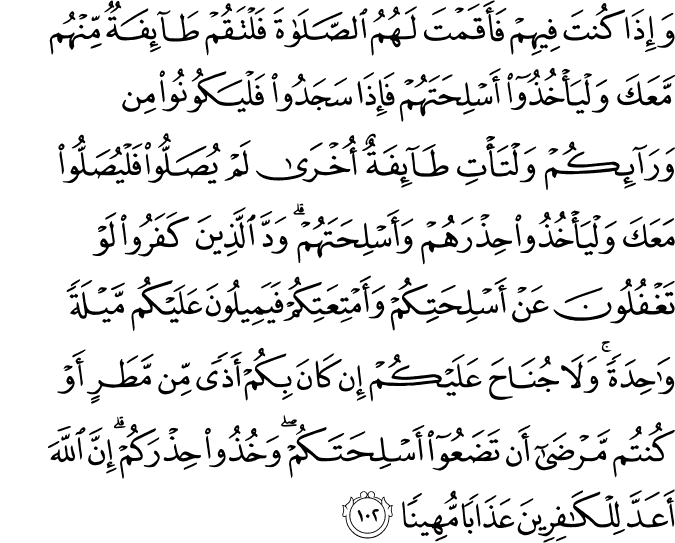
And when you (O prophet) are in their midst, and arrange for them the Salah, then, a party from them should stand with you and should take their arms along. Then, once they performed Sajdah, [Sajdah or Sujud, a way of prostration specified by the Shari'ah of Islam as a part of Salah. ]they should move away from you and the other party, which has not yet performed Salah, should come and perform Salah with you, and should take their precautionary measures and their arms. Those who disbelieve would want you to become heedless to your arms and your belongings so they come down upon you in a single move. And there is no sin on you, if you have some inconvenience due to rain or you are sick, in putting your arms aside. And do take your precautionary measures. Surely, Allah has prepared for the disbelievers a humiliating punishment. [102]

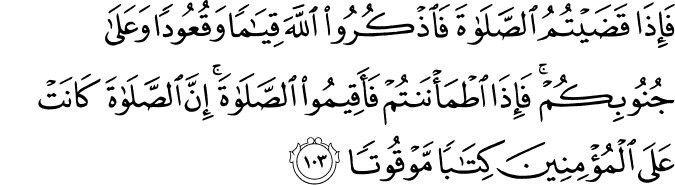
And once you have finished your Salah, then, remember Allah while standing, sitting and reclining. And as soon as you are secure, perform the Salah as due. Surely, Salah is an obligation on the believers which is tied up with time. [103]

And do not show weakness in pursuing these people. If you suffer, then, they suffer as you suffer, while you hope from Allah what they do not hope. And Allah is All-Knowing, All-Wise."[104]
(4:101-104)

Commentary


The subject of Jihad and Hijrah were taken up in previous verses. Since travel is involved in Jihad and Hijrah under most conditions, the likelihood of confrontation with the enemy is strong and frequent while making such a trip. Therefore, special mention has been made in the verses cited above of some particular leaves and concessions in the performance of Salah in due consideration of travel and its dangers.

The Concessions Given in Travel


(In Islamic legal terminology, Safar means journey or travel; Qasr refers to the making of one's Salah short while in that status. Thus, four obligatory Raka'at of Zuhr, 'Asr and 'Isha are reduced in number and confined to two Raka'at only.)

Rulings


1. Full Salah is made in a journey which is less than 48 miles.

2. If, after reaching the destination at the end of the journey, one intends to stay there for less than fifteen days, rules relating to 'journey' will continue to apply to him, that is, the obligatory four Raka'at of Salah will be reduced to half. This is Qasr. Now, if one intends to stay at one place for fifteen days, or more, it will become his place or country of residence. Here too, Qasr will not be observed as it was not observed in his original home country, that is, full Salah will be performed.

3. Qasr is done in the Fard (obligatory) Salah of Zuhr, 'Asr and Isha' only. There is no Qasr in Maghrib and Fajr, nor in Sunnah and Witr prayers.

4. If, there be no fear of possible danger during a journey, Qasr will still be observed in making Salah.

5. Some people are troubled by apprehensions of sin when making their Salah short (Qasr) in place of the regular full Salah. This is not correct because Qasr is also a rule of the Shari'ah following which brings no sin. On the contrary, it brings reward.

6. Verse 102 mentions a special way of offering Salah in a state where, due to the fear of enemy, all the Muslims cannot pray in a single congregation. This special way is called 'Salatul-Khawf, the details of which are found in the books of Islamic Fiqh. Verse 102 says: (And when you (O prophet) are among them and arrange for them the Salah). Let this not be construed to mean that the injunction of the Salah of Fear (Salatul-Khawf) is no more imperative because the blessed person of the noble Prophet Sallallahu 'Alayhi Wasallam: Peace be upon him is no more present among us.

The reason is that this restriction has been mentioned here in terms of the situation at that particular time, for there can be no sans-excuse Imam of Salah in the presence of the Prophet. After him, whoever is the Imam shall be deemed to be standing in his place and he will be the one to lead the Salatul-Khawf. All leading religious authorities agree that the injunction of Salatul-Khawf is operative even after him and has not been abrogated.

7. Just as making Salatul-Khawf is permissible when in fear of hostility from human beings, so it is when one is gripped with the fear of hurt from some beast like a lion or python and there is very little time left to make the Salah.

8. In this verse (102), mention has been made of both groups making one Raka'ah each, but the method of performing the second Raka'ah has appeared in Hadith which says: "When the Holy Prophet Sallallahu 'Alayhi Wasallam: Peace be upon him turned for Salam after the completion of his two Raka'at, the two groups went on to complete their one Raka'ah each on their own'. More details can be seen there.
[Ma'ariful Qur'an]
report post quote code quick quote reply
No post ratings
back to top
Rank Image
Seifeddine-M's avatar
London
4,762
Brother
4,175
Seifeddine-M's avatar
#350 [Permalink] Posted on 12th April 2012 09:45
Tafseer Of Surah an-Nisaa, Verses 105-113


"Surely, We have revealed to you the Book with the truth so that you may judge between people with the insight Allah has given to you. And do not be an advocate for those who breach trust. [105]

And seek forgiveness from Allah. Surely, Allah is All-Forgiving, Very-Merciful. [106]

And do not argue on behalf of those who betray themselves. Surely, Allah does not like anyone who is a sinful betrayer. [107]

They hide from people but do not hide from Allah. And He is with them when they make plans to say what He does not approve. And Allah encompasses whatever they do. [108]

Look, this is what you are -- you have argued for them in the worldly life but who shall argue for them with Allah on Doomsday, or who shall be their defender? [109]

And whoever acts evil or wrongs himself, then seeks forgiveness from Allah, shall find Allah Most-Forgiving, Very-Merciful. [110]

And whoever commits a sin, commits it only against himself. And Allah is All-Knowing, All-Wise. [111]

And whoever commits a vice or a sin, then shifts its blame to an innocent person, he indeed takes the burden of a false imputation and a glaring sin. [112]

And if the grace of Allah and His mercy were not with you, a group from them had resolved to mislead you. And they mislead none but themselves. And they can do you no harm. And Allah has revealed to you the Book and the wisdom and has taught you what you did not know. And the grace of Allah on you has always been great."[113]
(4:105-113)

Sequence


While discussing the matters relating to the open disbelievers, the Holy Qur'an has, in some places in the previous verses, referred to the hypocrites and has pointed out that Kufr or disbelief was the common denominator between them.

Further on, a particular episode relating to some hypocrites finds mention in the present verses, details of which are being given below.


The Background of These Verses


The nine verses (105-113) cited above refer to a particular episode. But, very much in accordance with the characteristic style of the Qur'an, the instructions given in this conection are not peculiar to this episode. They are, rather, a set of basic principles and rules commonly beneficial for all Muslims whether of a given time or of future generations.

Let us go to the event first, then consider the wisdom of related instructions which provide solutions to corresponding problems. The episode centres around the clan of Banu Ubayriq in Madinah. A man from this clan - his name being Bashir as in the narration of Tirmidhi and Hakim, or Tu'mah as in the narration of al-Baghawi and Ibn Jarir - broke into the house of Sayyidna Rifa'ah, the uncle of Sayyidna Qatadah ibn al-Nu'man, and committed a theft.

In the narration of Tirmidhi, it is also mentioned that this man was, in reality, a hypocrite. He used to live in Madinah yet was audacious enough to compose poetic satires insulting the noble Companions (R.A) and used to publicise these in the name of others while keeping his identity concealed.

As for the actual theft it was committed during the early period of Hijrah when Muslims generally lived under straightened circumstances facing all sorts of need, hunger and deprivation. The common food they ate was bread from barley flour or dates, or wheat flour which was scarce and just not available in Madinah. Once in a while, when it did come from Syria some people would buy it for guests or for some other special need. Thus, Sayyidna Rifa'ah bought some wheat flour for himself, put it in a bag, added some arms on top of it and stashed the bag in a small roomette of the house in all possible safety.

But, this man - Ibn Ubayriq, Bashir or Tu'mah - somehow came to know, broke into the house and decamped with the bag. When Sayyidna Rifa'ah discovered the theft in the morning, he went to his nephew, Qatadah and told him about it. Together they went out investigating in the locality. Some people said that they had seen the light of fire coming from the Banu Ubayriq house last night and that probably they were cooking what was stolen. When Banu Ubayriq learnt about their secret being out, they themselves came there and charged that the theft was committed by Labid ibn Sahl. Labid was well-known as a sincere and pious Muslim. When Labid himself came to know about this allegation, he came out of his house, sword in hand, saying: You are blaming me for this theft, now I am not going to put my sword back into the sheath, until the truth of this theft becomes clear.

Quietly, Banu Ubayriq confided to him: Do not worry. Nobody is blaming you. Moreover, this is not the sort of thing you would do. At this point, the narration in al-Baghawi and Ibn Jarir says that Banu Ubayriq charged a Jew with the theft and, very cleverly, made a track of seemingly falling flour from a slit in the bag, which was their own work, all the way from Rifa'ah's house to the house of the Jew. When the traces of the flour were discovered and word went around, they carried the stolen arms and armours as well to the same Jew and left these with him for safe keeping. Following investigations, they were recovered from his house. The Jew declared on oath that these were given to him by Ibn Ubayriq.

In order to bring the two narrations of Tirmidhi and al-Baghawi into harmony, it can be said that may be Banu Ubayriq had first charged Labid ibn Sahl with the theft, but once they realized that their ruse was not working, they targeted the Jew with the blame. Ultimately then, the case now rested between the Jew and Banu Ubayriq.

On the other side, Sayyidna Qatadah and Rifa'ah were overwhelmingly convinced on the basis of circumstancial evidence that this was the work of Banu Ubayriq. Sayyidna Qatadah went to the Holy Prophet Sallallahu 'Alayhi Wasallam: Peace be upon him and told him about the theft and also told him that he strongly suspected Banu Ubayriq. When Banu Ubayriq heard the news, they came to the Holy Prophet Sallallahu 'Alayhi Wasallam: Peace be upon him and complained against Sayyidna Qatadah and Rifa'ah that they were putting the blame for the theft on them without having any valid legal proof and despite the fact that the stolen property was recovered from the house of the Jew. They appealed to the Holy Prophet Sallallahu 'Alayhi Wasallam: Peace be upon him to restrain Sayyidna Qatadah and Rifa'ah from blaming them for the theft and if they had to sue anyone, they should sue the Jew.

Things as they appeared on the outside made even the Holy Prophet Sallallahu 'Alayhi Wasallam: Peace be upon him incline towards the probability that the theft was committed by the Jew and that the accusation against Banu Ubayriq was not correct. So much so that, according to the narration of al-Baghawi, the Holy Prophet Sallallahu 'Alayhi Wasallam: Peace be upon him had the intention of inflicting the punishment for theft on the Jew and sever his hand.

Matters went worse when Sayyidna Qatadah appeared before the Holy Prophet Sallallahu 'Alayhi Wasallam: Peace be upon him who admonished him by saying that he was accusing a Muslim family of theft without any proof. Sayyidna Qatadah was grieved about the whole thing and wished that he had not spoken to the Holy Prophet Sallallahu 'Alayhi Wasallam: Peace be upon him about this matter even if he had to bear by the loss of his property. Similarly, when Sayyidna Rifa'ah learnt about what the Holy Prophet Sallallahu 'Alayhi Wasallam: Peace be upon him had said, he too exercised patience and said: (And Allah is the one from whom all help is sought).

Not much time had passed when a whole section of the Qur'an was revealed about this episode through which the reality behind it was shown to the Holy Prophet Sallallahu 'Alayhi Wasallam: Peace be upon him and general instructions covering such cases were given. As the Holy Qur'an exposed the theft committed by Banu Ubayriq and acquitted the Jew. Banu Ubayriq were left with no choice but to return the stolen property to the Holy Prophet Sallallahu 'Alayhi Wasallam: Peace be upon him who had it returned to the owner, Sayyidna Rifa'ah, who finally endowed all those arms for use in Jihad. When Banu Ubayriq found their theft exposed, Bashir, the son of Ubayriq ran away from Madlnah landing in Makkah where he joined the disbelievers. Consequently, if he had been a hypocrite earlier, he became an acknowledged disbeliever; and, if he was a Muslim earlier, he was an apostate now.

It appears in Tafsir al-Bahr al-Muhit that the curse of his antago�nism to Allah and His Messenger did not allow Bashir ibn Ubayriq to live peacefully even in Makkah. When the woman at whose house he had taken up residence found out about this episode, she threw him out of her house. Thus, loitering on the streets came the day when he broke into somebody else's house. The wall through which he went in collapsed on him and killed him right there.

These are the details of the episode. Let us now give some thought to what has been said in the Qur'an:

After telling the Holy Prophet Sallallahu 'Alayhi Wasallam: Peace be upon him the reality behind the case of theft, in the first verse (105), it was said: Allah has given you the Qur'an through revelations so that you can use the knowledge and insight gifted to you to decide matters accordingly, abstaining from taking sides with traitors, that is, Banu Ubayriq. No doubt, the obvious circumstances and evidences were such that a tilt towards the probability of the Jew having committed the theft was not a sin, yet contrary to the actual fact it was. Therefore, in the second verse (106), the Holy Prophet Sallallahu 'Alayhi Wasallam: Peace be upon him was asked to seek forgiveness from Allah because the station of prophets (A.S) is very high and Allah does not favour the issuance of even something so insignificant from them.

In the third verse (107), it has been emphatically asserted once again that the Messenger of Allah should not defend those who are disloyal and treacherous, for Allah does not like them.

The fourth verse (108) describes the condition of people who betray trust and act treacherously. It is strange that these people feel shy before other people like them and conceal their theft from them while they do not feel shy before Allah who is with them all the time and watches over everything they do, specially the occasion when they mutually conspired to put the blame on the Jew, went to the Holy Prophet Sallallahu 'Alayhi Wasallam: Peace be upon him, complained against Rifa'ah and Qatadah, charged them of false accusation and appealed to the Holy Prophet Sallallahu 'Alayhi Wasallam: Peace be upon him for support against the Jew.

The fifth verse (109) gives a strict warning to the supporters of Banu Ubayriq telling them that their support given to betrayers of trust in the mortal world does not end at that. There will be the Day of Doom when their case will come before Almighty Allah. Who will lend support to them at that time? The verse serves two purposes. It admonishes them, then reminds them of the hazards of the Hereafter persuading them thereby to repent and turn to Allah.

In the sixth verse (110), we can once again see the wise way of the Qur'an at work when, in order to save sinners from total disappointment, it was said that a sin was a sin, big or small. When a sinner repents and seeks Allah's forgiveness, he finds Him forgiving, merciful. As obvious, there is an element of persuasion for those who have committed sin suggesting that they still had the time and the hope to just desist and repent sincerely; nothing is lost, Allah will forgive everything.

In the event that these people choose not to repent despite the option given to them, the seventh verse (111) carries the assurance that this action of theirs brings no harm to Almighty Allah or His Messenger or to Muslims. The sad nemesis of a person's evil deed shall be faced by the person himself.

In the eight verse (112), a general rule of conduct has been set forth. It stipulates that anyone who himself commits a crime, then goes on to put the blame on some innocent person (as in the episode cited above where the theft was committed by Banu Ubayriq themselves and they went on to put the blame on Sayyidna Labid or the Jew) has done something grave by levelling a false accusation of great magnitude against an innocent person plus an open sin weighing heavy on one's shoulders.

Addressing the Holy Prophet Sallallahu 'Alayhi Wasallam: Peace be upon him in the ninth verse (113), it has been said: It was Allah's grace and mercy that He revealed to you the reality behind the event of theft, otherwise these people would have misled you into error. But, since you are not alone, Allah's grace and mercy is with you, these people can never mislead you into error.

On the contrary, they themselves fall into error. Be sure that these people cannot harm you in any way whatsoever because Allah has revealed the Book and wisdom to you and taught you what you did not know.


The Holy Prophet صلى الله عليه وسلم and Ijtihad


From verse 105 which begins with the words: (Surely we have revealed to you the book with the truth) helps establish five rulings:

1. The Holy Prophet Sallallahu 'Alayhi Wasallam: Peace be upon him had the right to arrive at his judgement in situations not covered by an explicit authority given in the Holy Qur'an. In situations of major importance, there were many decisions he took by his Ijtihad.

2. The second rule that emerges from here is inseparably linked with the authenticity of Ijtihad. It means that, in the sight of Allah, an Ijtihad can be considered trustworthy only when it is based on and is deduced from Qur'anic principles and the clear authority of its text. Simple opinions or views are not trustworthy, nor can they be termed as Ijtihad in the sense recognized in Shari'ah.

3. The third rule of guidance we get to know is that the Ijtihad done by the Holy Prophet Sallallahu 'Alayhi Wasallam: Peace be upon him was not like that done by Mujtahid Imams where the probability of an error of judgement always remains.

As for the Holy Prophet Sallallahu 'Alayhi Wasallam: Peace be upon him, when he took a decision on the basis of his Ijtihad any possible error in the judgment would always stand corrected by Allah Almighty. Therefore, when he took a decision based on his Ijtihad and nothing against it came from Almighty Allah, then, this was an indicator that the decision taken finds favour with Allah and is correct in His sight.

4. The fourth rule of guidance we come to know is: What the Holy Prophet Sallallahu 'Alayhi Wasallam: Peace be upon him understood from the Qur'an was nothing but what Almighty Allah had Himself made him understand. A possibility of misunderstanding just did not exist there. This is contrary to the case of other 'Ulama and Mujtahidin whose understanding of the Qur'an cannot be attributed to Almighty Allah in the sense that it was what Allah had told them. You will realize the difference when you carefully look at (with the insight Allah has given to you) which refers to the noble Prophet Sallallahu 'Alayhi Wasallam: Peace be upon him in this very verse. This is why - when someone said to Sayyidna 'Umar: (Decide as Allah shows you to) - he scolded him by saying: 'This is special to the Prophet of Allah Sallallahu 'Alayhi Wasallam: Peace be upon him.

5. The fifth ruling we deduce from here is that pursuing or advocating a false case or a false claim or to second or support them is totally haram (forbidden).


The Reality of Repentance


Verse 110 which begins with the words: tells us that all sins, whether they affect others or affect one's own self, that is, whether they violate the rights of human beings (Huququl-'Ibad) or rights of Allah (Huququllah), can be forgiven by one's repenting and praying for forgiveness. But," it is necessary to know the reality of showing repentance and seeking forgiveness. Mere verbal declarations of 'I seek Allah's forgiveness' (Astaghfirullah) and 'I turn to Him in repentance' (Wa atubu ilaihi) are not acts of genuine repentance as such. Therefore, according to a consensus of 'Ulama, the person who is involved in some sin, is not ashamed of it and does not leave it or, at least, does not resolve to leave it in the future, then, his verbal declaration of Astaghfirullah is an open mockery of repentance.

In short, for repentance (Taubah) to be genuine, three things are necessary:

1. Being ashamed of past sins.

2. Immediately leaving the sin one is in.

3.Resolving to stay away from sin in future.

However, forgiveness for sins related to the rights of the servants of Allah has to be sought from the wronged party itself; or, one should, to begin with, pay what was due or fulfill what was denied. These are binding conditions of genuine repentance.

See also


Tawbah (Repentance) - http://www.muftisays.com/forums/du-aas-supplications/5476/tawbah-%28repentance%29.html

Forgive me for I have sinned - http://www.muftisays.com/forums/du-aas-supplications/5116/forgive-me-for-i-have-sinned..html

Attributing One's Sins to Others Brings Added Punishment


From verse 112 - - we know that a person who himself commits a sin, then goes on to ascribe it to an innocent man, does something terrible - he doubles and hardens his sin. He has made himself deserving of severe punishment, the punishment of his own sin, then the added punishment for lying and accusing falsely.

The Reality of Qur'an and Sunnah


In verse (And Allah has revealed to you the Book and the wisdom and has taught you what you did not know), by pairing al-Kitab (the Book) and al-Hikmah (the Wisdom) it has been pointed out that Hikmah which is the name of the Sunnah and teachings of the noble Prophet Sallallahu 'Alayhi Wasallam: Peace be upon him was also sent down by none but Allah Almighty. The difference is that its words are not from Allah and that is why they are not part of the Qur'an. But, its meanings and that of the Qur'an are certainly from Allah, therefore, it is obligatory to act in accordance with both.

This explains what some jurists say about Wahy (Revelation) being of two kinds: Matluww - that which is recited, and Ghayr-Matluww that which is not recited. Wahy Matluww or the revelation which is recited is the name of the Qur'an - the words and meanings of which are both from Allah. And Ghayr-Matluww or that which is not recited is the name of the Hadith of the Rasul the words of which are from the Holy Prophet Sallallahu 'Alayhi Wasallam: Peace be upon him and the meanings of which are from Allah.

See also:


The Authority of Sunnah (Mufti Taqi Usmani) - http://www.muftisays.com/forums/books/6466/the-authority-of-sunnah-shaykh-mufti-taqi-usmani-ha.html

The Authority Of Sunnah And Hadith, In The Light Of The Holy Quran - http://www.muftisays.com/forums/books/6636/the-authority-of-sunnah-and-hadith,-in-the-light-of-the-holy-quran.html

Ruling on those who reject the Ahaadeeth - http://www.muftisays.com/blog/Seifeddine-M/2640_01-03-2012/ruling-on-those-who-reject-ahadith.html

Another problem which gets resolved from the words: (and taught you what you did not know) (113) is that the noble Prophet Sallallahu 'Alayhi Wasallam: Peace be upon him did not have the all-comprehending knowledge, of the entire universe equal to Almighty Allah, as some ignorant people do insist. The truth is that the measure of his knowledge was corresponding to what Allah bestowed upon him. However, there is no doubt that the knowledge bestowed upon the Holy Prophet Sallallahu 'Alayhi Wasallam: Peace be upon him exceeds the combined knowledge of all created beings. [Ma'ariful Qur'an]
report post quote code quick quote reply
No post ratings
back to top
Rank Image
Seifeddine-M's avatar
London
4,762
Brother
4,175
Seifeddine-M's avatar
#351 [Permalink] Posted on 13th April 2012 09:21
Tafseer Of Surah an-Nisaa, Verses 114-115


"There is no good in most of their whisperings unless one bids charity or a fair action or a reconciliation between people. And to one who does this to seek the pleasure of Allah, We shall give a great reward. [114]

And whoever breaks away with the Messenger after the right path has become clear to him and follows what is not the way of the believers, We shall let him have what he chose, and We shall admit him to Jahannam. And it is an evil place to return."[115]
(4:114-115)

Sequence


Moving from the episode of theft and the conspiracies made to cover up the crime by false accusations against others, the text now highlights positive things that can be done through mutual consultation and which could help one to remain obedient to the Messenger's teachings and the command of Allah without ever trying to go against the ideal path taken by those who believe in Allah and His Messenger.

Commentary


In the first part of the verse (114): translated as 'there is no good in most of their whisperings..', it has been declared that most talks people hold and plans they make to ensure transitory worldly gains, while unmindful of the concerns of their life-to-come, are devoid of good.

The second part: means that real good can come forth from mutual consultations only when people persuade each other to take part in charitable activities or ask people to do what is good and right or tell them to make peace between one another. It is said in a hadith that anything one says is harmful for him in one way or the other unless, of course, the subject of his utterance is the remembrance of Allah or that he is bidding the Fair and forbidding the Unfair.

Bidding the Fair stands for Amr bi al-Ma'ruf which refers to every action considered good in the Shari'ah and is patently recognized as such by those who know it. In contrast, there is the forbidding of the Unfair which stands for Nahy 'an al-Munkar which refers to every action considered undesirable in the Shari'ah and is squarely unrecognized and unfamiliar to those who know it.

Bidding the Fair includes all imperatives and motivations through which people are led to do what is good and right. Things like helping the oppressed, assisting the needy with loans, guiding the lost, all fall under this broad category. Though, charity and reconciliation between people are also part of this definition, but they have been taken up separately because their benefit reaches from one to another and improves the collective life of a community.

In addition to that, these two fields of activity cover what is most essential about public service. They seek to bring benefit to Allah's creation and they protect people against pain and loss. Charity spreads out benefits to people and reconciliation between them stops mutual pain and loss. Therefore, according to a consensus of the scholars of Tafsir, the word Sadaqah (charity) used here carries a general sense which includes the obligatory zakah, voluntary charities and everything done to bring benefit to someone.


The Graces of Making Peace


The Holy Prophet Sallallahu 'Alayhi Wasallam: Peace be upon him has spoken highly about the merit of removing mutual bickerings among people and of bringing them to understand, accommodate and cooperate with each other. He said:

"Shall I not tell you about an act which is far superior in rank to fasting, prayers and charity? The Companions (may Allaah be pleased with them) submitted, 'Please do.' He, then, said: "That act is the removal of discord. That is, to remove bickering between two persons, make peace between them and thus eliminate discord."

He has also said: "Mutual discord among people is what really shaves." Then, he explained it by saying: "This discord does not shave the head, but it shaves off one's faith."

In the concluding part of the verse (114), there appears a significant reminder that these good deeds to bid charity and fair action or a reconciliation among people can only be worthwhile and acceptable when they are undertaken sincerely, and exclusively for the pleasure of Allah, without any traces of personal or material interest.


The Consensus of the Community (Ijmaa') is a Valid Religious Authority


Two things have been identified as a great crime and as a cause of one's consignment to Hell in verse 115: (And whoever breaks away with the Messenger after the right path has become clear to him...). The first is opposing the Messenger of Allah (peace and blessings of Allaah be upon him).

Obviously, doing so is Kufr (disbelief, infidelity) and a terrible curse. The second crime relates to a violation of universal Muslim consensus. It means the abandoning of something which has the universal agreement of all Muslims and opting for some other way against them. This explains that the consensus of the Muslim community has valid religious authority. In other words, we know that following the injunctions given in the Qur'an and Sunnah is obligatory. Similarly, when the Muslim Ummah (Community) agrees about something universally, following its consensus becomes equally obligatory. Any opposition to this consensus is a grave sin as was said by the Holy Prophet Sallallahu 'Alayhi Wasallam: Peace be upon him in a hadith:

That is, the hand of Allah is on the Muslim community. Whoever breaks away or separates himself from it will himself be separated for consignment to Hell.

Imam al-Shafi'i (may Allaah have mercy on him) was asked: 'Can the validity of the authority of the Consensus of Muslim Ummah be proved from the Holy Qur'an?' He devoted to the recitation of the Qur'an full three days, completing three recitals each during the day and night. Finally, the proof that he came up with was this verse. When he cited it before scholars, they all agreed: This proof is sufficient to confirm the authority of 'Ijma', the Consensus of Muslim Community.
[Ma'riful Qur'an]

See also:

The Status Of Ijma In Islam - http://www.muftisays.com/blog/Seifeddine-M/2354_17-12-2011/seekers-quest-series-.-10%29-the-status-of-ijma-in-islam.html

The Position Of Ijmaa' In The Ummah - http://www.muftisays.com/blog/abu+mohammed/444_14-10-2010/the-possition-of-ijmaa%27-in-the-ummah.html

Evidence From The Book Of Allaah (سبحانه و تعالى) - http://www.muftisays.com/forums/taqleed-the-straight-path/6673/evidence-from-the-book-of-allaah-%28swt%29.html
report post quote code quick quote reply
No post ratings
back to top
Rank Image
Seifeddine-M's avatar
London
4,762
Brother
4,175
Seifeddine-M's avatar
#352 [Permalink] Posted on 14th April 2012 09:53
Tafseer Of Surah an-Nisaa, Verses 116-121


"Surely, Allah does not forgive the ascribing of a partner to Him and forgives anything short of that for whomsoever He wills. And whoever ascribes a partner to Allah has indeed gone far astray. [116]

They invoke none, besides Him, but females; and they invoke none but Satan, the rebel [117]

whom Allah has cursed. And he (the Satan) said, 'Tor sure, I will take a set share from Your slaves, [118]

and I will lead them astray and I will tempt them with false hopes and give them my order so they shall slit the ears of cattle and I will give them my order so they shall alter the creation of Allah. And whoever takes the Satan as friend instead of Allah has incurred an obvious loss. [119]

He (the Satan) makes promises to them and he tempts them with hopes. And the Satan does not make a promise to them but to deceive. [120]

As for such, their shelter is Jahannam and they shall find no escape from it."[121]
(4:114-115)

Sequence


Though, the mention of Jihad in preceding verses includes all forces hostile to Islam, yet the actual description was limited to Jews and the hypocrites. Out of the larger group of antagonists there were the pagans who were much more in numbers. The verses that follow take up their beliefs and point out to the punishment they will face. This has a coherence of its own at this place. It will be recalled that the thief mentioned earlier became an apostate. The lasting punish�ment he thus earned for himself becomes evident. (Bayan al-Qur'an)

Commentary


The first verse (116) (Surely, Allah does not forgive the ascribing of a partner to Him and forgives anything short of that for whomsoever He wills ...) has appeared earlier (48) in Surah al-Nisa' in the same words except for the words at their ends. In verse 48 appearing earlier, the words at the end are: (And whoever ascribes a partner to Allah has designed a great sin) while the words at the end of verse 116 before us are: (And whoever ascribes a partner to Allah has indeed gone far astray).

As explained by master exegetes, the reason for this difference is that the addressees of the earlier verse (48) were the Jewish people of the Book who knew all about the truth of Tauhid (Allah's oneness), the falsity of Shirk (ascribing of a partner to Allah) and the veracity of the mission of the noble Prophet Sallallahu 'Alayhi Wasallam: Peace be upon him, through the Torah. Despite that, they got involved in Shirk. Thus, through their own conduct, they pretended that it was the very teaching of the Torah which is total forgery and false accusation.

That is why it was said: (... has designed a great sin) at the end of verse 48. As for the verse before us (116), the addressees were the pagans of Makkah who did not have the background of any Book or Prophet before that time, but the rational arguments in support of the Oneness of Allah were all too clear. Taking stones crafted with their own hands as their objects of worship was something ineffectual, false and erroneous even in the sight of someone with ordinary common-sense. Therefore, here it was said: (... has indeed gone far astray).


The Eternal Punishment of Shirk and Kufr


Some people express doubt at this point. They think that punish�ment should be proportionate to the deed. The crime of disbelieving and of ascribing partners to Allah committed by the Kafir and the Mushrik was committed within the limited time frame of a given life. Why would its punishment be limitless and permanent? The answer is that the doer of Kufr and Shirk simply does not regard what he does as crime. This is, on the contrary, taken as something good and proper, worth one's while.

Therefore, his line of action is accompanied by his firm intention that he will always be like that. Now, if such a Kafir or Mushrik adheres to this position right through the last breath, he has committed a permanent crime to the extent of his choice and volition, therefore, the punishment for it has to be permanent.


Zulm


There are three kinds of Zulm (injustice):

1. That which Allah will never forgive.
2. That which could be forgiven.
3. That which meets retribution from Allah.

The first kind of injustice is Shirk, the ascribing of a partner to Allah; the second kind of injustice is falling short in fulfilling the rights of Allah, known as Huququllah; and the third kind of injustice is the contravention of the rights of Allah's created beings against each other, known as Huququl-'Ibad. (Ibn Kathir vide Musnad Bazar)


What is the Reality of Shirk?


To consider any created being other than Allah equal to Allah in worship, or in love and reverence, is what Shirk really is. The Holy Qur'an has reported the words of the disbelievers they shall utter on arrival into the Jahannam: 'By Allah, we were in obvious error when we had equated you with Allah, the Lord of all the worlds.' (26:97,98)

It is evident that even the polytheists did not believe that the idols of their making were the Creator and the Master of the universe. It was, rather, under other erroneous assumptions that they had taken to regarding their idols equal to Allah in worship or in love and reverence. This was the Shirk which caused their being in Jahannam (Fath al-Mulhim).

In short, taking any created being as equal to Allah in His particular attributes - such as, the Creator, the Provider, the Absolute Master, the Knower of the Seen and the Unseen - is Shirk.
[Ma'ariful Qur'an]
report post quote code quick quote reply
No post ratings
back to top
Rank Image
Seifeddine-M's avatar
London
4,762
Brother
4,175
Seifeddine-M's avatar
#353 [Permalink] Posted on 16th April 2012 05:49
Tafseer Of Surah an-Nisaa, Verses 122-126


"And those who believe and do good deeds, them We shall admit to the gardens beneath which rivers flow. They shall live there for ever - a real promise from Allah. And who is more truthful than Allah in his word? [122]

This is not (a matter of) your fancies or the fancies of the People of the Book. And whoever does evil shall be requited for it and shall find for himself, besides Allah neither friend nor helper. [123]

And whoever, male or female, does good deeds and is a believer -- they shall enter Paradise and they shall not be wronged in the least. [124]

And who is better in Faith than one who has surren�dered his self to Allah and is good in deeds, and has followed the creed of Ibrahim, the upright. And Allah has made Ibrahim a friend. [125]

And to Allah belongs what is in the heavens and what is in the earth. And to everything Allah is encompassing."[126]
(4:122-126)

Commentary

A Dialogue Between Muslims and the People of the Book Contending for Glory Against Each Other


Verse 123 which begins with the words: : 'This is not (a matter of) your fancies or the fancies of the People of the Book...', is about a cross talk between Muslims and the People of the Book. It is followed by a wise and judicious ruling on the confronting claims aimed at bringing the contestants to the right path. Finally, given here is a standard measure of determining as to who is superior and acceptable in the sight of Allah, a standard which, if observed carefully, would not let any human being fall into error.or go astray.

According to Sayyidna Qatadah, once it so happened that some Muslims and the People of the Book started talking to each other in a vainglorious strain. The People of the Book said that they were superior to Muslims because their Prophet came before the Prophet of Islam and that their Book appeared before the Qur'an of Muslims did. The Muslims countered by saying that they were superior to all of them for their Prophet was the Last of the Prophets and their Book was the Last of the Books which has abrogated all previous Books. Thereupon, the verse cited above was revealed. It means that such self-glorification and self-congratulation does not behove anyone for nobody becomes superior to anybody simply on the basis of conjectures, fancies and claims. Instead, everything depends on deeds. No matter how noble and superior one's Prophet and Book may be, it is the deed of the adherent which will count. If he acts evil, he will receive the kind of punishment from which he can never hope to be rescued by anyone.

When this verse was revealed, the noble Companions were acutely disturbed. Imam Muslim, al-Tirmidhi, al-Nasa'i and Ahmad (R.A) have reported a narration from Sayyidna Abu Hurairah in which he said: When this verse was revealed : "And whoever does evil shall be requited for it", we were deeply grieved and concerned. We submitted to the Holy Prophet Sallallahu 'Alayhi Wasallam: Peace be upon him : 'This verse leaves nothing out - the minutest of evil found in our deeds shall be requited!' The Holy Prophet Sallallahu 'Alayhi Wasallam: Peace be upon him said: 'Do not worry. Keep doing what you can to the best of your ability for (the punishment mentioned here does not necessarily have to be that of Hell, instead) whatever hardship or pain which afflicts you makes amends for your sins and requites your evil deeds, to the limit that even a thorn which pinches someone's foot becomes an expiation of some sin.'

There is another narration which says that any sorrow or pain or sickness or anxiety which afflicts a Muslim in the life of this world becomes an expiation of his or her sins.

According to a narration of Sayyidna Abu Bakr Radhi-Allahu Anh: Allah be pleased with him as reported in Jami' al-Tirmidhi, Tafsir Ibn Jarir and elsewhere, when the Holy Prophet Sallallahu 'Alayhi Wasallam: Peace be upon him recited this verse: (And whoever does evil shall be requited for it) to him, he felt as if his back was broken. When the noble Messenger of Allah noticed the reaction on him, he asked: 'What is the matter with you?' Thereupon, Sayyidna Abu Bakr Radhi-Allahu Anh: Allah be pleased with him submitted: 'Ya Rasulallah, there is hardly anyone among us who can claim to have done nothing bad in one's life. Now, if every evil deed has to be requited, who can hope to go unscathed from among us?' He said: 'O Abu Bakr, you and your believing brothers need not worry about it because worldly hardships that you face shall make amends for your sins.'
As it appears in another narration, he said: 'O Abu Bakr, do you not get sick? Are you never tested by distress and sorrow?' Sayyidna Abu Bakr said: 'No doubt, all this does happen.' Then, he said: 'There, this is the requital of whatever evil you may have done.'

In a hadith appearing in Abu Dawud, Sayyidah 'A'ishah has been reported to have said: 'A discomfort faced by a servant of Allah in fever, or a pain that afflicts him in any other way, even the pinch of a thorn, all become an expiation of his or her sins, so much so that even the insignificant effort made by someone to look for something in one of his pockets and finding it in another comes to be an expiation of his sins.'

In short, this verse is a reminder to Muslims as well that they should not indulge in tall claims and wishful thinking. On the contrary, they should be concerned with what they actually do, for their success will not come solely on the basis of their formal adherence to a given Prophet and a Book. Instead, their real prosperity lies in making certain that their belief in them is correct and that they are particular about doing good deeds as enjoined. Verse 124 says: . It means a man or woman who does good deeds, subject to the condition that such deeds issue forth from true faith, shall certainly go to Paradise fully rewarded for all his or her deeds without being wronged in the least. The hint given here is that the People of the Book or other non-Muslims may also have some good deeds of their own, but, since their faith is not sound, therefore, those deeds of theirs are not acceptable. As for Muslims, since their faith is sound and their deeds too are good, therefore, they are the successful ones, and superior to others.


Acceptability in the Sight of Allah: A Criterion


The fourth verse (125) lays down a criterion to help determine correctly as to who is acceptable in the sight of Allah, and who is not. This criterion has two components. Any shortfall in either of the two components makes all efforts go waste. A careful look will reveal that all strayings into error and evil, wherever they may be in this wide world, are triggered because of a shortfall in one of these two components. Compare Muslims with non-Muslims. Or, compare the different sects, groups and parties within the Muslim community itself. You will come across the same two points of reference - any deviation from either is bound to land one in disgrace. The verse says:

And who is better in Faith than one who has surrendered his self to Allah and is good in deeds, and has followed the creed of Ibrahim, the upright...) (125)

It means that there can be no way better than the way of the person who is an embodiment of two virtues:

1. Firstly, 'surrenders his or her self to Allah.' In other words, acts for the good pleasure of Allah with all sincerity at one's command without ever contaminating one's deeds with hypocritical or materialistic motives.

2. Secondly, 'and is good in deeds.' In other words, the way in which one acts should also be correct. According to the great commentator, Ibn Kathir, the way in which one acts, the correct way, means that it will not be some self-invented way. On the contrary, this will have to be the unalloyed way of Islam as based on the injunctions of Almighty Allah and the teachings of His noble Messenger Sallallahu 'Alayhi Wasallam: Peace be upon him.

Thus, we can see that there are two conditions for any deed to be acceptable in the sight of Almighty Allah. These are sincerity of intention and soundness of action, that is, being in accordance with the Shari'ah and Sunnah. The first of the two conditions, Ikhlas or sincerity, relates to the heart, the inner most human dimension. The second condition, the compatibility with Shari'ah, relates to the human exterior. Whoever fulfills both these conditions finds his or her exterior and interior perfectly synchronized. But, the moment one of the two conditions is found missing, that which is done becomes imperfect and unsound. The loss of sincerity makes one a hypocrite in practice while the failure in following the Shari'ah, the designated way, makes one go astray.


Nations go astray because they lack sincerity or do not act right


The history of nations and faiths reveals that all deviant groups of peoples have either lacked sincerity or have not acted right. These very two groups have been indentified in Surah Al-Fatihah as those who have deviated from the straight path. Those referred to as (who incurred (Your) wrath) are people who lack sincerity, and those called (who have gone astray) are those who have not acted right. The first group is a victim of desires while the other, that of doubts.

Everyone generally understands the first condition, that is, the need for sincerity and the futility of acting without it. But, good conduct - that is, following the Shari'ah - is the condition even many Muslims ignore. They think a good deed is a good deed and could be done at one's choice although the Holy Qur'an and the Sunnah have made it perfectly clear that good conduct depends exclusively on the teachings of the Holy Prophet Sallallahu 'Alayhi Wasallam: Peace be upon him and on following the Sunnah, the example set by him. Doing less than that and doing more than that are both crimes. The way offering three raka'at of Zuhr prayers instead of the prescribed four is a crime, so, offering five is also a crime and sin of the same nature.

The rule is: The condition set forth by Almighty Allah and His Messenger Sallallahu 'Alayhi Wasallam: Peace be upon him for any act of worship is final. Any addition of conditions or restrictions from one's own side or taking to some form other than the one laid out by him are all impermissible and patently against the norms of good conduct, no matter how attractive they may appear to be on the surface. All new alterations (Bid'at and Muhdathat) in the established religion which the Holy Prophet Sallallahu 'Alayhi Wasallam: Peace be upon him declared to be straying into error, and against which he left behind emphatic instructions for Muslims so that they "can stay safe, are all of this nature. Ignorant people do this with 'sincerity' as an act of worship worthy of the reward and pleasure of Allah, but the deed of such a person goes waste or becomes even sinful in the light of the Shari'ah bequeathed by the noble Prophet Sallallahu 'Alayhi Wasallam: Peace be upon him. It is for this reason that the Holy Qur'an has repeatedly stressed on good conduct, that is, on following the Sunnah.

It appears in Surah al-Mulk: (So that He tests you as to who among you is good in deed - 67:2). It will be noticed that the words used here are: (good in deed) and not (outnumbering in deeds). It shows that the text is not talking about the numerical abundance of deeds. It is, rather, pointing out to the doing of good deeds - and a good deed is nothing but what is done in accordance with the Sunnah of the Holy Prophet Sallallahu 'Alayhi Wasallam: Peace be upon him.

This very concept of good conduct and the practical adherence to the Sunnah of the noble Prophet Sallallahu 'Alayhi Wasallam: Peace be upon him has been identified in another verse of the Holy Qur'an in the words (17:19) It means that Allah accepts the efforts and deeds of those who intend to have the good of the Hereafter, pure and unadulterated by any temporal considerations, and that they are making the needed effort, and that the effort they are making is proper as well, and the proper effort is exactly what has been explained to the community by the Holy Prophet Sallallahu 'Alayhi Wasallam: Peace be upon him through his word and deed. Any shift from this ideal of effort - whether increased or decreased - will not be accepted as the proper effort. Proper effort is nothing but what has been termed as good deed in the present verse.

Let us now recapitulate that the acceptance of any deed with Allah depends on the fulfillment of two conditions. These are sincerity and good deed. Good deed is another name of the act of following the Sunnah of the Holy Prophet Sallallahu 'Alayhi Wasallam: Peace be upon him. Therefore, everyone who intends to do a good deed with full sincerity must first find out how it was done by the noble Messenger of Allah and what instructions he has left behind for us in that connection. We must understand that any deed of ours which stands removed from the course set by our noble Prophet, known as his Sunnah, will stand unacceptable. Therefore, in all our deeds relating to Salah, Sawm, Hajj, Zakah, Sadaqat, Khayrat, Dhikr of Allah, Salah (durud) and Salam, it is necessary to keep in mind the way these were done by the Messenger of Allah Sallallahu 'Alayhi Wasallam: Peace be upon him and how he told us to do them.

At the end of the verse (125), an example has been cited, the example of sincerity and good conduct set by Sayyidna Ibrahim (A.S) the following of which has been declared ab mandatory. By saying: (And Allah has made Ibrahim a friend), it has been hinted that this high station bestowed on Sayyidna Ibrahim (A.S) has good reason behind it for he was absolutely and superbly sincere and his deed too was sound and correct with intimation from Allah.
[Ma'ariful Qur'an]
report post quote code quick quote reply
No post ratings
back to top
Rank Image
Seifeddine-M's avatar
London
4,762
Brother
4,175
Seifeddine-M's avatar
#354 [Permalink] Posted on 17th April 2012 08:32
Tafseer Of Surah an-Nisaa, Verses 127-130


"And they ask you about women. Say, "Allah answers you about them, and so does what is recited to you from the Book regarding orphaned women whom you do not give what is prescribed for them and tend to marry them,*and regarding the weak from the children and that you should maintain justice for the orphans. And whatever good you do Allah is aware of it. [127]

And if a woman fears ill treatment or aversion from her husband, then, there is no sin on them in entering into a compromise between them. And the compromise is better. And avarice is made to be present in human souls. And if you do good and fear Allah, then, Allah is all-aware of what you do. [128]

And you shall never be able to maintain real equality between wives, even though you are eager to. So, do not lean totally (towards one) and leave the other hanging. And if you mend and fear Allah, then, Allah is Most-Forgiving, Very-Merciful. [129]

And if they separate, Allah shall, through His capacity, make each of them need-free. And Allah is All-Embracing, All-Wise."[130]
(4:127-130)

[*The Qur'anic words admit two possible translations: First, "and tend to marry them," which refers to the people who, attracted to the beauty of the orphan girls, used to marry them without giving them the due rights, of a wife. The second possible translation is: "and you avoid marrying them:. It refers to the people who did not marry the orphan .girls because of their unattractive features, but at the same time did not let them marry others, because they wanted that their wealth should remain in their hands.]

At the beginning of this Surah, particular injunctions relating to orphans and women were mentioned. Also stressed there was the mandatory nature of the need to fulfill their rights. The reason was that, during the days of Jahiliyyah, some people would simply refuse to give any part of the inheritance to them, others would unlawfully eat up what they got in inheritance or through any other alternate source, still others would marry them but avoided paying full dower they were entitled to; these were practices prohibited as stated earlier. This caused different situations to arise. There were those who thought that women and children are not entitled to inherit as a matter of right - may be, this injunction had come as an expedient measure for some people only and it was likely that it will be abrogated later. Some of them even waited for this to happen. But, when there was no abrogation, they decided among themselves that they should go directly to the Holy Prophet Sallallahu 'Alayhi Wasallam: Peace be upon him and ask him. This they did. According to Ibn Jarir and Ibn al-Mundhir, this very question was the reason behind the revelation of this verse and the verses which followed carried additional rulings relating to women (Bayan al-Qur'an).


Commentary

Some Qur'anic Instructions About Married Life


Verses 128-130 which begin with the words: (And if a woman fears ill treatment or aversion from her husband ...) and end at (... All-Embracing, All-Wise) carry instructions about the painful and hard part of married life which is faced by every married couple during one or the other stage of their long association. This is mutual displeasure and tension which, if allowed to prevail without being checked through proper control, does not only result in severe problems for the couple in their married lives but also, at times, carries the evil effects to families and tribes involving them in all sorts of mutual confrontation and even fighting and killing.

The Glorious Qur'an has come to introduce a system of family life for man and woman both, keeping in view the whole range of their feelings. This system when followed will definitely make a home a paradise. Love and harmony will replace whatever bitterness there may be in the family. Just in case, inevitable circumstances bring the couple to the limit of separation, it would still be desirable to see that the parting of ways is done smoothly and painlessly. After that, when the relationship breaks, it is also necessary to watch that it leaves no emotional fallouts in the form of enmity, hostility, harm or hurt.

Out of these three verses, verse 128 is about circumstances under which relationship between a husband and wife becomes strained for reasons beyond their control. Both parties seem to be helpless in the matter. However, their mutual bitterness makes it likely that they will fail in fulfilling the rights they have on each other. For example, a husband does not have amorous feelings in his heart for his wife and she has no control over the means which could change his heart. She may be ugly or aged while the husband is handsome. Thus, it is obvious that the woman cannot be blamed in any way for what she is, nor can the man be censured for whatever he is.

Eventualities of this nature as part of the background in which the worse under reference was revealed, have been reported in Mazhari and elsewhere. Under such circumstances, as for men, the general rule given by the Holy Qur'an is: (2:229) that is, 'retain in an honourable manner or part amicably'. It means that if the intention is to continue living with one's wife, then, it is necessary to live with her amicably, fulfilling all rights due to her in the recognized manner. For anyone who finds himself incapable of doing so, it is proper to release her from the bond of marriage in a decent way. Now, if the woman too is willing to be released, the situation is open and clear as the parting of ways will come about in a pleasant manner.

But, should it be that the woman, under such conditions, is not willing to secure her release - whether in the interest of her children or because she has no other supporter - then, she is left with only one alternative: Get the husband to agree to some option. For example, the woman may surrender all or some of her rights while the husband takes it to be reasonable enough as it unburdens him of many claims against him with the advantage of having a wife in bonus. May be this arrangement makes peace prevail between them.

That such a compromise could be expected has been pointed out in this verse of the Holy Qur'an by saying: (Avarice is made to be present in human souls). In such a compromise, the greed of the woman lies in her intense desire to protect the future of her children for she fears that her release from the husband will ruin it,, or that her life elsewhere may come out to be more bitter. On the other side, the husband is tempted by what the woman does. He sees that she has forgiven her dower due on him fully or partly and that she has also stopped from claiming other rights as well. Why then, he may think, should it be at all difficult for him to get along with her? Thus, a mutual compromise would become easy.
Then, along with this, it was also said:

"And if a woman fears ill treatment or aversion from her husband, then, there is no sin upon them in entering into a compromise between them."

Here, the expression (... there is no sin upon them ...) has been used to cover the nature of the deal which, on the surface, appears to be a sort of bribe where the husband has been tempted with the forgiveness of dower and other claims and the bond of marital life has been kept intact. But, this (sagacious) statement of the Qur'an has made it clear that this is not included under bribery. Instead, it is included under expediency in the sense of a wise consideration under complex circumstances when the parties involved surrender their initial claims and agree to some moderated mean. This is permissible.


The Interference of Others in a Marital Dispute


According to al-Tafsir al-Mazhari, the words used in the Holy Qur'an at this place are that the husband and wife should enter into a compromise in between them. Here, the word (between the two of them) suggests that it is better if no third person interferes in husband-wife matters - let the two of them come to mutual compromise on some basis. This is because the injection of a third person may, at times, make the very compromise impossible. Even if such a compromise is reached, the weaknesses of the couple get exposed before a third person unnecessarily, staying safe against which is expedient for both parties.
Towards the end of this verse (128), it was said:

"And if you do good and fear Allah, then, Allah is all-aware of what you do."

In the background of options given earlier, the husband did have the legal choice of releasing his wife on the basis of emotional incompatibility which made it difficult for him to fulfill her rights. Then, according to the first sentence of this verse, it is also permissible to enter into a compromise with one's wife when she offers to surrender some of her claims.

Now, the last of the verse cited here brings forth a third option. The meaning of what has been said is: 'But, if you keep the fear of Allah in your heart and elect to be gracefully benign in your conduct and carry on accommodatingly with the relationship despite your emotional incompatibility and keep fulfilling her rights as due, then, this excellent conduct of yours is before Allah, the result of which is obvious. Almighty Allah will reward you for your forbearance and for the graces of your good deeds with blessings you can never imagine'. Perhaps, this is the reason why the text stops at; 'Allah is all-aware of what you do.' It does not spell out the return for the good deed. The hint thus given is that it will be far more than one can ever imagine.


A Summary of Comments Made


When the husband, for some reason, feels emotionally estranged with his wife and realizes that his rights remain unfulfilled, he should try to correct matters which fall within the range of what the wife can do. Such effort of correction can temporarily be expressed in the form of coldness, hard advice and even soft disciplining under circumstances of extreme compulsion as it has already appeared in the early verses of Surah al-Nisa'. If the husband loses hope in correction in spite of all his efforts, or there is something about it the correction of which is just not in the control of his wife, then comes the situation in which the law of Islam gives him the right to divorce and release his wife in a decent manner without any altercation. But, if he elects to go along with the relationship living under the same conditions while ignoring his rights and fulfilling hers in full, then, this conduct of his is highly meritorious and deserving of a great reward.

In contrast, if the case is the ether way around, that is, the husband does not fulfill the necessary rights of his wife for which reason the wife wishes to be released by him. Now, under this situation, if the husband is also willing to release her, the course is clear. The woman too has the right to react when the husband wishes to release her on the basis of non�fulfillment of his rights - she too has the right to opt for her freedom. In case, the husband is not ready to release her on his own, the wife has the right to reclaim her freedom through an Islamic court. But, if she braves through the cold and crooked ways of her husband with patience surrendering her claims to due rights, carries on living with him in a spirit of accommodation and keeps fulfilling his rights, then, this is highly meritorious for her and deserving of a great reward.


The Guideline in Essence


Thus, on the one hand, the Holy Qur'an gives to both parties the legal right to remove difficulties from their relationship and to receive their due right; while, on the other, by prompting both of them to demonstrate high morals and to be patient with the loss of their rights, the instruction given was that they should abstain from severing their relationship to the farthest limit of possibility. Both parties should bypass bits of their claims and come to a compromise on some mutually agreed formula.

Compromise: The Better Option


Initially, this verse simply mentions that compromise is permissible in the event of a husband-wife difference and towards the end of the verse, the parties have been prompted to carry on with the rela�tionship in the best spirit of patience and forbearance in the event that such a compromise does not materialize. In between, there appears a sentence which proves the desirability of compromise as the favoured choice. It was said: (The compromise is better). The nature of the sentence is fairly general as stated. It certainly includes husband-wife disputes in the present context. However, it also includes all other kinds of family differences as well as all mutual disputes, altercations and litigations that come up in worldly life. This is because the words of the Holy Qur'an are general - 'The compromise is better'.

Thus, the parties would fare better if they avoid being stubborn about the fulfillment of their demands in toto and elect to forgo some of these from each side and agree to a compromise on some middle ground. The Holy Prophet Sallallahu 'Alayhi Wasallam: Peace be upon him has said:

"Every compromise is permissible between Muslims except a compromise in which something unlawful has been made lawful or something lawful has been made unlawful and Muslims must abide by accepted conditions except a condition in which something lawful has been made unlawful." (Narrated by Al-Hakim from Kathir ibn 'Abdullah, Tafsir Mazhari)

For example, it is not permissible to enter into a compromise with one's wife on the condition that the husband will also marry her sister because Islamic law prohibits combining two sisters in the bond of marriage. This is haram or unlawful. Or, the husband may wish to compromise on the condition that he will not fulfill the rights of the other wife for this amounts to turning something lawful into something unlawful.

Since, in the hadith narration quoted above, every compromise has been declared as permissible in a general sense, Imam Abu Hanifah has deduced from this statement the ruling that all kinds of compromises are permissible. They may be with an avowal, for example, the defendant's confession that he owes $1,000 as claimed by the plaintiff following which a compromise may be arrived at either by the surrender of a certain part of the total amount claimed by the plaintiff, or by his taking something in lieu of the claimed amount, or through a lack of avowal or disavowal by the defendant who may simply wish to reach a certain compromise no matter what the claim be in reality. Or, despite a disclaimer, the defendant may bring himself round to pay up some of the amount just to end the dispute and this very action may make the compromise possible. All these three kinds of compromise are permissible. However, in the eventuality of silence or denial, there does exist a difference among some jurists.

Finally, worth mentioning here is a problem which relates to the compromise between a married couple mentioned in this verse. If a woman makes a compromise by surrendering some of her rights, this compromise will totally eliminate the right of the woman the fulfill�ment of which stood incumbent on the husband at the time of the compromise. For example, the payment of the dower which was due to to be paid by the husband before the compromise.

So, when she makes a compromise by forgiving the whole or part of the dower, then, this dower or its part would stand devolved after which her right to claim it would lapse. But, the rights the fulfillment of which was just not obligatory on the husband at the time of the compromise - for example, the payment of expenses in the future or the right to privacy which would be applicable in the future - will not be, for all practical purposes, his responsibility to fulfill. If a compromise is reached on the basis of a surrender of these rights, the right of the woman to claim these does not devolve for ever. Instead, she can declare any time she so chooses that she is not willing to forgo the right in future. Under this situation, the husband will have the choice to release her. (Tafsir Mazhari etc.)

In the last verse (130): (And if they separate, Allah shall, through His capacity, make each of them need-free), both parties have been comforted in case all efforts to put things right between them come to naught and they have to separate. This should be no cause for concern. Allah Almighty will make each of them free from needing the other. The woman will get another home, and a source of support, and the man will find another woman. The power of Allah is extensive. There is no reason to lose hope. Let each one of the couple think of the life they had before getting married. They were two separate individuals who did not know each other as husband and wife. Almighty Allah made it possible for them to be united in marriage. The same thing can happen again.

By saying: (And Allah is All-Embracing, All-Wise) at the close of the verse, it has been confirmed that the dimensions of Allah's capacity are most extensive and everything that issues forth from Him is based on wisdom. It is quite possible that the very separation may be the most expedient solution of the problem. The post-separation period may bless them with mates that make their lives good to live.


No One is Responsible for Something Beyond His Control


In order to make married life pleasant and stable, the Holy Qur'an has given important instructions to both parties in these verses. Out of these, there is the verse: (And you shall never be able to maintain real equality between wives ... -129) which carries a special instruction for both. At this point it will be recalled that the Holy Qur'an has already established in the beginning of Surah al-Nisa' that a man who holds more than one wife in the bond of marriage is duty-bond to maintain justice and equality among all wives, and that if one thinks that he would be unable to fulfill this obligation, he should not take more than one wife. It was said: "But, if you fear that you will not maintain equity, then, (keep to) one woman (4:3)."

The Holy Prophet Sallallahu 'Alayhi Wasallam: Peace be upon him has, by his word and deed, declared that maintaining justice and equality among wives is a very emphatic injunction and he has given stern warnings to those who contravene it. Sayyidah 'A'ishah Radhi-Allahu Anha: Allah be pleased with her has said that the Holy Prophet Sallallahu 'Alayhi Wasallam: Peace be upon him took great care in making perfectly sure that he treats his wives equally and justly. While he did so, he prayed to Allah:

O Allah, this equalization of mine is in what I have in my control, therefore, do not make me answerable for what is in Your control (that is, emotional inclination) and not in mine.

Who could be in control of his self more than the Holy Prophet Sallallahu 'Alayhi Wasallam: Peace be upon him?

Yet, the matter of emotional inclination was what he too ruled as something out of his control and prayed to Almighty Allah that he be excused on that count.
The veneer of the words in verse 3 of Surah al-Nisa' gave the impression that maintaining equity between wives was an absolute obligation which, obviously, includes equity in emotional inclination while this is something not in one's control. Therefore, in this verse of the Surah al-Nisa', the matter was clarified by saying that in things which one does not control, equality is not obligatory. However, equality shall be observed in matters within one's control, for example, equality in spending nights with them, their living standards and cost of maintenance. Allah Almighty has revealed this injunction in a way which compels a God-fearing person to put it into practice. It was said: (And you shall never be able to maintain real equality between wives, even though you are eager to. So, do not lean totally (towards one) and leave the other hanging).

This leads us to realize that the inability to maintain equality pointed out in this verse actually refers to the equality in emotional inclination which is beyond human control. Then, the words of this verse: (So, do not lean totally ...) themselves contain the justification of this sense. This is because the words mean: 'Even though maintaining equality in emotional inclination is not within your power, yet you should not lean totally towards one of your wives so much so that you start preferring her even in matters which lie within your power and control'.

Thus, this verse of Surah al-Nisa' (129) becomes a clarification of the earlier verse (3) of the same Surah which outwarldly appeared to be suggesting that equality in emotional inclination too was obligatory. Now, this verse makes it precisely clear that this is not obligatory because it does not lie in one's power. Instead, what is obligatory is the equality in matters which do lie in one's power and discretion.


This Verse Cannot be Used Against Polygamy


Incidentally, the details appearing above also serve to remove the misunderstanding of those who, by juxtaposing these two verses, wish to conclude that the verse appearing at the beginning of Surah al-Nis'a (3) says; 'If you cannot maintain equality between wives, marry only one'; while, the other verse (129) says: 'Maintaining equality between two wives is just not possible'; therefore, the outcome is: The very keeping of two (or more) wives in the bond of marriage is impermissible as such!

Though surprising, Allah Almighty has Himself phrased these very two verses with the necessary material to remove this misunderstanding. The indication given in the present verses by the use of the words: (So, do not lean totally) has appeared immediately before while the words used in verse 3 were: "But, if you fear that you will not maintain equity, then, (keep to) one woman." Here, in the later verse, saying: If you fear' as a condition openly indi�cates that maintaining justice and equality between wives is not beyond the realm of possibility or ability. Otherwise, there was no need for this extended word arrangement, more so, not to the limit of two full verses. For example, the verse which says: (Forbidden for you are your mothers and your daughters - 4:23) carries details pertaining to women marriage with whom is forbidden. Then, by saying: (and that you combine two sisters in the bond of marriage - 4:23), it has been declared that combining two sisters in marriage is unlawful. Similarly, it was quite possible to say that having more than one wife simultaneously is unlawful. If so, the restriction of (two sisters) with (that you combine) would have become redundant.

It was possible to say this in one single sentence, something like: (and that you combine two women in the bond of marriage) which would have made it unlawful in the absolute sense. But, the Holy Qur'an avoids this lexical brevity for the sake of a longer narration, the detail of which extends to as much as two full verses. This treatment also indicates that the verse: (that you combine two sisters in the bond of marriage - 4:23) is, in a way, suggesting the justification of combining more than one woman in the bond of marriage which is quite permissible with the condition that they should not be sisters of each other.
[Ma'ariful Qur'an]
report post quote code quick quote reply
No post ratings
back to top
Rank Image
Seifeddine-M's avatar
London
4,762
Brother
4,175
Seifeddine-M's avatar
#355 [Permalink] Posted on 18th April 2012 08:44
Tafseer Of Surah an-Nisa, Verses 131-134


"And to Allah belongs what is in the heavens and what is in the earth. And We have ordered those who were given the Book before you, and (ordered) you yourselves to fear Allah. And if you disbelieve, then, surely to Allah belongs what is in the heaven and what is in the earth. And Allah is All-Independent, Every-Praised. [131]

And to Allah belongs what is in the heavens and what is in the earth. And Allah is enough to trust in. [132]

If He so wills, He can make you go, O men, and bring others in. And Allah has the power to do that. [133]

Whoever seeks the return of this world, then, with Allah is the return of this world and of the Hereafter. And Allah is All-Hearing, All-Seeing."[134]
(4:131-134)

Sequence


After having stated the rules of behaviour as related to women and orphans, the text now reminds the promise of rewards for those abiding by these rules, and the warning for those contravening them, which is the usual style of the Holy Qur'an.

Significant Inferences


Readily noticeable here is the repetition of which means that everything created in the heavens and the earth belongs to Allah. Repeated thrice, these words signify three shades of meaning. In the first place, the aim is to point out to the limitless scope of Allah's power of creation which lacks nothing.

In the second instance, the objective is to focus on Allah's attribute of self-sufficiency, self-adequacy and His being need-free. It means: Should one disbelieve, deny or reject the good counsel given, He is in no need of anyone's obedience for He stands ever-praised in His pristine glory. The third mention of these words embodies a statement of Allah's mercy which makes things work for people. It means: Should one fear Allah and be obedient to Him, Allah will fulfill all his needs, because He is the owner of every thing in this universe.

The third verse (133) gives a clear and conclusive statement that Almighty Allah is fully capable of eliminating such people by withdrawing them from the scene of life and replacing them with others, submitting and obedient. This too goes on to prove that Allah is above and beyond any need and that the disobedient ones must themselves shudder at their obduracy and correct their untenable stand.
[Ma'ariful Qur'an]
report post quote code quick quote reply
No post ratings
back to top
Rank Image
Seifeddine-M's avatar
London
4,762
Brother
4,175
Seifeddine-M's avatar
#356 [Permalink] Posted on 19th April 2012 10:03
Tafseer Of Surah an-Nisaa, Verse 135


"O those who believe, be unpholders of justice - witnesses for Allah, even though against (the interest of) yourselves or the parents, and the kinsmen. One may be rich or poor, Allah is better caretaker of both. So do not follow desires, lest you should swerve. And if you twist or avoid (the evidence), then, Allah is all-aware of what you do."[135] (4:135)

The Real Purpose of Sending Prophets عليهم الصلاة والسلام and Scriptures


In this verse of Surah Al-Nisa', all Muslims have been instructed to uphold justice and be true when appearing as witnesses. Besides, things which can become impediments to the establishment of justice or the availability of true evidence have been removed in a highly eloquent manner. A verse of Surah al-Ma'idah (Volume 3) which will follow immediately after the completion of Surah al-Nisa' carries the same subject. In fact, their words are nearly common.

Then, there is a verse in Surah al-Hadid which tells us that the important purpose of sending Sayyidna Adam (A.S) as the viceregent of Allah in this world followed by other blessed prophets one after the other with the same status alongwith Scriptures and Missions was to see that justice prevails in the world with peace coming in its wake. The objective was to have every human being as a distinct individual adopt justice as his or her hallmark within his or her circle of influence or control. As for the chronically contumacious who would not take to the path of justice and fairness through good counsel, education and communication and continue being dogged in their contumacy, then, they will be the ones who have to be compelled to observe justice through legal process and due penalization and punishment.

The words of this verse from Surah Al-Hadid (57:25) are as follows:

We have sent Our messengers with clear signs and We have sent with them the Book and the Balance so that people stand firm with justice and we sent the iron in which there is great awe, and benefits for people.

Thus we know that the system under which Prophets and Books were sent was basically aimed at establishing justice. The reference to sending down iron at the end of the verse hints towards the eventuality when the good counsel alone would not be enough to make people abide by justice. Instead, there would still be some compulsive miscreants who must be disciplined with the deterrent of iron, chains and bars and other weapons, in the best interest of establishing justice.


Abiding by Justice is Not for the Government Alone


Now, we have before us the present verse Surah al-Nisa' (4:135), and verse 8 of Surah al-Ma'idah (5) -

Be steadfast for Allah as witnesses for justice. And malice against a people should not bid you to not doing justice. Do justice. That is nearer to Taqwa. And fear Allah. Surely, Allah is all-aware of what you do. (5:8)

as well as the verse from Surah al-Hadid (57:25) cited immediately above. In these verses, it has been clearly stated that establishing, and maintaining justice and being steadfast on it is not simply tne duty of governments and courts. The instruction has been given to every human being obligating him or her to fulfill the demands of justice by being personally firm about it and, at the same time, by making efforts that others too stay equally firm about seeing justice done.

However, a certain level of justice does fall in the jurisdiction of government and its officials when the wicked, the rebellious and the contumacious challenge and confront the processes of justice by flouting it personally as well as by stopping others to carry out its dictates. On such occasions, penalization and punishment do become necessary. This enforcement of justice, obviously, can be done only by government which holds the reins of power in its hands.

In the world today, leave alone the illiterate millions, even fairly educated people think that the dispensing of justice is the sole duty of governments and courts and the masses of people are not responsible for it. This attitude is one of the major reasons which has made the government and the people act as two confronting parties in every country and every state.

As a result, a gulf of conflict divides the rulers and the ruled. Masses of people from every country demand and expect justice and fairness from their government but, strangely enough, are not themselves ready and eager to uphold justice. The outcome is all too visible everywhere in the World. Law stands on hold. Crime wave rides high. No doubt, we have law-making bodies in every country costing millions. When elections come, the furore created to elect representatives really shakes God's earth. Then, these elected few, being supposedly the cream of the whole country, go on to make laws with great concern and caution keeping in view the needs and sentiments of their electorate.

Then, the law is put forth for public opinion. When favourable, the law is considered enforceable. Then, the whole machinery of the government with its countless departments and experienced personal goes about enforcing the law so made. Now, this is a window to the custom-ridden world we live in. We have to look afresh and aim higher. In order to do something like this, we have to shake off from the torpor of blind following, the following of self-promoting custodians of civilization, and we shall, then, realize that things are not as bright as we are being made to see.

Compare the state of affairs for a hundred years from now, say 1857-1957. The data will confirm that with every increase in law�making, there increased the exhibition of popular will in law and a corresponding increase in the machinery of law enforcement. One kind of police sprouted out in many more kinds resulting in a more than matching increase in ever-escalating crimes causing people to remain far more deprived of justice. With this graph of conditions rising up, more disorder in the world started showing up.


Belief in the Hereafter and the Fear of God: The Only Guarantee of Universal Peace


The world is waiting for someone sensitive and discerning who would cross over the barriers of customised routines and seriously consider the message brought by the Arabian messenger Sallallahu 'Alayhi Wasallam: Peace be upon him and deliberate in the reality of things as they are. Peace in the world has never been achieved through penal codes, nor will it ever be. The guarantee of universal peace can be delivered by nothing but the belief in the Hereafter and the fear of God. This twosome is the channel through which all obligations of the ruler and the ruled, masses and the government merge together on a common platform. Everyone starts pulsating with the crucial sense of individual responsibility. When it comes to respecting and defending law, the masses of people cannot get away by saying that this was the job of the officials. It will be noticed that the verses of the Holy Qur'an dealing with the establishment of justice as cited above end with an exhortation to this very revolutionary article of faith.

The present verse of Surah al-Nisa' ends with the reminder: (Allah is all -aware of what you do). At the end of the verse from Surah al-Ma'idah, first came the instruction to observe Taqwa, the fear of Allah, after which it was said: (Allah is aware of what you do). Then, at the end of Surah al-Hadid, it was said: (Allah is powerful, mighty).

Seen together, these three verses do not rest at giving instructions to both officials and masses that they should not only uphold and establish justice personally but should also see that others too do that. These verses go further ahead through their concluding statements whereby they focus all attention to a decisive reality which has the potential to generate a great revolution in human life and its aspirations. This, in a few words, is the realization of the power and domain of Almighty Allah, the thought of having to be present before Him, and of reckoning, and of retribution. This was, again in a nutshell, the secret behind the peace which prevailed in the less-educated world a hundred years ago as compared with what we have in bour day; and, infact, it is the abandoning of such a valuable teaching that has deprived the modern progress-claiming, high-flying and satellite-borne world from the blessings of genuine peace on earth.

It is in the best interest of the liberal people of the world to realize that science and its progress can take them to all sorts of frontiers - they can climb the skies, camp on stars and visit the depths of seas - but, the real end-product of all these high-tech equipments and efforts is something which they would fail to find on far away stars or in ever new inventions. This is still there for seekers to find. It is there, clear and true as ever, in the message brought by the Prophet Sallallahu 'Alayhi Wasallam: Peace be upon him who appeared in Arabia, may our lives, be ransomed for him and may the peace and blessings of Allah be upon him, within the message and teaching of his, that of believing in Allah and believing in the life-to-come and its reckoning:

"Listen! Hearts rest at peace through the Dhikr (remembrance) of Allah." (13:28)

Day by day, the astonishing discoveries of science do no more than confirm the most perfect power of Almighty Allah and go on to clearly demonstrate the state-of-the-art mastery of His creation which has no match. Before the skill and range of such creativity, every human claim to progress stands humbled - as the famous Persian line: seems to ask: If you have no wisdom and no vision, what is the use of doing what you do?

Recapitulating, we can say that the Holy Quran has, on the one hand, declared the establishment of justice and fairness as the very purpose of a universal order in the world while, on the other hand, it has proposed a unique system which - if adopted and put into practice - would metamorphose this very blood-thirsty and iniquitous world into a society of virtuous people which, in turn, would become Paradise now, instant and cash, much earlier than the promised Paradise of the Hereafter. In fact, one of the explanations given regarding the verse of the Qur'an: : 'And for one who fears the high station of his or her Rabb (Lord), there will be two Paradises' is exactly what has been stated above.

That is, the God-fearing will have two Paradises, one in the Hereafter and the other right here in this world. There is nothing Utopian about the idea. That it is feasible has been already demonstrated by the great harbinger of this message, the Holy Prophet of Islam, upon him the blessings of Allah, and peace. He has-bequeathed this message to posterity, not as some unproven theory, but as a practical and functioning system. Then, after him, came al-Khulafa' al-Rashidun, the rightly-guided Caliphs and many more from among the rulers who followed the Sunnah of the noble Prophet of Islam strictly. As and when they acted in accordance with the principles set for them, the lion and the lamb were seen drinking at the same water trough, an imaginary saying for the ideal climate of justice for all, the strong and the weak, the poor and the rich, the labourer and the capitalist. Totally eliminated was whatever difference there could be between human beings. Law was respected by every individual in bolted homes and in the darkness of nights. This is no fairy tale. These are facts of authentic history widely corroborated and confessed, even by open-minded non-Muslims.

After understanding the essence of the Qur'anic system, detailed explanation of the verse is given in the next page/s.


Explanation


The verse under reference opens with the words: - (... be upholders of justice). The word, Qist, when it begins with Kasrah on Qaf, (the vowel point for i), it means justice and fairness. The true sense of justice and fairness is that every holder of a right should be given his or her due in full. Taken generally, it includes the rights of Allah (Huququllah) and all kinds of human rights as well.

Inclusive in the thrust of the meaning of 'upholding justice' (qiyam bil 'qist) is that nobody shall inflict injustice on anybody; also that the perpetrator of injustice (zalim) shall be stopped from inflicting injustice (zulm) and the victim of injustice (mazlum) shall be supported; and also that appearing as witness shall not be avoided, if witness is needed to help the victim of injustice to have his or her usurped right back; and also that the witness shall be true and factual as it really is, whether for or against anyone; and also that those who hold the reins of authority and dispensation of justice in their hands shall treat both parties to the case before them, equally and equitably. There shall be no tilt of any sort toward any one of the two. Statements given by witnesses shall be heard carefully. Every effort possible shall be made to investigate the case. Then, finally, perfect justice shall be observed in the verdict.


Impediments to Justice


Though the two verses from Surah al-Nisa' and Surah al-Ma'idah quoted earlier come from two different chapters, yet their subject is almost the common denominator between them. The only difference is that justice is normally impeded, obstructed or compromised by two things. Firstly, by love, kinship or friendship or link with someone which pushes the witness to testify in his favour so that he remains shielded against loss or that he profits by it. As for the judge or Qadi who is to give the verdict is affected by any such linkage, he would naturally have the urge to decide the case in favour of the party of his linkage.

Secondly, justice is impeded by hostility towards someone which may take the witness to testify against him, while it could also become the cause of an unfavourable judgement given by the judge or Qadi. So, love and hate are passions which can cause one to move away from the path of justice and become involved with all sorts of injustice and oppression.

These very two impediments have been removed in both the verses of Surah al-Nisa' and Surah al-Ma'idah. The instruction given in the verse of Surah al-Nisa' is about removing the impediment of kinship or nearness. It has been said there: (4:135) which means: even if your testimony goes against your parents or near relatives, say what is true and ignore the factor of such relationship when testifying the truth. And removed through the verse of Surah al-Ma'idah is the impediment of grudge, malice or enmity. So, there it was said: (And malice against a people should not bid you to not doing justice. Do justice. That is nearer to Taqwa - 5:2). As clear from the translation, it means that malice should not make one desert the path of justice and go about testifying or ruling against them.

In addition to that, there is a slight difference between the form of address and the mode of expression appearing in these two verses. In Surah al-Nisa', it was said: (...upholders of justice, witnesses for Allah - 4:135) while the words from Surah al-Ma'idah are: (be steadfast for Allah as witnesses for justice - (5:8). To explain, we can say that the first verse contains two instructions: Uphold justice and witness for Allah. As for the second verse, the same two things have been commanded but with a changed form of address, that is, 'be steadfast for Allah and witnesses for justice.'

Most commentators say that this change in address shows that both these things are two interpretations of the same reality. At one place, it was referred to as being steadfast with justice and witnesses for Allah, while at another, the word arrangement was: Steadfast for Allah and witnesses for justice. Moreover, worth noticing is the mode of expression adopted in both these verses where multiple-worded sentences such as or have been preferred, although the command to do justice could have been given through the use of one single word 'Aqsitu' Do justice (as in Surah Al-Hujurat, - 49:9).

Actually, the choice of the longer sentence is there "to indicate that being just and fair in a particular case accidentally does not liquidate one's responsibility wholly. The reason is that being able to do justice in one or the other case is a natural possibility which can apply even to the most evil and tyrannical ruler who may find himself having done justice in some case. So, by the use of the word, qawwamin (those who uphold and are steadfast), it has been established that upholding justice and fairness is a constant duty which must be observed at all times, under all conditions, for every friend or foe.


Qur'anic Principles of Universal Justice


Now, concluding our discussion about the meanings of verse 135 in conjunction with verse 8 of Surah al-Ma'idah, it can be safely said that the principles of universal justice by one and all enunciated through these two verses form part of the many distinctions of the glorious Qur'an. These can be better appreciated when seen through two major aspects as given below:

1. To begin with, officials and masses of people have all been alerted to the supreme subdueing power of Almighty Allah and to the ultimate reckoning of the fateful Day of Retribution so that they could think, stop and deter or be prepared to face the consequences. In view of this, the masses themselves have to respect law, and the officials who are responsible for the enforcement of law, they too, have to keep the thought of Allah and Akhirah (God and the Hereafter) before them while enforcing law and thus be the servants and not the thoughtless masters of God's multitudes of people. They should make law a source of service to people and a source of betterment of the whole world. never causing their worries to increase, never engineering ways to condemn victims of injustice to their grinding mills of red tape, never making them suffer from injustice multiplied with more injustices, and finally, never ever selling law for mean desires or paltry gains. By saying: Be steadfast for Allah - witnesses for Allah, both officials and masses have been exhorted to act for Allah and act with sincerity at its best.

2. The second element of importance here is that the responsibility of establishing justice and fairness as a way of life has been placed on the shoulders of all human beings. As for the verses from Surah al-Nisa' and Surah al-Ma'idah wherein, by saying: (O those who believe), the entire Muslim community has been addressed. But, in Surah al-Hadid, by saying: (so that mankind stands firm with justice - 57:25), this duty has been considered binding on all human beings.

Similarly, by saying: (even though against yourselves...), instruction has been given that justice is not something to be demanded from others only, instead, it should also be exacted from one's own self. It means that one should say nothing against what is true and just, even when one has to declare something against one's own self, even if such an action is likely to bring loss upon one's person, because this loss is insignificant, tiny and transitory. On the contrary, should someone elect to placate his self by flat lies, then he has bought for himself the severe punishment of the Day of Retribution.
[Ma'ariful Qur'an]
report post quote code quick quote reply
No post ratings
back to top
Rank Image
Seifeddine-M's avatar
London
4,762
Brother
4,175
Seifeddine-M's avatar
#357 [Permalink] Posted on 20th April 2012 12:18
Tafseer Of Surah an-Nisaa', Verses 136-137


"O those who believe, do believe in Allah and His Messenger and in the Book He has revealed to His Messenger and in the Books He has revealed earlier. And whoever disbelieves in Allah and His angels and His Books and His Messengers and the Last Day has indeed gone far astray. [136]

Surely, those who believed and then disbelieved, believed again and then disbelieved, then went on increasing in their disbelief - Allah is not to forgive thein nor lead them on the path."[137]
(4:136-137)

Sequence


Discussed upto this point were subsidiary injunctions mostly, alongwith issues relating to faith ('Iman) and disbelief (kufr) appearing as a corollary to dealings with antagonists. Onwards from here, these issues appear in some detail continuing almost close to the end of the Surah. In the sequence of statements, first comes a description of 'Iman (faith) as credible in the sight of the Shari'ah. After that, various groups of disbelievers have been censured for their beliefs and for some of their deeds also which issue forth from their faulty beliefs.

Important Notes


1. The first part of the verse 137 which begins with the words: (Surely, those who believed and then disbelieved, believed again and then disbelieved, then went on increasing in their disbelief) refers to the hypocrites. But, some commentators say that this verse is about the Jews for they were the ones who first believed, then, after having taken to the golden calf, became disbelievers. After that, they repented and believed. Then again, they rejected the prophethood of Sayyidna 'Isa (A.S) and fell back into disbelief. Finally, by refusing to believe in the prophethood of Sayyidna Muhammad Sallallahu 'Alayhi Wasallam: Peace be upon him, they further increased in their disbelief (Ruh al-Ma'ani).

2. The second part of the verse 137: ( --Allah is not to forgive them nor lead them on the path), when read as a whole with the first part, would mean that their repeated return to disbelief will cause their very ability to receive true guidance to be taken away from them and, in that event, they will have neither the future option to repent nor the opportunity to believe. Otherwise, the general rule laid out by the definitive texts of the Qur'an and Sunnah is that a disbeliever (kafir) or an apostate (murtadd), no matter how hardened, has his past sins forgiven -- if the taubah (repentance) made by him is sincere and true. So, if such, people too change and repent, the law of amnesty and forgiveness is open.
[Ma'ariful Qur'an]
report post quote code quick quote reply
No post ratings
back to top
Rank Image
Seifeddine-M's avatar
London
4,762
Brother
4,175
Seifeddine-M's avatar
#358 [Permalink] Posted on 21st April 2012 10:30
Tafseer Of Surah an-Nisaa', Verses 138-141


"Give the hypocrites the good news that for them there is a painful punishment [138]

- those who take the disbelievers for friends rather than the believers. Are they seeking honour in their company? But, indeed, all honour belongs to Allah, [139]

and He has revealed to you in the Book that when you hear the verses of Allah being disbelieved and ridiculed you should not sit with them unless they enter into some other discourse. You, in that case, would be like them. Surely, Allah is to gather all hypocrites and disbelievers in Jahannam [140]

- those who look for (a misfortune for) you, so, if there is a victory for you, they say, "Were we not with you?" And if there is a gain for the disbelievers, they say (to them) "Had we not overpowered you, still protected you from the believers?" So, Allah will decide between you on the Doomsday. And Allah shall never give the disbelievers a way against the believers."[141]
(4:138-141)

Commentary


In the first verse (138), the hypocrites have been given the news of a painful punishment. By articulating a distressing news with the word, 'basharah' (good news), the hint given is that everyone looks forward to some good news to brighten his or her future but, for the hypocrites, there is just no other news except this.

Seek Honour from Allah Alone


Close friendly relations with disbelievers and polytheists have been forbidden in the second verse (139). Warning has been served on those who do so. Right along, after giving the reason why people get involved with this disease, the practice has been declared ineffectual and absurd. The words of the text are: (139) (Are they seeking honour in their company? But, indeed, all honour belongs to Allah). To explain, we can say that the urge to meet and be friendly with disbelievers and polytheists is generally prompted by the assumption that their outwardly visible influence, power and collective strength may give honour and power to those who have close relations with them. Almighty Allah has exposed the reality behind this absurd notion by saying : You want to acquire honour from those who themselves have no honour. 'Izzah which means might and mastery, belongs to none but Allah and whenever some sort of might and mastery is given to any person, it is given by Allah. With the scheme of things being such, it would certainly be a gross lack of reason to go about acquiring honour by displeasing the owner and giver of real honour and stooping down to the level of scroungers for temporal honour through His enemies?

The same subject has appeared in the Qur'anic Surah al-Munafiqun with one addition as follows:

For Allah is all honour, and for His Messenger, and for believers - but, the hypocrites do not know. 63:8.

By adding the messenger and the believers with Almighty Allah in this verse, it has been emphasized that Allah is the only owner-possessor of real honour and it is He Who bestows on whosoever He wills a certain part of that honour. Since the Messenger of Allah and those who believe in them are dear in the sight of Allah, therefore, honour and mastery are given to them. As for the disbelievers and the polytheists, they themselves do not have this kind of honour, then, what sort of honour can one get by acting in league with them? Therefore, Sayyidna 'Umar Radhi-Allahu Anh: Allah be pleased with him said:

Whoever seeks honour through human beings (His servants) is disgraced by Allah. (Jassas)

As in Mustadrak al-Hakim, Sayyidna 'Umar Radhi-Allahu Anh: Allah be pleased with him said to Sayyidna Abu 'Ubaydah, the Governor of Syria:

You were the lowest (in numbers) and the weakest (in strength) among the people (of the world), then Allah made you exceed in numbers and strength with (the grace of) Islam; and you were the meanest (in status) among the people (of the world), then Allah raised you in honour with (the grace of) Islam. So, understand this very clearly: If you seek honour from any source other than Allah, Allah will disgrace you.

Explaining the meaning of this verse, the famous commentator, Abu Bakr al-Jassas has said in Ahkam al-Qur'an that the verse forbids the seeking of honour through friendship with disbelievers and sinners. However, the seeking of honour and power through Muslims is not forbidden because this verse of Surah al-Munafiqun has made it clear that Almighty Allah has blessed His messenger and the believers with honour. (Jassas, p. 352, v.2)

If the 'Izzah or honour mentioned here means the everlasting honour of the life-to-come, the 'Akhirah, then, its applicability to Allah's messenger and the believers in the life of the present world is quite obvious, for the honour of the 'Akhirah can never become the lot of any disbeliever or polytheist. Conversely, if it is taken to mean honour in the present life of the world, then, barring transitional periods and accidental happenings, this honour and mastery is, ultimately, the right of Islam and Muslims alone. Until such time that Muslims remained Muslims in the true sense, the whole world witnessed the spectacle. Then, there shall be the later period when Muslims will reassemble around true Islam under the leadership of Sayyidna 'Isa (A.S) ascendancy will again be theirs. That Muslims appear to be weak during the interim period, because of their weakness of faith and involvement with sins, does not go against it.

In the third verse (140): (... and He has revealed to you in the Book), by referring to another verse of the Holy Qur'an which had already been revealed' as a verse of the Surah al-An'am before the event of Hijrah in Makkah al-Mukkarrmah, it has been re-emphasized that Allah had sent, much earlier, the command that they should not even sit in the company of disbelievers and sinners. Now, surprising as it is, these heedless people have gone much beyond that by establishing friendly relations with them assuming that they were the bearers of honour and the wielders of power in their own right.

The verse of Surah al-Nisa' under discussion (140) and the verse of Surah al-An'am (68) which has been referred to in the Surah al-Nisa' both carry the same sense. That is, should some people sitting in a group be engaged in denying and deriding the verses revealed by Allah, then, as long as they stay occupied with this vain exercise, sitting in their company to participate or observe is also forbidden (haram). However, the words of Surah al-An'am have some generalization, and a little more detail for it says:

And when you see those who indulge in Our verses adversely, turn away from them, until such time that they may get busy with some subject other than that. And if Satan makes you forget, do not sit with the unjust people after the recollection. (6:68)

Here, in the verse cited above, the reference is to disputation in Divine verses which includes disbelief and mockery as well. Also included here is the act of distorting the meaning of a verse, that is, deducing such meanings from the verses of the Holy Qur'an which are contrary to the tafsir or explanation given by the Holy Prophet Sallallahu 'Alayhi Wasallam: Peace be upon him and his blessed Companions, or are against the consensus of the Muslim Community. Therefore, Sayyidna 'Abdullah ibn 'Abbas Radhi-Allahu Anh: Allah be pleased with him, as reported by Dahhak, has said that included within the sense of this verse are those who explain the Qur'an (tafsir) erroneously or distort its meaning (tahrif) or invent what is not there (bid'ah). The actual words of this report are being given below: (Mazhari, p.263, v.2)


The Impermissibility of Listening to Opinion-Based Explanations of the Holy Qur'an


From here we find out that a person who, while talking, explaining or teaching the Holy Qur'an, is not observant of the exegetical authenticity credited to the most righteous elders of the early period (i.e. the Companions of the Holy Prophet Sallallahu 'Alayhi Wasallam: Peace be upon him or their pupils) instead, indulges in giving meanings of the Qur'an contrary to those stated by them, then, participation in the Dars (teaching sessions) or Tafsir (Exegesis) of such a person shall be impermissible under the authority of the Qur'an, being a sin rather than a source of reward. In Tafsir al-Bahr al-Muhit, Abu Hayyan has said: These verses tell us that what is sinful to say verbally remains equally sinful when heard through the ears voluntarily. He has even put it in a poetic exhortation:

Protect your ears from hearing the evil
As you protect your tongue from saying it.


After looking at the element of some generalization in the verse of Surah al-An'am, we can now turn to the other element of additional remarks about the possibility of someone having joined the company of such people unknowingly. In that case, once it is realised, the person should immediately leave that gathering. The point is that one should not sit with unjust people when alerted to the situation.

Now, in both verses of Surah al-Nisa' and Surah al-An'am it has been declared that as long as they remain occupied with their cross-comments, sitting in their company is forbidden. Here, we face another aspect of the problem which is: When they stop talking in that particular strain and digress to some other topic, would sitting with them and taking part in mutual discourse at that time become permissible, or not? The Qur'an has elected not to be explicit on this situation, therefore, on this subject, there is a difference of views among scholars. Some have said that the reason for this prohibition was the disparagement and distortion of Divine verses - when that stopped, the prohibition stopped too.

Therefore, once they start talking about something else, sitting in their company is no sin. Some others have said that (sitting in) the company of such disbelieving, sinning and unjust people is not correct even after that. This is the position taken by Hasan al-Basri, may the mercy of Allah be upon him, the argument in support of his position comes from the following sentence of Surah al-An'am: It means: Once you remember, do not sit with the unjust people. It is obvious that an unjust person remains what he is even after having terminated the questionable conversation. Therefore, abstaining from sitting in his company is necessary. (Jassas)

Qadi Thanaullah Panipati has, in his al-Tafsir al-Mazhari, found consistency in both views by saying that should comments laced with disbelief, mockery and distortion of the Qur'an cease and be replaced by some other, topic of conversation, then, even at that time, sitting unnecessarily in the company of such people shall, after all, remain forbidden. But, should such participation be prompted by some religious contingency or physical need, it would be permissible.


Seclusion is Better Than Bad Company


Imam Abu Bakr al-Jassas (may Allaah have mercy on him) has said in Ahkam al-Qur'an: Should a Muslim, who is charged with the duty of forbidding the evil, witness sin being committed in a gathering, then, he should stop it by force, if he has the strength to do that. And should he be lacking in this capability, then, he should, in the least, show his displeasure, the lowest degree of which is that he should rise and leave such company:"

This is the reason why Sayyidna 'Umar ibn 'Abdul-'Aziz had some people arrested on the charge that they were drinking wine. On investigation, it was found that one of them was fasting. He did not drink the wine, but he was sitting in the company of those drunkards. Sayyidna 'Umar ibn 'Abdul-'Aziz punished him too for his unexplained sitting in that sort of company. (al-Bahr al-Muhit p.375, v.3)

It is useful to know that Ibn Kathir has reported at this point in his Tafsir the following hadith from the Holy Prophet Sallallahu 'Alayhi Wasallam: Peace be upon him where he has said:

One who believes in Allah and the Last Day should not sit to dine where alcohol is being served. (Ibn Kathir, p.567, v.l)

What has been said about leaving a gathering as part of a debated issue summarized above is hemmed by a condition. The condition is that leaving such a gathering shall not entail some sin according to Shari'ah. For example, joining the Jama'ah (congregation) in a Masjid is necessary. Should something contrary to the Shari'ah start happening there, one should not abandon praying with the Jama'ah because of that; instead, simple emotional displeasure against what is undesirable shall be considered sufficient. Similarly, there could be some other gathering the necessity of which stands proved in the Shari'ah.

If some people there start doing things which are contrary to the Shari'ah, then, leaving that gathering just because of the sin being committed by others would amount to committing a sin of your own. This is neither reasonable, nor correct. Therefore, Hasan al-Basri said: If we were to keep giving up what we must do just because of the sins of other people, we shall be paving the way for all sorts of sinners to come and destroy the Sunnah and Shari'ah.

See also:


Good Company - http://www.muftisays.com/blog/Seifeddine-M/381_30-07-2010/good-company.html

Caution Against Evil Company and Advice regarding Pious Company‏ - http://www.muftisays.com/forums/articles--stories--more/6318/caution-against-evil-company-and-advice-regarding-pious-company8207-.html

The Effect Of Company - http://www.muftisays.com/blog/ummi+taalib/563_11-11-2010/the-effect-of-company.html

The Need for both Good Company and a Good Environment - http://www.muftisays.com/blog/Seifeddine-M/2315_09-12-2011/the-need-for-both-good-company-and-a-good-environment.html

To Sum Up


The nature of socialization with disbelieving or falsely-believing people takes some of the following forms:

1. By condescending to their infidelistic assaults. This is infidelity (kufr).

2. By showing repugnance when confronted with open expressions of disbelief. This, if done without a valid excuse admitted by the Shari'ah, is 'fisq' or sinfulness, contrary to the required behaviour of unalloyed righteousness.

3. For some worldly need. This is allowed.

4. To dessiminate injunctions of Islam. This is an act of worship, 'Ibadah.

5. Under compulsion, exigency or emergency or helplessness (idtirar). This is excusable.


Accommodating Disbelief is Disbelief


Towards the later part of the verse (140), it was said: (You, in that case, would be like them). It means: 'If you kept sitting in such a gathering where the Word of Allah is being rejected or ridiculed or distorted, quite unruffled, almost willingly, then, you too, by becoming an accomplice in their sin, have become like them.'

The sense of 'having become like them' can be explained either as: 'God forbid, if your own thoughts and feelings are such that you show your liking for and are satisfied with their expressions of disbelief, then, in reality, you too are a disbeliever (kafir), because liking kufr is nothing but kufr.' Otherwise, if that is not the case, 'being like them' would mean: 'By your participation in the activity of those who are busy hurting Islam and Muslims through their falsification of the Faith, you too, by your abetment of their conspiracy, have become, God forbid, like them.'
[Ma'ariful Qur'an]
report post quote code quick quote reply
No post ratings
back to top
Rank Image
Seifeddine-M's avatar
London
4,762
Brother
4,175
Seifeddine-M's avatar
#359 [Permalink] Posted on 23rd April 2012 11:49
Tafseer Of Surah an-Nisa, Verses 142-144


"
Surely, the hypocrites (try to) deceive Allah while He is the One who leaves them in deception. And when they stand for Salah, they stand up lazily showing off to the people, and do not remember Allah but a little, [142]

wavering between (this and) that, neither here nor there. And whom Allah lets go astray for him you shall never find a way. [143]

O those who believe, do not take the disbelievers for friends instead of the believers. Do you want to produce before Allah a clear evidence against yourselves?"[144]
(4:142-144)

The censure on hypocrites appearing earlier continues through the present verses. Their blameworthy approach to matters of Faith has been clearly identified here and is self-explanatory through the translation given.

Maulana Ashraf 'Ali Thanavi rahimahullah has, in his Tafsir Bayan al-Qur'an, taken up the question of 'standing up lazily' in the expression: which appears in verse 142 saying: 'The laziness censured here is doctrinal laziness, (that is, slothfulness towards observance of the arti�cles of faith due to lack of true conviction). However, laziness which is there despite correct beliefs stands excluded from the purview of this censure. Then, should this laziness be there due to some excuse, such as, sickness, fatigue or sleepiness, it is not even blameworthy. But, when without excuse, it is.'
[Ma'ariful Qur'an]
report post quote code quick quote reply
No post ratings
back to top
Rank Image
Seifeddine-M's avatar
London
4,762
Brother
4,175
Seifeddine-M's avatar
#360 [Permalink] Posted on 24th April 2012 11:16
Tafseer Of Surah an-Nisaa, Verses 145-147


"Surely, the hypocrites are in the lowest level of the Fire, and you shall never find for them a helper [145]

- except those who repent and correct themselves and hold on to Allah and make their Faith pure for Allah. So, those are with the believers, and Allah shall give the believers a great reward. [144]

What would Allah get by punishing you, if you are grateful and believe? And Allah is Appreciating, All-Knowing."[147]
(4:146-147)

The purpose in previous verses was to point out to some ugly traits of the hypocrites, though their punishment of being in Hell with disbelievers was also mentioned as a corollary to another subject.

From this stage onwards, the purpose is to state their punishment clearly. Since the inherent effect of such impending punishment generates a sense of fear in a good-natured person which usually becomes the reason for early repentance, therefore, exemption from punishment has been promised to those who repent along with the incentive of good reward for them.


The Meaning of Sincerity


The statement: (Make their Faith pure for Allah) in verse 146 shows that a deed in order to be acceptable with Allah has to be free of hypocrisy and exclusively for His sake and pleasure, for Muslim jurists have enunciated the meaning of Mukhlis (translated with the weaker equivalent 'sincere') as follows:

A sincere person is one who acts for Allah alone and does not like that people praise him for it. (Mazhari)
[Ma'ariful Qur'an]
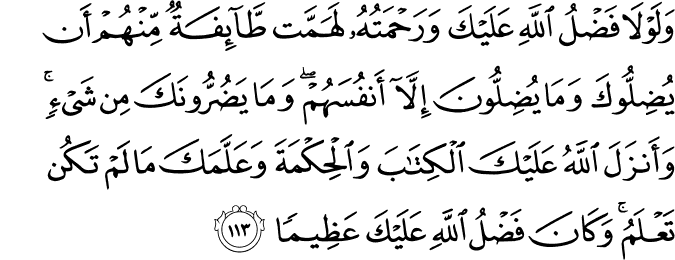
report post quote code quick quote reply
No post ratings
back to top

Jump to page:


Quick Reply

CAPTCHA - As you are a guest, you are required to answer the following:


In the above image: What part of the day is the background image (it's not day)?