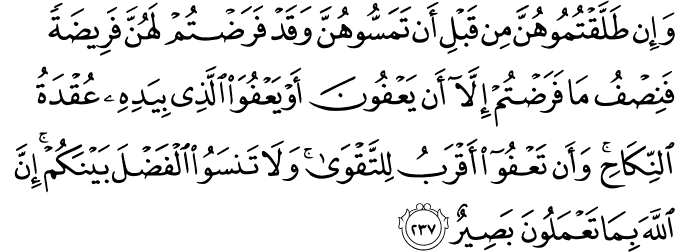
"There is no sin on you if you divorce women when you have not yet touched them nor fixed for them an amount. So, give them benefit, a rich man according to his means and a poor one according to his means - a benefit in the recognized manner, an obligation on the virtuous. And if you divorce them before you have touched them, while you have already fixed for them an amount, then there is one half of what you have fixed, unless they (the women) forgive, or forgives the one in whose hand lies the marriage tie. And it is closer to Taqwa* that you forgive. And do not forget being graceful to one another. Surely, Allah is watchful of what you do." (2:236-237)
* (The sense of being responsible to Allah)
Commentary Keeping dower and consummation in view, divorce can be of four situations. The injunction concerning the first two of these has been stated in these verses. (1) Dower is not fixed and consummation has not taken place. (2) Dower is fixed but consummation has not taken place. (3) Dower is fixed and consummation has taken place. Here the fixed dower will have to be paid in full. This injunction appears elsewhere in the Holy Qur'an. (4) Dower has not been pre-fixed but divorce was given after consummation. Here full mahr al-mithl (a dower as in the divorcees' family) will have to be paid. It means the amount of the dower will be the same as customarily given in the immediate family circle of the woman. This too has been taken up in yet another verse of the Holy Qur'an. The injunction related to the first two situations has been stated in the verses appearing here. Out of the two, the injunction for the first situation is: No dower is due but it is obligatory for the husband to give something on his own to the woman ~ the least being a set of clothes. In fact, the Holy Qur'an has not fixed any amount for this gift. However, it does indicate that the affluent should give in accordance with their capacity, which carries an element of persuasion for the man of means who should not behave tight-fisted in this act of grace. Sayyidna Hasan رضي الله عنه, in a situation like this, gave a gift of twenty thousand dirhams to the divorced woman, and Qadi Shurayh رضي الله عنه, that of five hundred dirhams; and Sayyidna Ibn 'Abbas رضي الله عنه has said that the lowest degree here is to give one set of clothes. (Qurtubi) In the second situation, when the woman's dower has been fixed before marriage and divorce occurs before actual consummation, the injunction says that the man shall be obligated to pay half of the dower already fixed. However, should the woman forgive, or should the man pay the whole, this will be a matter of free choice, as is evident from the verse: "Unless they (the women) forgive, or forgives the one in whose hand lies the marriage tie." (2:237)
The use of the word ya'fu ('forgives') to cover even the payment of full dower, perhaps, reflects the customary Arab practice of the payment of dower amount simultaneously with the marriage. If so, the husband has become, in the event of a pre-consummation divorce, deserving of taking half of the dower back. Now, if he yields voluntarily and does not take his halfback, this too, would virtually be an act of forgiving. And the act of forgiving has been declared more merit-worthy, and closer to Taqwa (the sense of being responsible to Allah, commonly rendered as piety or fear or righteousness in absence of an exact equivalent); because this forgiveness symbolically indicates that the severance of the bond of marriage was also done with magnanimity and good grace, which is the objective of the Shari'ah and certainly, deserving of great merit - the forgiveness could come from the woman, or from the man, it does not matter.
Explaining the words of the verse (in whose hands lies the marriage tie), the Holy Prophet (sallallaahu 'alaihi wa sallam) has himself said: 'the husband is the guardian (wali) of the bond of marriage.' This hadeeth appears in Darqutni as narrated by 'Amr ibn Shu'ayb رضي الله عنه from his father on the authority of his grandfather, and also from Sayyidna 'Ali رضي الله عنه and Sayyidna ibn 'Abbas رضي الله عنه (Qurtubi). This also proves that the authority to continue or terminate the bond of marriage rests with the husband. It is he who can pronounce talaq (divorce). The woman cannot divorce her husband. (Ma'ariful Qur'an)
"Take due care of all the prayers, and the middle prayer, and stand before Allah in total devotion. But if you are in fear, then (pray) on foot or riding. And when you are in peace, recite the name of Allah as He has taught you what you did not know."(2:238-239)
Commentary Based on the authority of some ahadith, a very large number of 'ulama', have said that al-salat al-wusta or the middle salah is the salah of 'Asr because there are before it, two Salahs during the day, that of Fajr and Zuhr; and after these come two evening Salahs, that of Maghrib and 'Isha'. Special emphasis has been placed on it because this is a time in which most of the people are busy in their professional work.
Incidentally, the Qur'anic word, Qanitin meaning obedient or submitting, rendered here as 'stand before Allah in total devotion', has been explained in Hadith as denoting sukut or motion-less silence. It was through this very verse that talking in salah was forbidden. Earlier, talking was permissible. The verse 239 has allowed a special way of offering prayers in the state of 'fear' i.e. the state of war. In such a state, one can offer salah (prayer) while standing, with a condition that he can stand in one place without moving, and can make the gesture of sajdah in a lower position than he makes in ruku'. However, salah cannot be performed while walking. If it is not possible to perform the prayer in the said manner, such as at the time of actualfighting, then, it is permissible to delay the prayer and to offer it later as qada'.
"And those among you who pass away and leave wives behind are to make a will in favour of their wives to benefit them for one year without being expelled. Then, if they move out, there is no sin on you in what they have done for themselves of the recognized practice. And Allah is Mighty, Wise. And the divorced women deserve a benefit as recognized, being an obligation on the God-fearing. This is how Allah makes His verses clear to you, that you may understand."(2:240-242)
The text now returns to the subject of divorce mentioned in verses 234-237. The command to take due care of all prayers (verses 238-239) put in between was to remind that the real thing in life is a constant orientation towards Allah, not only in prayers where it is more pronounced, but also in social relationships such as marriage and divorce, rather, in all areas of one's life. The message is: Follow rules set by Allah in your ultimate interest. Verses 240-242 cited above give guidance on the provision of residence and maintenance for widows which has been explained in the commentary which follows.
1) In the Age of Ignorance, the period of waiting for a widow was one year, and in Islam, it came to be four months and ten days rather than one full year as we already know from: 'They keep themselves waiting for four months and ten days,' in Verse 234, explained earlier. However, women were given a certain advantage in this respect. Those were the days when the injunction of inheritance was not revealed and a wife's share in the inheritance was yet to be determined; in fact, the rights of all others simply revolved around the will of the deceased, as we have already learnt from the explanation of the verse 2:180. Therefore, it was made obligatory that a woman should be allowed to live in the premises of her late husband's house for one full year if she so desires. It was also mandatory under this arrangement that she be given her maintenance during this period out of what has been left behind by her husband.
This rule is mentioned in this verse. Husbands have been instructed to make wills to this effect. Since this was the right of the woman and she had the choice to receive or leave it, therefore, it was not permissible for the inheritors to evict her out of the house, but it was permissible for her not to live in that house at her discretion, and leave her due for the inheritors. The condition, however, was that 'iddah or the waiting period of four months and ten days be completed. After the completion of this period she could leave the house of her husband and could enter into a new marriage with another person. This is what is meant by the Qur'anic expression: "Then, if they move out, there is no sin on you in what they have done for themselves of the recognized practice." However, going out during the period of 'iddah and getting married was all counted as sin -- not only for the woman concerned but also for those who could stop her yet did not do so. When 'the verse of inheritance' was revealed, the woman received her ordained share in the house and in all other items of inheritance on the strength of which she had the choice to live in her section of the house and spend out of her share in the inheritance after the completion of four months and ten days, and this verse was abrogated.
Verse 241: The Divorced Women Deserve A Benefit Providing compensatory benefits (mataa') for divorced women has also been dealt with in verses earlier than this, but that was restricted to two types of divorced women who were divorced before privacy and consummation. The first case of providing compensatory benefits was the giving of a set of clothes. The second case was of providing compensatory benefit in the form of half of the dower. Now remains the case of divorcees who were divorced after privacy arid consummation. Here, providing compensatory benefits to one whose dower has already been fixed lies in giving her the full amount of dower or mahr. For one whose dower has not already been fixed, a postconsummation divorce will make it obligatory to give her mahr almithl or 'equivalent dower' (as customarily given in the immediate family circle of the woman). If the word 'benefit' used in this verse is taken to mean 'dower', its payment is obligatory according to these details. However, if we take mata' to mean a particular benefit, that is, the giving of a gift or set of clothes, then giving this to a particular type of divorced woman is obligatory which has been pointed out earlier. In the rest of the cases, this is mustahabb or desirable. And should matd' be taken to mean maintenance or nafaqah, then it is obligatory until the expiry of 'iddah in the case of a divorce after which 'iddah has to be observed. The divorce may be revocable or irrevocable it does not matter. To sum up, the verse, by using universally applicable words, covers all situations.
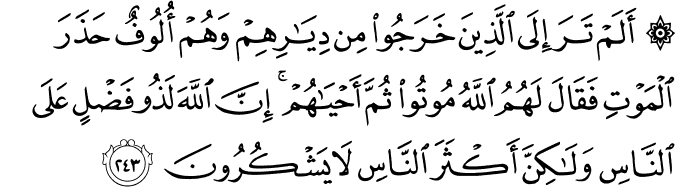
"Have you not seen those who being in thousands, left their homes to escape death? So, to them Allah said, "Be dead." Then He raised them alive. Surely, Allah is all-gracious to people, but most of the people are not grateful. And fight in the way of Allah, and know that Allah is All-Hearing, All-Knowing."(2:243-244)
Commentary In a uniquely eloquent manner, the two verses (243, 244) appearing above and verse 245 which follows, present guidance that prompts the sacrifice of one's life and possessions in the way of Allah Almighty. Consequently, before stating related injunctions, an important event of history has been taken up which makes it clear that death and life are subservient to the destiny determined by Allah. Going into a battle in jihad is not the cause of death, and running away from it, out of cowardice, is not the means to avoid death.
On the authority of revered Companions (Sahaabah) رضي الله عنه and their successors (Tabi'een) رضي الله عنه, Tafsir ibn Kathir explains this event as follows: There was a group of Israelites in a city which was struck by plague or some other epidemic. The whole group, some ten thousand in number, panicked. Leaving the city out of fear of death, all of them went out to camp in an open plain located between two mountains. Allah Almighty, in order to impress upon other peoples of the world that no living being can escape death by running away from it, sent two angels who stood on the two ends of the plain and sent forth some sort of shrill cry which caused all of them to drop dead instantly. Not one of them was left alive. When the people living in the adjoining area heard about this event, they hurried to the site. Making arrangements to shroud and bury ten thousand human beings was no easy task. They, therefore, enclosed the whole area with a fence of boughs making a hovel-like shed for the corpses which, in due course, were decomposed leaving bare bones lying around. After a long time, one of the prophets of Bani Israel, whose name has been identified as Hizqeel or Ezekiel (as), passed through this location. He was amazed to see human bone structures strewn all over inside an enclosed shed. The whole story of these people was related to him through revelation.
Prophet Hizqeel (Ezekiel) (as) prayed Allah to bring these people back to life. Allah Almighty answered his prayer and he was asked to address those crumbled bones in the following manner: 'O bones, old and worn, Allah commands you to gather together (joint by joint, as you were).' These bones received the command of Allah Almighty through the words of the Prophet and obeyed it. Isn't it that these very bones are considered by the whole world, devoid of reason and consciousness but they too, like every single particle of the world, are oriented to Divine commands and, possess senses and perceptive ability in proportion to their state of being, and are obedient to Allah Almighty. This is what the Holy Qur'an points to in the verse (20:50). It means that Allah Almighty created everything and then gave it (built-in) guidance in proportion to its state of being.
The great poet, Maulana Rumi رضي الله عنه has said about such phenomena: Dust, air, water and fire have been bonded together; To me and you they are dead; to God they are alive. So, when every human bone found its proper place at the behest of a single call, the Prophet was commanded to give yet another call to them as follows: bones, Allah Almighty commands you to wear your muscles, flesh, nerves and skin. Immediately following the call, every skeleton of bones turned into a complete corpse under their very eyes. Then came the command that their souls be addressed as follows: O souls, Allah Almighty commands you to return to your respective bodies you once inhabited. As the call was given, all corpses stood up alive before their very eyes and started looking around in wonder. They were saying: 'Sacred are You (O Lord); there is no god but You.'
This formidable event was not only a thought-provoker for the wise of the world, its philosophers and thinkers, and certainly, a decisive argument against the deniers of the Last Day, but was also a guidance for mankind pointing out that running because of the fear of death, be it from jihad or from plague or some other epidemic, is just not possible for one who believes in Allah Almighty and in the fate He has determined -- the one who is certain in his belief (Iman) that there is a time for death; it cannot come a second earlier, and it cannot be postponed to a second later. Therefore, this effort to run from death is not only redundant and wasteful, but also goes on to become the cause of Allah Almighty's displeasure.
Now let us look at this incident through the words of the Holy Qur'an. To relate the event, it says: 'Have you not seen those who left their homes to escape death?' It must be noted here that this incident belongs to a time thousands of years before the Holy Prophet (sallallaahu 'alaihi wa sallam). He just cannot be asked to see it. What then, is the purpose of saying 'Have you not seen?' Commentators have said that, in all situations where the Holy Prophet (sallallaahu 'alaihi wa sallam) has been addressed with the words: '(Have you not seen?) - although the incident belongs to a time earlier than him, and it cannot be 'seen' by any stretch of imagination ~ the act of seeing {ru'yah) stands for seeing through the heart {ru'yah al-qalb), which means seeing through knowledge and insight. In still other words, 'Have you not seen?' appears on such occasions in the sense of 'Did you not know?' But there is wisdom in allowing this situation to be expressed through the Qur'anic form. It points out that this incident is patently known and seen and that this incident is as certain as if it is being seen today, and is worth seeing too. The addition of the word (ila: toward) after 'Have you not seen?' helps pointing out in this direction as based on the nuances of the language.
Immediately following this, they have been identified as being fairly large in numbers -- (being in thousands). As to what the exact number was, there are various reports, but in accordance with the rules of Arabic language, this word ulufun is jam al-kathrah (plural of multitude), which is not used for something less than ten. This tells us that their number was not less than ten thousand. After that, it is said: (Allah Almighty said to them: 'Be dead'. This command of Allah Almighty could both be direct, or indirect - through an angel, as it is in another verse (36:82): 'When He wishes to do something, He bids it to be, so it comes to be.'
After that, it is said: surely Allah Almighty is immensely graceful to human beings. This includes the grace He showed to that particular group of people from the Bani Israel by bringing them back to life, as well as the grace He has shown to the community of Muhammad jgj, by telling them about this incident and by making it a model lesson for them. In the end, to awaken the negligence-prone man, it was said: 'But most of the people are ungrateful.' It means that human beings do behold thousands of demonstrations of Divine grace and mercy, yet most of them show no gratitude.
Related Injunctions And Rulings This verse helps us identify some facts and injunctions. These are as follows:
Divine decree overcomes human planning No effort can be effective against that which has been determined by Allah (Taqdeer) and running away from jihad or plague or its likes cannot help one save his life (Tadbeer), nor being in it can become a cause of death. The fact is that death comes at an appointed time; it can neither be earlier nor later.
Rules pertaining to the place of epidemic: It is not permissible to escape out from an area affected by plague and its likes for safety elsewhere. In addition to this, as said by the noble Prophet (sallallaahu 'alaihi wa sallam), it is not correct for other people to go there. It appears in Hadeeth: 'Allah Almighty has, through this disease (plague), punished peoples who were before you. So, when you hear about its spreading in a certain area, do not go there; and if it spreads in an area where you already are, do not go out escaping from it.' (Bukhari, Muslim, and Ibn Kathir)
It appears in Tafsir al-Qurtubi that Sayyidna 'Umar رضي الله عنه once embarked on a journey heading for Syria. When he reached Saragh, a place near Tabook bordering Syria, he came to know that the whole of Syria was affected by a severe plague. This was regarded as a great calamity in the history of Syria. This plague is known as 'Amawds', because it started from a town called 'Amawaas' (located near Baytul-Maqdis) and spread throughout the country. Thousands died and became shaheed (martyr) in this plague including many Sahaabah and Tabi'een (Companions and their Successors) (radiallaahu 'anhum).
When Sayyidna 'Umar رضي الله عنه heard about the severity of the plague, he decided to stay where he was and sought the advice of the noble Companions رضي الله عنه, whether they should go into Syria at such a time, or they should return back. There was not one blessed person present during the consultations who was aware of any guidance from the Holy Prophet (sallallaahu 'alaihi wa sallam) about this matter. Later, Sayyidna 'Abd al-Rahman ibn 'Awf رضي الله عنه narrated the following hadeeth: The Holy Prophet (sallallaahu 'alaihi wa sallam) referring to the disease (plague) said: 'This is a punishment that was inflicted on some peoples; later on some of it remained. This remainder goes away for sometime, then returns. So, one who hears that a certain area is affected by it, he should not go there; and one who is already there, he should not go out running from it (the plague).' (al- Bukhari and others)
When Sayyidna 'Umar رضي الله عنه heard this hadeeth, he ordered his men to return. Sayyidna Abu 'Ubaydah رضي الله عنه, the governor of Syria was present on the occasion. Taking notice of the orders given by Sayyidna 'Umar رضي الله عنه he commented: (Do you want to run from Divine destiny?) In reply, Sayyidna 'Umar رضي الله عنه said: 'O Abu 'Ubaydah, I wish this was said by someone else' meaning thereby 'a comment like this, and that too from you, is certainly surprising.' Then he said: 'Yes, we do run from Divine decree to (nothing but) Divine decree' meaning thereby - 'whatever we are doing we are doing in obedience to none else but Allah and His command which the Messenger of Allah (sallallaahu 'alaihi wa sallam) has explained to us.'
There is great wisdom in the prophetic sayings about plague: In accordance with the hadith stated above, we have been told that it is prohibited for outsiders to enter an area affected by plague or its likes; while it is equally prohibited for those who live there to run for their lives from that area. In addition to this, the basic Islamic belief is that neither going anywhere is the cause of death, nor running from anywhere is the source of deliverance from it. Keeping this cardinal belief of Islam in view, the given instruction is based on very far-sighted stances of wisdom.
(1) Let's look at the first element of wisdom in stopping outsiders from going into a plague-affected area. Isn't it quite possible that someone may be at the fag end of his years and should he die because of this disease, it might have occurred to the deceased at some stage before his death that he might have lived had he not come into that area. Not only him, others might also think that his death occurred because he came there; although, whatever happened was pre-ordained. His age was no more than that. No matter where he lived, his death had to come at that particular time. It may be noted that the belief of Muslims has been saved from indecision through this instruction lest they should fall a victim to misunderstanding.
(2) The second aspect of wisdom here relates to the guidance Allah Almighty has given to man that he should not go where there is a danger of being harmed, or an apprehension of being killed; in fact, he should do his best to keep away from everything that could cause harm or death. Not only that, it has been made binding on every man to save his life. This rule demands that one should, keeping his total trust and belief in Divine decree, take all necessary precautionary measures without any negligence. One of these measures is that he should not go to a place where his life may be in danger.
Similarly, the instruction, that residents of an area infected with plague should not escape out of their fearing death, has its own merits:
a) The first wise counsel has a social and collective nature. For instance, should this escaping in panic become contagious, the rich and the powerful in the area would certainly run away. But, what would happen to those who are incapable of going anywhere. To begin with, left all alone, they will be terrified to their death. Then there will be sick among them - who will take care of them? Should they die, who will manage their burial?
b) The second point of wisdom here tells that there will be some among the people present in that area who would be carrying germs of this disease. If they travel in that condition, they are likely to suffer more from all sorts of hardships. If they get sick while travelling, who knows what would come upon them. Ibn al-Madini رضي الله عنه has quoted the saying of scholars: 'One who runs from an epidemic never stays safe.' (Qurtubi)
c) There is still a third element of wisdom here. Isn't it that people infected by germs of the disease would be potential carriers of the epidemic wherever they go? If they elected to stay where they are, with patience and in trust, they might possibly get rid of the disease. And if, death was pre-ordained in this very disease, they will have the proud rank of shahaadah (martyrdom) because of their patience and perseverance, as has been pointed out in Hadith. Imam al-Bukhari رضي الله عنه has reported from Yahya ibn Ya'mur رضي الله عنه that Sayyidah 'A'ishah al-Siddiqah رضي الله عنه told him that she had asked the Holy Prophet (sallallaahu 'alaihi wa sallam) about plague when he informed her that this disease was a punishment sent to a people who were to be punished by Allah's will. Then, Allah made it mercy for true believers. So, a slave of Allah who stays on with patience and peace in his locality believing that no harm can touch him except that which Allah has decreed for him - for such a person the merit in return shall be equal to that of a shahid. And this also explains the hadith in which it is said: 'The plague is shahaadah (martyrdom) and one who dies in the plague is a shaheed (martyr).' (Qurtubi, vol.3, p. 235).
Some Exceptions The words used in the hadith are: (You should not go out running from it) which tell us that a person who goes somewhere else, not because of the fear of death, but because of some other pressing need, will not be affected by this prohibition. Similarly, if someone has a firm belief that he cannot escape his destiny wherever he goes, but he wants to go simply for change of climate, he is also exempted from this prohibition. Similarly, if a person enters an area affected by plague because of some pressing need while he firmly believes that death will not come to him just because he is coming here - since death is subservient to the will of Allah, it will be permissible for him to go there.
(3) The third principle inferred from this verse is: that it is also not permissible to desert Jihad from fear of death. This question has been taken up elsewhere in the noble Qur'an in greater details, where some special situations have been exempted. The subject dealt with in this verse reappears in yet another verse which deals with those who run away from Jihaad or do not take part in it. It is said: Some people (who did not themselves take part in jihad) say (about those who do take part in jihad, and die as shahids) 'These people did not listen to us, therefore, they were killed. If they had listened to us, they would have not been killed.'
(The blessed Prophet (sallallaahu 'alaihi wa sallam) was commanded to) tell them: If you have the power to escape death, why worry about others, worry about your own selves and rescue yourselves from death (that is, whether or not you go in jihad does not matter; death will come to you even when sitting home). It is a marvel of nature that the greatest commander of the Muslim army in the early days of Islam, Sayyidna Khalid ibn Waleed رضي الله عنه, who was known as the 'sword of Allah' and who spent his entire Islamic life in jihad, did not meet his death as a shahid on the battlefield! He died on his sick-bed, at his home. Close to his hour of death, lamenting over his dying on bed, he said to his family: 'I participated in so many great battles in jihad. I do not have a single part on my body, which has no wound-mark inflicted by swords and spears; but here I am, dying like a donkey on my bed. May Allah Almighty give no rest to cowards. Let them hear my advice.'
The incident relating to the Bani Israel was brought in this verse as an introduction. In the next verse appears the injunction relating to jihad and qital (fighting in the way of Allah) which was the real purpose in introducing this story, that is: Do not take going on jihad as going into the jaws of death and do not assume that running away from jihad will deliver you from your appointed time of death. Better still, obey the injunctions of Allah Almighty and achieve the best of both the worlds. Allah Almighty is the Hearer and Knower of all you say and do.
The third verse (245), which follows, deals with the merits of spending in the way of Allah.
"Who is the one who would give Allah a good loan so that Allah multiplies it for him many times? And Allah withholds and extends, and to Him you are to be returned."(2:245)
Commentary 1)(who would give Allah a good loan?) the word 'loan' refers to good deeds and to the act of spending in the way of Allah. This was expressed figuratively as qard (literally, 'loan'), otherwise everything belongs to Allah. It simply means that whatever you spend will surely be returned to you (in the form of a reward in the Hereafter) just as a loan is surely returned. The promise of increased or multiplied return appears in a hadith which declares that a date spent in the way of Allah is so increased by Allah Almighty that it outgrows the mountain of Uhud. Giving 'loan' to Allah Almighty has also been explained as the giving of actual loan to His slaves i.e. the human beings and thereby helping them in their hour of need. So, the act of giving loan has been credited with great merit in Hadith. The noble Prophet (sallallaahu 'alaihi wa sallam) said: 'For every Muslim, who gives loan to another Muslim, it will be equal to having given sadaqah (charity) twice.' (Mazhari with reference to Ibn Majah)
2) Hearing this verse, says Ibn al-'Arabi رضي الله عنه, people split in three groups. The first group is that of those unfortunate people who, after hearing this verse, said: 'Muhammad's Lord is poor, and we are rich.' The reply to this comment was given by another verse: 'Allah has surely heard the saying of those who said, "Allah is poor and we are rich".' (3:181)
The second group is that of those who, hearing this verse, elected to act against it and adopted miserliness as their way of life. The love and greed of material possessions so tied them down that they remained deprived of the very ability to spend in the way of Allah.
The third group is that of sincere Muslims who lost no time and acted as directed by the verse giving the best of their possessions in the way of Allah, such as is the case of Companion Abu al-Dahdah رضي الله عنه and others. When this verse was revealed, Sayyidna Abu al-Dahdah رضي الله عنه presented himself before the Holy Prophet (sallallaahu 'alaihi wa sallam) and asked him: 'O Messenger of Allah, may my father and mother be sacrificed to you, does Allah Almighty need loan from us, although He is Ghani, the one who needs no loan?' The Holy Prophet (sallallaahu 'alaihi wa sallam) said: 'Yes, Allah Almighty does wish to grant you entry in Paradise through it.' Hearing this, Sayyidna Abu al-Dahdah رضي الله عنه said 'Let the Messenger of Allah (sallallaahu 'alaihi wa sallam) stretch his hand forward.' He stretched his band forward. Now Abu al-Dahdah رضي الله عنه started saying: 'I own two date farms. I own nothing except these. I give the loan of these two farms of mine to Allah Almighty.' The Holy Prophet (sallallaahu 'alaihi wa sallam) said to him: 'Dedicate one of these as waqf (endowment) in the way of Allaah and keep the other to take care of your family needs.' Abu al-Dahdah رضي الله عنه said: "You be my witness that I spend the better of the two farms which has six hundred date trees in the way of Allah." He said: 'Allah will bless you with Paradise in return.'
Abu al-Dahdah رضي الله عنه came to his house and told his wife about it. She too was very pleased with this wonderful deal. The noble Prophet (sallallaahu 'alaihi wa sallam) said: 'Countless trees laden with dates and spacious palaces are eagerly waiting for Abu al-Dahdah (in Paradise).' (Qurtubi)
3) While returning qard (loan), paying a little more than taken is a favourable practice only if any increase on the amount of loan has not been made a pre-condition. The Holy Prophet (sallallaahu 'alaihi wa sallam) said: 'The best person among you is the one who fulfils his obligation (loan) in a good manner.'
If increase or premium has been made a condition, then, that is
haraam (unlawful), and it is riba (interest) as well.
"Did you not see a group from the children of Isra'il, after (the time of) Musa when they said to a prophet of theirs: "Send us a King so that we may fight in the way of Allah." He said: "Is it (not) likely, if fighting is enjoined upon you, that you would not fight." They said: "What is wrong with us that we would not fight while we have been driven away from our homes and our sons?" But, when fighting was enjoined upon them, they turned away, except a few of them. And Allah is All-Aware of the unjust. And their prophet said to them: "Allah has sent you 'Taloot' * as king. They said: "How could he have kingship over us when we are more entitled to the kingship than he? And he has not been given a wide measure of wealth." He said: "Allah has chosen him over you and has increased his size in knowledge and physique. And Allah gives His kingship to whom He wills. And Allah is Ail-Embracing, All-Knowing." And their prophet said to them: "The sign of his kingship is that the Ark shall come to you having therein tranquility from your Lord, and the remains of what the House of Musa and the House of Haroon had left, carried by the angels. Surely, in it there i.-; a sign for you, if you are believers." So, when 'Talut' set out along with the troops, he said: "Allah is going to test you by a river, so, whoever drinks from it is not my man, and whoever does not taste it is surely a man of mine, except the one who scoops a little with his hand." Then, they drank from it, except a few of them. So, when he crossed it and (crossed) those who believed with him, they said: "There is no strength with us today against 'Jaloot' ** and his troops." Said those who believed that they were to meet Allah: "How many small groups have overcome the large groups by the will of Allah. And Allah is with the patient." And when they faced 'Jalut' and his troops they said: "Our Lord, pour out patience on us, make firm our feet and help us against the disbelieving people." So, they defeated them by the will of Allah, and Dawood killed 'Jaloot', and Allaah gave him the kingdom and the wisdom and taught him what He willed. Had Allaah not been pushing back some people by means of some others, the earth would have been spoiled. But Allaah is all-gracious to all the worlds." (2:246-251)
* (Known in the Bible as Saul)
** (Known in the Bible as Goliath)
Commentary 1) Verse 246: "(When they said to a prophet of theirs: "Send us a king so that we may fight in the way of Allah")." These people from the Bani Isra'il had abandoned the injunctions given by Allah Almighty. When the infidel Amalekites were made to rule over them, they began thinking about correcting the situation. The name of the prophet mentioned here is Samu'eel (Samuel) (as).
Verse 248: The story of Taloot and Jaloot The Bani Isra'eel used to have the legacy of a wooden chest (also identified as the Ark of the Covenant). Moosa (Moses) (as) and other prophets of Bani Isra'il would keep this chest in the frontline of the battlefield. Its barakah (blessing, benediction) used to give them victory. When Jaloot (Goliath) overcame Bani Isra'il, he took this chest away with him. When Allah Almighty willed the return of the chest, it so happened that the infidels were struck by some epidemic or calamity at places where they carried this chest. Five cities were turned desolate. Nonplussed, they loaded it on two bullocks and drove them off. Then, the angels took control of the bullocks and made it reach Taoout's doorsteps. (Taloot is the Qur'anic name of the king known in the Bible as Saul) When the Bani Isra'il saw this sign, they believed in the kingdom of Taloot, who then mounted an attack on Jaloot while the weather was very hot.
Verse 249: (He said: Allah is going to test you by a river). The wisdom behind this test, as perceived by this humble commentator, appears to be as follows. Not difficult to imagine is the excitement created on such occasions but there are not many who would stay firm in their hour of trial. And should such a time come, the weakness shown by such people becomes contagious making others panic as well. Allah Almighty willed that such people be pruned out. This purpose was accomplished by this test, which is very appropriate, because steadfastness is necessary in fighting. So, being patient, when water is made available without asking in a state of intense thirst, is a proof of steadfastness, and dashing for water is a proof of its absence. Later on comes the unusual: Those who drank too much water became mysteriously more incapacitated. This has appeared in Ruh al-Ma'ani on the authority of Ibn Abi Hatim رضي الله عنه from Ibn 'Abbas رضي الله عنه. Now the events and sayings mentioned in this story tell us that there were three kinds of people among them:
(1) The weak in faith who failed to make the grade in their hour of
trial.
(2) The perfect who fully succeeded in their trial but did feel
concerned about how low they were in numbers.
(3) The most perfect who did not bother even about that.
"These are the verses of Allah that We recite to you with all veracity, and certainly you are among the Messengers." (2:252)
Since the affirmation of the prophethood of the noble Messenger of Allah (sallallaahu 'alaihi wa sallam) is also a major objective of the Holy Qur'aan, it has been so asserted as and when the occasion warrants. That he is correctly reporting the event (in verses 246-251), while he neither learnt it from someone nor heard it anywhere nor saw it, is a miracle which is a sound proof of his prophethood. Verse 252 here (and verse 253 which follows) demonstrate this proof. It is being said here that these verses in which this event has been mentioned 'are the verses of Allah that We recite to you with all veracity' and this proves that 'you are certainly among the Messengers.' (Ma'ariful Qur'an)
"Those are the messengers some of whom We have given excellence over some others. Among them there is he whom Allah spoke to, and some of them He raised steps higher. And We gave clear signs to 'Isa, the son of Maryam (Jesus, the son of Mary) and supported him with the Holy Spirit. And if Allah so willed, those succeeding him would have not fought against each other after clear signs had come to them. But they disagreed among themselves. So, there were some who believed and there were some who disbelieved and if Allah so willed, they would have not fought against each other. But Allah does what He intends."(2:253)
Commentary 1) In Verse 253, beginning with ('those are the Messengers'), the purpose is to give solace and comfort to the noble Prophet (sallallaahu 'alaihi wa sallam) since the deniers refused to recognize his prophethood, inspite of the fact that it was conclusively proved, as has been stated in the verse 252: (And certainly you are among the Messengers.) as well. This situation caused him pain. Therefore, Allah Almighty made him aware of the coming of other prophets too, in varying degrees of station, but universal belief was not witnessed in any of their communities - some supported while some others opposed. However, this too has its wise considerations which may not necessarily be visible to everyone, but this much is important that one should generally believe that there is definitely a certain wisdom behind this.
2) Since the words (Those are the Messengers some of whom We have given excellence over others) in this verse clearly indicate that some prophets are given higher status than others, we have a difficulty on our hands when we compare this with a hadeeth, where the Holy Prophet (sallallaahu 'alaihi wa sallam) has said: 'Do not seek preference among prophets. Do not give me precedence over Musa. I cannot say if anyone is better than Yunus ibn Matta.'
These ahaadeeth so obviously forbid the giving of preference to some prophets over some other prophets. The reply is: These ahadith mean to tell us not to give preference to some prophets over some others, without any proof, out of our own opinion. This is because a prophet's having higher status means that he has a high station in the sight of Allah. Obviously, this knowledge cannot be acquired through conjectures and surmises but should such a proof come from the Qur'an and Sunnah, establishing the precedence of some prophets over some others, then it will be necessary to believe in it.
Now, as to his saying: (I cannot say if anyone is better than Yunus ibn Matta) and (Do not give me precedence over Musa), this is related to the time when he was not given the knowledge that he has precedence over all other prophets. This was disclosed to him later on through revelation and he did tell the noble Companions رضي الله عنه about it. (Mazhari)
3) As regards the statement (Among them there is he whom Allah spoke to), it may be noted that the conversation with Musa عليه السلام may be without an angel as intermediary, but it certainly was not without hijab (obstruction of view). So, there remains no conflict of meaning with what has been stated in the verse: '(It belongs not to any mortal that God should speak to him) (42:51), in which conversation without hijab has been negated. However, post-death conversation without hijab is possible, so this verse from Surah al-Shura relates to the life in this world. (Ma'ariful Qur'an)
"O those who believe spend from what We have given to you before conies a day when there is no trading, no friendship, no intercession. And the disbelievers are the unjust."(2:254)
Commentary Many injunctions relating to acts of worship and dealings with human beings have been taken up in this Surah, specially all those a person dislikes to obey finding them burdensome. Then, the most difficult act is to 'spend' one's life and possessions; and when you look at Divine injunctions relating to most situations they either relate to a man's life or his possessions. And when a man falls into the trap of sin, it is either caused by his love of life or expediency of possessions in most cases. As such, the love for these two is the root of sins, and the defence against and the deliverance from it is the object of all acts of obedience. It is for this reason that, following the injunctions relating to worship and social transactions, the subject of 'fighting' and 'spending' in the way of Allah were taken up. The first appeared in (And fight in the way of Allah) (244) and the second in (Who is the one who would give Allah a good loan?) (245) After that, the former was emphasized by the story of Talut, and now, emphasis is being laid on the later by (Spend from what We have given to you) (254). Since a large number of affairs relating to the worship of Allah and dealings with human beings depend on spending out of what Allah has given, this subject has been dealt with in a greater detail. Therefore, the sections that follow have, in most of them, a discussion of the second aspect, which is, the 'spending' out of one's possessions. To sum up, it means: The time to act is still there. In the Hereafter, deeds are not on sale. They cannot be borrowed from a friend either. Once caught by the punishment, one cannot be released on someone's intercession, unless Allah Himself forgives. (Ma'ariful Qur'an, Mufti Muhammad Shafi rahmatullaahi alaih)
Tafseer Of Surah al-Baqarah (2), Verse 255 (Ayatul Kursi)
"Allah: There is no god but He, the Alive, the All-Sustaining. Neither doze overtakes Him nor sleep. To Him belongs what is in the heavens and what is on the earth. Who can intercede with Him without His permission? He knows what is before them and what is behind them. And they encompass nothing of His knowledge except what He wills. His Kursi (chair) extends to the Heavens and to the Earth, and it does not weary Him to look after them. And he is the High, the Supreme." (2:255)
The Merits Of Ayat-al Kursi This is the greatest verse of the noble Qur'aan. Ahaadeeth carry statements featuring its wonderful merits and blessings. It appears in the Musnad of Imaam Ahmad رضي الله عنه that the Holy Prophet (sallallaahu 'alaihi wa sallam) has said that this verse is the most meritorious of all. According to another hadeeth, the Holy Prophet (sallallaahu 'alaihi wa sallam) asked Sayyidna 'Ubayy ibn Ka'b رضي الله عنه 'Which is the greatest ayah (verse) of the Qur'an?' Sayyidna 'Ubayy ibn Ka'b رضي الله عنه said: 'Ayah al-Kursi '. Approvingly, the Holy Prophet (sallallaahu 'alaihi wa sallam) said: 'O Abu al-Mundhir, may Allah bless you in your knowledge.' Sayyidna Abu Dharr رضي الله عنه asked the Holy Prophet (sallallaahu 'alaihi wa sallam): 'O Messenger of Allah, which is the greatest ayah (verse) of the Qur'an?' He said : 'Ayah al-Kursi.' (Ibn Kathir from Ahmad in Al-Musnad). Sayyidna Abu Hurayrah رضي الله عنه has reported the Holy Prophet (sallallaahu 'alaihi wa sallam) saying: 'There is a verse in Surah Al-Baqarah which is the Sayyidah (the Chief) of the verses of the Qur'an. The Shaytaan leaves the house where it is recited.' According to a hadeeth in al-Nasaa'ee, the Holy Prophet (sallallaahu 'alaihi wa sallam) said: 'If someone recites Ayah al-Kursi after every fard salah, nothing stops him from entering Paradise except death.' It means that, immediately after death, this person will start witnessing the traces of Paradise and its comfort and tranquillity.
This verse describes the Oneness of Allah's being and attributes in a unique manner - He is living, He hears and sees, He speaks, He is self-existent, He is eternal and everlasting, He is the innovator and creator of the entire universe, He is above changes and effects, He is the master of the whole universe, He is so exalted in His majesty that no one can speak before Him without His permission; He is the wielder of such absolute power that the tremendous function of creating the universe, sustaining it and making it work steadily, does not cause him to tire or relax. So all-encompassing is His knowledge that not the minutest possible atom or drop, open or hidden, could stay out of it. This is, in brief, the core sense of the verse. Now let us take up the meanings of its words in some details.
This verse has ten sentences. The first sentence is:'Allah: There is no god but He.' The word (Allah) is like a proper noun for Allah's being. It means: 'the Being who combines all perfections and is free of all shortcomings.''There is no god but He' explains this Being. It says that there is absolutely nothing worth worshipping except this Being.
The second sentence is:'The Alive, the All-Sustaining.' The word 'Hayy' means 'the living' in Arabic. Out of the Divine names, the introduction of this word is to emphasize that He is Ever-living and Ever-lasting. He is above and beyond death. The word 'Qayyoom' is derived from Qiyaam which means 'to stand' and qa'im refers to 'one who stands.' The words, Qayyoom and Qayyam are forms of exaggeration. They mean: 'one who himself stands firmly and keeps others sustained and supported, all simultaneously.' Qayyoom is an attribute of Allah Almighty with which no created being can be associated, for what depends on others for its own existence and survival can hardly be expected to support something else. Therefore, a human being should not be called, 'Qayyoom . It is not permissible. People who corrupt the name, 'Abdul-Qayyoom (the slave of the Qayyum) by casually using just the second part - Qayyoom, commit a grave error resulting in their sinfulness.
The combination of Hayy and Qayyoom from among the attributive names of Allah Almighty (al-ism al-a'zam: the Great Name) according to several revered elders. Sayyidna 'Ali رضي الله عنه says: 'There was a time during the Battle of Badr when I wished I could see what the Holy Prophet (sallallaahu 'alaihi wa sallam) was doing. On arrival, I saw him in the state of sajdah, (the prescribed prostration) constantly saying, 'Yaa Hayyu Yaa Qayyoom'.'
The third sentence is:'Neither doze overtakes Him nor sleep.' The word (sinatun) denotes drowsiness which is the preliminary effect of coming sleep, while the word (nawm) refers to full sleep. The sense of the sentence; is that Allah Almighty is above and beyond states of drowsiness or sleep. When the word, Qayyum, appearing in the previous sentence; told man that Allah is holding in perfect working unison the whole universe, which includes in itself, all skies and earths and all there is in them - one could stray on to the idea, naturally so, in view of man's instinctive inquisitiveness, that the sacred 'Being' doing such a stupendous task must, at some time, feel tired, and need due moments of rest and sleep. In this second sentence of the text, man, who has limited knowledge and insight, and limited power, was warned that he should not measure Allah on his analogy or that of other created beings, never taking Him as similar to one's own self. He is above and beyond similarities and analogies. His power is absolutely perfect before which these doings are neither difficult nor tiresome and that His sacred being is above and beyond all sense-effects, weariness, exhaustion, drowsiness and sleep.
The fourth sentence is:'To Him belongs what is in the havens and what is in the earth.' The letter (lam) appearing in the very beginning, has been used to denote ownership. Thus it means that everything on the earth or in the heavens is all owned by Allah Almighty. He is the authority, and may do whatever He deems fit with them.
The fifth sentence is:'Who can intercede with Him without His permission?'Here are some points implied in this sentence: To begin with, when Allah Almighty is the master-owner of the entire universe and there is no one above Him, certainly then, no one is entitled to question Him about anything He does. In the wake of a command that flows from Him, the option of saying why and wherefore does not exist for anyone. However, someone interceding on someone's behalf was possible. This too has now been made clear that no mortal could even dare breath in the most exalted Presence of Allah Almighty; but there are servants of Allah Almightytwho have received the favour of His approval and acceptance and who would be specially allowed to speak and intercede. In short, recommendation or intercession, from anyone for anyone, will not be possible without Divine permission. It appears in Hadeeth that the Holy Prophet (sallallaahu 'alaihi wa sallam) said: 'On the day of resurrection, I shall be the first to intercede on behalf of all human communities'. This is called al-Maqam al-Mahmood, the praised station, which is one of the distinctions of our noble Prophet (sallallaahu 'alaihi wa sallam).
The sixth sentence is:'He knows what is before them and what is behind them.' It means that Allah Almighty is aware of all the states and events surrounding them. 'Before' and 'after' may also mean that Allah Almighty is aware of all states and events before their birth and after their birth. It is also possible that 'before' refers to states and events that are open to men, and 'after' denotes states and events that are hidden. If so, it would mean that the human knowledge covers certain things and does not cover certain others. Some things are open before a human being and some are hidden. But, before Allah Almighty all these are equal. His knowledge encompasses all these things equally. Incidentally, there is no contradiction in these two senses, which are both included in the scope of the verse.
The seventh sentence is:'And theyencompass nothing of His knowledge except what He wills.' It means that man and the rest of the created beings cannot cover even a part of Allah's infinite knowledge except a certain part which Allah Almighty Himself allows to be given out of His knowledge. This is all one can know. Here it has been made clear that the all-encompassing knowledge of every particle in the universe is a particular attribute of none but Allah Almighty. No man, no created being can claim to have a share in it.
The eighth sentence is: 'His Kursi extends to the Heavens and to the Earth.' It means that His Kursi (translated as chair or base of power) is so magnified that its spatial infinity houses, within itself, the seven heavens and the earth. Allah Almighty is above and beyond sitting and standing and all spatial location and placement. Such verses should not be taken up on the analogy of our own states and affairs. The comprehension of the state of being, and the reality of His attributes, is above and beyond human reason. However, there are authentic narrations in ahadith which simply tell us that 'Arsh (translated as 'throne', being a seat of authority) and Kursi (chair) are heavenly bodies many times larger than the heavens and the earth. Ibn Kathir has reported from Sayyidna Abu Dharr al-Ghifari رضي الله عنه that he asked the Holy Prophet (sallallaahu 'alaihi wa sallam) as to what the Kursi was and what did it look like. He said: 'By Allah, who is the master of my life, the seven heavens and the earth as compared with Kursi are like the small circle of a finger-ring lying on a huge plain.' In some other narrations it has been stated that Kursi as compared to 'Arsh (Throne) is also like the circle of a finger-ring on a huge plain.
The ninth sentence is:'And it does not weary Him to look after them.' It means that supporting the two magnificent creations of the heavens and the earth is not the least burdensome for Allah Almighty since doing so, with the perfect power of the Absolute Master, is easy.
The tenth and the last sentence is:'And He is the High, the Supreme.' It means that He is most exalted and great in majesty. In the previous nine sentences, the perfections of Allah's being and His attributes were stated. After having seen and understood these, every rational human being is bound to acknowledge that all honour, power and superiority belongs to none but the same Allah Almighty. To sum up, these ten sentences epitomize a description of Allah's Oneness and His perfections with clarity, and in detail. (Ma'ariful Qur'an)
"There is no compulsion in Faith. The correct way has become distinct from the erroneous. Now, whoever rejects the Rebel and believes in Allah has grasped the strongest ring that never breaks. And Allah is All-Hearing, All-Knowing."(2:256)
Commentary One who holds on to Islam firmly stays protected against destruction and deprivation. It was for this reason that such a person was likened to one who holds on firmly to the 'ring', the looped support of a strong rope, and thus manages to avoid falling down. As there is no danger of such a rope breaking apart and causing a fall, so there is no danger of destruction or loss in Islam - should somebody just abandon the rope, that would be an entirely different matter. And should somebody abandon Islam itself, that would be an entirely different matter too. (Maulana Thanavi: Bayan al-Qur'an). Keeping this verse in view, some people raise objections. They say this verse tells us that there is no compulsion in faith, although the teaching ofjihad and qitaal (fighting) in Islaam appears contrary to this principle.
Looking at this a little carefully, we can find out that the objection is not valid, since the teaching of jihad and qital in Islam is not to coerce people into accepting Faith. Had it been so, why would there be Islamic injunctions of jizyah to provide an umbrella of security for kuffaar (disbelievers) which protects their life, property and honour? In fact, this is to remove disorder, strife or fasad, for Allah Almighty dislikes fasaad, which is what the kuffdr are after. Therefore, Allah Almighty says: 'And they go about the earth spreading disorder and Allah does not like those who spread disorder.' (5:64) It is for this reason that Allah Almighty has ordained that the fasad created by these people should be removed byjihad and qital. So, killing such people is like the killing of serpents, scorpions and their harmful likes. Islam has firmly banned the killing of women, children, the aged and the crippled etc., even in the heat of jihaad on the battlefield, since they are incapable of creating disorder. Similarly, it has stopped the killing of those who become law-abiding citizens by promising to pay jizyah (compensatory dues paid by free non-Muslims under Muslim rule against guarantee of the security of their life, property and honour).
This approach of Islam makes it clear that it does not force people to accept and enter Faith, rather far from it, by using it as a method of stopping oppression in the world, it hopes to establish justice and equity and peace and security. When Sayyidna 'Umar رضي الله عنه invited an old Christian woman to accept Islam, she said in reply: 'I am an old woman nearing death.' Hearing this, Sayyidna 'Umar رضي الله عنه did not force her to come into the fold of Islam. In fact, he recited this very verse: 'there is no compulsion in Faith.'
Really and truly, coercion and compulsion to make one accept a faith are not possible at all because faith is not related to outward physical response; it relates to the heart. Coercion and compulsion affect nothing but the outsides of physique and this is all that is affected by jihad and qital (fighting in the way of Allah). Consequently, it is just not possible that people can be forced to accept faith through these measures. This proves that the verses ofjihad and qital are not contradictory to the verse: (There is no compulsion in Faith). (Mazhari, Qurtubi, Ma'ariful Qur'an)
"Allah is the Protector of those who believe. He brings them out of the depths of darkness into the light. As for those who disbelieve, their friends are the Rebels. They bring them out from the light into the depths of darkness. Those are people of Fire. There they remain for ever."(2:257)
Commentary This verse also tells us that faith ('Iman) is the greatest blessing and disbelief (kufr) is the greatest misfortune, and that there is darkness in friendship with those who disbelieve (kuffaar). (Ma'ariful Qur'an)
"Did you not see the one who argued with Ibraheem about his Lord, because Allah had given him kingship. When Ibraheem said: "My Lord is the One Who gives life and brings death," he said: "I give life and I bring death." Said Ibraheem: "Allah brings the sun out from the East, now, you bring it out from the West." Here, baffled was the one who disbelieved. And Allah does not put the unjust people on the right path."(2:258)
The verse refers to Namrood, the emperor of Babylon, who denied the very existence of God and had a debate with Sayyidna Ibraheem عليه السلام on this issue. Allah has given him political power over a large territory. He should have been grateful to his Lord. But, on the contrary, his political power inflated him with pride and arrogance; he started denying the very existence of Him. It is in this context that the Holy Qur'an says: 'the one who argued with Ibraheem about his Lord, because Allah had given him kingship.' In the course of argument, he asked Ibraheem عليه السلام about the basic attributes of God. He replied, "My Lord is the One who gives life and brings death." The foolish king did not understand the real nature of 'giving life' and 'bringing death.' Therefore, he argued that he, too, can kill anyone through his order and bring thereby death to him and can also let off a person sentenced to death and give thereby life to him. Obviously, his argument was totally absurd, because 'giving life' means to give life to something lifeless*.
* (And 'bringing death' means power which may remove the life from every living creature without a necessary intervention of an apparent cause.)
When Sayyidna Ibraheem عليه السلام felt that his addressee is unable to understand the real nature of 'giving life' and 'bringing death,' he switched over to another argument and said, "Allah brings the sun out from the East, now, you bring it out from the West." Here the king was baffled and could not answer the Abrahimic argument. But even after the truth became clear to him, he did not accept the guidance. Hence the Qur'anic statement: "And Allah does not put the unjust people on the right path."
Injunctions And Related Considerations 1) It is evident from the words used in the verse that if an infidel is given political power or a high worldly status, there is no harm (for a Muslim) in referring to him as a holder of that position (Qurtubi).
2) The verse also affirms the permissibility of having debate with such an infidel in order to manifest the difference between right and wrong.
3) Some people doubt the validity of the last argument of Sayyidna Ibraheem عليه السلام, because Namrood could have refuted it by a counter demand from Ibraheem عليه السلام and could have said, "If there is a God, let Him bring the sun out from the West." But it is obvious that he could not come out with this counterdemand. The reason is that as soon as he heard the argument, he came to the conclusion that (he himself or anybody else cannot bring out the sun from the East or the West and) it is surely a divine function which proves the existence of God. And once it is proved that it is God who brings the sun out from the East, it necessarily follows from it that He has the power to bring it out from the West also. The king also came to the conclusion that Ibraheem عليه السلام is the messenger of Allaah, and if the prayed Allaah to bring out the sun from the West, Allaah will do it, in which case such a miraculous event may bring a revolution against him and he may be deprived of his kingdom. Therefore, he did not make such a demand and having no other answer, was baffled With the argument. (Bayan al-Qur'an) (Ma'ariful Qur'an)
"Or, [are you not aware) of him who, passing by a township which had fallen into utter ruin, exclaimed: "How can Allah bring this town back to life now that it is dead?' Thereupon God caused him to be dead for a hundred years, then brought him back to life, and said, 'How long have you remained thus?' He said, 'I have remained thus a day or part of a day.' Allah said, No. You have remained thus for a hundred years. Just look at your food and drink: none of it has rotted. And look at your ass. We will make you a sign for mankind. Look you at the bones, how We put them up and then clothe them with flesh.' When it had all become clear to him, he said, I know now that Allah has power over all things.'"(2:259)
Commentary
The Qur'ān does not give details of the identity of the man or the ruined township because such details add little to the significance and impact of the story. Were these necessary, they would not have been omitted in the Qur'ān. Despite the absence of detail, however, the scene comes to life and stirs the imagination with great clarity and power. It is a scene of death, desolation and destruction; a town in ruins, with walls and columns caved in on their foundations, the effect of which is eloquently expressed in the man's incredulity as he exclaims: "How can Allah bring this town back to life now that it is dead?" (Verse 259)
The man is perfectly aware of Allah's presence, but the impact of that scene of devastation is so powerful that he wonders in disbelief how life could ever be returned to that rubble. It is a most evocative and moving impression which the Qur'ān, in its inimitable style, depicts with eloquence and awesome brilliance. "Thereupon Allah caused him to be dead for a hundred years, then brought him back to life, and said, 'How long have you remained thus?' He said, I have remained thus a day or part of a day.' Allah said, No. You have remained thus for a hundred years. Just look at your food and drink, none of it has rotted. And look at your ass. We will make you a sign for mankind. Look you at the bones, how We put them up and then clothe them with flesh.'" (Verse 259) The man was not given a rational argument as to how a dead body could be brought to life again, but was himself made to undergo that experience. Such a personal direct approach is often more effective than any logical or visible demonstration. It involves one's senses, emotions and feelings. Its impact is sharp and overwhelming.
While he was dead, the man naturally lost all sense of time and could not tell how long he had been in that state. This is easy to understand, since human beings can misjudge things even when they are in control of their senses. Our material senses are not the only or the most accurate means of perception. Allah said: "No. You have remained thus for a hundred years." (Verse 259) But the man had no way of telling. His provisions remained in good condition. "And look at your ass. We will make you a sign for mankind. Look you at the bones, how We put them up and then clothe them with flesh." (Verse 259) Which bones are referred to here: the man's own bones, as some commentators maintain? Had it been so, he would have immediately noticed, and would not have thought that he remained in that state for only a few hours or a day. Therefore, we are inclined to uphold the view that the reference here is to the bones of the ass whose gathering together and covering with flesh, before the man's own eyes, was a compelling sign of Allah's power. The fact that the man, the ass, and the provisions were affected in different wais under the same physical and environmental conditions is another sign of that absolute, limitless and unrestricted divine power. Thus the man gas made to understand how Allah could bring that desolate town back to life again. As to how this miracle was achieved, the answer is: in the same way as every other miracle, including the creation of life itself, which we often tend to overlook, forgetting how totally ignorant we are of its reality. All we know is that life comes from Allah, in the way He wills it to be.
In his study The Origin of Species, Charles Darwin, the eminent British biologist, traces life back to the amoeba, a simple single-celled organism, but goes no further in explaining the origin of life. For most unscientific reasons, relating to the historic conflict between science and the Christian Church in Europe, Darwin's theory does not acknowledge the logical and evident truth that life must originate with a creator.
Darwin claims that to explain life's affairs by the notion of the existence of a creator isto introduce an unnatural element into a purely mechanical situation. The situation, in fact, is far from being a purely mechanical one. What we need to look for is an explanation for this mystery that stares us in the face. It is indeed evident for all to see. Darwin himself is compelled by the force of natural common sense to refer the whole phenomenon of life to 'the first cause', without telling us what this cause was.
It is the power capable of initiating life in the first instance and, according to Darwin's own controversial thesis, is capable of directing the descendants of the first living cell in the direction Darwin supposed they had taken in the process of natural selection. It is pure evasion, obfuscation and muddle. Going back to the parable of the man and the ruined city, one wonders what could explain the fact that things can exist in the same place and under the same environmental conditions but be affected differently. It could not be explained in terms of the creation or restoration of life. The explanation lies in the limitless and unrestrained nature of the divine will, which is bound by none of the laws or needs we consider absolute and incontrovertible.
Human beings fall into grave error when they apply human rational or 'scientific' assumptions to Allah Almighty or His actions, for a number of reasons. How can Allah or His actions be subjected to laws based on man's limited knowledge and experience, and on his imperfect understanding and interpretation of that experience? Even if we assume that the laws man has discovered are final and conclusive, how can we be certain that they are the ultimate and overriding truth? The absolute divine power of Allah creates laws but is not restricted by them. It is completely free to decide.
We learn from this passage that in addition to granting life and causing death, Allah's power and will are absolute. The Qur'ān lays particular emphasis on this fact and seeks to instil it in the hearts of believers in order to refer them directly to Allah, whom they should seek beyond the visible material world. The man in our present story had come to the right conclusion when he said: "I know now that Allah has power over all things." (Fi Zilal al-Qur'an, Volume 1)
"And when Ibrahim said: "My Lord, show me how You give life to the dead." He said: "Is it that you do not believe?" He said: "Of course, I do, but it is just that my heart be at peace." He said: "Then, take four birds and tame them to your call, then put on every mountain a part from them, then give them a call, and to you they shall come running. And know that Allah is Mighty, Wise."(2:260)
Commentary This is the third story taken up in the above verse (260). The gist of the story is that Sayyidna Ibrahim (Abraham) (A.S) sought from Allah Almighty the favour of being shown as to how He would bring the dead back to life. Allah Almighty asked him why he had made such a request. Was it because he did not believe in His perfect power which controls everything? Sayyidna Ibrahim (A.S) explained his true state of mind. In fact, there was no question of his being suspi�cious about the Resurrection, because the infinite power of Allah is manifest every moment to every sensible person both in the universe and in his own being. However, it is a part of human nature that un�less one sees an unusual event happening before his own eyes, he keeps wondering how and in what manner it is going to happen. Such thoughts often disturb one's peace of mind. It was in this context that Sayyidna Ibrahim (A.S) made a request to Allah for witnessing the procedure of the revival of the dead.
Accepting this request, Allah Almighty provided for him an exceptionally unusual scenario for personal sighting which, at the same time, was to show a resolution of all doubts and misgivings the disbelievers nursed. That scenario was activated when he was commanded to get hold of four birds and keep them as pets. When they grow so domesticated that they come to him at his call and he too starts knowing them well enough so that there remains no doubt about a stranger bird taking their place; then he should kill those four birds, make mince-meat of everything ~ bones, feathers all included -dividing it in several portions. After that, using his own discretion, he should place one portion each on top of a different hill. Then he was to call them. Inshallah, they shall come back to life by the perfect power of Allah Almighty and come running to him.
In Tafsir Ruh al-Ma'ani, on the authority of Ibn al-Mundhir, it has been narrated from Sayyidna Hasan Radhi-Allahu Anh: Allah be pleased with him that Sayyidna Ibrahim (A.S) did what he was commanded to do. When he called them, then in no time, bone to bone, feather to feather, flesh to flesh, everything took its original form, the birds became alive and came running to Sayyidna Ibrahim (A.S). Allah Almighty said: 'O Ibrahim, this is how, on the Day of Resurrection, I shall assemble in no time all parts and bodies, and breath life into them.'
The Qur'an has used the expression: (and to you they shall come running). These particular words mean that the birds will come running, which tells us that they will not come flying because if they came flying across the sky, the doubt -- that they went out of sight and were replaced in the process -- would remain. Now if they came running on the ground, they will be fully in sight. Through this happening, Allah Almighty made Sayyidna Ibrahim (A.S) see a sample indicator of life after death, following resurrection, which helped resolve, through visual experience, all doubts expressed by polytheists and disbelievers.
That there is rising after death and that there is life in the Hereafter give disbelievers their greatest difficulty in comprehension. They think man becomes dust after death, then somewhere this dust scatters away with the wind, somewhere it flows away with water, somewhere it reappears in the form of trees and planted fields, so much so that its particles spread out to the far sides of the world. Now to gather these scattered parcels and human parts and to infuse life into them are things short-sighted man finds difficult to understand because he measures everybody on the scale of his own power and status, and does not deliberate in the non-analogous Power above him!
Although, should he peep a little into his own being, he would start seeing that, even today, his existence is a collection of parts and particles spread all over the world. The mother and father through whom man comes into being and the food that goes to make their blood and body are themselves nothing else but particles brought together from different corners of the world. Then comes the post-birth period, deliberation in which will show that the food causing growth, causing formation of blood and flesh is totally composed of different particles coming from all over the world. The milk that man drinks is part of some cow or water buffalo or goat and these composed parts came into those animals through the fodder that they have eaten. Who knows the chaff and grain in their fodder came from which country and who can tell how the winds roaming round the world have introduced particles from many an unnamed land into their nurture. So, one can only marvel in how many ways and from how many corners of the world the perfect power and the precise plan of Allah Almighty has accumulated in the body of one man the whole wide world's produce, its grains and fruits and everything else man eats and uses as medicine, and which become part of his body.
If man, negligent and short-sighted, would for a moment leave the world aside and get on with doing a little research on his own body, he would discover that his being itself is composed of so many parts some of which belong to the East, some to the West, some to the South and still some to the North. Right this day, the precise plan of Divine power has accumulated in his body all those particles scattered around the world, and after death, these particles will disperse again in the same manner. Now, why should it be at all difficult for His perfect power to assemble them a second time? Specially so, when He was the One who had assembled these scattered particles in his being.
Some Related Questions And Their Answers
The incident mentioned in the above verse raises certain questions:
1) To begin with, why did Ibrahim (A.S) raise this question at all while he was, in accepting faith in the perfect power of Allah Almighty, the foremost believer out of the whole world of his time?
This has already been answered earlier when it was said that the question raised by Sayyidna Ibrahim (A.S) was not, in reality, based on any doubt. The purpose of the question was to reaffirm that Allah Almighty will raise the dead on the Day of Resurrection. Given His perfect power, this was not distant or surprising in any manner at all; it was rather absolutely certain. But raising the dead to life is beyond man's power. He never saw a dead person rising to life. Then, the act of raising the dead to life could take different modes and forms. Now it is man's nature that he keeps inquiring into modes and forms of that which he does not know by visual experience. In doing so, his thoughts wander in different directions as a result of which he bears by the pain of mental distraction. The state that helps remove this mental distraction and is replaced by a heart at rest is called sukun or peace. This is what Sayyidna Ibrahim (A.S) sought through his request.
Incidentally, the difference between 'Iman (faith) and Itmi'nan (peace) also comes out from this discussion. 'Iman is the name of that voluntary belief or certainty, which man receives about something not seen or known, by trusting the Rasul (messenger of Allah) while Itmi'nan refers to peace of the heart. There are times when one does perfectly believe in something not seen, but there is no peace of heart because its modes and forms are not known. This peace can come only by visual experience. Sayyidna Ibrahim Khalilullah (A.S) was also a perfect believer in life after death -- his question was simply concerned with the modality of man's being raised to life.
2.) When Sayyidna Ibrahim Khalilullah (A.S), had simply asked as to how the dead will be raised and had no doubt in the actual raising of the dead, the question is: How can the Divine interrogation: 'ls it that you do not believe?' be explained? It would seem that there was no occasion for it.
The answer is that Sayyidna Ibrahim (A.S) had meant to say that there is no doubt in the actual happening, but the question can be taken in two senses, the obvious one relates to this very position, that is, he wished to inquire how the dead will be raised. But the words of the question may also point out to a second sense which is prompted by doubt in or denial of the real power. For instance, you see a heavy package and you are sure that such and such a person cannot lift it and then, to test his capacity, you challengingly tell him -- let's see how you lift it. Since anybody could have taken Sayyidna Ibrahim's (A.S) question in this wrong sense, therefore, Allah Almighty, in order to free Sayyidna Ibrahim (A.S) from this possibility, addressed him with so that he could say bala (bala: yes, why not) in reply, and thus get past the ambush laid out by liars and accusers.
3) At least, Sayyidna Ibrahim's question settles this much that he was not at peace concerning the problem of life after death, although it has been reported from Sayyidna 'Ali Radhi-Allahu Anh: Allah be pleased with him that he said: 'If curtain is raised from that which is unseen, it will add nothing to my certainty and peace since I enjoy perfect peace through my very faith in the unseen'. Now, when some of his followers enjoy such an elevated state of peace how can it be that the very 'friend of Allah' will remain without it?
In this connection, let us be clear that Itmi'nan or peace of heart has its own gradations. There is an Itmi'nan that the men of Allah (awlia' Allah) and the True (siddiqin) have. Then there is an exalted grade of Itmi'nan which is given to the general line of prophets (A.S). And there is a grade even above it which is bestowed upon the special ones in the form of visual experience.
Surely, Sayyidna Ibrahim Khalilullah (A.S) had the degree of peace which Sayyidna 'Ali Radhi-Allahu Anh: Allah be pleased with him had, even a higher degree of Itmi'nan which is special to the station of prophethood. In this degree of Itmi'nan, Sayyidna Ibrahim (A.S) was superior to all his followers. Now what he is respectfully asking for is that highest degree of Itmi'nan which is bestowed upon the very special prophets -- as it was with our Holy Prophet Sallallahu 'Alayhi Wasallam: Peace be upon him who was granted special Itmi'nan by means of a visual experience of Paradise and Hell.
In short, using this question as an excuse to say that Sayyidna Ibrahim (A.S) did not have peace of heart is not correct. Avoiding that, we can simply say that the absolutely perfect peace of heart which comes in the wake of visual experience was not there and that was why he had made this request.
Towards the end of the verse it was said: that is, Allah Almighty is All-Powerful and All-Wise. Through 'Aziz, the perfect power of Allah was pointed to, and through 'Hakim' (the All-Wise), it wqs indicated that it is in Allah's wisdom that visual experience of life after death is not granted to everyone, otherwise it is not at all difficult for Allah to make every man see it for himself. But, in that case, the superior quality of having faith without seeing (al-'iman bil 'ghayb) will not be there. (Ma'ariful Qur'an)
This cannot be undone and I am sure it will be greatly appreciated.
We apologise but you have been denied access to report posts in this thread. This could be due to excessively reporting posts and not understanding our forum rules. For assistance or information, please use the forum help thread to request more information. Jazakallah